The central bank made a rare policy statement, explicitly encouraging residents to proactively and appropriately "deleverage" for the first time.
On July 15, the People's Bank of China released the 2026 H1 Financial Statistics Report and held a press conference to introduce the implementation of monetary policy and financial data for the first half of 2026.

There are two key takeaways:
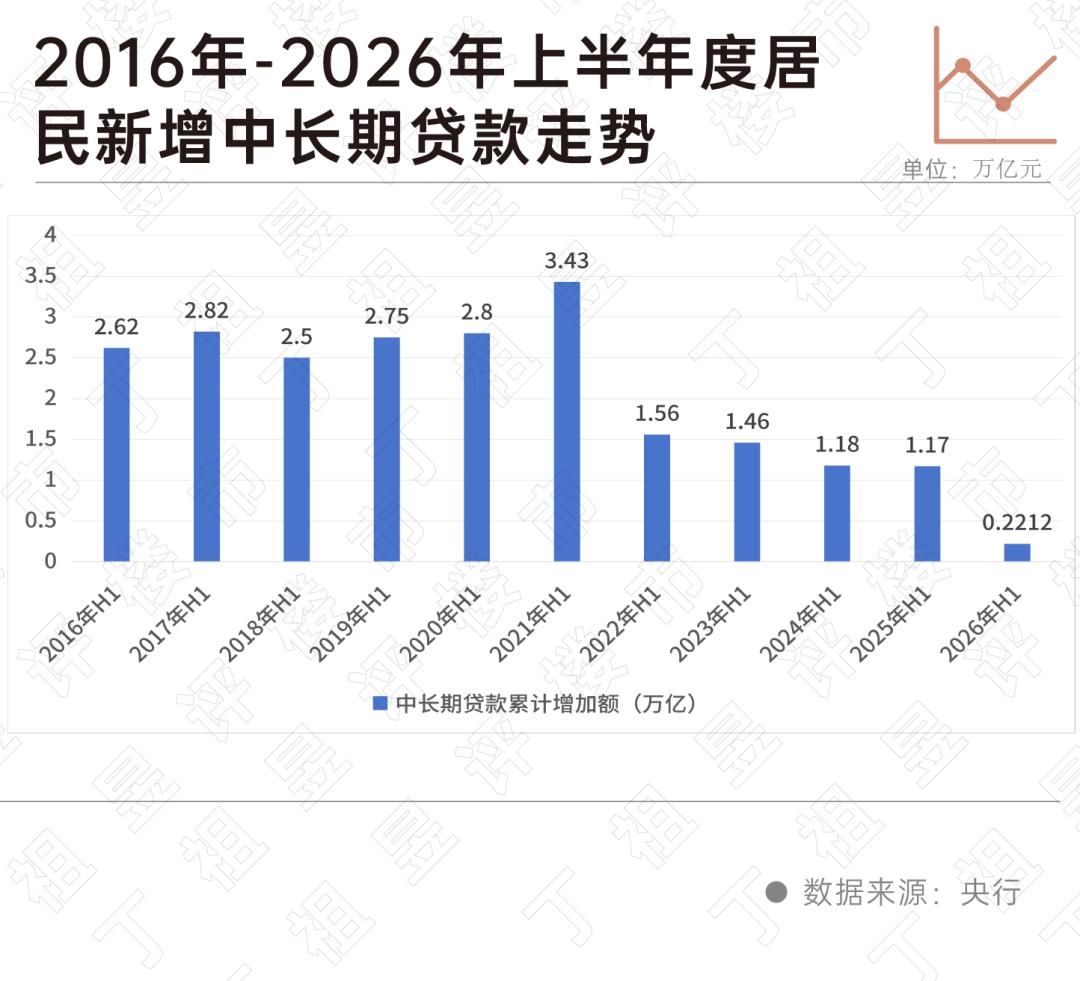
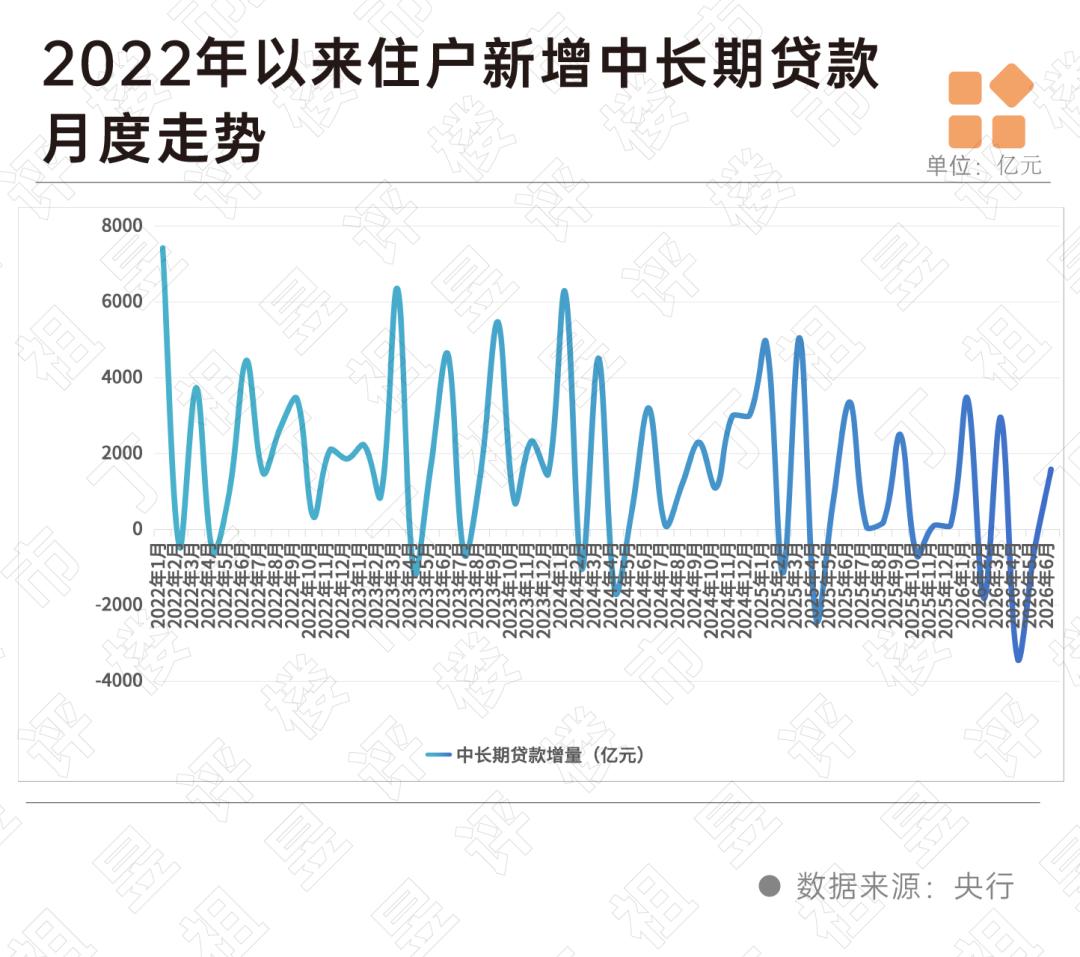
1. Household loans shifted from a 1.17 trillion yuan increase in the same period of 2025 to a 366.8 billion yuan decrease in H1 2026. Among them, medium- and long-term loans (mainly mortgage loans) recorded a cumulative increase of 221.2 billion yuan, the lowest level for the same period in nearly a decade. Medium- and long-term loans increased by 158.4 billion yuan in June, reversing two consecutive months of negative growth in April and May.
2. In June, the average interest rate on newly issued personal housing loans stood at around 3.1%, roughly flat compared with the same period last year. At the end of June, the outstanding personal housing loan interest rate was 0.13 percentage points lower than that of the previous year's corresponding period.
01
First Mention by the Central Bank
Households Proactively Undertake Moderate "Deleveraging"
Household credit performance remained weak in H1.
Short-term household loans saw a cumulative decrease of 588.1 billion yuan in the first half of the year, while medium- and long-term household loans posted a cumulative increase of 221.2 billion yuan, a figure that stood at 1.17 trillion yuan in the same period last year, representing a reduction of over 900 billion yuan in incremental growth year-on-year. Household credit has contracted significantly.
Combined with the 7.58 trillion yuan increase in household deposits, it is clear that households' defensive savings behavior has not yet been reversed.
Looking back over a longer timeline, cumulative medium- and long-term loan increases in the first half of each year from 2016 to 2021 all exceeded 2.5 trillion yuan. From 2022 to 2025, the cumulative increment declined year by year but remained above 1.1 trillion yuan.
By H1 2026, the cumulative increase amounted to only 221.2 billion yuan, indicating a sustained weakening in household mortgage demand.
In monthly terms, medium- and long-term household loans increased by 158.4 billion yuan in June, down 53% year-on-year with 176.9 billion yuan less in incremental growth. Behaviors such as early loan repayment and reduced mortgage borrowing among households are still prevalent.
However, the positive growth recorded in June, which reversed the negative trend from April to May, sends a positive signal. This demonstrates a marginal recovery in household mortgage demand in June.
The Director of the Survey and Statistics Department of the People's Bank of China explained at the press conference: A large proportion of household loans are mortgage loans. As households proactively engage in moderate "deleveraging", interest payment expenditures and debt levels have decreased, leading to dynamic adjustments in household balance sheets.
Meanwhile, the Director of the Monetary Policy Department of the Central Bank explicitly stated: For a period ahead, monetary and credit expansion will shift from an extensive growth model to an intensive development pattern, where "slower growth with improved quality" in lending is likely to become a new normal in macroeconomic operations.
With the advancement of "slower but higher-quality" loan growth and moderate household deleveraging, the trend of contracting medium- and long-term household loans will continue in the short term.
02
Newly Issued Personal Housing Loan Interest Rate Around 3.1% in June
Household loan interest rates are operating steadily at low levels. Currently, the interest rate on newly issued personal housing loans remains at a relatively low level, which drives down the interest rate of outstanding personal housing loans.
In June, the average interest rate on newly issued personal housing loans stood at around 3.1%, roughly the same as the corresponding period last year.
At the end of June, the outstanding personal housing loan interest rate was 0.13 percentage points lower than that of the previous year's corresponding period.
The 5-year-plus Loan Prime Rate (LPR) has remained unchanged for 13 consecutive months. The 3.1% interest rate on newly issued personal housing loans in June is already within the range of historically lowest levels.
In the real estate sector, most cities have lifted the lower limit on mortgage interest rates, allowing banks to independently determine mortgage rates based on market conditions. As market interest rates continue to decline, the marginal effect of interest rate cuts is diminishing.
In recent years, the maximum loan amount for provident fund loans has been continuously raised across regions. Under the general trend of "deleveraging", more people are choosing provident fund loans to replace commercial mortgages, making a near-term reduction in the LPR linked to housing loans unlikely.
The Central Bank noted that its monetary policy toolkit is abundant but did not signal further interest rate cuts, indicating that the moderately accommodative monetary policy stance for the second half of the year remains unchanged. Regarding interest rates, the Central Bank will guide and regulate interest rate levels in accordance with macroeconomic performance, price trends, and macro-control requirements.
Based on this assessment, short-term mortgage rates will continue to stay at low levels.
03
Moderately Accommodative Monetary Policy
Supports Industry Stabilization in H2
This press conference marked another important statement from the People's Bank of China following the second-quarter regular meeting of the Monetary Policy Committee on July 4, systematically summarizing the effectiveness of monetary policy implementation in H1 and clarifying policy directions for the second half of the year.
Overall, the core guideline for monetary policy in H2 has been confirmed. The Central Bank explicitly committed to continuing to implement a moderately accommodative monetary policy, properly managing the intensity, pace, and timing of policy implementation, strengthening counter-cyclical and cross-cyclical adjustments, focusing on expanding domestic demand and optimizing supply, to enhance the endogenous driving force of economic development.
In general, China's economy withstood pressure and operated within a reasonable range in H1 2026. Preliminary calculations show that the gross domestic product (GDP) reached 69.57 trillion yuan in the first half of the year, representing a 4.7% year-on-year increase at constant prices. The growth rate in Q2 was slightly lower than that in Q1. However, the foundation for sustained steady and positive economic performance still needs further consolidation.
Expectations of an accommodative monetary environment will provide strong support for the stable and progressive development of the macro economy in H2 and the accelerated formation of a new development model for the real estate sector.
This article is sourced from the WeChat public account "Ding Zuyi's Real Estate Commentary", authored by the Editorial Department, and published by 36Kr with authorization.