A secondary vocational school student created a viral hit grossing over 100 million yuan, and marginalized film industry figures changed their fate with AI | DeepKr Lite
"AI Changed My Fate"
In the elite narrative of the AI era, stories of underdogs rising to success have emerged.
In May, Liu Ziyu, a technical secondary school graduate from the real estate industry in Yuxi, Yunnan Province, created "Zombie Scavenger" which has accumulated over 100 million views across all platforms, and was hailed as a "domestic Love, Death & Robots". As a result, he received an overseas job offer from a Hollywood producer. This short film is equipped with English subtitles, but an industry practitioner who has contacted Liu Ziyu said that his English is not good, and he even "can't bypass the Great Firewall".
A month later, Liu Ziyu, born in 1997, was named "Douyin Rising Star Future Director" at the Douyin Movie Night. Under his account, a netizen named "AAA Yunhuan Road ** Building Materials Wholesale Brother" commented: "Awesome, you have boarded this Noah's Ark of AIGC. When can us ordinary workers turn our lives around?" followed by a crying emoji.
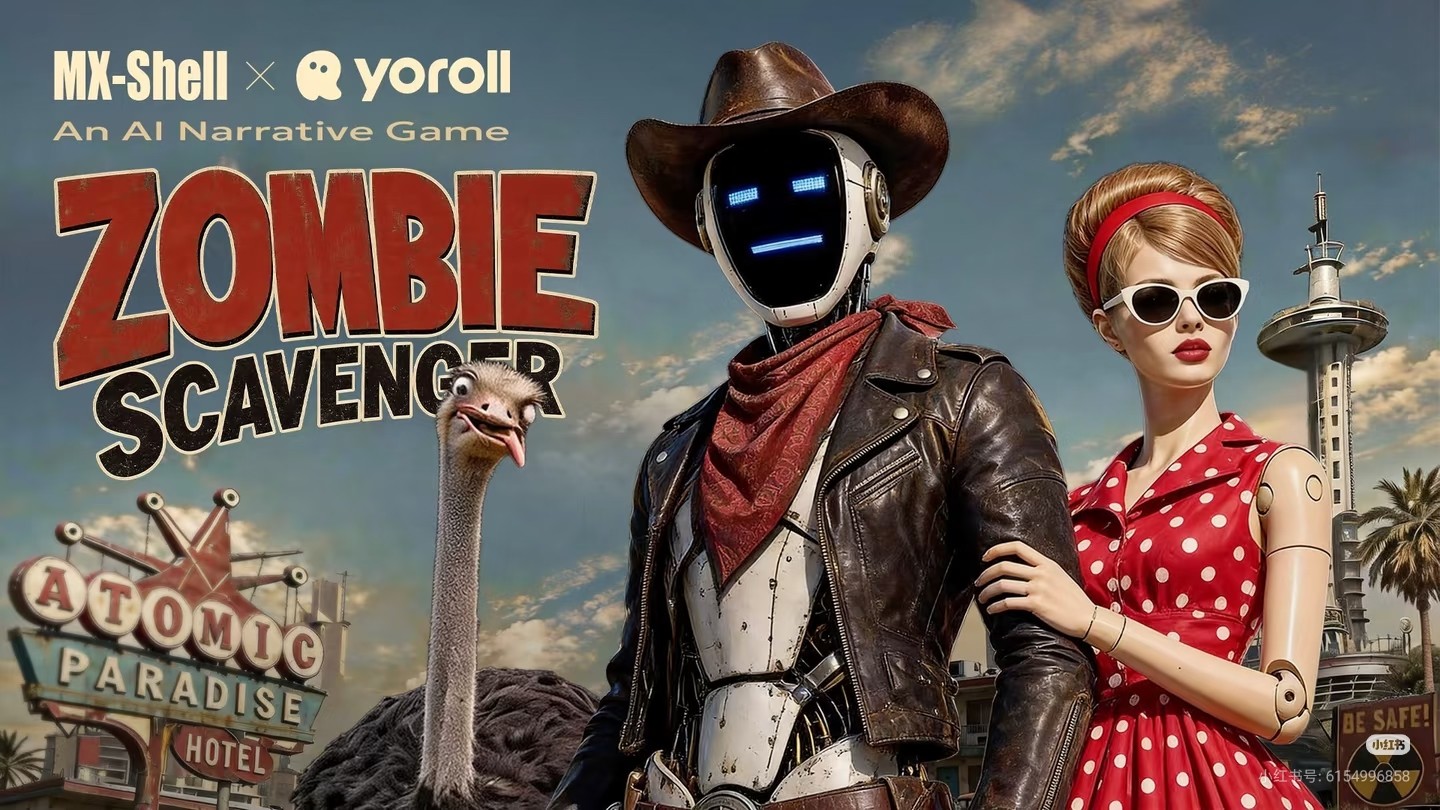
The poster of "Zombie Scavenger", image sourced from Liu Ziyu's Xiaohongshu account
Meng Ke, born in 2004, is another person who has "turned his life around". He recently won the AIGC Best Director Award at the Beijing Film Festival for his AI short film "Mold" which was produced entirely in an internet cafe. Meng Ke, who has no formal professional training, said in an interview: "Without AI, I might never have been able to step onto the stage of a film festival in my entire life. AI changed my fate."
Meng Ke leads a team of more than 20 people, almost all of whom are post-2000s generation, and many of them are college students. He said that if you spend your entire life working hard just to own a house worth one or two million yuan, that would be utterly meaningless.
In the past, to become a director, you could hardly afford to make any mistakes. First of all, you almost had to graduate from the Beijing Film Academy or the Central Academy of Drama. During your studies, you had to keep participating in competitions and winning awards, gambling on the possibility of building connections, just to get a chance to join a film crew — and most likely, you would only end up in a minor role like a production assistant.
Even after breaking into the industry, directors are not all equal. The chief content officer of a top domestic video platform stated bluntly at an internal event that without the hit short drama "Summer Findra", there would be no possibility for the film industry to cooperate with its director Zhang Dama — who used to be just an advertising director.
The domestic film and television industry is characterized by high costs, high risks, and long return cycles. Project approval has become increasingly dependent on famous directors, renowned screenwriters, and popular stars, which in turn drives costs even higher. Director A Zhou gave an example to 36Kr: nowadays, for a project to "get approved" — that is, to secure funding from investors — it usually needs at least one A-list star, otherwise there is no room for negotiation. The salary for such a star often amounts to tens of millions of yuan, exceeding a quarter of the total project cost.
Costs are rising higher and higher, but the content does not necessarily get better, making investing in film and television projects as risky as gambling. The emergence of AI has reduced film and television production costs by "an order of magnitude", according to iQiyi CEO Gong Yu.
Losses during the process of turning creative ideas into reality have also been reduced. In the traditional industry, "many times a good script gets altered by comments from capital, then from directors and actors, and drops from 80 points to 60 points," one practitioner commented.
A group of young, marginalized AI directors, leveraging increasingly mature AI models, with the efforts of one or just a few people, have achieved results that used to require teams of dozens or even hundreds of people — the chilling prophecy that "1% of people will replace most jobs" in the film industry seems to have come true.
People in the traditional film and television circle often do not welcome them. A producer, while discussing AI directors with peers, could feel the shared disdain in their exchanged glances: "A mob of no-names."
The output and platforms that people in the traditional film and television industry used to take years to achieve — polishing scripts, coordinating with platforms, raising investment, signing actors, negotiating with core creative teams — are quickly being matched by AI directors. "It's like a swimming competition. We focus on what posture to dive with and what moves to make, but they just swim straight to the finish line."
Yet these negative reviews cannot change the fact that the rules of the film industry have already shifted.
The AI Director's Creation Manual: Prompts, Aesthetics, and Human Touch
The sudden rise of AI directors is first and foremost attributed to a stunning, exceptional work.
Right after the New Year, Liu Chi, still recovering from an illness, lay on a rocking chair at home and spent a week writing the script "Seven Days of Floating Life", based on her own near-death experience of being injured by a boat while diving in Bali. The film later won the AIGC Best Feature Film Award at the Beijing Film Festival, just over a month before the registration deadline.
On the first day back at work after the holiday, Liu Chi and her colleagues gathered for a script reading — the female lead is trapped in a moral dilemma where suing the perpetrator might break apart a complete family. The lawyer comforts the female lead by saying, "Their freedom is no more important than your life." When they read this line, silence fell over the small team, and some of the female team members had tears in their eyes. At that moment, Liu Chi was certain that this project was feasible.
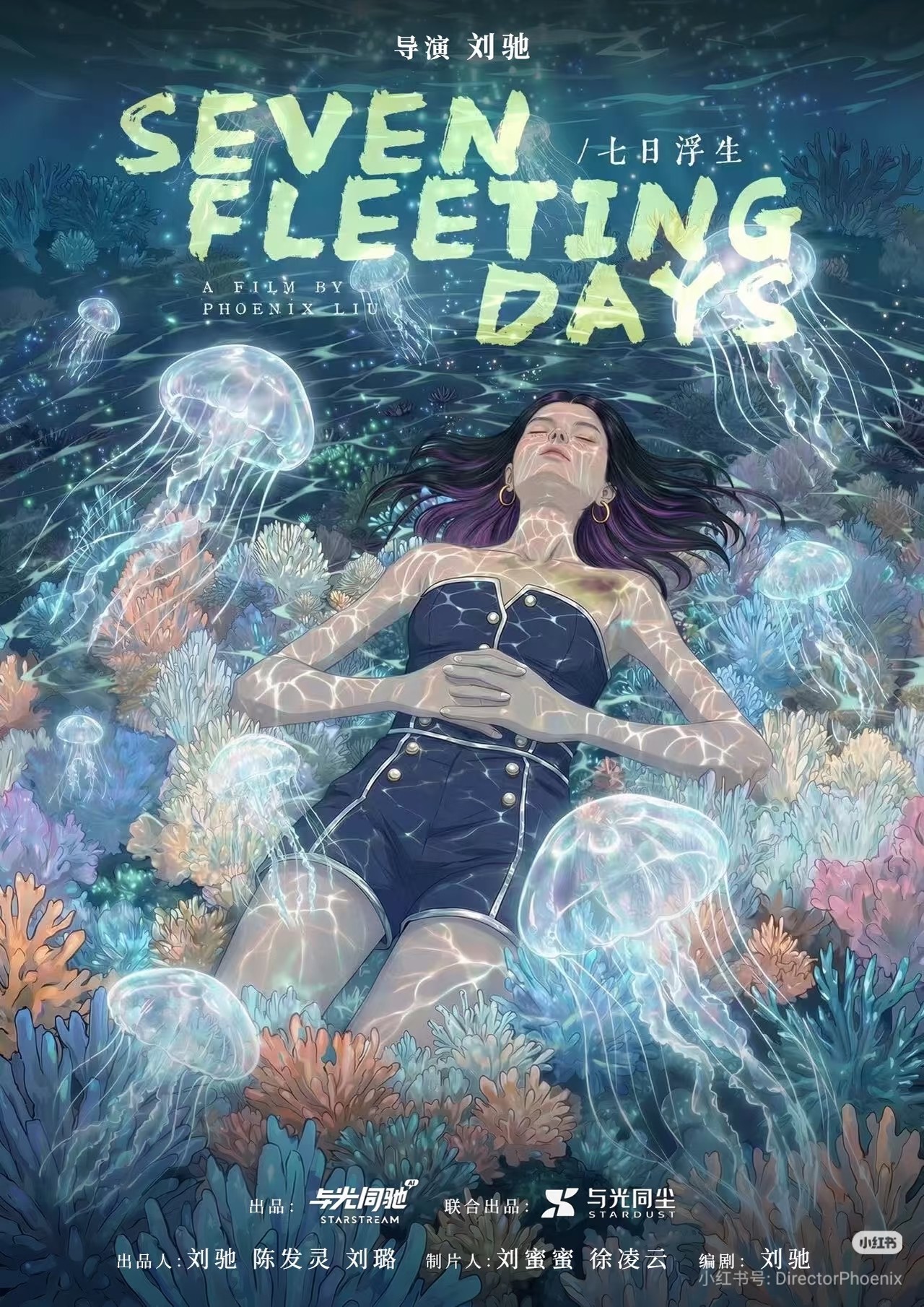
The female lead in "Seven Days of Floating Life"
She paused all other projects and threw herself intensively into this nearly 50-minute AI film. The team had a total of 7 people, and the division of roles was eliminated — everyone collaborated on every part of the work.
Due to the tight schedule, almost all video generation large models and tools available on the market had to be used. Before finishing work each day, Liu Chi and her colleagues would feed as many storyboard scripts as possible to the AI. The next day when they came to work, they could collect the generated clips, then screen and compile them.
But the storyboard scripts cannot be fed to the AI as they are. "AI cannot accurately understand the context, character relationships, and emotions in the script, so we need to break down each scene in great detail," Liu Chi said. She would explain the scenes to each team member, just like a traditional film director guiding actors. "For example, if I write in the script 'his eyes look down at the ground', I need my teammates to understand why he does that — out of guilt or deep in thought — instead of mechanically inputting prompts."
In the AI short drama industry, a mechanical version of a prompt often reads like this: The female lead laughs so hard in extreme joy that she runs out of breath and falls asleep instantly on the male lead's shoulder. The hustle and bustle goes quiet in a second. The male lead looks at her with full tenderness, and gently lifts her up in a princess carry.
For the equally award-winning AI short film "Peony Story", its creator Liu Yuqing wrote the prompts like this: Take Image 1 as the first frame. The person lying in bed suddenly coughs, opens their eyes, and rolls over to the left side of the frame (camera movement reference: Video 1). The two people beside them run away to the left side of the frame in fear. Push the camera to this angle of the person on the bed (insert Image 2). This sequence depicts the scene where the protagonist's lover is seriously ill.
— The former emphasizes dramatic plot points, leaving the specific details to the AI. The latter uses AI to restore the creator's own vision, relying heavily on human creativity.
Outstanding aesthetic taste is another common trait shared by this group of AI directors.
The artistic style of "Peony Story" was established even before the story itself. Sun Jintao, who studies lacquer painting art, is full of curiosity about various materials. After the emergence of AI, she began to explore whether she could integrate the texture of "rice paper" into three-dimensional characters and scenes, and updated a series of image works called "Forms Born on Rice Paper" on Xiaohongshu — but she was struggling to find a story to carry these visual ideas.

Works from the "Forms Born on Rice Paper" series, created in July 2025
Later, when Sun Jintao was inquiring about PhD application information, she met Liu Yuqing, who was studying at the University of Hong Kong. Liu Yuqing took the initiative to propose that they produce an AI film and television work in the same style to amplify the existing popularity. The two hit it off immediately: Sun was responsible for the art direction, while Liu took charge of the script and visual content generation.
Liu Yuqing loves films, and her favorite director is Éric Rohmer, one of the representative figures of the French New Wave. At first, she did not like AI, because early AI video generation was too rough and unstable. But with the advancement of large models, she realized that the things she wanted to create could now be realized. So she wrote a script based on Yu Xuanji, a poet from the late Tang Dynasty, telling the story of how rumors slandered women, and how people almost forgot a woman's talent amid all the gossip.
To ensure the accuracy and consistency of the style, this 7-minute short film required almost every key frame — 10 frames per minute — to be reworked. "We had to do everything ourselves, whether it was retouching or drawing," Sun Jintao told 36Kr. As a result, the production cycle of "Peony Story" spanned half a year, and the two women who collaborated seamlessly only met once during that period.
When AI can do almost anything, the human element becomes prominent instead, and becomes the key factor that determines the texture of a film.
The AI short film "Paper Phone" went viral across the entire internet in March, and was claimed by various model and tool manufacturers. One "continuity error" was finally kept in the final cut: the protagonist's hand did not press any buttons, but the call got connected anyway. The director was reluctant to change it, because the micro-expressions of the characters, emotional tension, and shot transitions in this version were all perfectly executed.
In an AI work, prompts, aesthetics, and human touch are all important. Meanwhile, investment — the link that determines the life and death of traditional film and television projects — disappears entirely in the creative process of AI directors.
The two creators of "Peony Story" roughly calculated that the total cost of this work was 2,000 yuan, which was spent on purchasing three memberships from two large model platforms. In the traditional film and television industry, a cost of tens of millions of yuan and a team of hundreds of people would be called a "low-budget" production. Other creators could not even specify how much their work cost — it was not a number worth caring about.
Can real-person live-action filming really be replaced? This is the ultimate question for all film and television practitioners.
"Audiences' consumption of an artistic work lies not only in the content itself, but also in the production process, which we call the aesthetics of labor," said Wang Lei, Dean of the School of Animation and Digital Arts at Communication University of China. Live-action content has an enormous workload, but this has also become its unique advantage.
People who love Hayao Miyazaki may have heard this story about his creative process: the entire film "Ponyo on the Cliff by the Sea" used 170,000 hand-drawn sketches. The scene where a jellyfish surfaces alone was drawn 1,613 times by hand. While audiences enjoy the content of this work, they are also keen to discuss the staggering amount of labor that went into making this animated film.
AI directors all agree that many great expressions and performances still require live-action filming. Film and television works are related to human emotions, experiences, historical memories, and future imaginations — and we cannot completely entrust such content to the "black box" of AI.
Who Will Be the 1% in the Future of the Film Industry?
The moment their fame arrived, collaboration offers from all directions poured in. Model and application companies are the most active players. They regard AI directors as "super creators", or "Super Creators" for short.
A practitioner told 36Kr that after "Paper Phone" became a hit, the Kling AI team under Kuaishou took the naming rights in a very aggressive manner, investing tens of times more money than other platforms for promotion. Another AI video application company, in order to poach AI directors, voluntarily covered their flight tickets, accommodation, and competition fees without any prior cooperation agreement — not to mention providing all the Tokens needed for creation.
"Someone from a top model company contacted me the very next day, hoping to include their name in the promotion, but I really did not use their product," an award-winning AI director at the Beijing Film Festival said helplessly. The other party immediately said it did not matter even if they did not use it — they only needed to mention in the promotion that they were a Super Creator of their platform.
Xiao Qi, who is in charge of Super Creator operations at a large model company, has been "poached" many times recently. To secure the right schedule and exclusive cooperation, she tried her best to contact the creators first, but in the face of overwhelming money and resources, the agreed cooperation would be overturned immediately. Top industry players like Kling and TapNow have snatched deals from her more than once.
"I'm really tired of fighting for these. I live in constant anxiety every day," Xiao Qi said.
In fact, Super Creators do not bring high direct conversion rates for model and tool companies. They mostly serve as Showcases to demonstrate the capabilities of the models. But different from others, Jimeng and Kling have an additional function for Super Creators: "Super Creators help them develop film-grade content, accumulate more data assets and templates, so as to attract general users," a practitioner of AI video products told 36Kr.
However, the first-tier players with leading model capabilities remain calm and unshakable when facing AI directors. An award-winning AI creator told 36Kr that after they won the award, almost all well-known domestic model and tool companies reached out to them — except for Jimeng, which is under ByteDance and backed by the Seedance model.
Among the AI directors that 36Kr contacted, only one established cooperation with Jimeng, and they took the initiative to reach out. To secure the cooperation, this Super Creator had to submit a resume and project proposal, just like applying for a job. She could feel that Jimeng was looking for directors who "had won awards at international film festivals overseas and had experience making feature films".
The traditional film and television industry is also hunting for AI talents.
Bold players like Bona Pictures have recently released job openings where more than 70% of positions are AI-related. Bona is also promoting an AI-native film project, aiming to claim the title of "the first theater-released AI film". Before this, the company had suffered losses for four consecutive years, and AI is regarded as their last hope.
In contrast, Enlight Pictures has chosen a different path. An industry insider told 36Kr that Enlight's core strategy still focuses on IPs and animated films. In 2025, Enlight Pictures' total revenue reached 4.04 billion yuan, of which film and television and related derivative businesses contributed 3.682 billion yuan, mainly driven by the hit animated film "Nezha: The Devil's Birth". "Everyone knows AI is important, but they are still in a wait-and-see state."
After Liu Ziyu became famous, Enlight Pictures also contacted him, but the two sides failed to reach a cooperation. The company wanted Liu Z