Hit a 10-year high, is the cosmetics market reviving?
Following the consecutive declines in June of the previous two years, cosmetics retail sales saw a sharp surge this June.
On July 15, the latest data from the National Bureau of Statistics showed that in June 2026, the retail sales of cosmetics reached 45.6 billion yuan, a year-on-year increase of 12.6%, hitting an all-time high for the same period in history. This growth rate is also the largest monthly increase since November 2024.
In terms of overall performance, in the first half of this year, the total retail sales of cosmetics accumulated to 244.5 billion yuan, a year-on-year increase of 6.3%, outperforming the overall consumer market. This indirectly reflects that the cosmetics category still maintains strong consumer resilience, with an obvious trend of recovery and rebound.
Regarding this growth, some industry insiders are optimistic about this round of "rebound after hitting the bottom"; however, others point out that the growth rate exceeds their actual perception, the scale growth is mainly concentrated in leading enterprises, and the profit side has not yet shown obvious recovery.
So, how exactly did the cosmetics market perform in the first half of this year?
First positive growth in 3 years, the highest increase in 20 months
Today, the latest data released by the National Bureau of Statistics shows that in June this year, the total retail sales of social consumer goods reached 4,269.1 billion yuan, a year-on-year increase of 1.0%. Among them, the total retail sales of cosmetics achieved the highest monthly growth rate in 2026.
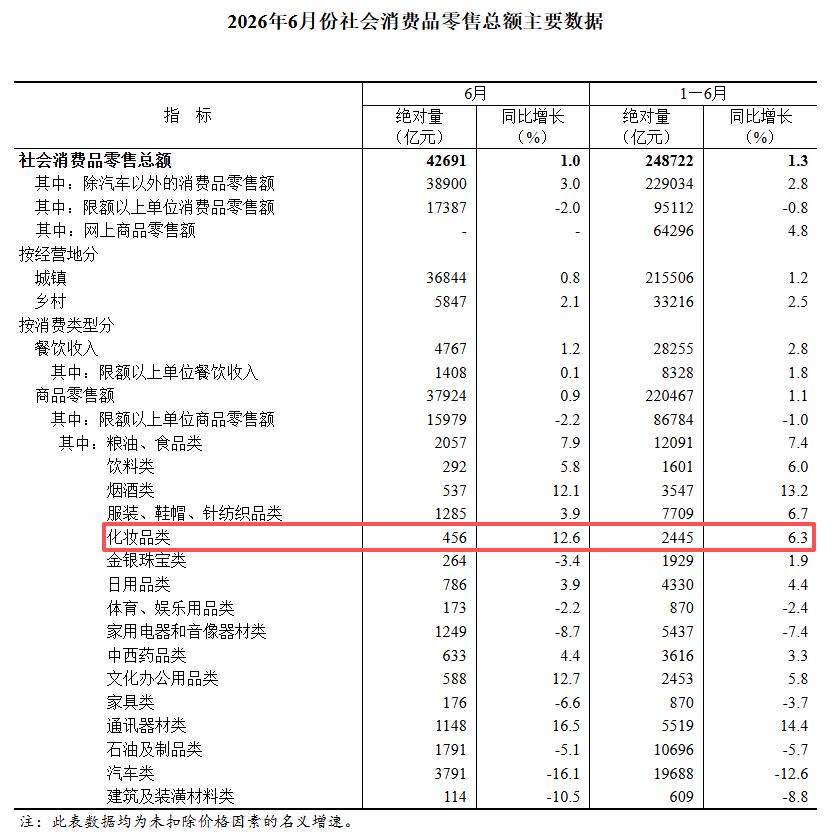
Screenshot from the official website of the National Bureau of Statistics
Qianyan sorted out the cosmetics retail data for June in the past 10 years (2017-2026) and found that before 2024, possibly benefited from the "618" shopping festival, the retail sales of cosmetics in June rose steadily from 21.5 billion yuan to 45.1 billion yuan, but the year-on-year growth rate showed an overall fluctuating downward trend. By 2024, the retail sales in June dropped sharply to only 40.5 billion yuan, which was lower than the level in 2022; in 2025, although the retail sales in June did not stop the decline, the decline narrowed to 2.3%.
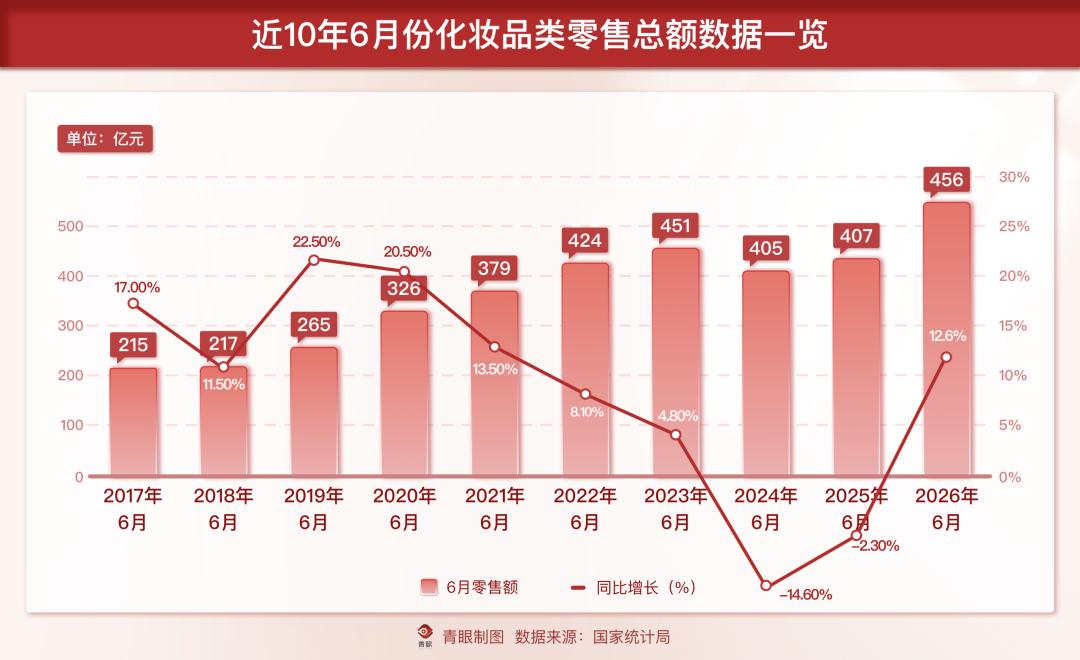
In June this year, the retail sales of cosmetics rebounded strongly, reaching 45.6 billion yuan, a sharp year-on-year increase of 12.6%, which not only set the highest record for the same period in the past 10 years, but also reversed the consecutive two-year downward trend at once, with the year-on-year growth rate second only to 22.5% in 2019 and 20.5% in 2020.
It is worth noting that this growth rate is the first double-digit growth in nearly 20 months since November 2024. During this period, the monthly growth rate of cosmetics retail sales lingered in single digits for a long time, and even recorded negative growth many times. Returning to the double-digit growth track in June this year also indirectly indicates that the industry has entered a substantive recovery stage, with a clear signal of warming up.
However, it should be noted that the high growth in June this year was, to a certain extent, affected by the low base formed by the consecutive declines in the previous two years.
In addition, on the whole, data released by the National Bureau of Statistics shows that in the first half of this year, the total retail sales of social consumer goods reached 24,872.2 billion yuan, a year-on-year increase of 1.3%. Among them, the total retail sales of cosmetics was 244.5 billion yuan, a year-on-year increase of 6.3%.
In other words, in the first half of this year, the cosmetics category outperformed the overall market, showing strong demand resilience of the beauty category.
Qianyan sorted out the total retail sales of cosmetics in the first half of the past 10 years (2017-2026) and found that the industry scale continued to expand, but the growth rate gradually slowed down. Among them, only 2017, 2019 and 2021 recorded double-digit growth, and most of the rest remained in single digits, with only 1.0% and 2.9% in 2024 and 2025 respectively.
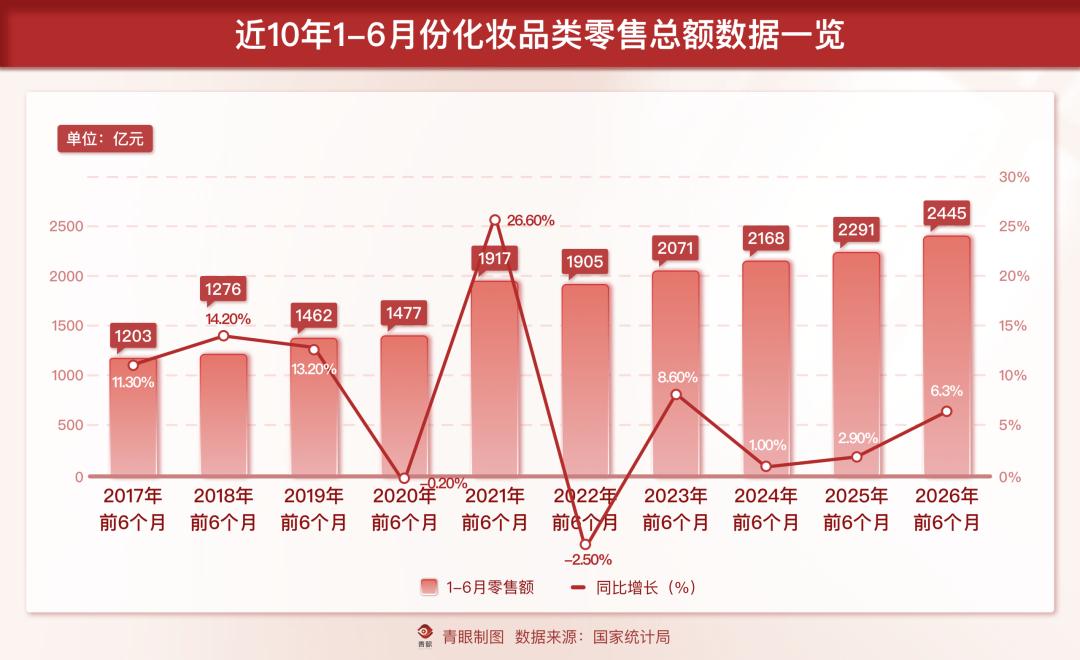
Entering 2026, this situation has improved. In the first half of this year, the total retail sales of cosmetics increased by 6.3% year-on-year to 244.5 billion yuan, and the growth rate hit the best performance for the same period in the past three years. Although it did not reach the double-digit level, it has been significantly improved compared with the previous two years.
Online growth, offline pressure, domestic brands' market share continues to expand
Then, under the overall warming market, how did domestic brands perform? What are the noteworthy points on the channel side?
The latest data from Qianyan Intelligence shows that in the first half of the year, China's cosmetics sales reached 518.91 billion yuan, a year-on-year increase of 4.6%. Among them, domestic brands reached 268.67 billion yuan, a year-on-year increase of 7.9%; while foreign brands increased by 1.2% year-on-year to 250.23 billion yuan.
In terms of channels, in the first half of this year, the online channel increased by 10% year-on-year to 294.97 billion yuan, while the offline channel scale was 223.93 billion yuan, a year-on-year decline of 2.0%.
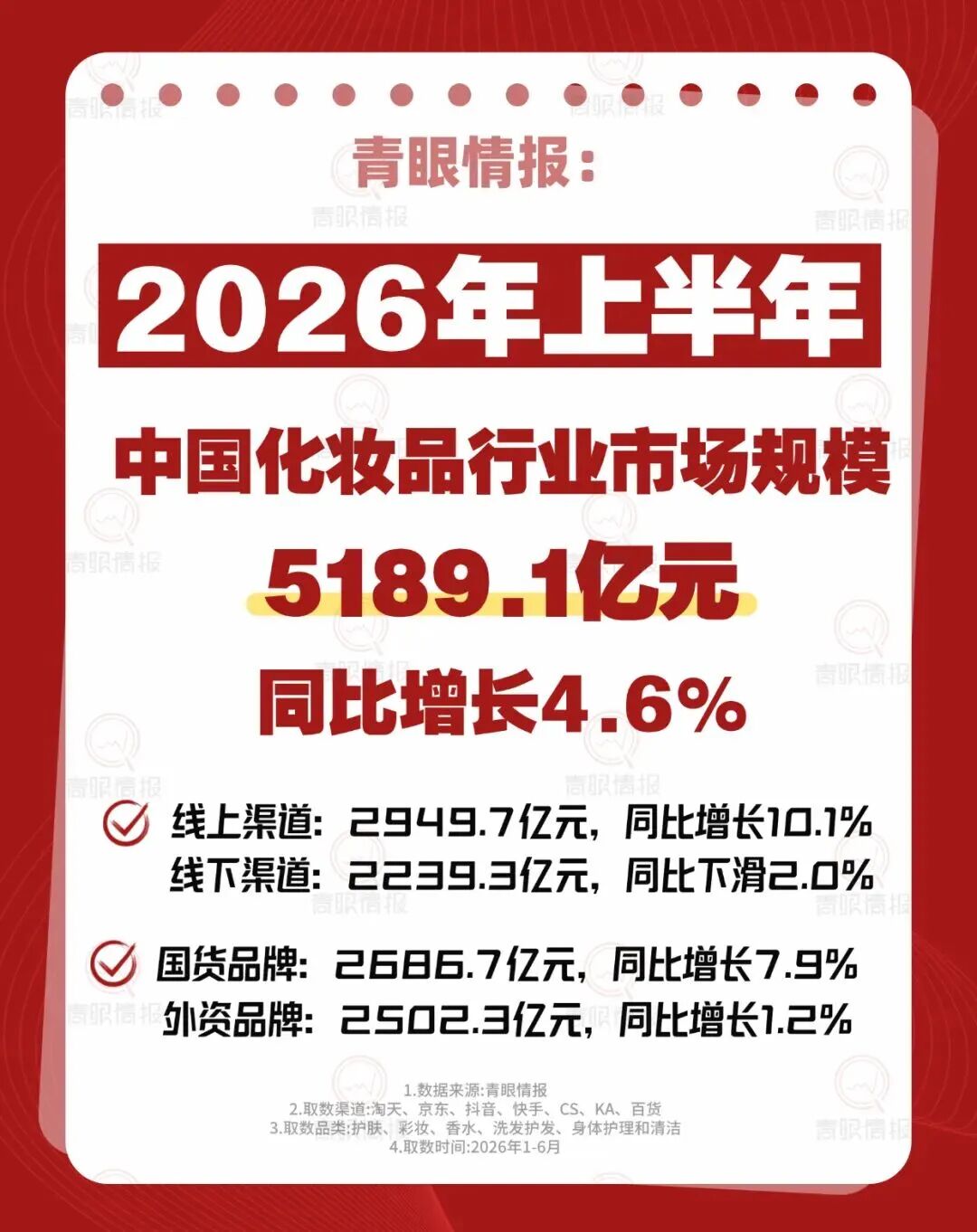
Image source: Qianyan Intelligence
It is not difficult to find that since the beginning of this year, domestic brands have maintained a strong growth momentum, with further rising market share, but channel differentiation has intensified.
Data from Qianyan Intelligence shows that calculated by online transaction volume, in the first half of this year, the leading camp continued to expand, with 9 brands exceeding 3 billion yuan, while there were only 7 in the whole year of 2025.
In the TOP20 overall online cosmetics channel list, foreign brands took the top three positions, namely L'Oréal, Estée Lauder, and Lancôme; Proya and Kans ranked fourth and sixth with 4.423 billion yuan and 3.246 billion yuan respectively. Thanks to channel innovation and product differentiation, Maogeping and Guyu achieved a rise in rankings, with the former jumping 6 places, showing a clear breakthrough momentum.
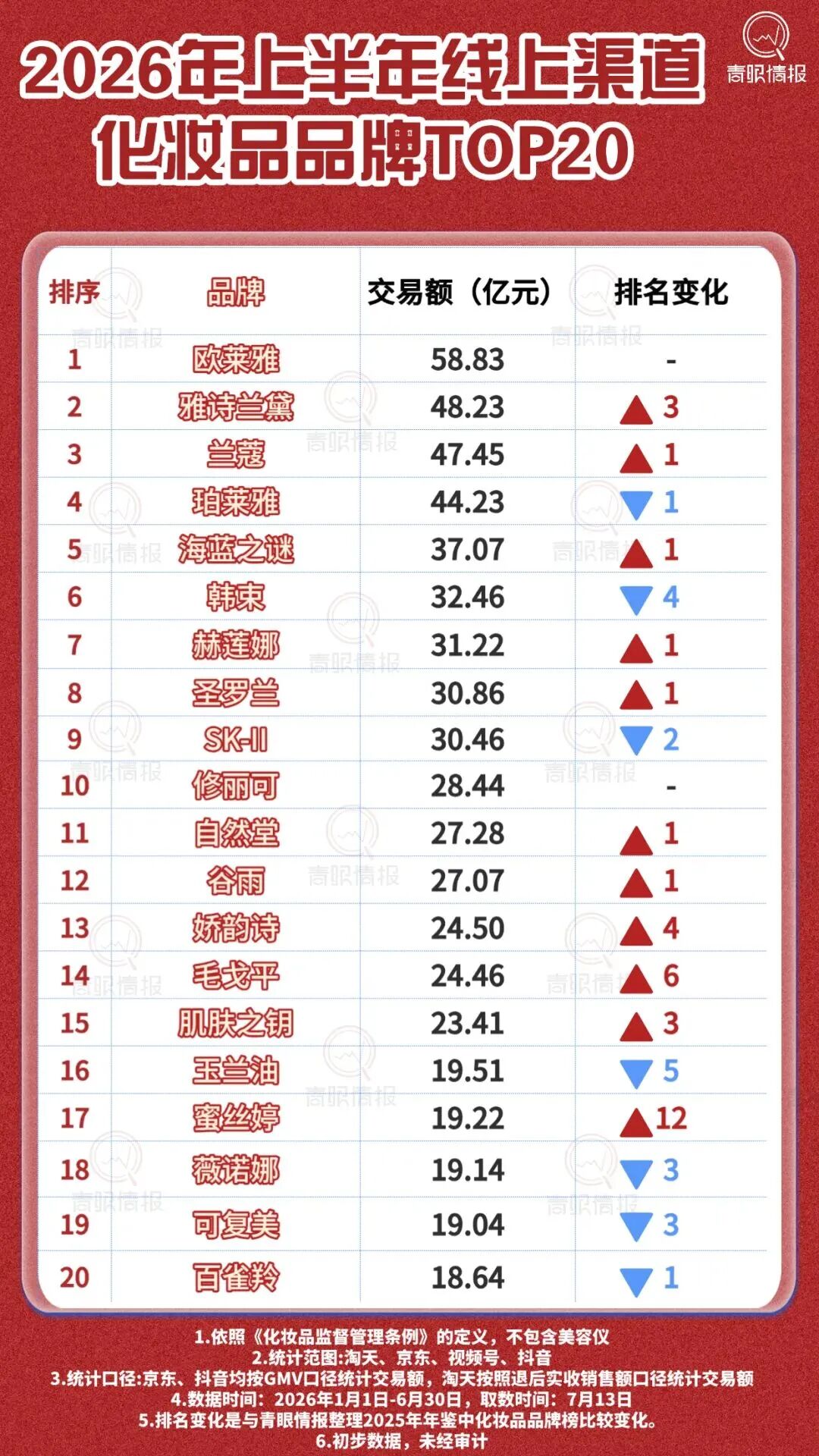
Image source: Qianyan Intelligence
At the same time, emerging domestic brands have seen a collective explosion in niche tracks. Taking the TOP20 online makeup and fragrance brands in the first half of the year as an example, Carslan rose to 3rd place, Dilowe climbed 3 places to 4th, Huazhixiao surged 7 places to 5th; DPDP and BABI had particularly prominent jumps, with the former rising 24 places and the latter 14 places.
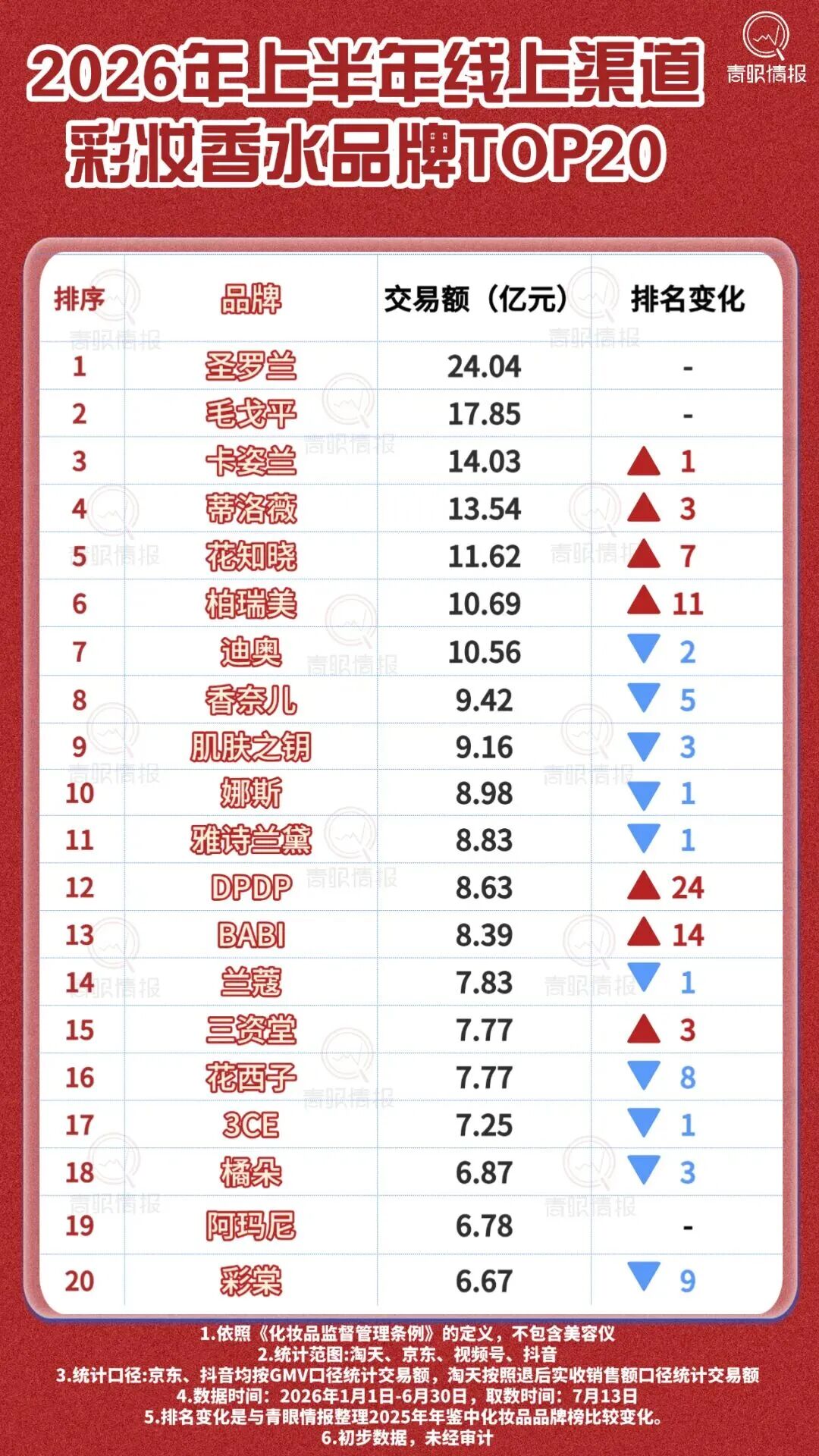
Image source: Qianyan Intelligence
In the skincare track, the strength of domestic brands should not be underestimated either. Looking at the TOP20 online skincare brands in the first half of the year, domestic brands almost occupy "half of the country". Among them, Proya ranked second with 4.417 billion yuan, almost on a par with the top-ranked L'Oréal (4.443 billion yuan); while Lin Qingxuan jumped 6 places to 18th with 1.479 billion yuan.
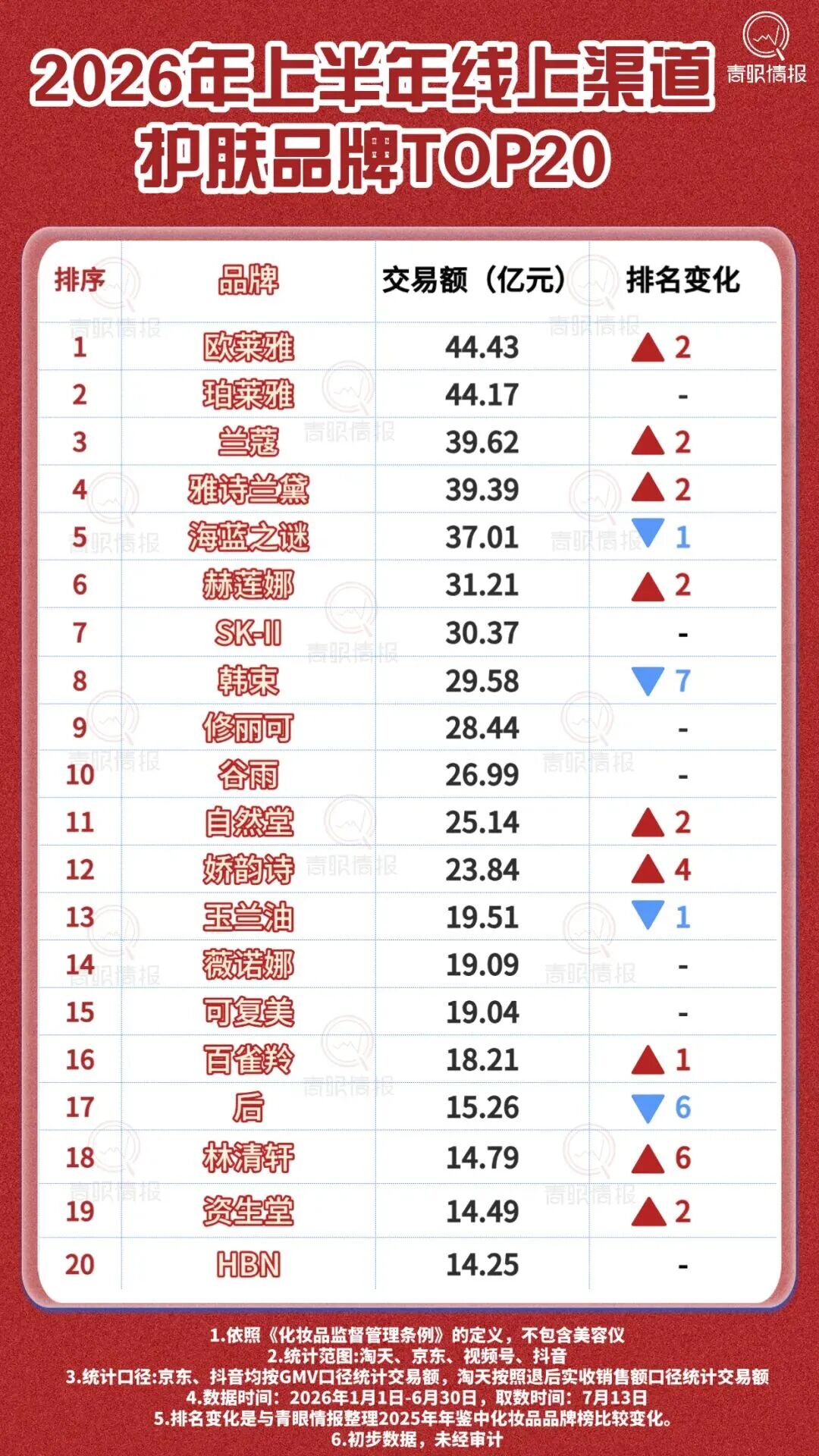
Image source: Qianyan Intelligence
As we all know, the growth of online scale in the first half of the year is inseparable from the "618" shopping festival. Although affected by factors such as "promotion fatigue" and increasingly rational consumption, the explosive power of "618" has been diluted, it is still an important node for brand growth. Taking Tmall's "618" as an example, in this year's promotion, Proya outperformed many big brands to take the top spot.
Meanwhile, new products and new categories have become the new growth curve for many brands during this year's promotion. Public data shows that after Tmall 618 started, the number of new products whose transaction volume quickly exceeded 10 million yuan increased by 60% year-on-year, and new products accounted for one-third of the TOP100 best-selling items.
It is worth noting that although the offline channel has been under continuous pressure in recent years, many brands still firmly "place their bets" on it. A typical example is Marubi, which clearly defined offline as the new growth direction for 2026 at its dealer conference earlier this year, and launched a full-link empowerment strategy.
Cheng Yingqi, founder of BINGQUAN Oral Care Toothpaste, also told Qianyan that in the second half of the year, the company will "grasp both online and offline", continue to penetrate the offline market, focus on deeply cultivating small and medium-sized supermarkets and CS channels, and improve offline penetration and sales performance by optimizing the terminal product structure and promotion policies, expecting to achieve steady growth.
Uneven performance, caution still needed in the second half of the year
Overall, from the data point of view, the cosmetics industry has shown certain signs of recovery in the first half of this year, and the half-year performance forecasts recently disclosed by many enterprises have also confirmed this trend.
For example, on the raw material side, Lichen Industrial announced that its attributable net profit is expected to be 140 million yuan to 160 million yuan, a year-on-year increase of 154%-191%, which is mainly due to the sharp year-on-year rise in the market price of surfactants and the improvement of gross profit margin. This also reflects the market performance of the raw material side to a certain extent.
In this regard, Chen Laicheng, founder of Mashanghui Cosmetics CRO Platform, believes: "This year, affected by the turbulent situation in the Middle East, the prices of basic raw materials such as petroleum derivatives and deep-processed palm kernel oil derivatives have skyrocketed, and related enterprises are therefore in short supply; at the same time, the surge in the number of filings for functional new raw materials also reflects that enterprises are chasing high ground of innovative technologies enthusiastically."
In terms of brands, LaFang Home, known as the "first private daily chemical stock", announced that its attributable net profit is expected to be 37 million yuan to 41.5 million yuan, a year-on-year increase of 482%-552%; while "the first mother and baby stock" Jinfa Labi expects its attributable net profit to be 500,000 yuan to 750,000 yuan, turning from loss to profit compared with last year.
The above performance improvement, in addition to the enterprise's own operational adjustments, may also be related to the improvement of the overall environment. Chen Laicheng told Qianyan that after the traffic playbook no longer has advantages, the market environment of low-price involution has improved significantly. Coupled with the policy restrictions on low-price involution by domestic regulatory authorities and platforms, the beauty industry is expected to embark on a new growth curve.
However, not all enterprises have this perception. Many industry insiders pointed out that the cosmetics retail sales in the first half of the year significantly exceeded expectations, and they did not feel this kind of recovery themselves. The overall environment is still under pressure, and a cautious attitude should be maintained in the second half of the year.
Among them, some brand enterprises are affected by factors such as brand positioning, channel structure, and product innovation capabilities, and their performance is not satisfactory.
Cheng Yingqi said bluntly that in the first half of this year, terminal consumption was weak, consumers were more conservative and their decisions were more rational, and the overall market sales speed slowed down. Moreover, with the increase in promotion and investment costs, coupled with homogeneous competition and price wars, the whole industry has fallen into a situation of "increasing revenue without increasing profit".
In addition, relevant persons in charge of ODM/OEM enterprises also expressed similar views to Qianyan: the total market volume is growing, but the way the "cake" is distributed is being completely rewritten — the increment is intercepted by leading enterprises, while the bottom foundries are slowly "losing blood".
In the view of the above industry insiders, differentiation has become a foregone conclusion. Compliant factories with R&D capabilities will benefit from the recovery, while low-end foundries that rely on low prices and mass production are accelerating their exit. "The industry's survival logic has changed: in the past, it was enough to run fast, but now only those who run steadily can survive."
This statement makes sense. According to Qianyan's previous statistics, in the first half of this year alone, at least 20 cosmetics enterprises have entered bankruptcy proceedings or been forced into liquidation. Although the number has decreased compared with the same period last year, it is still nearly twice that of the first half of 2024 (11 companies).
It can be seen that the "big reshuffle" of the industry is still accelerating, and market share is further concentrated in leading enterprises with comprehensive advantages in R&D, brand and channels. It has become normal for small and medium-sized enterprises lacking core competitiveness to be eliminated in the stock competition.
However, although the external environment remains complex, all enterprises are