Xiaohongshu urgently needs a "second growth curve"
Recently, Xiaohongshu has quietly launched an in-house startup incubation project codenamed "Darwin." All employees are open to sign up, selected participants will work full-time off their regular duties, and the project is led directly by core L3-level executives. The internal slogan released is resounding: Build another product on the scale of Xiaohongshu.
The name "Darwin" itself is quite meaningful. What is the core logic of the theory of evolution? Survival of the fittest. By naming the project this way, Xiaohongshu likely implies that it cannot survive without evolution.
To be honest, this judgment is not an overstatement. Looking at China's top internet companies, almost every single one has found its second and third growth drivers.
After Taobao, Alibaba developed Alipay and cloud computing, twice transforming itself from an e-commerce company into a far larger entity; Tencent expanded from QQ to WeChat, then from gaming to cloud services, thriving across multiple fields where each business can independently support the revenue of a listed company; ByteDance is even more notable, advancing from Toutiao to Douyin, from Douyin to TikTok, and from TikTok to Doubao, every relay has kept perfect pace, with each segment moving faster than the last.
Only Xiaohongshu, despite its popularity for years, has no gaming business, no cloud computing, no independent second app that has gained traction, and has not established a competitive scale in any new track to rival leading players, outside of its main app.
Therefore, from the perspective of "KlaRui", the launch of "Darwin" is less an ambitious innovation experiment than an urgent self-rescue by Xiaohongshu amid growth anxiety.
Advertising accounts for 70% of revenue, but the ceiling is approaching
Let's first look at a set of figures.
In 2025, Xiaohongshu's total annual revenue reached approximately 42 billion yuan, a 40% year-on-year increase. Among this, advertising revenue hit 32 billion yuan, accounting for as high as 76% of total revenue. Two years ago, this proportion stood at 65%.
Revenue is rising, profits are rising, and the share of advertising is also rising. On the surface, this looks like a story of growing profitability. But if you dig deeper, this trend exactly reveals the problem: The increase of advertising share from 65% to 76% means that the relative weight of Xiaohongshu's non-advertising businesses, mainly e-commerce, is shrinking. It's not that e-commerce was not attempted, but that the e-commerce business failed to gain momentum, allowing advertising to occupy a larger share instead.
Next, look at e-commerce. Xiaohongshu's e-commerce GMV in 2025 was around 850 billion yuan, which sounds considerable, but in the same period, Douyin's GMV reached 4.3 trillion yuan, and Taobao and Tmall's combined GMV was about 9.5 trillion yuan. More critically, the conversion rate: Xiaohongshu's in-app order conversion rate is only 0.7%-1.2%, ranking low among mainstream e-commerce platforms.
Users get inspired to buy products on Xiaohongshu, then take screenshots, open Taobao, search for the brand name, and place orders. This user journey has remained largely unchanged for years, and it still seems the same today.
Xiaohongshu itself is well aware of this pain point. In 2025, it completely shifted its strategy, no longer insisting on a closed-loop ecosystem, and instead partnered with Taobao, JD, and Meituan to launch the "Red-Taobao Plan", "Red-JD Plan", and "Red-Meituan Plan". Users who see recommendation notes on Xiaohongshu can directly click links to jump to Taobao to complete their orders.
This choice may be based on financial considerations: the gross profit margin of advertising is far higher than that of e-commerce, it is an asset-light model that does not require managing supply chains, warehousing, logistics, and return processing. However, this choice also locks in a hard ceiling:
The scale of advertising revenue is always determined by brands' marketing budgets, and these budgets are ultimately determined by their e-commerce sales on other platforms. Xiaohongshu is helping others sell goods, only to collect a portion of advertising fees. The bulk of the profits flows to others.
Worse still, this ceiling is being compressed by another force.
AI is eroding the foundation of Xiaohongshu's business
Xiaohongshu's commercial value is built on the "Search + Product Discovery" ecosystem. Over 70% of its monthly active users use the in-app search function, with 600 million daily searches in the fourth quarter of 2024, once regarded as the strongest challenger to Baidu. Users' habit of "turning to Xiaohongshu when unsure" forms the foundation for the platform's advertising premium.
But AI is rewriting this entry logic.
In the past, a user looking for sunscreen would open Xiaohongshu, search for keywords, browse dozens of notes, check reviews from different users, scroll through comment sections to find negative experiences, and finally make a purchase decision. Now, users can directly ask Doubao: "Recommend a sunscreen suitable for oily skin, with a budget under 200 yuan." AI aggregates reviews from across the web to provide 2-3 options, and sometimes even attaches purchase links from Douyin E-commerce.
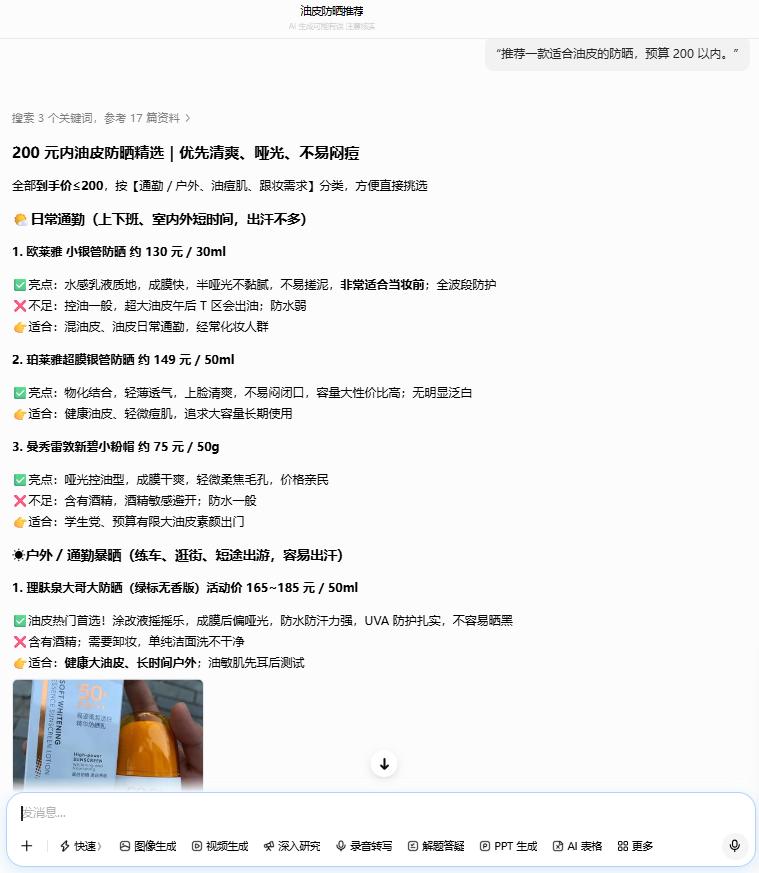
The entire process of browsing Xiaohongshu notes has been compressed into a few seconds.
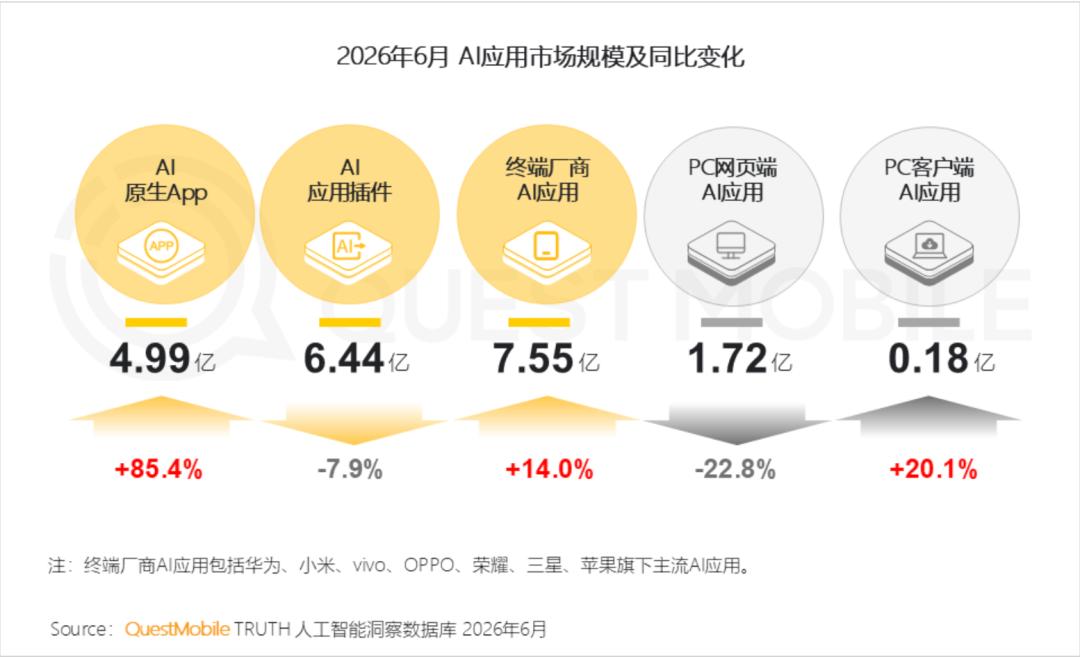
Data from QuestMobile shows that as of May 2026, the monthly active user base of AI-native apps has reached 499 million, with 92.7 average usage times per user per month. AI is becoming the "first touchpoint" for users to access information.
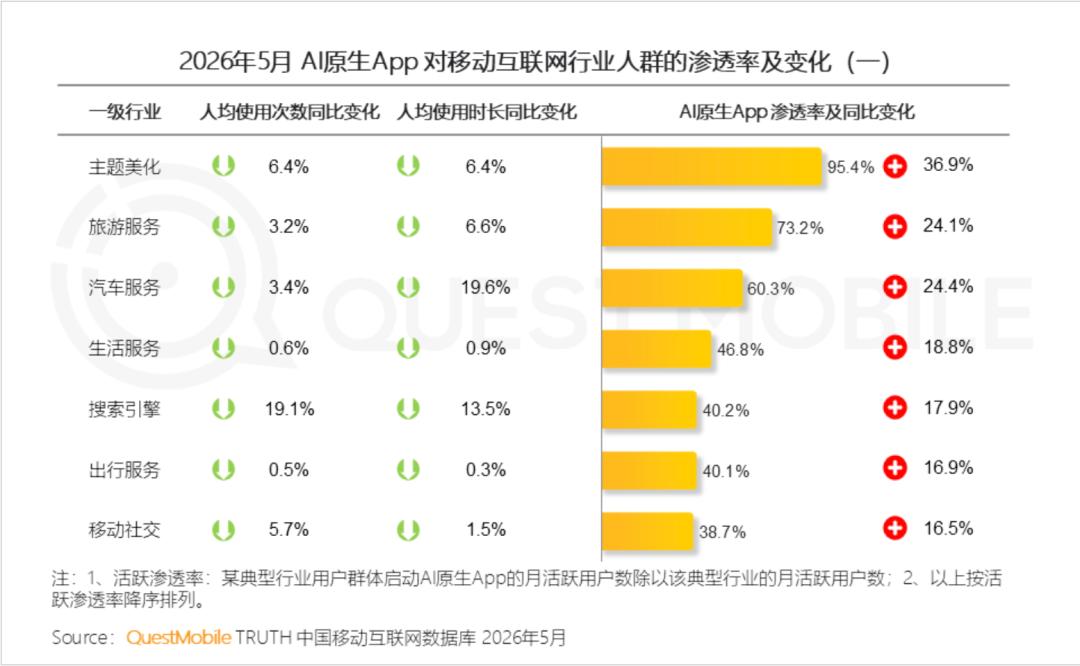
At the same time, the average monthly usage times of search engine apps dropped 19.1% year-on-year, and usage duration decreased 13.5% year-on-year. The market share of traditional search is being steadily eaten away by AI.
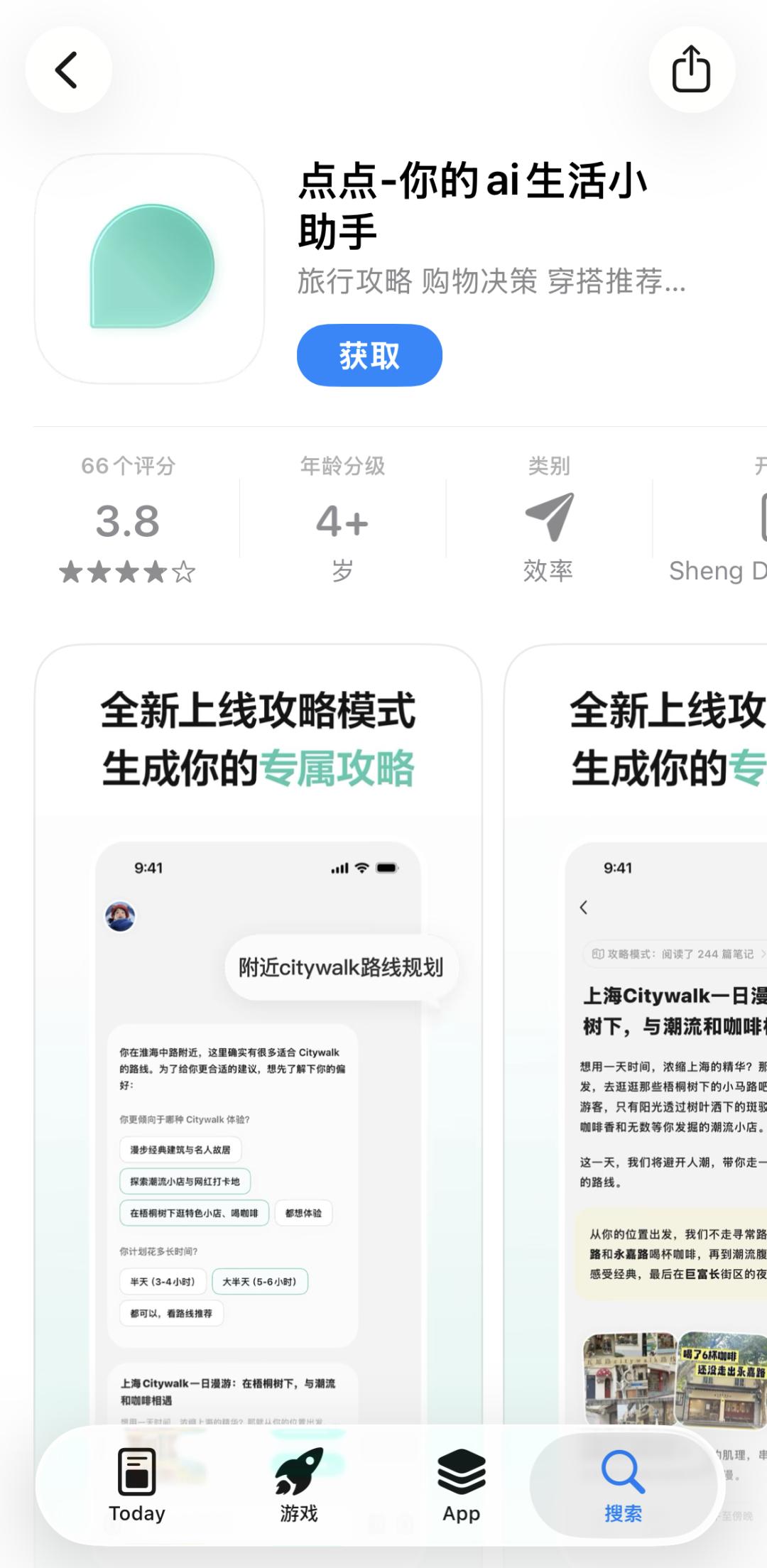
Xiaohongshu's own AI product "Diandian" is its attempt to defend its position. This AI life search assistant runs as an independent app and is also embedded in the main Xiaohongshu app. However, as of April 2026, Diandian only ranked 186th on the App Store download chart, with just 66 user reviews, while Doubao had 1.92 million reviews in the same period. The gap is not just a difference in scale, but a difference in dimension.
In early 2026, Xiaohongshu established Dots, a first-level AI department that integrates model R&D, infrastructure, engineering, and product teams, directly led by new CEO Conan.
This marks that AI has been upgraded from a supporting tool to a core strategic direction. However, organizational restructuring does not equal improved product capabilities, and it still takes time to verify whether Dots can deliver tangible results.
The core problem lies in this: Xiaohongshu's search value is built on "real people sharing real experiences"; the value of AI search is built on "efficient information integration". These two logics inherently conflict. If AI directly summarizes note content for users, users will no longer need to open Xiaohongshu, and traffic will be cut off. If AI only acts as a supplementary search tool, it is just a shell added to the original search system, a defensive product that can hardly become a new growth driver.
What Xiaohongshu needs is not just an AI search assistant, but a completely new product logic tailored for the AI era. But so far, this new logic has not been found.
User growth has hit a plateau, and the cost of breaking into broader markets is staggering
Now let's look at the user side.
In May 2026, "LatePost" exclusively disclosed that Xiaohongshu's domestic daily active users exceeded 170 million, and monthly active users exceeded 400 million, which looks decent, but still lags behind Douyin's 1 billion monthly active users by a significant margin.
To expand its user base beyond its core demographic, Xiaohongshu launched its most expensive user acquisition campaign ever: spending nearly 1 billion yuan to secure the broadcast rights for the 2026 FIFA World Cup in the US, Canada, and Mexico. On the first match day, the number of live viewers surged 55 times, the proportion of male viewers exceeded 60%, and there were 90 million fan interactions in the first three days.
But whether the male users attracted by the World Cup will stay, and whether they can be converted into advertising and e-commerce value, is still uncertain.
However, one thing is certain: a temporary traffic surge driven by a single event does not equal structural growth. In early 2023, Xiaohongshu internally set the goal of "targeting 300 million DAUs based on the existing 100 million DAUs"; two years later, DAUs are still hovering around 170 million. The fact that the target was lowered from 300 million to 200 million itself shows that growth is far more difficult than expected.
Therefore, going back to the "Darwin" project. It is widely agreed that Xiaohongshu needs a second growth driver. The debate is about what exactly this second growth driver is, and where it will come from.
Many people think that since Xiaohongshu excels at product discovery, its second growth driver should be to deepen and expand this strength, for example, by launching vertical e-commerce platforms, developing local lifestyle services, or building AI product discovery assistants.
But users come to Xiaohongshu for authenticity. Once the platform heavily promotes e-commerce, the content will become more commercialized, and this sense of authenticity will fade.
As a result, Xiaohongshu's e-commerce efforts are always walking a tightrope: pushing too hard will damage the community atmosphere; pushing too lightly will fail to drive meaningful e-commerce volume.
What if the second growth driver does not lie along this extended path? What if it is something completely different?
Perhaps this is exactly the potential of the "Darwin" project. It is not about adding a new feature module to the main Xiaohongshu app, but building a completely independent product from scratch. An independent product may mean independent user groups, independent usage scenarios, and an independent business model, eliminating the need to walk the tightrope between community operations and e-commerce.
For now, we still do not know what kind of independent product can emerge from Xiaohongshu's organization.
Final Thoughts
Whether "Darwin" can evolve into a successful product depends not only on the project's scale and resource allocation, but more importantly, on whether Xiaohongshu can break free from its inherent genetic limitations, transforming from a community operation company into a company with multiple core competencies. This leap is the true evolution.
Xiaohongshu has at least taken the first step toward change. Now, we will see if it can go all the way.
This article originates from the WeChat Official Account "TopKlout KlaRui" (ID: TopKlout), authored by TopKlout, and published by 36Kr with authorization.