Soaring by 460%, Zhao Lusi's new brand has set its sights on this track
Recently, Zhao Lusi's personal beauty brand ROSE AMIGO made its public debut at her Galaxy Macau concert, gifting its Glow & Bloom Lip Mask to attendees as a souvenir, which has drawn widespread attention from across the industry and beyond.
According to filing records from the National Medical Products Administration (NMPA), ROSE AMIGO has only one neck mask product registered to date. This strategy differs from the common path taken by most celebrity-backed beauty brands in the past, which typically entered the market with facial masks as their debut offering.
So why did Zhao Lusi choose to enter the beauty industry starting with a neck mask?
ROSE AMIGO Has Launched Its Flagship Store, With Its First Registered Product Being a Combined Face and Neck Mask
Information from the China Trademark Office shows that the applicant for the international trademark "ROSE AMIGO" under Class 3 is Chengdu Maning Enterprise Management Co., Ltd. (hereinafter referred to as "Chengdu Maning"). The company was founded on August 26, 2025, with Zhao Lusi as the actual controller and beneficial owner holding a 90% stake. This means the trademark is fully owned by the enterprise under Zhao Lusi's control.
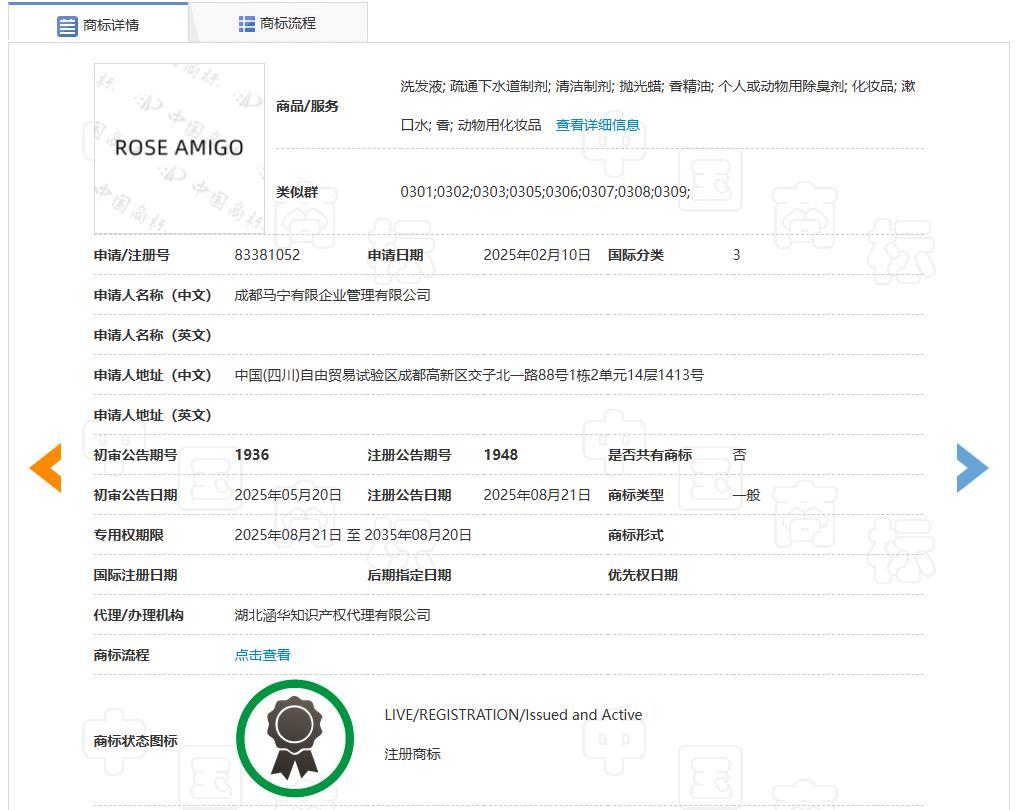
Screenshot from the China Trademark Office
It is understood that ROSE AMIGO has launched an official brand account on Xiaohongshu, as well as the "ROSE AMIGO Skincare Flagship Store" account on the Douyin platform. Both accounts are Blue V verified, with 8,222 and 10,000 followers respectively, and their operating entity is Beijing Meimeimei Cosmetics Co., Ltd. (hereinafter referred to as "Beijing Meimeimei"). Currently, no products are available for sale in the ROSE AMIGO Skincare Flagship Store.
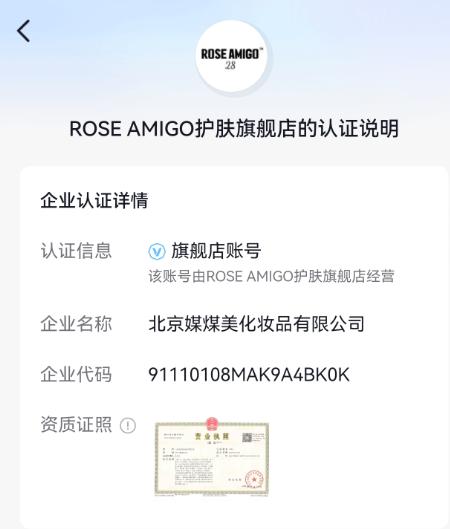
Screenshot from Douyin
From an equity structure perspective, no direct correlation has been found between Beijing Meimeimei and Chengdu Maning so far.
According to information on ROSE AMIGO's official Xiaohongshu account, the brand's slogan is "You are your own perfect number, I am the AMIGO who understands you". The name "ROSE" is taken from Zhao Lusi's English name Rosy, while "AMIGO" means "friend" in Spanish. The number 28 in the brand logo corresponds to Zhao Lusi's birthday.
ROSE AMIGO made its debut at Zhao Lusi's Macau concert (held July 11-12), where ticket holders could receive a free ROSE AMIGO Glow & Bloom Lip Mask on site. Photos shared by Zhao Lusi's fans on social media show the product packaging features the exclusive "Stay Romantic" visual theme of the Macau concert.
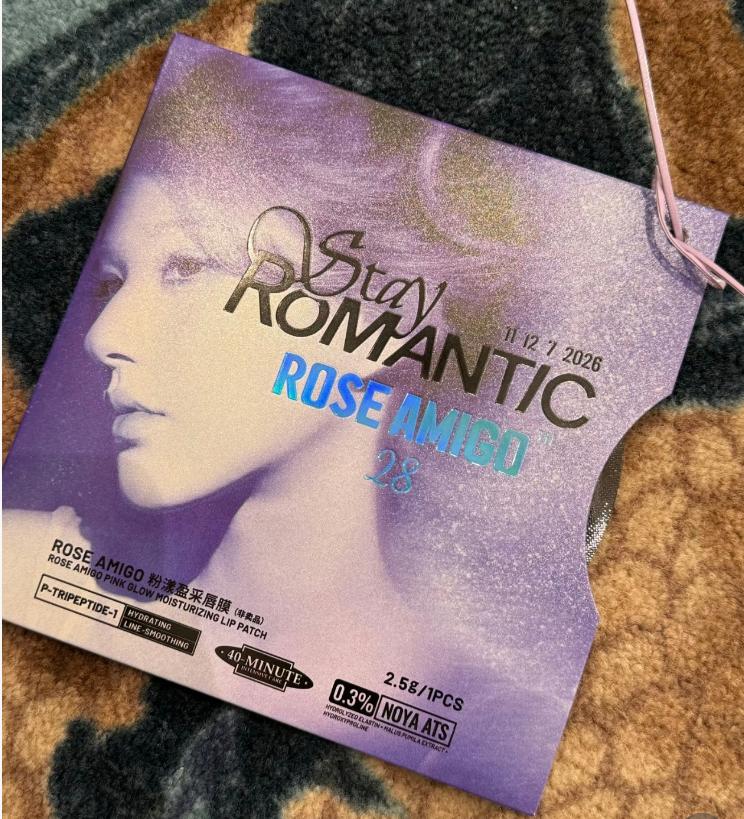
ROSE AMIGO Glow & Bloom Lip Mask (Image source: Xiaohongshu)
Qingyan's inquiries found that the ROSE AMIGO Glow & Bloom Lip Mask is not filed with the NMPA. Multiple regulatory engineers told Qingyan that "even as a gift or non-sale item, cosmetic products still require official filing". However, it is worth noting that this lip mask was distributed in Macau rather than the Chinese mainland market, so it does not fall under the jurisdiction of mainland Chinese cosmetic regulations.
Notably, the only registered product currently traceable under the ROSE AMIGO brand is the "ROSE AMIGO Radiant Renewal Red Carpet Face & Neck Mask". Filing records show the product was registered on June 25 this year, with both the filer and manufacturer being Guangdong Haitang Pharmaceutical Co., Ltd., a contract manufacturer that mostly produces for small and medium-sized brands. The product's efficacy claims cover four categories: moisturizing, anti-wrinkle, firming, and soothing.
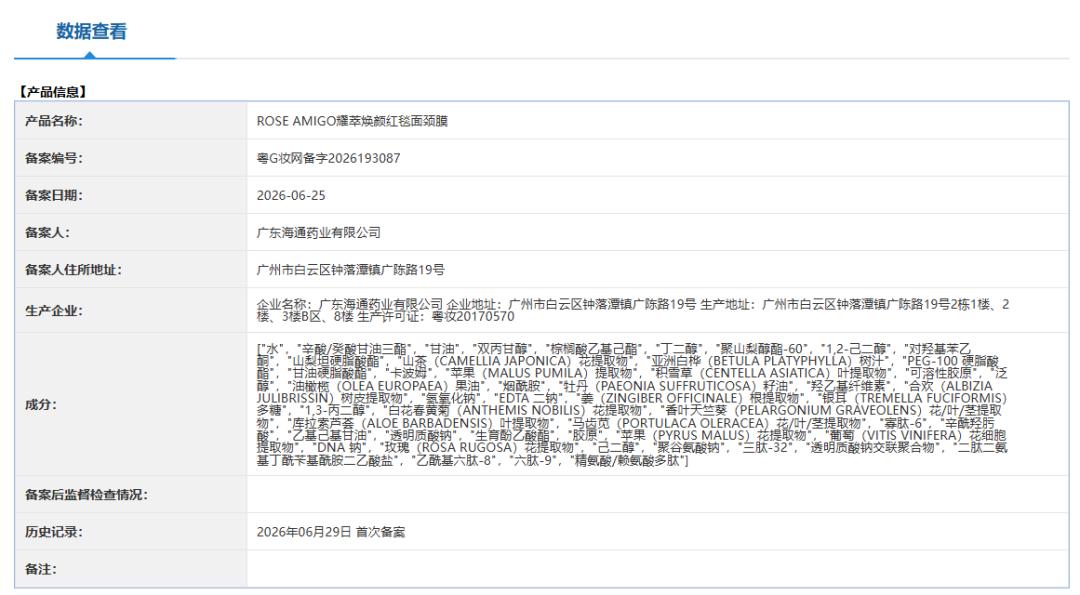
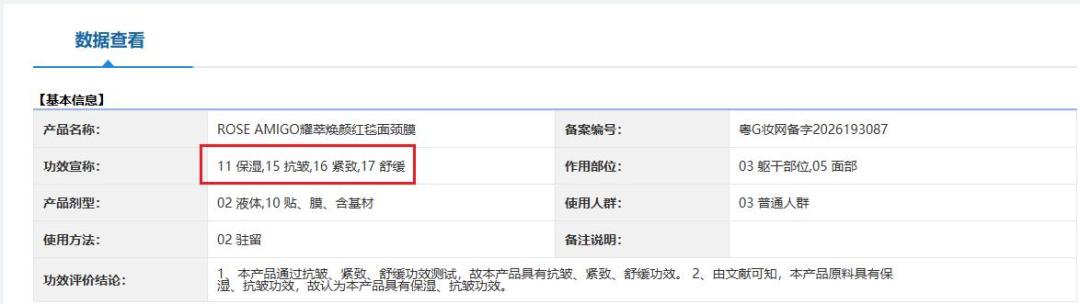
Records from the National Medical Products Administration
This means the product ROSE AMIGO is most likely to launch first in the Chinese mainland market is this already registered Radiant Renewal Red Carpet Face & Neck Mask.
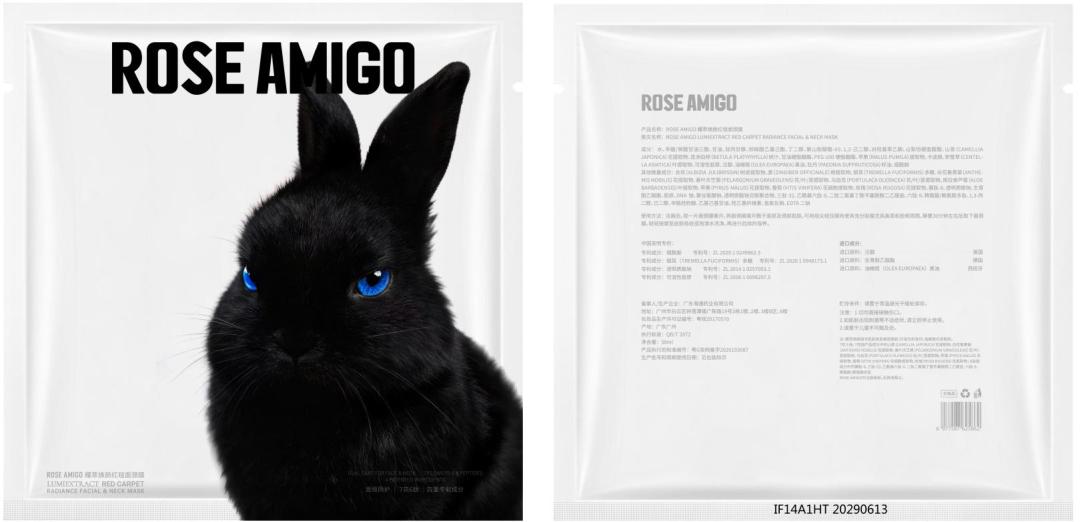
ROSE AMIGO Radiant Renewal Red Carpet Face & Neck Mask (Image source: NMPA)
Avoiding Red Sea Competition, Focusing on High-Growth Niche Tracks
In fact, celebrities entering the beauty industry is far from a new phenomenon. Figures like Fan Bingbing, Zhang Ting, and Ming Dao have all launched their own beauty brands. In particular, Fan Bingbing's Fan Beauty Diary, launched in 2018, stands out as one of the most successful celebrity-backed beauty brands.
According to multiple media reports, the brand's estimated annual revenue reached 1.8 billion yuan in 2025. During this year's 618 shopping festival, Fan Beauty Diary delivered an impressive performance, ranking 19th in the top 20 beauty brands on Taobao and Tmall during the promotion.
It is worth mentioning that Fan Beauty Diary first broke into the beauty market with its signature Sea Grape Hydrating Mask. Beyond Fan Beauty Diary, most celebrity-backed beauty brands launched in earlier years — including Carina Lau's anti-aging mask line, Zhang Ting's TST, Zhang Xinyu's MISS ZHANG, and Li Jing's Jplus — all used facial masks as their entry point into the industry.
Undoubtedly, the choice of a debut product for a new beauty brand always serves as the most direct reflection of its strategic intent. So why did ROSE AMIGO specifically choose to start with a neck mask?
First, looking at the competitive landscape of the beauty industry, China's cosmetics market has long entered a stage of stock or even shrinking competition, with the efficacy skincare segment in particular already facing extremely fierce rivalry.
In the facial skincare segment, core categories such as lotions, creams, masks, and serums have long had their market share firmly occupied by international premium brands and leading domestic players. International names like Estée Lauder and Lancôme dominate the high-end market, while domestic leaders including Proya, Winona, and CHANDO deeply cultivate the mass and mid-range segments. With mature supply chains, well-established distribution networks, and long-cultivated consumer recognition, these brands have built extremely high industry barriers.
For newly emerging brands entering the market, launching with homogeneous facial skincare products will neither allow them to build overwhelming advantages in product efficacy or formulation technology, nor enable them to achieve breakthroughs in pricing, channels, or brand reputation.
The mask segment that was once favored by celebrities has long since become a saturated red sea. Data from Oteo Consulting shows that as early as 2022, among all sheet masks sold across online platforms, low-cost masks priced at around 3 yuan per sheet accounted for 32.58% of total sales. As a result, entering the market with masks at this point would likely drag new brands into a vicious cycle of low-price competition.
On the other hand, as anti-aging demands become increasingly universal across all age groups and more granular, and social media continues to popularize beauty standards such as the "swan neck", consumers' awareness and acceptance of neck care keep rising, driving a surge in demand for neck anti-aging products. For example, in the past, people would casually spread leftover face cream onto their necks, but now "text neck" — neck lines caused by prolonged hunching over mobile phones — has become a widespread pain point, especially a core beauty concern for women in the 25-35 age group, who are starting to seek more professional and effective neck care solutions.
Data confirms this trend. According to the *2025 China Mask Market Innovation and Global Consumption Trend Report* jointly released by Nox Bellcow and User Insight, the growth momentum of the neck mask segment has been extremely strong, with GMV of neck masks growing by 60.8% in 2024. Data from Youmi Data's *2025 Growth of Skincare and Makeup Subcategories on Douyin E-commerce* further shows that neck care sales skyrocketed 460% year-on-year.
More notably, data from Magic Mirror indicates that in the neck care market in the first three quarters of 2025, neck creams accounted for 90.62% of market share while neck masks only took 9.38% — yet the year-on-year sales growth rate of neck masks reached 70.31%, outpacing the 65.63% growth of neck creams.
This shows that neck masks are a relatively small but fast-growing niche category; their current small market size also means major beauty giants have not yet prioritized this segment, resulting in far lower competition intensity than the facial mask market. The high growth rate, meanwhile, represents considerable untapped market potential, giving early entrants the opportunity to build first-mover advantages.
Looking at the competitive landscape, most players in the current neck care market are unbranded white-label products. According to Qingyan Intelligence data, in the Douyin neck mask top 20 brand ranking for the first half of this year (January-June), the top three spots were taken by KAN'S, Kezhu, and Kangaroo Mommy. Well-known brands including Creator, Unilever's Bio-MESO, and Forest Cabin also made the list, while the remaining 70% of ranked brands are white-label names such as Kaveline, Novia, and Sweet Whisper.
Taking Haini Group's Kezhu as an example, the brand has built strong consumer recognition in the neck care segment. Public media reports show that in 2025, the brand achieved 290 million yuan in sales in a single quarter. According to Sullivan data, Kezhu's signature Silver Bandage Neck Mask has ranked first in national online neck mask sales for three consecutive years (2023-2025).
Overall, however, the neck care segment — and especially the neck mask category — is still in the early stage of "having the product category but no dominant brands". Consumers' awareness of neck care is being awakened through market education, and brand loyalty has not yet been established, creating the perfect window of opportunity for new brands to enter the market.
Over 20 New Brands Launched in the First Half of the Year
In fact, ROSE AMIGO's market entry logic is not an isolated case, but a microcosm of the collective trend in brand development across the beauty industry in the first half of 2026. Most new brands are focusing on a specific niche segment for their market debut, rather than launching with a full-category product matrix.
According to incomplete statistics from Qingyan, 24 new beauty brands have been launched since January this year. Skincare remains the most popular track, with 12 new brands covering skincare categories, accounting for 50% of the total; 7 new brands focus on hair and body care; there are relatively few new makeup brands, with only 3 launched; and 1-2 new brands have emerged respectively in the men's skincare, maternal and infant care, and personal & home care segments.
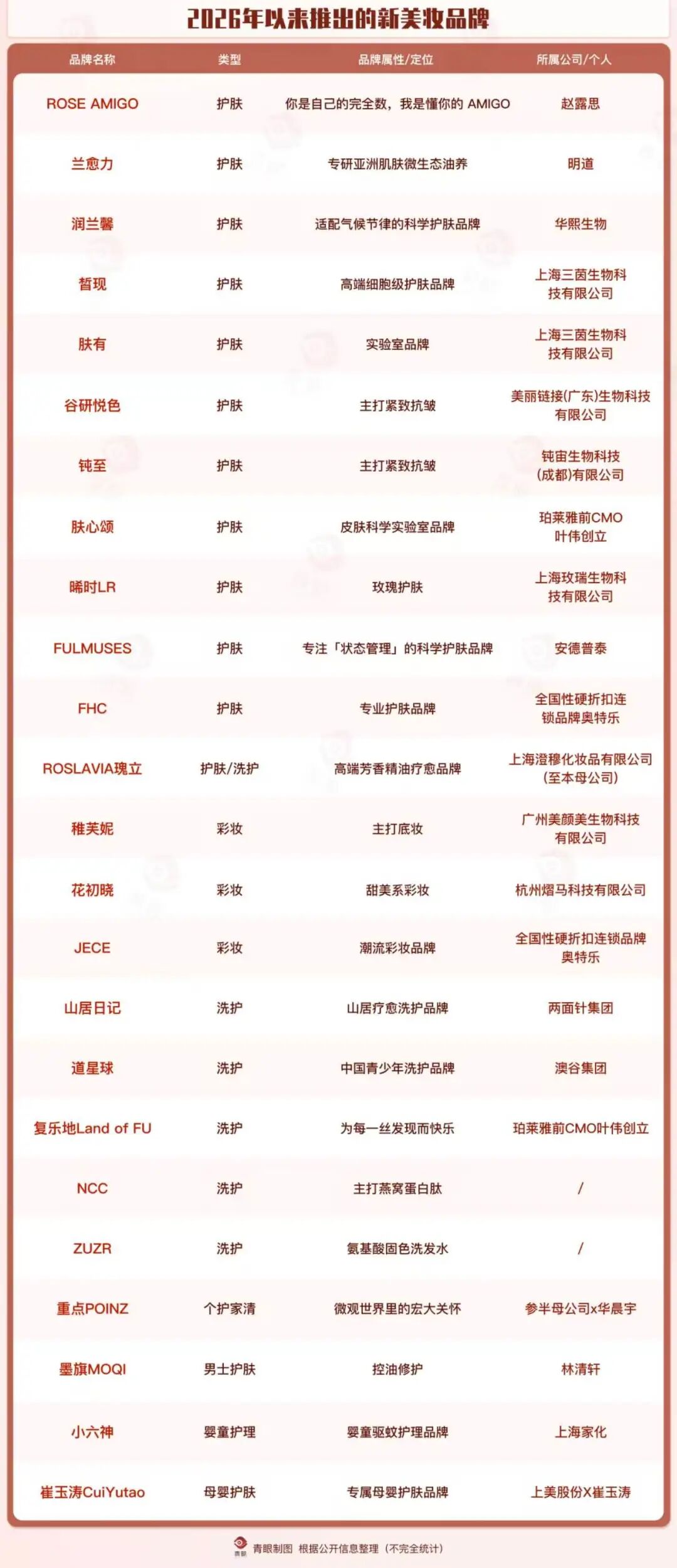
Based on the compiled data of new brands in the first half of the year, the market entry logic, track selection, and brand positioning of new beauty brands launched this year all present distinct new characteristics.
First, in terms of track selection, most of them focus on niche efficacy tracks, with anti-wrinkle & firming, microecological oil-infused skincare, and cell-level skincare as core directions. For example, Xixian, launched by Shanghai Sanyin Biotechnology Co., Ltd., positions itself as a high-end cell-level skincare brand. Its debut product is a lyophilized serum, which claims to precisely target three key areas: skin cells, the dermal layer, and the epidermal layer, to achieve three synergistic effects: cellular repair, collagen regeneration, and barrier strengthening.
Lanyuli, launched by Ming Dao, enters the oil-infused skincare track with a focus on "specialized research in microecological oil care for Asian skin". The brand has already launched an "Orchid Oil" product, which claims to use rare orchid ingredients to deliver soothing, brightening, and firming effects. In the hair care segment, the two new brands NCC and ZUZR focus on bird's nest protein peptide and amino acid color-protecting shampoos respectively; in the makeup category, Zhifni specializes in base makeup.
In addition, new brands are positioning themselves with strong professional attributes, with "science" and "laboratory" becoming key buzzwords. For example, Runlanxin, a new skincare brand launched by Bloomage Biotech, positions itself as a "scientific skincare brand adapted to climatic rhythms". Runlanxin advocates that the skin is a dynamic ecosystem that continuously interacts with the environment, and is affected by climatic and environmental factors such as temperature, humidity, light, and wind. As such, its product R&D and formulation design are all centered around "responding to climate change, adapting to different geographical regions, and matching daily skincare scenarios".
Similarly, FULMUSES, a skincare brand launched by Andapta — a company with 15 years of experience in medical R&D incubation — positions itself as a "scientific skincare brand focused on skin state management". Another brand, Fuyou, also launched by Shanghai Sanyin Biotechnology Co., Ltd., is positioned as a "laboratory brand"; while Fuxinsong, founded by Ye Wei, former CMO of Proya, is positioned around "skin science" as a skin science laboratory brand.
Third, most new brands are backed by leading industry enterprises or deeply tied to celebrities/IPs. It is clear that the operators of new brands in the first half of this year demonstrate strong industrial attributes: they include leading industry enterprises and senior practitioners such as Bloomage Biotech, Shanghai Chicmax, Jahwa, and former core executives of Proya, as well as established beauty groups such as the parent company of Zhuben, Forest Cabin, and Liangmianzhen, and even offline