12 IPOs in 2 days, the Hong Kong Stock Exchange is getting overcrowded
Another scene resounds with the echoes of ceremonial gongs.
On July 9, the Hong Kong Stock Exchange saw seven companies ring the listing bell collectively—RIGOL Technologies, Dingtai High-Tech, Luxshare Precision, Qiyunshan Food, Rokae Robotics, 3H Group, and East e-Paper, whose businesses span sectors including electronic measuring instruments, PCB drill bits, consumer electronics manufacturing, snack foods, robotics, and electronic ceramics.
Among them, Luxshare Precision (02475.HK) is the largest new stock, with a market capitalization exceeding HK$400 billion; 3H Group (06951.HK) has a market cap of HK$200 billion; Dingtai High-Tech (01377.HK) opened lower at HK$330 per share, with a market cap of approximately HK$140 billion; Rokae Robotics (03752.HK) debuted with an opening market value of around HK$10 billion; RIGOL Technologies (00537.HK) opened at HK$37.36 per share, boasting a market cap of roughly HK$8 billion; East e-Paper (01770.HK) has a market value of about HK$4 billion; and Qiyunshan Food (02797.HK) carries a market cap of HK$1 billion.
The subscription lineup assembled behind these IPOs is equally impressive: the seven companies collectively introduced over 70 cornerstone investors, with total subscription amounts surpassing HK$100 billion. Luxshare Precision attracted 28 cornerstone investors including Temasek, GIC, the Abu Dhabi Investment Authority, Tencent, and Taikang Life; Dingtai High-Tech secured 17 cornerstone investors such as Shenzhen Hongfa Technology, E Fund Management, and Taikang Life; the cornerstone list for 3H Group features names like Temasek, JPMorgan Chase, Alibaba, Tencent, and Goldman Sachs Asset Management—the list goes on and on.
At this point, the seven IPOs are officially launched. Coincidentally, looking back at the seven newly listed companies, just one day earlier on July 8, five companies—Momenta-W, Rayze Technology, In-Driving, Baoguang New Materials, and Basic Semiconductors—had already completed their listings on the Hong Kong stock market. It is worth noting that East e-Paper was originally scheduled to list on the 8th, but its listing was delayed to today as it needed extra time to finalize the announcement containing the final offering price and other details, as well as to obtain regulatory approvals.
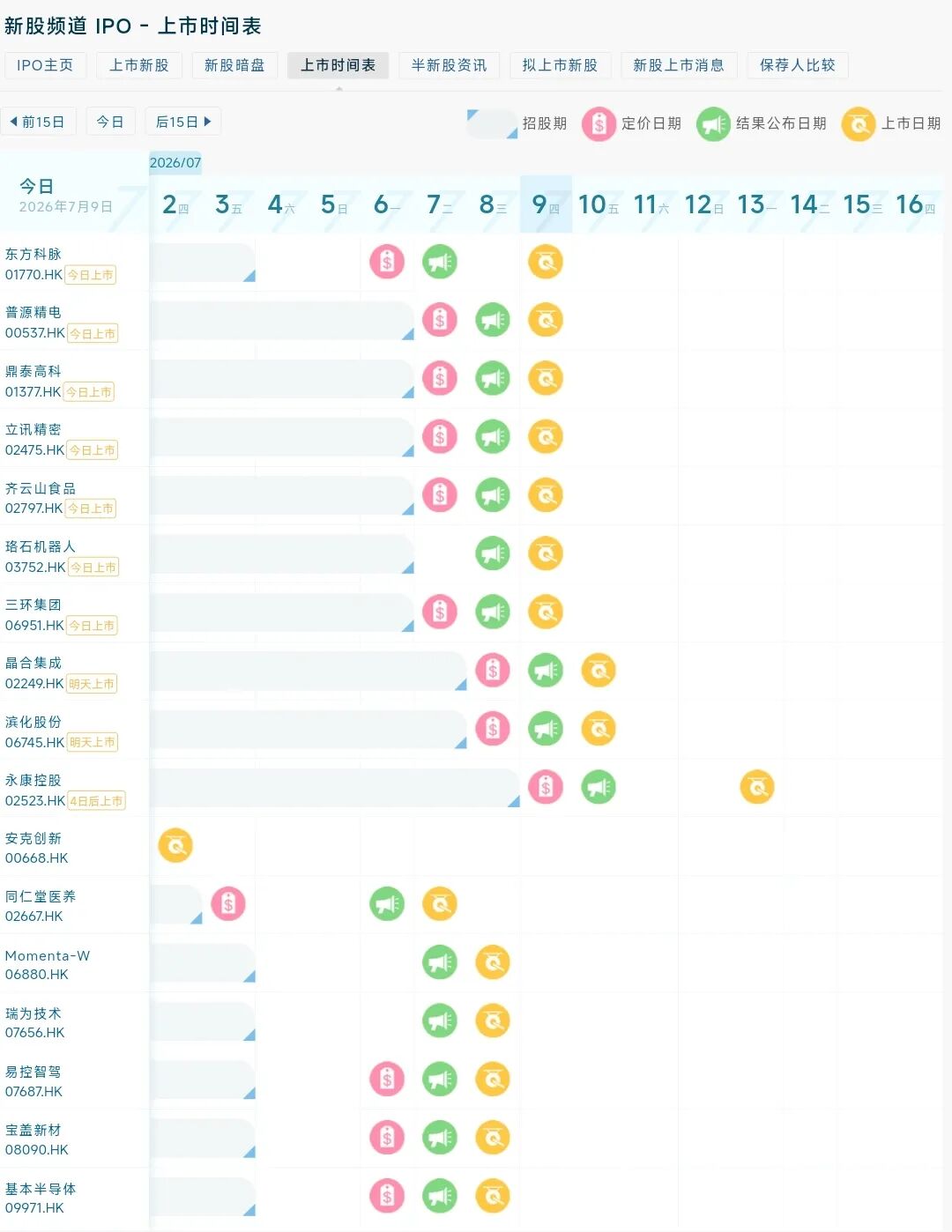
As we can see, behind the grand spectacle of 12 IPOs in two days lies a long-awaited exit window opening up in the secondary market.
Seven IPOs in a Single Day
The rare sight of seven gongs ringing in unison on the same day naturally sparks curiosity about the leaders behind these newly listed companies who struck the listing mallet.
Let's start with Luxshare Precision, the highest-market-cap company in this batch of IPOs. The story of its founder, Wang Laichun, is already the most legendary chapter in the "Queen of Apple Supply Chain" narrative. Born in 1967 to an ordinary family in Chenghai, Shantou, Guangdong Province, Wang Laichun dropped out of school early due to family financial constraints. In 1988, she traveled south to Shenzhen and became one of the first 150 employees recruited by Foxconn on the Chinese mainland, working there for a full 10 years. During that time, she rose from an ordinary component inserter to a high-ranking section supervisor. In 1998, 31-year-old Wang Laichun submitted her resignation, pooled her savings with her brother Wang Laisheng, acquired equity in Hong Kong Luxshare, used its Hong Kong-funded status to secure orders, and set up factories on the mainland to produce computer connectors—with many early orders "spilling over" from Foxconn.
In 2004, Wang Laichun founded Luxshare Precision in Shenzhen, continuing to apply Foxconn's refined management model. After the 2008 financial crisis, the company shifted focus to independent R&D. In 2011, it entered Apple's supply chain by acquiring Kunshan Linkcom, and later secured key orders for AirPods and full iPhone assembly—gradually evolving from Foxconn's "student" to its "competitor". In 2017, Apple CEO Tim Cook visited China, traveled to Kunshan to tour Luxshare Precision, and praised Wang Laichun, saying, "You've built an outstanding people-centric culture, and we're thrilled to partner with you!"
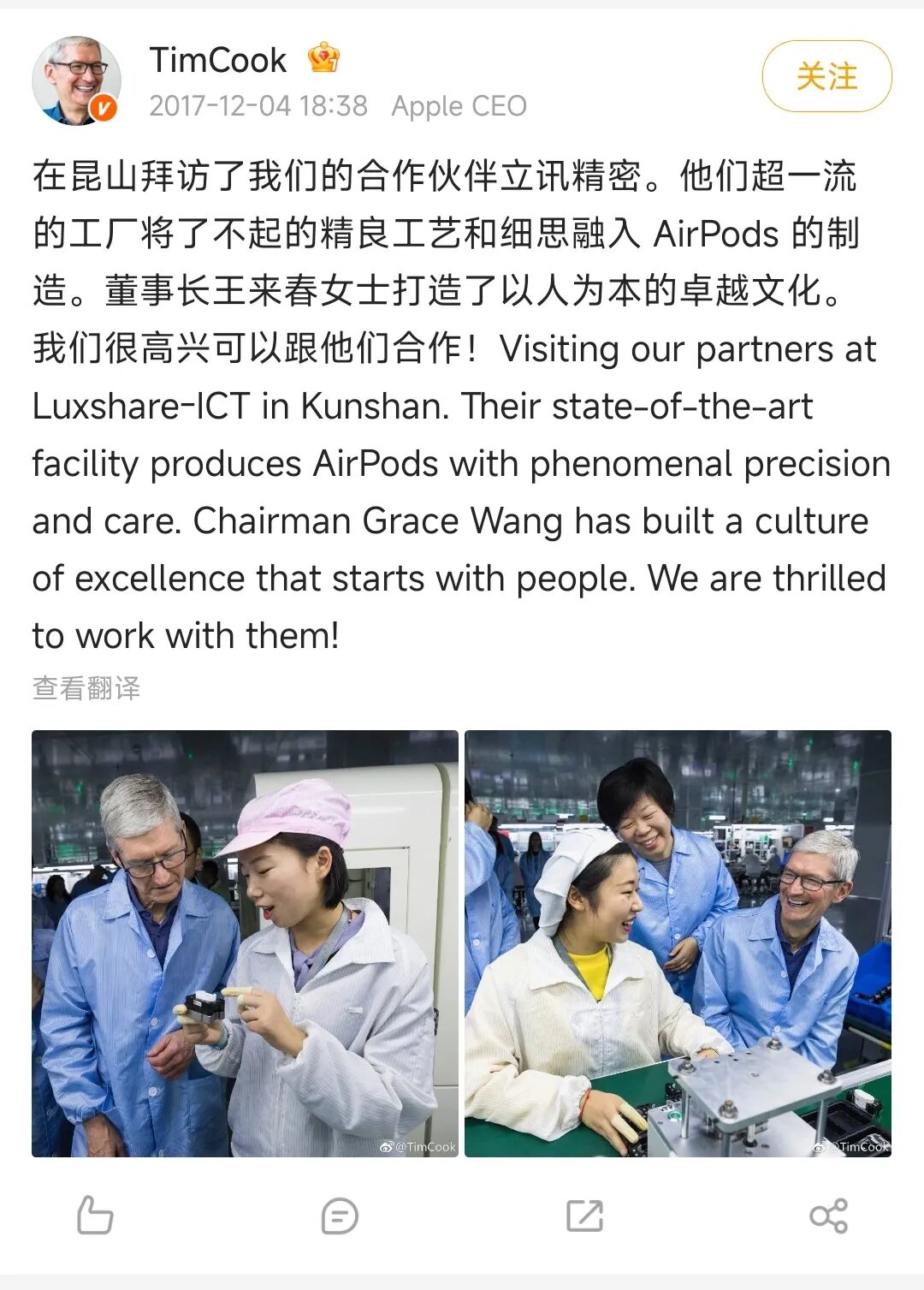
Image source: Tim Cook's Weibo
Today, this former small OEM has grown into an industry leader with annual revenue of 332.344 billion yuan and net profit of 18.170 billion yuan. In 2010, Luxshare Precision listed on the Shenzhen Stock Exchange; with this Hong Kong listing, the company has now established an "A+H" dual-market financing platform.
The story of Dingtai High-Tech also features a female entrepreneur at its core. Chairperson Wang Xin was born in 1973 to an ordinary rural family in Henan Province. At 16, she traveled south to Dongguan to work, starting as an ordinary assembly line worker in a toy factory. Unwilling to limit herself to just tightening screws, she studied accounting in her spare time and familiarized herself with business operations. Later, she joined a Taiwan-funded PCB manufacturing factory, starting as a frontline operator before rising to workshop supervisor, then transitioning to sales—gaining hands-on experience with financial records, production lines, and orders.
In 1997, with savings of 20,000 to 30,000 yuan and her family's encouragement, Wang Xin set up her own business in Houjie, Dongguan, founding the "Dingtai Electronic Materials Distribution Department". Initially, she ran a niche, trivial second-hand business refurbishing drill bits, but dedicated herself fully to it. Under her leadership, the company's output grew year after year, and it listed on the ChiNext board in 2022, with its market cap climbing steadily. Following its successful Hong Kong IPO, Dingtai High-Tech has also completed its "A+H" financing platform layout.
3H Group is another success story of a small factory evolving into a hundred-billion-market-cap leader. Born in 1949, Zhang Wanzhen dropped out of school at 16 to work as an apprentice in a bamboo ware factory, weaving bamboo baskets and pasting bamboo products to make a living. In 1970, as China's electronics industry boom began, the struggling bamboo ware factory decided to take a risky bet and pivot to manufacturing resistors. Zhang Wanzhen was sent to Guangzhou to learn carbon film resistor technology, surviving on steamed buns while studying blueprints—successfully leading the factory through its transformation from bamboo products to electronic components. In 1973, he officially joined the state-owned Chaozhou Radio Ceramic Parts Factory, the predecessor of 3H Group. Starting as an ordinary worker, he dedicated himself to researching ceramic powder formulations and firing processes, rising through the ranks to workshop director, deputy factory director, and eventually factory director.
In 1992, Zhang Wanzhen led the enterprise's shareholding reform, officially renaming the factory Chaozhou 3H (Group) Co., Ltd., and took on the roles of chairperson and general manager to fully steer the company. Later, he set his sights on fiber optic ceramic ferrules, a product monopolized by global giants like Japan's Kyocera. Over 20 years, he mastered every detail from ceramic powder formulations to sintering processes—driving the cost of this once-monopolized product (which sold for over 100 yuan apiece) down to less than 0.4 yuan, making its production cost one-fifth of that of Japanese manufacturers. In December 2014, 3H Group listed on the Shenzhen Stock Exchange ChiNext board, completing its A-share market layout. With the gong sounding at the Hong Kong Stock Exchange today, 3H Group has now achieved dual "A+H" listings.
Rokae Robotics tells the entrepreneurial story of three young people. In the summer of 2015, Hua Tuo and two like-minded partners resigned from their Fortune 500 jobs, moved to Beijing, and founded Rokae (Beijing) Technology Co., Ltd., targeting the robot control system market that was previously monopolized by foreign players. After years of development, Rokae Robotics now covers three product lines: industrial robots, flexible collaborative robots, and embodied intelligent robots. Notably, Rokae Robotics is the only company in this batch of new stocks with a pure "robotics" label.
East e-Paper is the world's second-largest e-paper display manufacturer and the largest global producer of commercial e-paper displays, holding a dominant market position in sectors like electronic shelf labels and e-readers. Its revenue is projected to reach 1.713 billion yuan in 2025, representing a 48.8% year-on-year increase, with its profits maintaining three consecutive years of growth.
The stories of RIGOL Technologies and Qiyunshan Food are less dramatic, but each has secured a strong foothold in their respective niche markets. RIGOL Technologies built its business on oscilloscopes and spectrum analyzers under its "RIGOL" brand. According to Frost & Sullivan data, by revenue, it is already China's largest electronic measuring instrument supplier, ranking 8th globally in 2025. Qiyunshan Food is the smallest of the six companies and the only consumer goods firm, specializing in snacks like wild sour jujube cakes. It holds approximately 29% of China's wild sour jujube food market share in 2025, ranking first.
Thus, the historic moment of seven IPOs in a single day at the Hong Kong Stock Exchange was realized.
12 IPOs in Two Days, Backed by a Wave of Cornerstone Investors
Coincidentally, one day before the seven IPOs debuted on July 9—on July 8—the Hong Kong Stock Exchange also welcomed five new listed companies.
Among them, Momenta-W is the first stock in the "Physical AI" track, primarily offering L2-L4 level autonomous driving solutions, with its 2025 revenue projected to reach 2.413 billion yuan and a three-year compound annual growth rate exceeding 80%. Rayze Technology focuses on visual intelligence, ranking first in the domestic civil aviation visual product market share across three sectors: civil aviation, commercial spaces, and safe driving. In-Driving specializes in mine autonomous driving and is the world's first enterprise to deploy over 2,500 unmanned mining trucks, with its 2025 revenue expected to hit 1.435 billion yuan and a three-year CAGR exceeding 130%. Baoguang New Materials operates in the composite material trench cover sector—a niche but stable traditional manufacturing industry—listing on the Hong Kong Stock Exchange's GEM board. Basic Semiconductors is a domestic Chinese silicon carbide power semiconductor enterprise.
In just two short days, 12 companies have rung their listing bells at the Hong Kong Stock Exchange.
Interestingly, these 12 companies, which operate in nearly unrelated sectors, follow two completely distinct capital logic models. On one end, some have cornerstone investor lineups bordering on extravagant: for example, Luxshare Precision brought in 28 institutions including Temasek, GIC, the Abu Dhabi Investment Authority, Tencent, and Taikang Life, which subscribed for $1.5 billion, accounting for 48.44% of the offering. Dingtai High-Tech attracted 17 institutions including Shenzhen Hongfa Technology, HHLR, Kingboard, E Fund Management, and Taikang Life, with total subscriptions of approximately $254 million. The cornerstone list for 3H Group includes Temasek, JPMorgan Chase, Alibaba, Tencent, and Goldman Sachs Asset Management, with a subscription ratio of around 49.8%.
Momenta and In-Driving, which listed on July 8, demonstrate a different capital logic: direct participation by industrial capital. Among Momenta's 14 cornerstone investors, Mercedes-Benz Group invested $25 million, and BYD's affiliate Golden Link invested $15 million—both of which are long-time shareholders and partners of the company. On In-Driving's cornerstone list, funds under Zijin Mining and XCMG Industrial Investment each invested $20 million, and Zijin Mining itself is a customer of In-Driving's unmanned mining truck business. This pattern—industrial capital evolving from customers to shareholders, then becoming cornerstone investors for IPOs—repeats across many of these newly listed Hong Kong companies.
Meanwhile, four companies—East e-Paper, Rayze Technology, Basic Semiconductors, and Baoguang New Materials—did not introduce any cornerstone investors. Notably, even without cornerstone support, they still garnered strong enthusiasm from retail investors. For example, Basic Semiconductors saw its margin financing subscriptions oversubscribed by nearly 800 times at one point.
The Hong Kong Stock Exchange Is Running Out of Space
"I've never seen so many people in this hall before," said Tong Tang, Chairman of the Hong Kong Stock Exchange, emotionally on June 26, as gongs resounded through the HKEX Financial Hall to celebrate the exchange's 26th anniversary.
Looking back to June 26, six hard-tech companies and one tech ETF listed on the same day, raising a total of HK$19.2 billion—setting a new record for the highest number of single-day listings this year. Multiple companies rang their listing bells simultaneously, presenting a powerful hard-tech-themed ceremony as a significant 26th-anniversary gift to the Hong Kong Stock Exchange.
The 12 IPOs across July 8 and 9 represent the continuation of this bustling trend.
Behind this excitement lies solid supporting data. In its recently released "2026 Hong Kong IPO Market Mid-Year Review and Outlook", PricewaterhouseCoopers (PwC), one of the Big Four accounting firms, noted that as of the first half of 2026, the total fundraising amount and number of listings on the Hong Kong IPO market have hit five-year highs. During this period, the Hong Kong IPO market raised a cumulative HK$210 billion, a 92% year-on-year increase, ranking second globally. A total of 87 new stocks were issued, up 98% year-on-year: 83 listed on the Main Board, 2 transferred from the GEM to the Main Board, 1 listed via introduction, and 1 listed on the GEM.
The "A+H" listing model accounts for over half of total IPO fundraising. According to PwC data, in the first half of the year, "A+H" companies raised a total of HK$121.7 billion. Many mainland Chinese enterprises in sectors like artificial intelligence, semiconductors, and hard tech have chosen to pursue dual listings or list in Hong Kong first before issuing A-shares. This explains why Dingtai High-Tech, Luxshare Precision, RIGOL Technologies, and 3H Group all chose to list in Hong Kong at the same time—they are already well-established on the A-share market, and only needed a second financing platform to connect with global capital.
Raymond Gold, PwC's Capital Markets Services Lead Partner, explained the reason for this cluster of listings: Hong Kong's listing rules require that financial results submitted for application must be within a six-month validity period. Since most mainland Chinese companies use December 31 as their fiscal year-end, this creates a pattern where applications are concentrated at the end of June, leading to a wave of listings in July. He also projected that Hong Kong's total 2026 IPO fundraising could reach HK$380 billion, with new stock first-day performance improving simultaneously—over 80% of new stocks recorded first-day gains, up from around 70% in the first half of 2025.
Data shows that as of June 30, the Hong Kong Stock Exchange still had 534 pending listing applications. Meanwhile, the A-share primary market is also heating up in tandem with the Hong Kong market.
According to Wind data, 71 companies listed on the A-share market in the first half of 2026—20 more than the 51 in the same period last year, representing a nearly 40% increase. Total fundraising reached 70.574 billion yuan, more than doubling the 37.355 billion yuan in the same period last year. All 71 new stocks rose on their listing day, with none falling below their issue price, recording an average closing gain of around 280%. Combining the Hong Kong, A-share,