On the eve of Xiaohongshu's listing, the VIE structure tilted in favor of its employees.
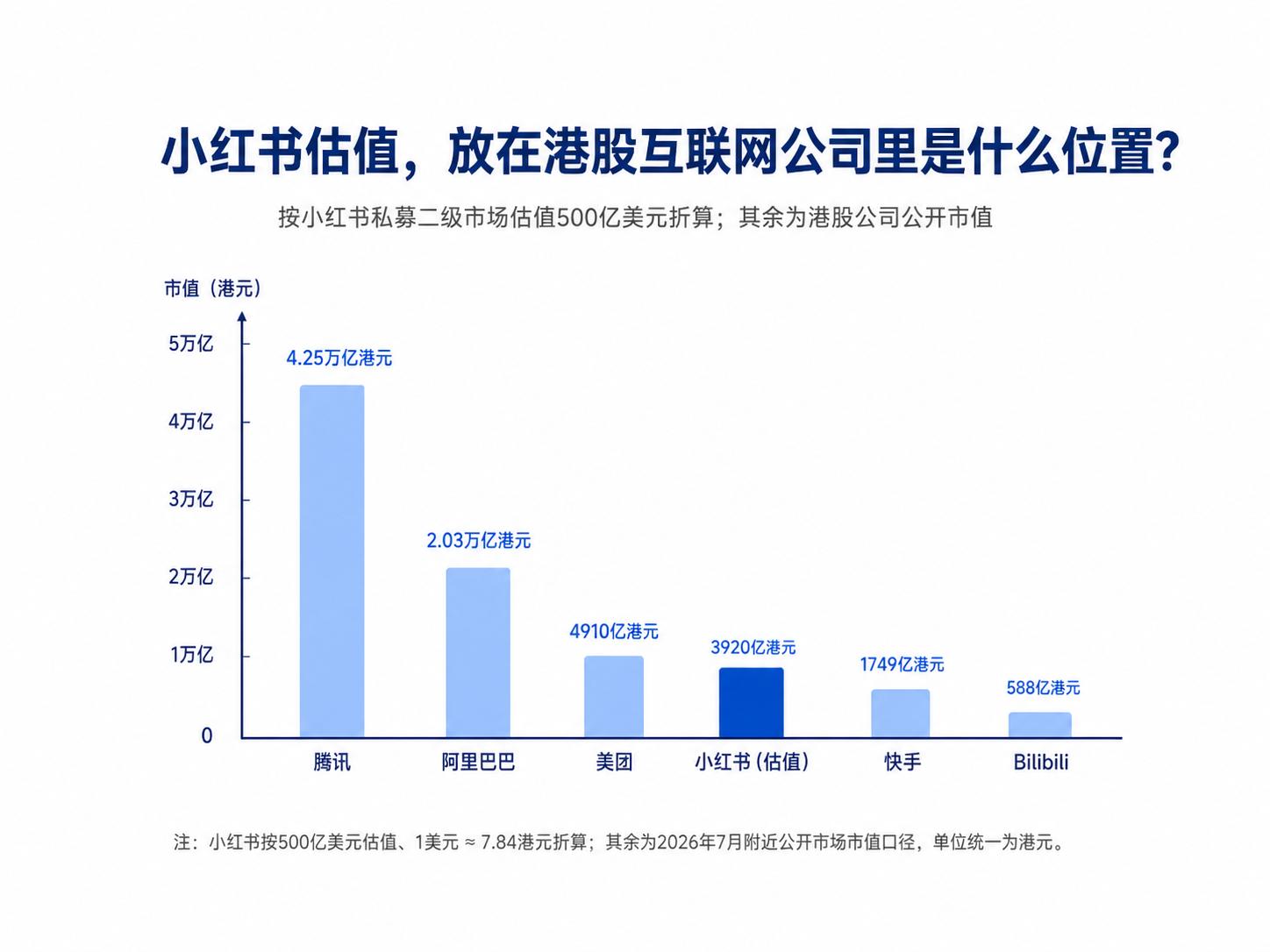
According to Reuters, Xiaohongshu could potentially list on the Hong Kong Stock Exchange as early as the second half of this year. Valued at $50 billion in the private secondary market, it is set to create a significant number of new multimillionaires.
For the Hong Kong market, Xiaohongshu is no ordinary unicorn. Following Kuaishou and Meituan, it is one of the few remaining Chinese internet platforms that investors still believe can weave a cohesive narrative around "community, advertising, e-commerce, search, and consumer decision-making."
But on the eve of its IPO, a public whistleblower report filed by a former executive using his real name has turned this wealth-creation story into a pre-listing stress test.
On June 29, Chen Hao, former head of direct sales for southern China at Xiaohongshu's commercial division, publicly announced that he had submitted a real-name "complaint regarding Xiaohongshu's main entity listing compliance" to the Hong Kong Stock Exchange's Listing Department and the Securities and Futures Commission (SFC) on June 28. He attached supporting documents including first and second-instance court judgments, option litigation files, and old and new employment separation certificates.
Public reports show that the dispute between Chen Hao and Xiaohongshu initially stemmed from a layoff carried out just before his options were due to vest. In December 2023, roughly five months before the first batch of options matured, Xiaohongshu "phased out" Chen Hao on the grounds that he was "not competent for his job." Chen then launched a two-year legal battle, and the court ruled partially in his favor, ordering Xiaohongshu to pay approximately RMB 850,000 in compensation, including damages for wrongful termination, lost option value, and the issuance of a revised employment separation certificate.
Generally, a single labor dispute is unlikely to derail a mega-platform's IPO. However, the core of Chen's complaint to the HKEX and SFC centers on alleged inconsistencies in Xiaohongshu's disclosures regarding its VIE structure, employee stock options, and listing information — precisely the area the HKEX scrutinizes most closely.
1. How Did the VIE Structure Evolve From a Financing Tool to an Employee Stock Option Issue?
To understand the leverage Chen Hao has over Xiaohongshu, we first need to examine the corporate relationships within its VIE structure.
Chen Hao signed contracts with two different entities: his domestic employment agreement was with "Shu Yi Shu Er Guangzhou Branch," while his offshore stock options were granted by Xingin International Holding Limited.
During litigation, Xiaohongshu argued that there was no controlling relationship between the offshore option-granting entity and the domestic operating entity, and therefore it was not obligated to compensate Chen for his lost options.
This is the crux of the problem. In court, Xiaohongshu claimed its two entities were independent — but in its Hong Kong listing documents, it must demonstrate that they are under unified control. These two conflicting narratives create a direct contradiction.
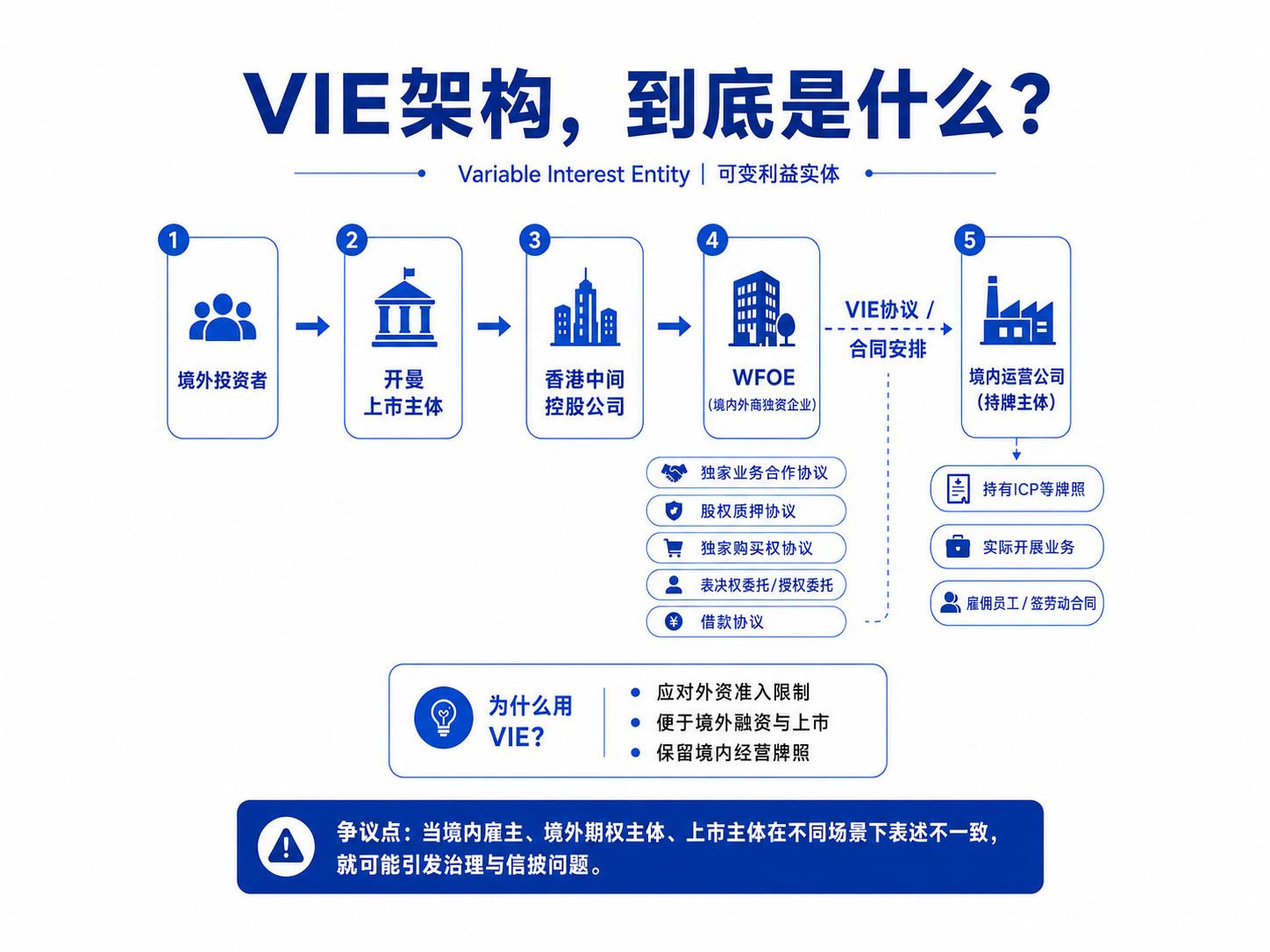
To grasp this issue, we must first revisit the basics of the VIE structure.
VIEs have long been the dominant framework used by Chinese internet companies to list overseas.
Since many internet-related businesses face foreign investment restrictions, offshore investors cannot directly hold equity in mainland operating companies. As a result, companies typically establish an offshore listing vehicle (often a Cayman Islands entity), which then enters into a series of contractual agreements with a Hong Kong subsidiary, a mainland wholly foreign-owned enterprise (WFOE), and the actual domestic operating entity.
Through these agreements, the offshore listed entity can capture the economic benefits and operational control of the mainland business, while investors hold shares in the offshore parent company.
Historically, companies including Alibaba, Baidu, Pinduoduo, JD.com, and NetEase have all relied on VIE agreements to facilitate overseas financing. During their listing processes, they were required to explicitly confirm to the HKEX, NYSE, or Nasdaq that even without direct equity ownership of the mainland business, they exercised de facto control through VIE contracts — without which the entire listing structure would be invalid.
However, in scenarios involving labor disputes, stock options, regulatory oversight, and litigation, this arrangement creates complications: when an employee holds offshore option rights, what is the exact relationship between their domestic employer and the offshore granting entity? If a company emphasizes the independence of these entities in court, could that undermine its claims of unified control in its prospectus?
2. Who Is Feeling the Pressure From the Former Executive's Whistleblower Report?
In recent years, the listing stories for Chinese internet platforms have grown increasingly difficult to tell. Large platforms have hit growth ceilings, valuations for new consumer brands have corrected downward, and core sectors like short video, local services, and e-commerce have matured into fiercely competitive landscapes. Against this backdrop, Xiaohongshu still retains a rare uniqueness: it functions both as a content community and a critical consumer decision-making entry point, boasting strong user stickiness while already proving its ability to monetize through advertising and deliver profitability.
The Financial Times previously reported that Xiaohongshu achieved roughly $500 million in net profit in 2023, with total revenue reaching approximately $3.7 billion. On the user front, the platform has around 350 million monthly active users, with male users accounting for roughly 26% — a demographic the company is actively expanding through content focused on automobiles, luxury watches, soccer, and gaming. Reuters, meanwhile, reported that Xiaohongshu's monthly active users exceed 400 million, citing sources projecting its 2026 profits could reach $3 billion.
While different reports vary slightly in their figures, they all confirm that Xiaohongshu has evolved far beyond a lifestyle community to become one of China's few large-scale content platforms that still retains significant growth potential.
As a result, Xiaohongshu's valuation surge — from $17 billion in 2024 to $50 billion by the end of 2025, with market rumors pointing to a potential $70 billion+ valuation at IPO — represents a massive redistribution of interests between two key stakeholder groups.
For investors, Xiaohongshu's listing will provide a long-awaited exit opportunity. The platform's backers include long-term institutional investors such as Tencent, Alibaba, Sequoia Capital affiliates, DST Global, Hillhouse Capital, and Temasek.
For employees, stock options were often a core incentive that led them to join Xiaohongshu in the first place. A successful IPO would turn years of paper wealth into tangible assets. Xiaohongshu has repeatedly raised its employee option strike price: reports indicate that in October 2025, the grant price was adjusted to $25 per share with an exercise price of $2, translating to roughly $23 in paper profit per share. More recent reports note the grant price has been further increased to $30 per share, while the exercise price remains $2, generating around $28 in paper profit per share. Using these figures as a rough estimate, an employee holding 50,000 to 60,000 options could see their paper gains approach the RMB 10 million mark.
This is the broader commercial context behind Chen Hao's case. What makes his report so damaging to Xiaohongshu is that it arrives just as the company is on the cusp of this massive wealth realization event.
3. A Whistleblower Report Does Not Automatically Kill an IPO
Many observers assume that once a report is filed, the HKEX will launch an investigation and Xiaohongshu's IPO will collapse. But the reality is far more nuanced.
First, no regulatory body has yet issued any formal determination that Xiaohongshu's listing is non-compliant.
Second, the HKEX does not concern itself with emotional narratives — it only cares about consistency in disclosure. Regulators will assess whether the allegations constitute material information, whether the issuer and its sponsors have conducted sufficient due diligence, and whether the prospectus is truthful, accurate, and complete. If disputes, potential liabilities, or corporate governance gaps exist, the HKEX will verify that these have been fully disclosed.
The HKEX and SFC typically do not retry labor disputes from scratch like a court would. Instead, they will issue inquiries to four key parties: the sponsor, the issuer's legal counsel, the auditors, and the company's management.
Therefore, the standard process after the HKEX receives a whistleblower submission is: first, it will assess whether the materials contain material listing information, then notify the sponsor to provide supplementary explanations. After the sponsor completes additional due diligence and the issuer's lawyers issue updated legal opinions, the company will file a revised prospectus or supplemental disclosures, allowing the HKEX to resume its review.
This is why the team that should be most on edge at Xiaohongshu is not its PR department, but its sponsor group. Ultimately, it is the sponsor that signs off on the prospectus, confirms there are no material omissions, and bears corresponding legal liability.
We can outline three potential scenarios for Xiaohongshu's IPO progress, drawing parallels from three historical precedent cases:
Scenario 1: The listing proceeds after supplementary disclosures are filed to address identified risks
In 2021, SenseTime delayed its Hong Kong IPO due to risks associated with U.S. investment restrictions. Reuters reported that SenseTime planned to update its prospectus to include disclosures about the potential impact of the U.S. investment ban before relaunching its offering.
This represents the most favorable outcome. Regulatory risks do not necessarily terminate an IPO, but they may require the company to reissue disclosures, reset its valuation, and conduct a new round of investor roadshows.
Scenario 2: A major regulatory risk factor directly leads to a temporary IPO suspension
Ant Group is the most iconic example. Originally scheduled for a dual listing on Shanghai's STAR Market and Hong Kong in 2020, the Shanghai Stock Exchange announced a suspension of its domestic offering, citing major events including regulatory interviews and significant shifts in fintech regulatory policy. Ant Group subsequently announced a parallel postponement of its Hong Kong H-share listing.
Scenario 3: Undisclosed pre-IPO risks trigger far more severe consequences after the listing is completed
For instance, Luckin Coffee listed on Nasdaq in 2019, but in January 2020 it was targeted by a short-seller report alleging fraud. An internal investigation later confirmed that senior executives and related parties had fabricated massive transaction records. In December 2020, Luckin ultimately paid a $180 million fine and was delisted from the exchange.
Evaluating these three precedents, we believe Xiaohongshu's situation is not as severe as it might initially appear.
Every large company has a history of labor disputes, contractual conflicts, and minor legacy issues. But capital markets do not fear risk — they fear risks that investors were never given the chance to understand upfront. What Xiaohongshu is facing is neither financial fraud nor a data security investigation — it is a listing compliance complaint rooted in an employee stock option dispute.
For Xiaohongshu, the best-case scenario is that this incident is classified as an isolated individual labor dispute. By supplementing relevant risk disclosures, clearly explaining the VIE structure relationships, and fully disclosing the labor dispute and option arrangements, the company can continue moving forward with its IPO.
The worst-case scenario is that this escalates into a broader corporate governance issue. If more employees who were laid off before their options vested come forward with similar reports, the problem will evolve from a single-case compensation claim into a potential contingent liability that could erode investor confidence in the company's employment compliance and organizational stability. If regulators demand that sponsors expand the scope of their due diligence reviews, the entire listing timeline could be significantly extended.
Chinese internet companies once used VIE structures to solve financing challenges and stock options to attract top talent. Now, as they return to list in Hong Kong, these two foundational tools are forcing Xiaohongshu to answer a single critical question: are you truly a company with transparent governance, consistent accountability, and risks that investors can fully understand?
This article originates from the WeChat public account "Yicai Business Review," written by Wu Lingwei, and is republished by 36Kr with authorization.