Can a $990,000 mechanical boyfriend barely keep his balance? Can UBTECH really make a compelling case for companionship robots?
Humanoid robots are rushing toward the consumer market at an accelerated pace, but even amid expectations of a trillion-dollar industry, the products have not yet mastered the basics of stable movement.

During the 2026 Spring Festival Gala, Cai Ming once again starred in a robot-themed skit "Grandma's Favorite". This time, she played an elderly person living alone who craves companionship, while the robot role was replaced by a bionic doppelgänger that nearly perfectly replicates her appearance and demeanor. Back then, this scene was merely an artistic vision on the Gala stage.
Today, that artistic vision has turned into commercial products on shelves. Recently, UBTECH launched the first product of its consumer-grade brand "U-World" in Shenzhen: the "full-size hyper-realistic humanoid robot U1 Series", priced from 119,800 yuan to 990,000 yuan, with the top-tier configuration costing as much as a house in third- or fourth-tier cities in China.
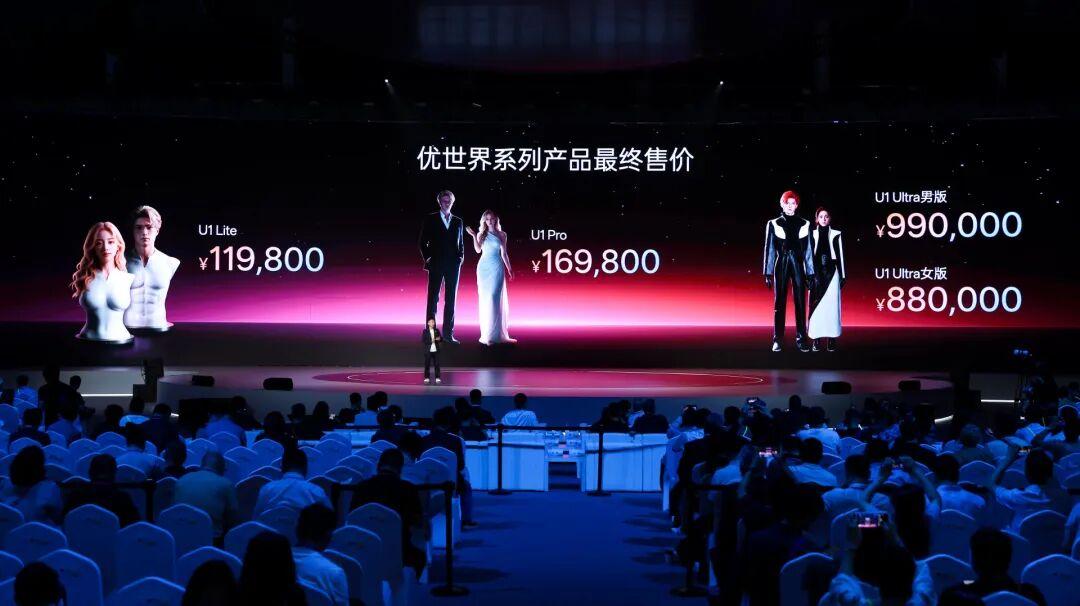
Photo from the launch event of UBTECH's U1 Series robots. Source: Guangzhou Daily
Previously, most mainstream robots on the market were designed for factory operations and stage performances. The sudden emergence of a "cyber companion" with a bionic appearance that can interact, chat, and communicate immediately sparked public curiosity. The news that "990,000-yuan hyper-realistic companion robot is on sale" quickly topped the trending search list.
Pre-sales data is also very impressive. According to official announcements, pre-sale orders for the U1 Series exceeded 13,000 units, with deposits alone surpassing 40 million yuan. UBTECH's total sales of full-size humanoid robots in 2025 were only 1,079 units, meaning the U1 Series' one-month pre-sales volume is about 12 times its annual sales volume of the previous year.
In stark contrast to the booming terminal market, the capital market remains far more reserved. On the day of the launch event, UBTECH's stock price surged more than 18% intraday and closed up 7.48%, only to plummet 9.92% just two trading days later, with a net outflow of main funds reaching 334 million Hong Kong dollars, nearly erasing all previous gains.
UBTECH seems to have secured the first entry ticket to the companion robot market, so why is the capital market not buying into it? Are consumer-grade humanoid robots a real industry trend or a false demand?
UBTECH Returns to Its Roots
UBTECH has stepped one foot into the companion robot track, with fast deployment speed but products that are not yet mature and stable enough.
The newly launched U1 Series is stratified by price and features:
The entry-level Lite model, priced at 119,800 yuan, is a half-body lightweight device that can perform basic interactions such as turning its head, blinking eyes, and holding conversations, positioned primarily for individual companionship and scientific research demonstrations;
The mid-range Pro model, priced at 169,800 yuan, features a full-size build with static interaction capabilities including sitting, lying down, hugging, and displaying subtle micro-expressions, targeting daily emotional companionship;
The top-tier Ultra model, available in male version at 990,000 yuan and female version at 880,000 yuan, supports bipedal walking, dancing, and full-home following, positioned as an entry point for extreme bionic interaction and developer ecosystem. None of the three models are equipped with any household functions such as folding clothes, cooking, or sweeping floors, targeting users including young singles, elderly groups with health care needs, and middle-class consumers willing to pay for emotional value.
With seemingly impractical high prices ranging from hundreds of thousands to nearly a million yuan, UBTECH's confidence comes from two aspects:
First, it has invested heavily in technology. On the software side, it pursues natural interaction: the Resonance-LM emotional large model carried by the U1 can recognize more than 20 types of emotions, and its bionic dual-brain system achieves 500-millisecond intuitive responses and hundred-billion-level reasoning. On the hardware side, it focuses on realistic appearance and movements: 88 degrees of freedom joints, bionic skin, synchronized speech lip movements and micro-expressions have greatly reduced the mechanical feel of the device.
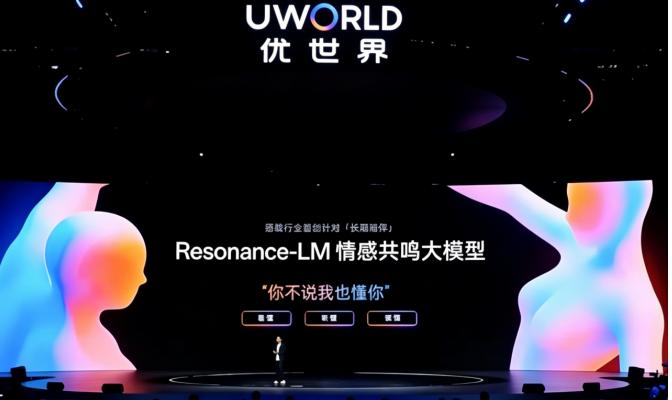
Introduction to the emotional resonance large model at the launch event. Source: ifanr
Second, its confidence comes from its grasp of market prospects. Tan Min, the Chief Brand Officer, asserted at the launch event: "The human-robot companionship economy is the first scenario in human history that features unlimited emotional value, unbounded companionship, and full life-cycle coverage as a rigid demand". He predicted that within ten years, China's hyper-realistic robot market will explode from the current 10-billion-yuan scale to the trillion-yuan level.
A combination of "grand narrative + technological packaging" should have been a powerful strategy, but the gap between the actual product and the brand's depicted vision is far too large.
At the launch event, some buyers pointed out that the product differs greatly from the official rendered images. The appearance has a strong mechanical feel on the face, with obvious flaws visible on the bionic skin upon close inspection. The interaction also has noticeable defects: conversations are laggy and stuttering, walking is unsteady, and overall smoothness is insufficient. Online feedback is even more pointed, with many viewers bluntly stating that "the product fails to match the advertised version". These negative voices surrounding the product are also a key reason for UBTECH's volatile stock performance.
This is not UBTECH's first attempt to enter the consumer market. As the first publicly traded humanoid robot company, it is often regarded as a strong player in the industrial robot field, but in fact, it started its business with smart home robots in its early days.
Founded in 2012, UBTECH entered the market with consumer-grade robots. In 2014, it launched its first smart home robot Alpha Series, and in 2018, it launched the Wukong educational and popular science robot, completing its early technology accumulation and brand building through these products.
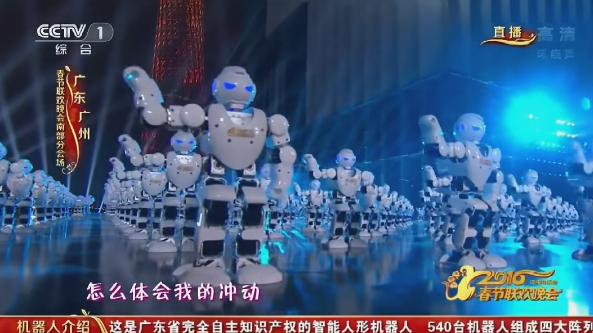
The Alpha Series gained widespread fame through its appearance at the Spring Festival Gala, completing brand building. Source: Tencent News
In 2021, the company shifted its focus to large robots, and its self-developed Walker Series was deployed in batches in industrial scenarios such as smart logistics and automobile manufacturing. Relying on its deep cultivation in the B2B sector, UBTECH successfully listed on the Hong Kong Stock Exchange in 2023.
Currently, UBTECH's total delivery volume of full-size humanoid robots has exceeded 1,000 units, 80% of which are applied in industrial scenarios.
This achievement proves that the B2B business model has been validated. So why did UBTECH turn around and plunge into the companion robot track?
Financial pressure is the primary reason. From 2022 to 2025, UBTECH's total revenue exceeded 5.3 billion yuan, but its cumulative net loss reached as high as 4.2 billion yuan. Under continuous losses, the company urgently needs new growth drivers to stabilize its operations. Some institutional estimates show that if the current pre-sales volume of the U1 Series is delivered smoothly, UBTECH is expected to significantly reduce its losses and even approach the break-even point.
Making money is only an immediate goal, while the bigger plan lies in the ecosystem. Founder Zhou Jian has repeatedly stated that UBTECH's goal is to develop the "brain" and build an ecosystem. In his view, hardware revenue is a one-time gain, but ecosystem revenue can be sustained, with profit margins far exceeding those of hardware itself. Home companion robots are the track with the most imagination and the greatest potential to build an ecosystem, and he has clearly decided to invest 50% of the company's energy in this direction.
Changes in the external environment have also pushed UBTECH back to its old business. At this stage, the B2B market is rapidly becoming a red sea, with the industrial humanoid robot track getting increasingly crowded. Unitree, Agibot, and other companies have raised their 2026 shipment targets to tens of thousands of units. With its current scale, UBTECH may struggle to withstand the competitive pressure from these players.
On the other hand, policy support is clearly favorable. This year, eight government departments including the Ministry of Commerce jointly issued a document, including companion robots in the key support scope of national-level consumption promotion policies for the first time, marking a shift from industrial technology support to stimulating domestic consumer demand.
With mounting pressure in the B2B market and the opening of a policy window for the consumer market, UBTECH's shift to home scenarios is almost an inevitable choice.
And its strategic turn is just the beginning. Looking at the entire consumer-grade robot industry, players are deploying far faster and more densely than people imagine.
Humanoid Robots Are Gradually Becoming Accessible to the Masses
Industrial robots sell a "story of efficiency", with clients usually strictly calculating the return on investment. Consumer-grade robots are different: they have certain practical values in specific scenarios and can also deliver emotional value, which perfectly aligns with the booming consumer market trend.
In the past year, China's emotional consumption market has continued to heat up. The current market size has exceeded 2.72 trillion yuan, and it is expected to reach 3.17 trillion yuan in 2026. Countless consumers are willing to pay for companionship, healing, and self-pleasure, collectively supporting a trillion-dollar market.
According to a report from AVIC Securities, more than 18% of young people spend over 2,000 yuan per month on emotional consumption, and 60% of consumers are less price-sensitive to emotional consumption. Emotional value has transformed from a hidden preference into an explicit consumer behavior.
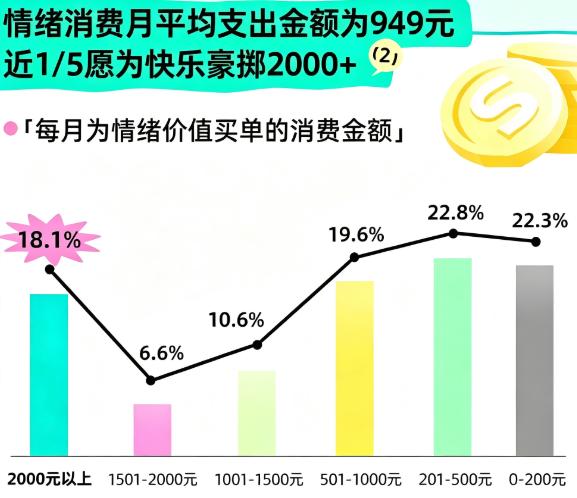
Data source: AVIC Securities
We are currently at a critical moment when the humanoid robot industry is moving from technological breakthroughs to large-scale commercialization. Consumer-grade robots, which combine solid demand foundation and huge imagination space, have become the focus that leading players are competing to occupy.
Since last year, humanoid robots have accelerated their penetration from the B2B market to the consumer market.
Established industry players took the lead. Unitree Technology successively launched two products, the G1 and R1. The former focuses on entertainment and companionship, while the latter targets developers and technology enthusiasts, serving both as a lightweight development platform and an interactive physical pet.
Agibot's new product Lingxi X2 can run, jump, and chat. Its built-in multimodal large model "Silicon-Light Dynamic Language" can demonstrate more than 30 types of micro-expressions, judge emotional states through facial expressions and intonation, and make corresponding responses, with plans to enter family scenarios in the future.
Emerging player First Shape Technology launched two product lines: the Elf Series and the Lan Series. The Elf Series features hyper-realistic humanoid robots capable of emotional mapping, while the Lan Series is suitable for educational companionship and commercial display scenarios.

Product display of First Shape Technology's Elf Series. Source: TMI Technology
Songyan Dynamics launched Bumi, a robot mainly targeting children's educational enlightenment and family companionship, aiming to become a technological medium connecting the emotions of two generations. Fourier Intelligence released the GR-3, which focuses on "warm technological companionship" and serves public scenarios such as health care and companionship for the elderly living alone.
With high-tech products and high-frequency scenarios emerging one after another, professional players are fiercely competing in the front end, rapidly heating up the consumer-grade robot track.
Before the leading players can determine the winner, this boom has soon attracted the cross-border force of automobile manufacturers.
XPeng's IRON robot, which focuses on family companionship and commercial tour guiding, plans to achieve annual sales of over 1 million units by 2030. Tesla's Optimus, targeting home services, aims to be sold to the public in 2027 and become a "standard household device".
Xiaomi's CyberOne focuses on home care and companionship, adapting to the daily needs of dual-income families. Chery's Muyin M1 covers scenarios such as household assistance, elderly health monitoring, and home security patrols, and is now available on e-commerce platforms including JD.com.
Nearly ten mainstream automakers such as GAC Group, Changan Automobile, Li Auto, and BYD have successively entered the market through self-development or investment, adopting the path of "B2B experimentation first, followed by C2C commercial practice". According to incomplete statistics, nearly 20 automakers at home and abroad have poured into the humanoid robot track, officially kicking off the cross-border wave from four-wheeled vehicles to two-legged robots.
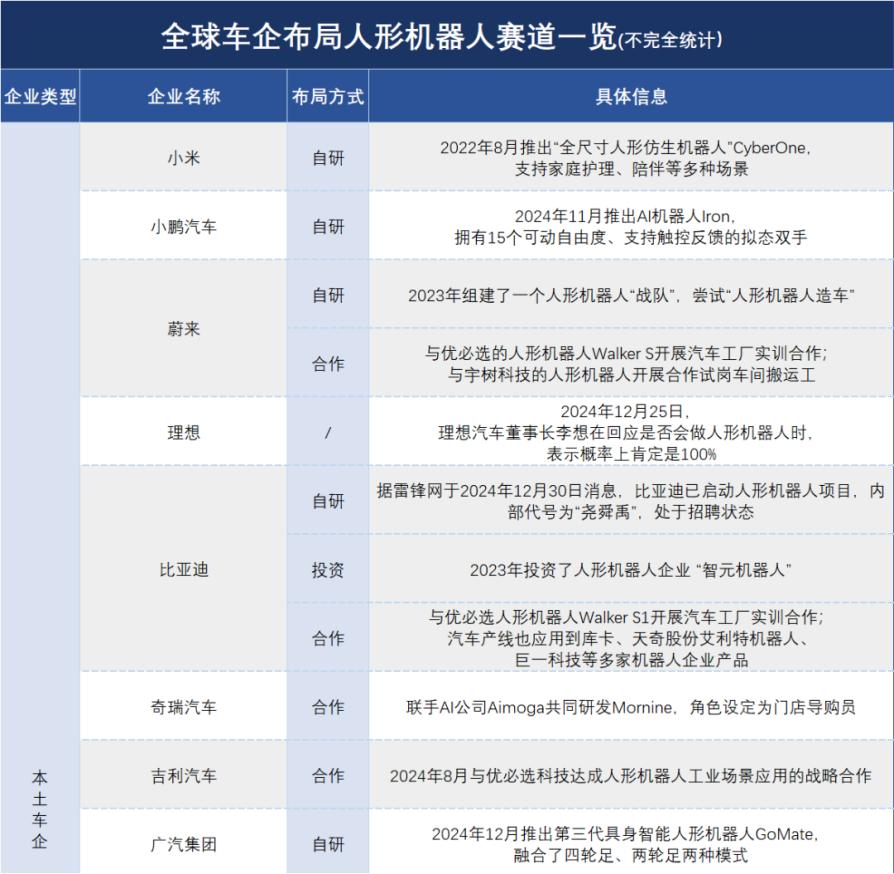
Partial list of global automotive giants deploying humanoid robots. Source: Caijing Magazine
The collective entry of automakers has made the track more crowded and the atmosphere more intense. Professional players who were originally competing on products and technology suddenly find themselves facing a group of rivals with more abundant capital and more mature supply chains, and the pressure to get ahead is growing rapidly.
At this point, the winning rule has emerged: "Whoever wins over C-end users first will take the initiative in the next round of financing and valuation". As a result, the industry battlefield has shifted from technological competition to price competition, with leading players taking the lead in launching price cuts.
Unitree G1 was reduced from 99,00