The oil prices have fallen back, but the global energy logic has been rewritten.
On June 25, Brent crude oil futures, one of the international crude oil benchmarks, once fell to around $72 per barrel, lower than the closing price on February 27 before the US-Iran conflict. The US West Texas Intermediate (WTI) crude oil futures also once dropped to $68, approaching the level before the conflict.
On June 17, the United States and Iran signed a memorandum to end the fighting. The expectation of the resumption of supply via the Strait of Hormuz is pushing down crude oil prices.
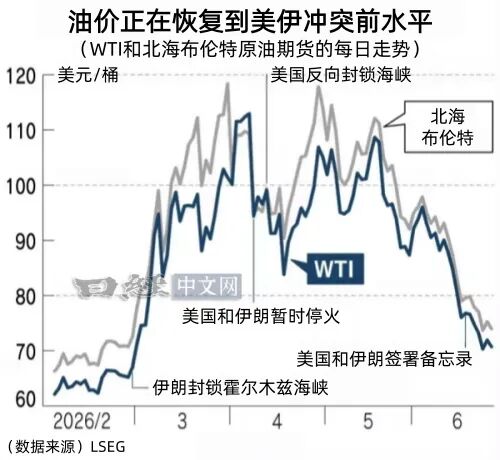
Although oil prices have returned to the level before the conflict, it is difficult to easily restore the market environment and trading trends that have changed due to the conflict. One of them is the "move away from the Middle East" brought about by the diversification of procurement sources.
01
"There may be a discount on Middle Eastern crude oil," said an energy trader based in Singapore. It is reported that the procurement of Middle Eastern oil faces an increase in insurance premiums due to geopolitical risks, and there may be a downward trend compared to the original price.
To avoid risks, the international market is accelerating the reduction of its dependence on Middle Eastern crude oil. The Japanese government expects to achieve 100% procurement of crude oil from regions outside the Strait of Hormuz in July. In 2025, 93% of Japan's imported crude oil still relied on transportation via the Strait of Hormuz. In the medium and long term, Japan will also promote the improvement of refining facilities so that they can process crude oil produced in regions outside the Middle East, such as the United States. India and South Korea are also promoting measures to reduce their excessive dependence on Middle Eastern crude oil.
Large oil companies are also committed to getting rid of the Middle East. ExxonMobil in the United States has accelerated the deep - sea development project in Nigeria, and Shell in the United Kingdom has decided to acquire a Canadian oil and gas company.
The spot price of Dubai crude oil fell to $65 per barrel on June 25, hitting the lowest level since early February. It has fallen faster than Brent and WTI futures. Tetsu Yoshida, a commodity analyst at Rakuten Securities Economic Research Institute in Japan, pointed out that "as a unique downward pressure on Dubai crude oil, the factor of moving away from the Middle East may have been realized in the future."
If the geopolitical risks intensify and lead to an increase in procurement costs, the incentive mechanism for actively purchasing Middle Eastern crude oil itself may be shaken, and it will turn into a situation of "although there is a supply, but won't buy if it's not cheap."
There has also been a trend of "breaking away from the Organization of the Petroleum Exporting Countries (OPEC)". OPEC sets production quotas for each member country and carefully adjusts the production quotas according to supply and demand and prices, playing the role of a "supply - demand adjuster".
On June 25, it was reported that the United Arab Emirates (UAE), which had objections to the production quota restrictions, withdrew from OPEC in May, and Iraq was also considering withdrawing. If Iraq withdraws, the share of OPEC+ in the world's oil supply will drop from 48% in 2025 to 40%, reaching the lowest level in history.
After the conflict, Iran has demonstrated its ability to actually control the Strait of Hormuz by interfering with ship navigation and levying passage fees. It also implies the possibility of joint management with Oman, the country on the opposite shore, in the future. In the future, the concern that Iran will manipulate prices by turning on and off the "tap" of global crude oil supply still remains.
At the same time, the trend of reducing dependence on oil continues. Affected by factors such as the cancellation of subsidies by the Trump administration, the popularization of pure electric vehicles (EVs) once slowed down. However, as oil prices rise, consumers are starting to switch from fuel - powered vehicles to electric vehicles.
02
In the financial market, which has been paying close attention to oil prices, there is also an atmosphere that the environment before the conflict will not return.
Previously, the market generally believed that until February, the Federal Reserve's monetary policy would still be adjusted in the direction of easing, and there would be 1 to 2 interest rate cuts within the year. However, affected by the rise in oil prices pushing up the US inflation expectations, the market expectations quickly reversed, and began to bet that the Federal Reserve would restart interest rate hikes. Although there are still differences in the number of interest rate hikes, the expectation of an interest rate cut within the year has basically disappeared.
Even if oil prices fall, the global economic and financial situation is difficult to return to the state before the conflict. The impact of the military conflict is so huge.
This article is from the WeChat official account "Nikkei Chinese Net" (ID: rijingzhongwenwang), author: Nikkei Chinese Net, published by 36Kr with authorization.