The beauty sector records its first negative growth during the 618 shopping festival, marking the start of a bubble-deflation process
56.1 billion yuan. This is the scorecard of the beauty industry in this year's 618 mid - year shopping festival. If we count from the first 618 in 2008, the 618 mid - year shopping festival has been around for 18 years and has officially entered the mature stage.
The "2026 618 Full - network Sales Data Interpretation Report" recently released by Xingtu Data shows that during the promotion period from May 13th to June 18th, 2026, the cumulative sales of the full - network e - commerce reached 934 billion yuan, a year - on - year increase of 4.0%.
While the overall market showed a slight increase, the beauty track experienced a decline. Data shows that the total sales of the beauty and skincare category reached 42.5 billion yuan, a year - on - year decrease of 1.62%; the sales of perfume and makeup reached 13.6 billion yuan, a year - on - year decrease of 4.9%. The combined sales of the two categories totaled 56.1 billion yuan, a year - on - year decrease of 2.43%.
The decline in the figures is not surprising. What really deserves to be questioned is: What is happening in the beauty 618?
With a 4% slight increase in the full - network sales, why did the beauty industry "decline against the trend"?
Let's first look at the overall situation. The "2026 618 Full - network Sales Data Interpretation Report" by Xingtu Data shows that during the promotion period from May 13th to June 18th, the cumulative sales of the full - network e - commerce reached 934 billion yuan, a year - on - year increase of 4.0%, and the growth rate has significantly narrowed compared with previous years.
The independent monitoring data from the Fudan Consumer Big Data Laboratory cross - validates this. It estimates that the year - on - year growth of the full - network retail sales during this year's 618 is about 3.2%, also pointing to the overall trend of the slowdown in the growth of the overall market. The slight differences between the data of the two institutions are mainly due to different statistical calibers, but they jointly confirm a core conclusion: China's e - commerce industry has fully entered a new stage of stock competition from the incremental expansion stage.
Analysys pointed out in the "2026 '618' Full - cycle Observation of the Shopping Festival" that the underlying logic of this year's shopping festival has undergone a fundamental change: the entire industry has uniformly abandoned the complex rules of combined orders and full - amount discounts and turned to the minimalist approach of "official direct price cuts and single - item immediate price cuts". In essence, the industry is bidding farewell to the extreme price involution, and the focus of operation has shifted from "scaling up" to "improving quality". This change directly reduces the decision - making cost of consumers and also reduces the internal operational consumption of merchants. Although it suppresses the GMV growth rate in the short term, it significantly improves the authenticity of transactions and the quality of profits.
Against the background of a slight overall increase in the market, the beauty category has become one of the consumer tracks with the most obvious growth rate callback. Xingtu Data monitoring shows that in this year's 618 on comprehensive e - commerce platforms, the sales of beauty and skincare products decreased by 1.62% year - on - year, and the sales of perfume and makeup decreased by 4.90% year - on - year. From the perspective of the category structure, the decline of the makeup category is greater than that of the skincare category, reflecting the demand differences under consumption stratification: as a basic and essential category, skincare has stronger consumption resilience; while makeup is more likely to be compressed in an environment where consumption tends to be more cautious.
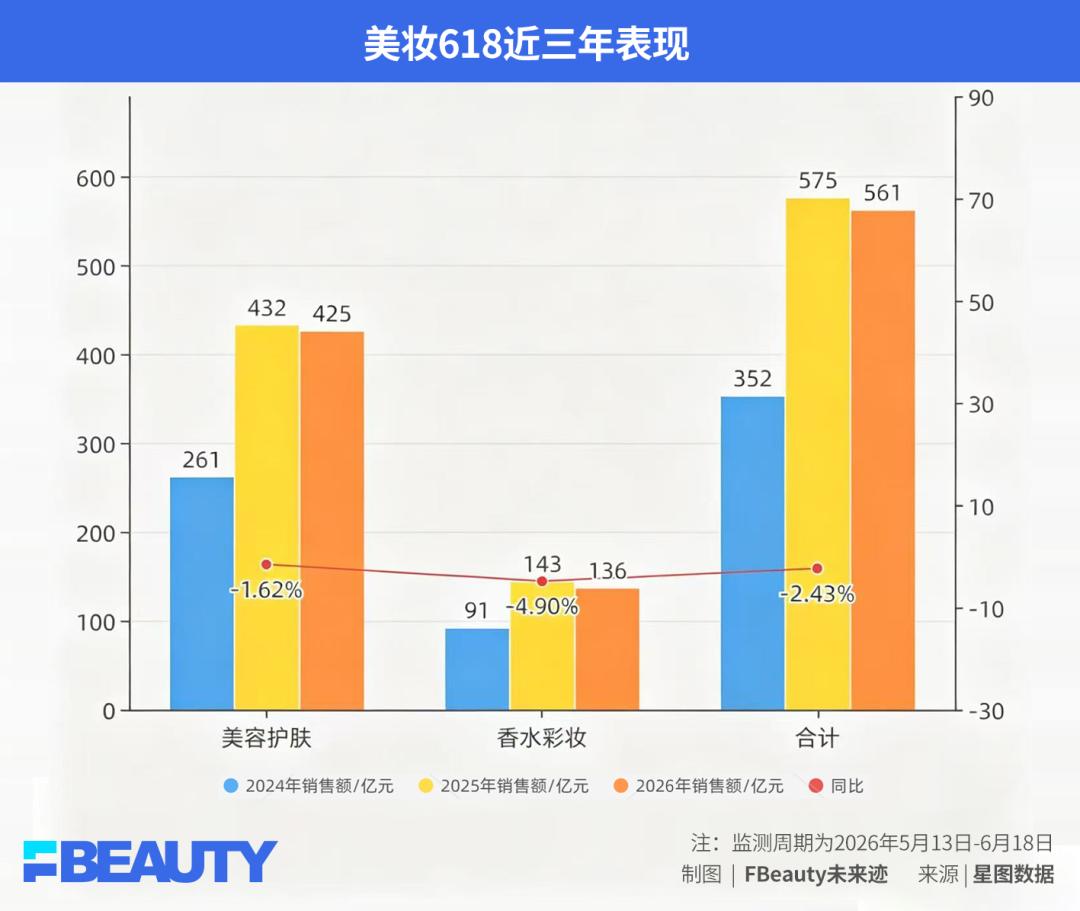
This round of callback is first due to the natural decline caused by the high - base effect. Comparing with the data of the same period in 2025 from Xingtu Data: the sales of beauty and skincare products in that year were 43.2 billion yuan, a year - on - year increase of 65.52%; the sales of perfume and makeup were 14.3 billion yuan, a year - on - year increase of 57.14%, and the combined growth rate exceeded 63%. The high growth in 2025 was largely due to the pent - up demand released by the consumption recovery, the extension of the promotion period (one week longer than in 2024), and the increased platform subsidies, which to some extent over - drew the subsequent consumption potential. The decline in 2026 is a normal mean reversion.
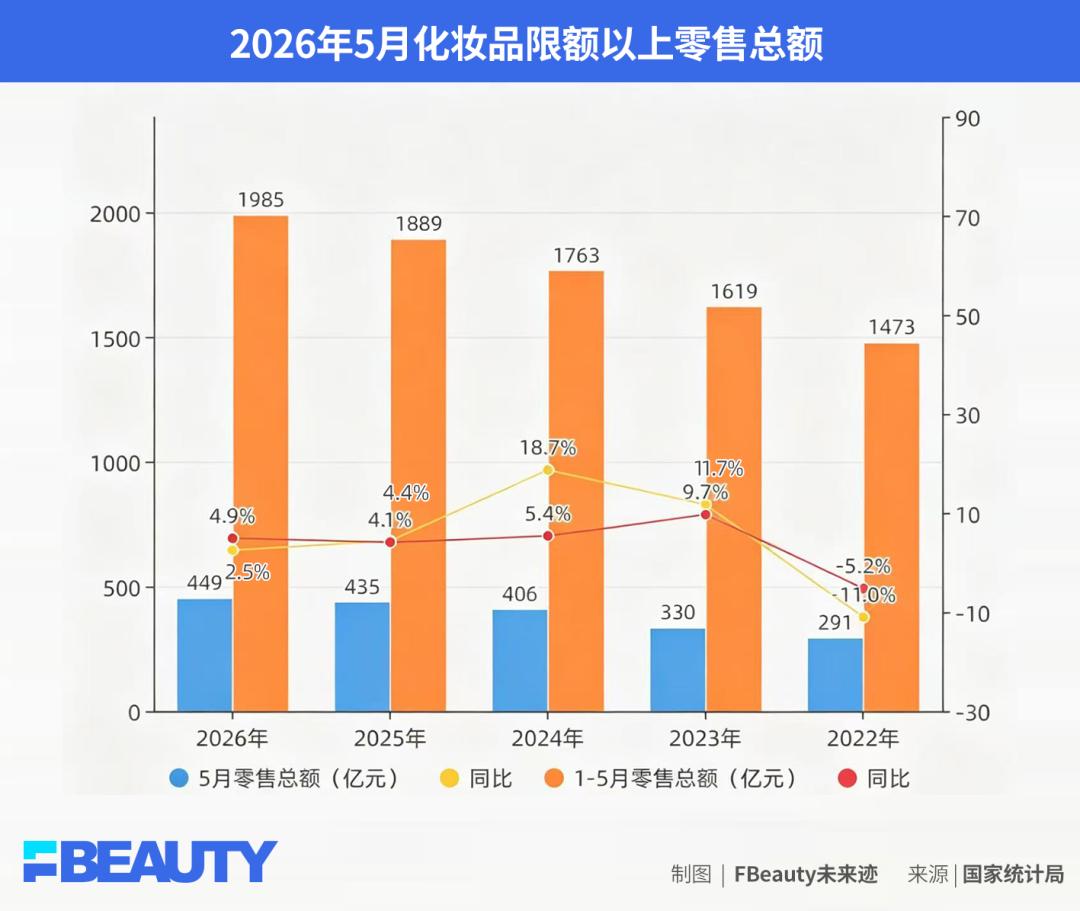
The deeper logic is the speed shift of the entire beauty retail industry. Data from the National Bureau of Statistics shows that the retail sales of cosmetics by units above the designated size in May were 44.9 billion yuan, a year - on - year increase of 2.5%; the cumulative retail sales from January to May were 198.5 billion yuan, a year - on - year increase of 4.9%.
Although major e - commerce platforms have advanced the 618 promotion period significantly in recent years, the year - on - year growth rate of cosmetics retail sales in May this year dropped from 4.4% in the same period last year to 2.5%, and the increase has significantly narrowed. This shows that against the background of the industry fully entering the stock era of medium - and low - speed growth, the explosive effect of the shopping festival naturally weakens.
The rationalization of consumer behavior is another core driving force for the callback. Analysys pointed out that current consumer decision - making has fully shifted from "impulsive hoarding" to "precise satisfaction", and non - essential beauty products bear the brunt. When the gap between the promotion price and the daily price continues to narrow and "low prices every day" become the norm on the platform, consumers no longer hoard skincare and makeup products beyond their needs just to "get discounts", and the "siphon effect" of the shopping festival on consumption continues to weaken.
At the same time, merchants actively abandon the loss - making volume - rushing strategy and reduce the launch of low - price products for attracting traffic, which also pulls down the overall sales to a certain extent, but in return, they get a healthier profit structure and brand assets. Coupled with the "moisture - squeezing" effect brought by the standardization of e - commerce taxation - currently, the comprehensive tax rate of e - commerce generally reaches 8 - 9 percentage points, and the previous model of brushing orders to boost sales is completely unfeasible due to high costs, and the shopping festival data further returns to real consumer demand.
Brand pattern: International high - end brands defend their positions, while domestic brands break through in different tiers
If the beauty 618 in 2025 was a time when domestic brands soared and international brands recovered, then 2026 has entered a new stage where international brands counter - attack and domestic brands differentiate.
International high - end brands: Master local gameplay and continue to release high - end dividends
In the past two years, international beauty brands performed poorly on emerging channels such as Douyin due to problems such as not adapting to the rhythm of live - streaming e - commerce and chaotic price systems. However, the data of this year's 618 shows that leading international groups have completed the make - up of local operation. With their profound brand accumulation and product strength, they have regained the dominance of the high - end market.
Let's first look at the Tmall front. In this year's full - cycle ranking list of Tmall Beauty 618, SkinCeuticals, Estée Lauder, and Proya ranked in the top three. SkinCeuticals rose from the 6th place last year to the 1st place this year, becoming the biggest dark horse. International high - end brands such as Lancôme, SK - II, L'Oréal Paris, LA MER, and Helena Rubinstein firmly occupy the top 10 positions. Overall, international groups still occupy most of the seats among the top 20 brands, and the high - end skincare track continues to release consumption potential.
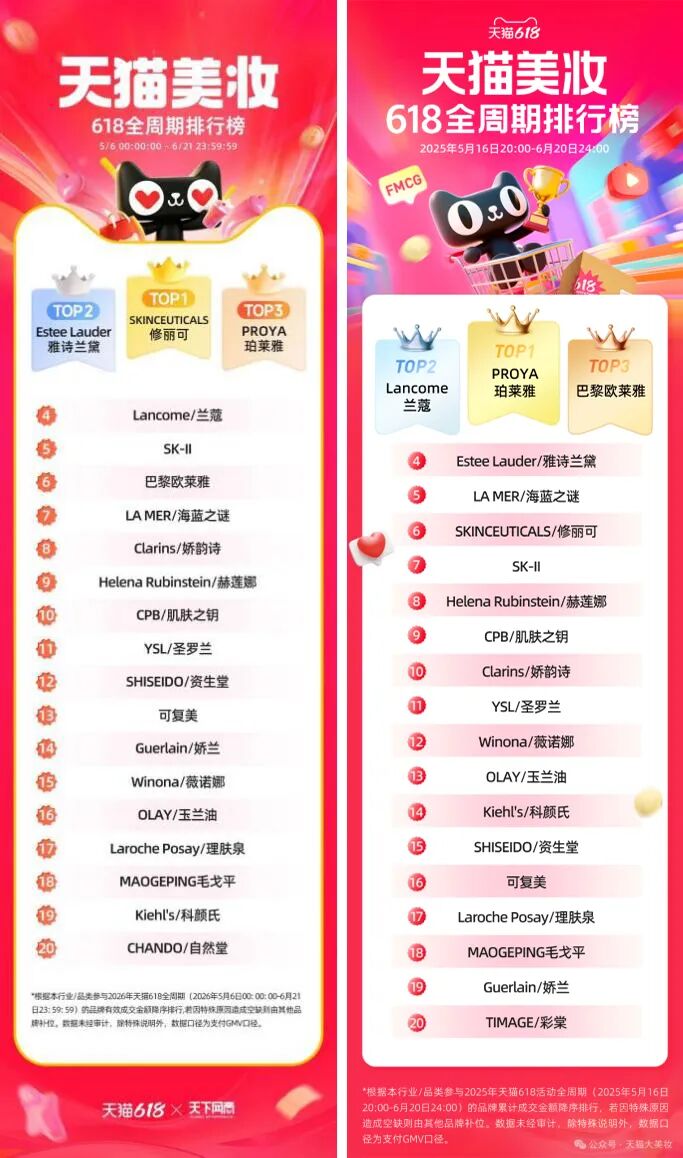
Full - cycle ranking lists of Tmall Beauty 618 in 2025 and 2026
Then look at the JD battlefield. Among the top 10 beauty brands in the sales list of JD 618's opening - day speed - race ranking, international brands occupy all 10 seats. Xingtu Data also shows that among the top 5 sales of the two categories of beauty and skincare and perfume and makeup on JD 618, only Maogeping, a domestic brand, made it onto the list. Foreign brands have obvious advantages in high - unit - price products, gift - giving scenarios, and repeat - purchase blockbuster products.
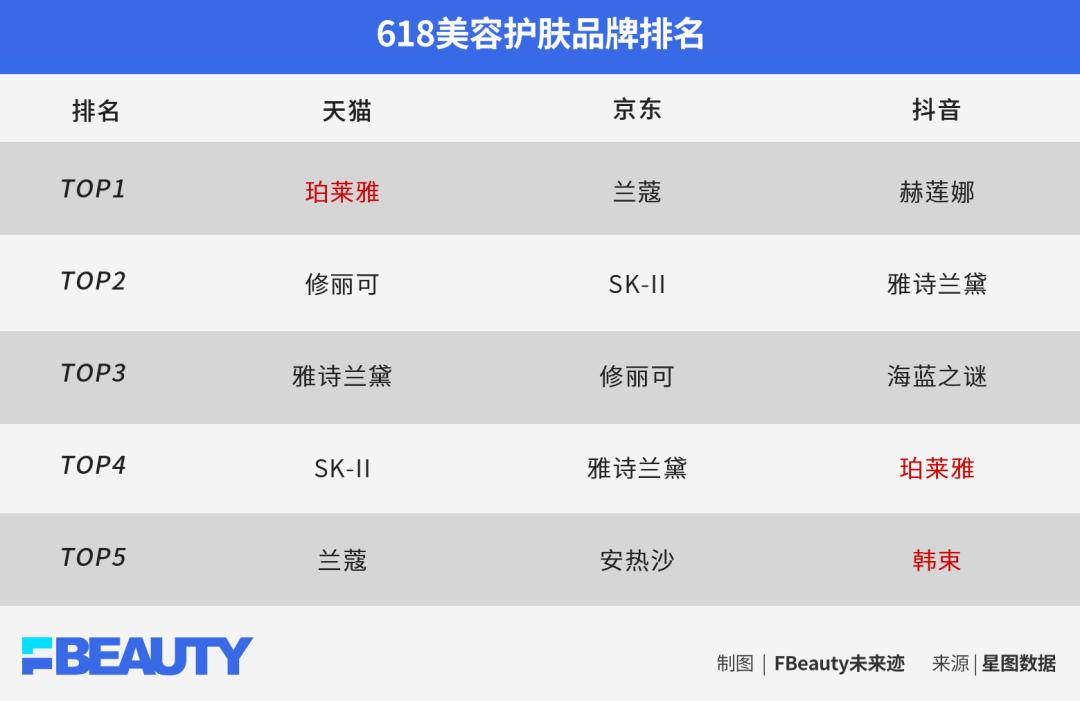
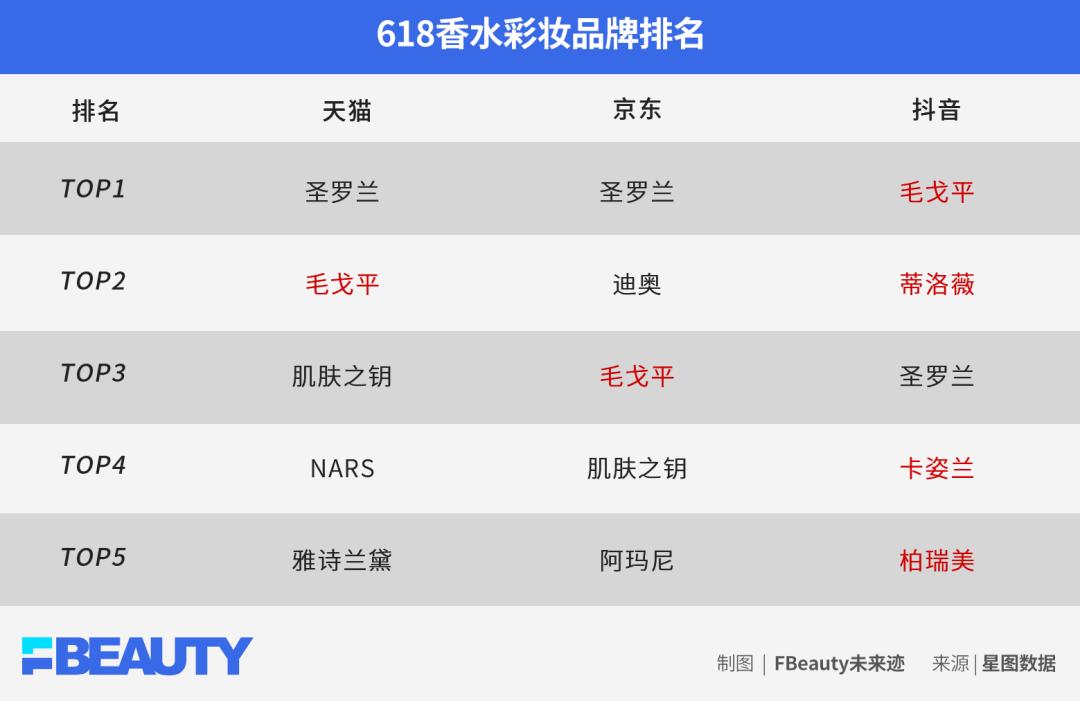
What is most worthy of attention is the change on the Douyin platform. Douyin, which was previously considered a "gathering place" for emerging brands, is now being rapidly "occupied" by international brands. According to the 618 closing battle report released by Douyin e - commerce, the number of international beauty brands whose turnover driven by consumer vouchers exceeded one million yuan increased by 67% year - on - year. Xingtu Data shows that the top three beauty and skincare brands on Douyin are Helena Rubinstein, Estée Lauder, and LA MER.
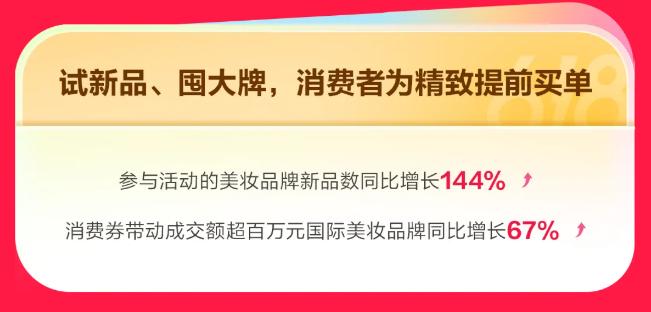
Source: Douyin 618 closing battle report
Why can international high - end brands make a strong comeback on Douyin? The core lies in the maturity of the dual - path collaborative model of "influencer matrix + brand self - live - streaming". Leading foreign brands have built a relatively balanced operation structure. Coupled with the long - term accumulated brand awareness, they have more advantages in competing for traffic during the shopping festival.
Domestic beauty brands: The leading brands are stable, and dark horses emerge frequently
Although the "offensive momentum" of domestic brands is not as obvious as in previous years, the strength of the leading brands remains stable. According to Xingtu Data, Proya has won the first place in the sales of Tmall beauty and skincare brands for three consecutive years and also ranks among the leading brands on multiple platforms such as Douyin.
As a representative of domestic high - end makeup brands, Maogeping has successfully surpassed a series of international brands and become one of the top two in the perfume and makeup categories on the three major platforms of Tmall, JD, and Douyin.
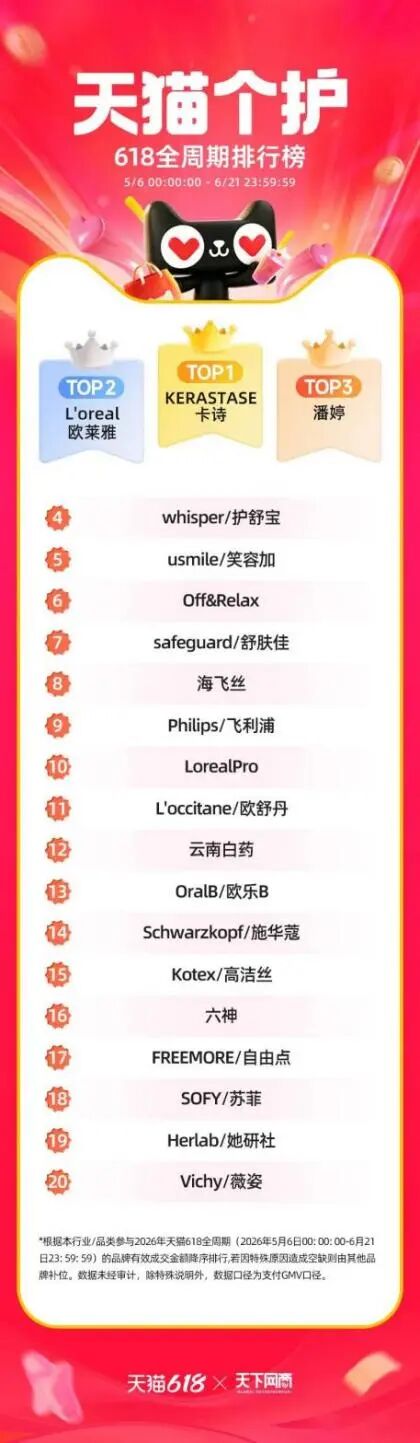
It is worth noting that among the top five in the sales of the makeup and perfume category on the Douyin platform, only Saint Laurent, an international beauty brand, is short - listed, ranking third. In the full - cycle ranking list of Tmall personal care products during the 618, domestic brands such as usmile and off&relax can also be seen.
Incremental growth also emerged in the segmented and emerging tracks. A group of domestic brands with clear positioning have achieved counter - trend growth through in - depth operation in vertical tracks. For example, Fan Beauty Diary's GMV on the Tmall platform increased by 78.77% year - on - year, ranking 6th in the full - cycle ranking list of Tmall domestic beauty brands during the 618. Its GMV on the Douyin platform increased by 47.27% year - on - year, and it also ranked 9th in the "mask transaction list" of JD Beauty 618.
This also confirms that in a stock competition environment, differentiated positioning and precise population operation are still the core paths for domestic brands to break the situation.
Debubbling, and the 618 is being redefined
On the one hand, the overall sales have declined; on the other hand, international high - end brands have regained their voice, and leading domestic brands continue to hold their ground. The previous growth model that relied on extending the promotion period, platform subsidies, low - price hoarding, and influencer - driven volume to boost GMV is being systematically rewritten. "FBeauty Future Track" found that there are four specific changes in this debubbled beauty 618.
Change 1: The business goal has shifted from "scaling up" to "improving quality"
During this year's 618, the beauty industry is returning to the actuarial business of brand power and repurchase rate. The shopping festival is no longer just a window for boosting sales volume, but a mid - year exam to test the digital customer acquisition ability, user asset precipitation, and compliance operation level.
This debubbling has a profound industry background. In the past beauty live - streaming e - commerce, it was normal for influencers' commissions to account for 30% - 50% of the brand's sales. What's more fatal is that "once the traffic investment stops, the transactions disappear", and users cannot be precipitated as brand assets at all. When "having scale but no profit" becomes a common dilemma for merchants, the industry has to rethink the meaning of the shopping festival.
Among the limited information released by the platforms this year, two indicators are the most significant as a weather vane: One is the data from the first stage of Tmall 618, which shows that the repurchase rate of beauty products during this year's 618 exceeded 40%, the number of new product launches increased by 33% year - on - year, and the number of new products with sales exceeding ten million increased by 60%; the other is that Douyin revealed in its 618 closing battle report that the number of new products of beauty brands participating in the event increased by 144% year - on - year.
Repurchase means that the shopping