The Disappearing Senior Executives
Recently, I read a news article that really shocked me.
Satya Nadella, the CEO of Microsoft, directly dissolved the Senior Leadership Team (SLT). This power center, which had been operating for decades with dozens of senior executives reporting directly to the CEO, just disappeared.
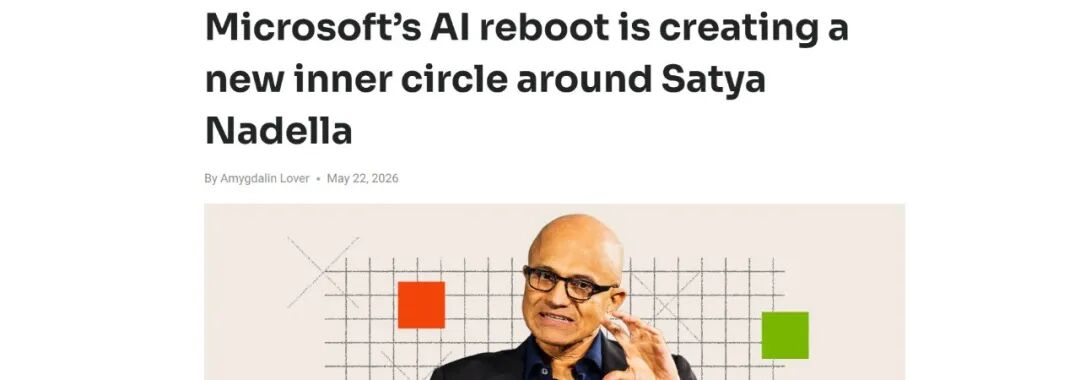
In its place, there are two new teams:
One is the Corporate leadership team, consisting of only five people: him, the president, the CFO, the CHO, and the CEO of the business division. These five people are in charge of the company's overall operations and governance and hold weekly meetings.
The other is the engineering team, with a total of 35 people, including engineers, product leaders, and researchers. These people don't report through multiple layers of leadership but sit together and work like a startup.
In addition, he specifically formed a three - person group to manage Copilot and personally reviews the AI indicators every week.
This is really radical. Previously, we thought that with the advent of AI, middle - level management might disappear. But now it seems that the wave of organizational flattening driven by AI is hitting the old power structure at an unprecedented speed.
In the future, a large number of senior executives are being quietly "phased out" by the times.
01
The value of senior executives is weakening
Many companies develop rapidly and have strong combat capabilities when they are small. However, when the company grows and the number of senior executives increases, they become slow, bloated, and inefficient.
Why? Because as the organization expands, the number of senior managers increases, but their value decreases.
In the AI era, this trend will be accelerated to the extreme.
First, the organizational form is changing from a "pyramid" to a "flat" structure.
The traditional organizational form is a pyramid. At the top is the CEO, followed by CXOs, then directors, managers, and supervisors, and at the bottom are front - line employees. Information is passed down layer by layer from the top, and decisions are made at the top and passed down to the bottom.
The core assumption of this structure is: Senior executives have more information and stronger decision - making abilities, so they are needed to "transmit information up and down."
However, in the AI era, the organization is moving from a "pyramid" to a flat structure. In this structure, information is transparent, decisions are distributed, and value is directly created.
Those senior executives who only play the role of "information transfer" will lose their reason for existence.
Second, the information advantage is being completely replaced by AI.
What was the biggest advantage of traditional senior managers in the past? It was the information advantage. They knew the company's strategic direction earlier than front - line employees and were more aware of the industry trends. This information asymmetry formed the basis of their power.
But now, AI can capture, analyze, and summarize massive amounts of information in real - time and generate insightful reports at an extremely fast speed.
For example, if a CEO wants to know the latest developments of competitors, he doesn't need to wait for the weekly report from the marketing director. He can just ask AI.
When information becomes transparent, instant, and low - cost, those senior executives who rely on "information gaps" to make a living will lose their footing.
Third, the value of experience is being diluted by data.
In the past, another core value of senior executives was "experience." They had been in the industry for decades, accumulating a large amount of experience and intuition. This experience was something that young employees didn't have and was indispensable to the enterprise.
However, the emergence of AI is changing all this. AI can learn human experience of several decades in a few minutes and make more accurate judgments through data analysis.
When the value of experience is diluted, those senior executives who only "live on their past achievements" face the risk of being replaced.
02
Which senior executives will be eliminated?
Does it mean that senior executives will completely disappear?
I don't think so.
Those who are really at risk of being eliminated are the pseudo - senior executives with fixed roles and single - value.
They have three prominent characteristics.
Characteristic 1: Loudspeaker - type executives without independent thinking.
They just follow what the boss says without their own thinking. They translate the instructions from above to the subordinates and report the situation from below to the superiors. They don't create value but are just information carriers.
If the boss says the strategy this year is to go all - in on online business, they will just convey the boss's words to their subordinates without any change.
As for how to break it down and how to implement it, they don't know. They just say, "It's the boss's requirement." When they need to make a decision, they dare not take the initiative and always say, "I'll ask the boss again."
If they are just loudspeakers, AI can easily replace them, and with higher efficiency.
Characteristic 2: Bureaucratic - type executives who don't get involved in the business.
The typical characteristics of this type of executives are: being detached from the front - line and far from the business. They sit in spacious offices, look at reports, listen to briefings, and then give various "instructions."
They don't know the actual situation at the front - line and don't understand the real needs of customers. Their focus is inward rather than outward. They spend all day thinking about how to manage people, how to set up processes, and how to formulate systems.
This type of executives is the biggest killer of organizational efficiency. The processes they formulate often make front - line employees suffer. The decisions they make are often out of touch with the market. They consume a large amount of organizational resources but don't create any actual value.
In the AI era, the organization will become more and more transparent and agile. Those executives who don't get involved in the business and don't understand the business details will have nowhere to hide. Because data and results speak for themselves. What you have done and what you haven't done are clear at a glance.
The boss will increasingly clearly see: who is really creating value and who is just muddling through.
Characteristic 3: Conservative and stubborn experience - based executives.
In this era, experience is rapidly depreciating. The experience accumulated in the past twenty years may have completely lost its effectiveness today.
And those young people who are willing to embrace change and learn new tools are achieving far more than them with the help of AI.
So, if a senior executive clings to old experience, refuses to evolve, and refuses to embrace change, he will become the biggest obstacle to the organization's progress. They use the mindset of the industrial era to manage a company in the intelligent era.
What's even more terrible is that he is still directing a group of front - line employees who use AI to work. This is a disaster.
After the arrival of the AI era, these pseudo - senior executives will become a thorn in the boss's side. Because they receive the highest salaries, enjoy the best benefits, and occupy the most resources. They have the highest costs but don't create value.
The annual salary of a vice - president may be one million, but the things he does every day can be done by AI for just a few hundred dollars. The boss is not stupid and can calculate this account clearly.
03
Which senior executives will not be eliminated?
AI will eliminate pseudo - senior executives but not real senior executives. So, which senior executives can survive and thrive?
1. Have the boss mindset
What is the boss mindset? It means regarding yourself as the owner of the company rather than an employee.
Senior executives with the boss mindset will actively think about the company's strategic direction, actively look for business growth points, and actively solve problems that are "out of their scope of responsibility." They don't wait for the boss's instructions but find problems, propose solutions, and promote implementation on their own.
AI can't replace this kind of person. AI can give 100 suggestions, but it won't lose sleep because of a wrong judgment, and it won't be anxious about the company's survival. It only focuses on output, not on taking responsibility.
And the value of senior executives lies precisely in "taking responsibility": daring to make choices in uncertainty and daring to bear all the consequences of their choices.
AI can never be responsible for the results, but real managers can.
2. Have high cognitive ability and judgment
In the AI era, information is no longer a scarce resource, but "judgment" still is.
Because in the real business world, many problems often don't have standard answers. When should you take risks? When should you be conservative? When should you adhere to principles? When should you be flexible? These all depend on human judgment.
Senior executives with high cognitive ability can grasp the essence in complex information, make correct decisions in uncertainty, and point out the direction when others are confused. This ability can't be easily replicated by AI.
Because AI's "judgment" is based on the induction and reasoning of historical data, while human judgment can be based on intuition, values, and foresight of the future.
Especially when facing new and unprecedented situations, human judgment is still irreplaceable.
3. Have good character and be capable of doing things
This statement sounds simple, but it is the ultimate moat.
Having good character means you are trustworthy. In the AI era, the value of trust will only increase. When AI can complete most of the work, the trust, cooperation, and tacit understanding between people become even more precious.
Being capable of doing things means you can not only direct others but also do things yourself. In the AI era, what is needed is not senior executives who only "talk the talk" but "all - around players" who can both formulate strategies and fight on the front - line.
When the team encounters difficulties, you can roll up your sleeves and work together; when AI can't solve the problem, you can step in and solve it yourself.
The boss won't want to let go of such a person, and AI can't replace them.
Finally, I want to say: This is the worst of times and the best of times. AI is like a magic mirror that eliminates those who muddle through and gives opportunities to those with real abilities to stand out.
The times won't say goodbye when they abandon you, but they will also be equally generous when they reward you.
May we all be the ones rewarded by the times.
This article is from the WeChat official account "Zhang Lijun", written by Zhang Lijun, and is published by 36Kr with authorization.