Exposing the details of DeepSeek's financing: How Liang Wenfeng maintains control
The biggest news in the AI circle in the past two days is that DeepSeek's first - round financing has finally been finalized.
50 billion RMB, 7.4 billion US dollars, with a valuation exceeding 50 billion US dollars. This is the largest single - round financing in the Chinese AI industry to date.
Among them, Tencent invested 10 billion, CATL 5 billion, JD.com and IDG 3 billion each, and the National AI Fund made a direct investment of 1 billion... The figures are huge, the shareholders are powerful, and it's quite impressive.
The really exciting part of DeepSeek's this - round financing is how Liang Wenfeng still firmly holds the steering wheel of the company after presenting this capital feast of 50 billion.
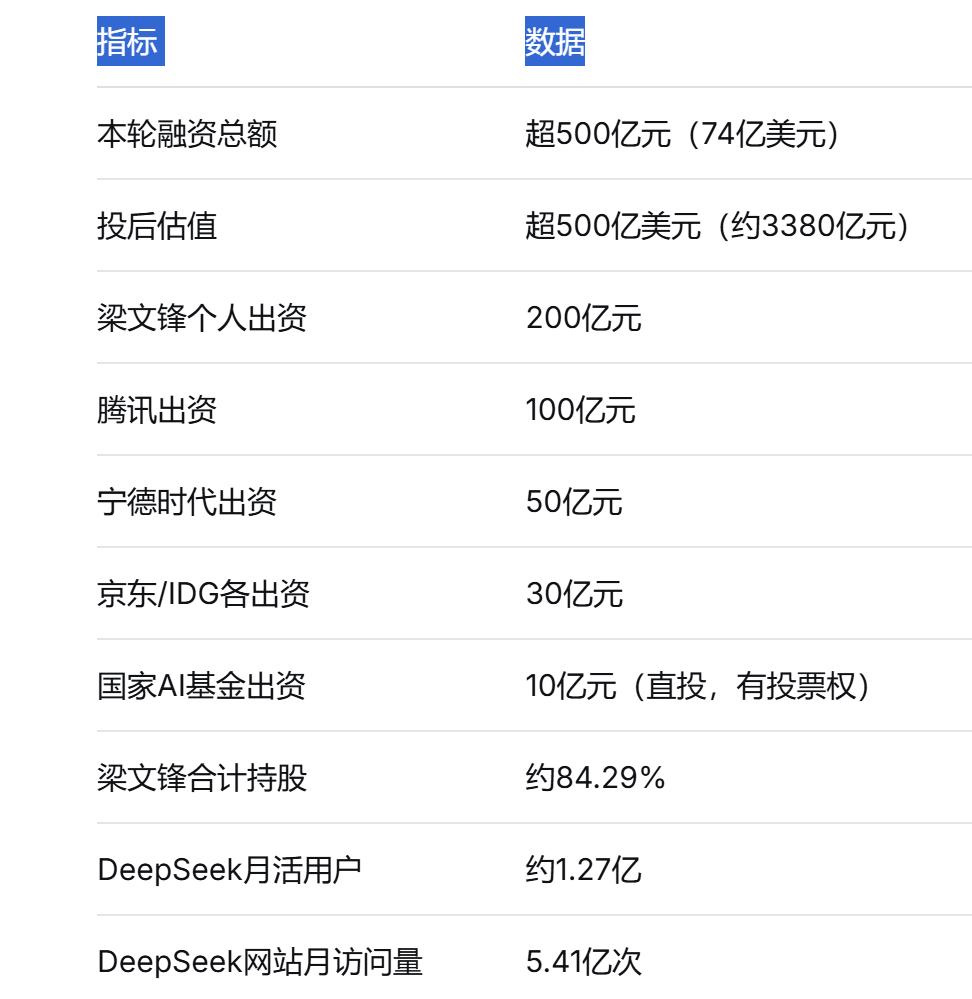
Data source: Public query, compiled by the junior sister of the investment banking circle
Liang Wenfeng's "unconventional operations"
Let's first briefly review the framework of this - round financing.
On June 16th, according to The Information, DeepSeek completed its first external financing, raising over 50 billion RMB.
Liang Wenfeng personally invested 20 billion, making him the largest investor; Tencent invested 10 billion, CATL 5 billion, and JD.com and IDG 3 billion each. The valuation exceeded 50 billion US dollars.
If it were just these, it would just be another "big AI financing news". But the trick DeepSeek played this time lies in the transaction structure, a textbook - level control defense strategy.
Liang Wenfeng's carefully - laid "triple insurance".
The special feature of this - round financing is not the amount, but how the money comes in, how the rights are divided, and how the investors exit.
The money doesn't go directly into the company but first into the "pocket" managed by Liang Wenfeng. Reports say that except for the National AI Fund, other external investors are required to inject funds into a limited partnership managed by Liang Wenfeng, rather than directly investing in DeepSeek itself.
In plain language: The money you invest doesn't directly buy equity in DeepSeek but goes into a "fund pool" controlled by Liang Wenfeng. This pool is then connected to the company in some way, but voting rights - sorry, you don't have any.
External investors get economic rights, the right to participate in future financing preferentially, and higher - level financial information. But how the company develops, how the strategy is set, and which technical route is chosen - it has nothing to do with you.
A five - year lock - up period, don't expect to make quick money. This - round financing also has a five - year lock - up period. During these five years, most investors cannot sell their shares.
Five years. In the impetuous AI track where "going public in three years and retiring in five years" is the norm, a five - year lock - up period basically cuts off the idea of short - term arbitrage. DeepSeek's logic is clear: It doesn't welcome capital that wants to make quick money, only funds that are willing to accompany the company in the long run.
Liang Wenfeng's team also requires verification of the real identities of the limited partners behind all the investment funds to avoid the risk of the equity ultimately flowing into the hands of unknown entities. They will check clearly who you are and where your money comes from.
The National AI Fund is an exception, the only "exception". The most special part of the whole transaction is the National Artificial Intelligence Industry Investment Fund, which directly invests 1 billion in DeepSeek, is not subject to the five - year lock - up period, and has voting rights in the company.
Other external funds are placed in a limited partnership structure, while the National AI Fund directly enters the company's equity layer. This arrangement not only shows DeepSeek's extreme caution about control but also indicates that this company's position in the Chinese AI industry system is no longer just an ordinary startup.
With the triple insurance in place, Liang Wenfeng has implemented the principle of "you can give money, but you can't have a say" to the extreme.
The author believes that this is not a coincidence but a carefully - designed "control battle" by Liang Wenfeng's team.
Why does Liang Wenfeng go to such great lengths?
The answer lies in DeepSeek's genes.
This company was founded in 2023 and originally came from the AI team under Liang Wenfeng's quantitative fund, Magic Square. Before the R1 model became popular in early 2025, DeepSeek had never carried out external financing and had not introduced venture capital like most large - model startups.
It is more like a research - oriented model laboratory: a small team, less external pressure, and an emphasis on open - source and model efficiency.
For nearly three years, DeepSeek adhered to the principle of zero external equity financing. The costs of R & D, computing power procurement, and talent salaries were all fully borne by the self - operating income of its parent company, Magic Square Quantitative.
At its peak, Magic Square Quantitative's asset management scale exceeded 70 billion. In 2025, the average return rate of its products reached 56.55%. The stable cash flow continuously supported DeepSeek's construction of super - computing clusters and investment in large - model pre - training.
In other words, DeepSeek has never been a company that survived by VC blood transfusion. Its underlying logic is "endogenous hematopoiesis", not "external ripening".
However, large - model R & D continuously consumes computing power, and the competition for top researchers is getting more and more expensive.
The Information reported that DeepSeek has lost some core researchers: Luo Fuli, an important contributor to V3, joined Xiaomi; another researcher, Guo Daya, who participated in the previous model R & D, also joined ByteDance with a higher salary.
According to public information statistics, at least 5 core R & D personnel have left successively, covering four core technology lines: base model, reasoning, OCR, and multi - modality.
Financing is an inevitable choice. But Liang Wenfeng's choice is to finance but control.
He had laid the groundwork before the financing. On April 27th, DeepSeek's registered capital increased from 10 million to 15 million. Liang Wenfeng's direct shareholding ratio increased from 1% to 34%, and he held about 84.29% of the equity through direct and indirect means.
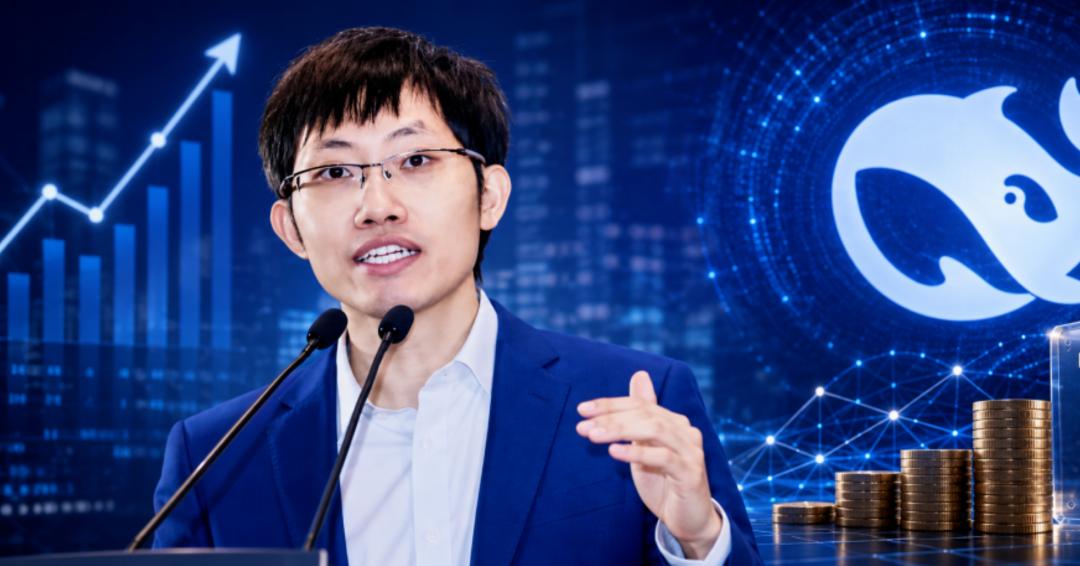
Before the financing even started, the "firewall" for control had been built.
Now that the money is in hand, where to spend it?
With 50 billion in the bag, the use of this funds and DeepSeek's strategic direction are also highly concerned.
Two keywords: infrastructure and productization.
Infrastructure: From renting computer rooms to building self - owned data centers. Recruitment information shows that DeepSeek is recruiting at the Wulanchabu Intelligent Computing Center in Inner Mongolia and has newly set up the position of "IDC Design and Planning Engineer" to be responsible for the planning and construction of ultra - large - scale intelligent computing centers from MW to GW level. This indicates that it is shifting from renting computer rooms to building self - owned data centers.
This is a clear signal: DeepSeek is not satisfied with being just a "model company"; it wants to become the owner of AI infrastructure. Building a self - owned intelligent computing center means lower long - term computing power costs, higher scheduling efficiency, and absolute control over core resources.
Productization: From models to Agents. At the product level, DeepSeek is forming an "Agent Harness" team led by senior researcher Chen Deli, with the goal of creating DeepSeek Code Harness to compete with Anthropic's Claude Code.
Recruitment information shows that DeepSeek is transforming the capabilities of cutting - edge models into Agent products, and all work outside the model is classified into the Harness category.
The core path is defined as "Model + Harness = Agent", and all engineering actions outside the model, such as context management, tool invocation, file reading and writing, and terminal execution, are all classified into the Harness category.
Rather than just a routine team expansion, this is the first organizational signal of DeepSeek's strategic shift from a "model company" to a "product company".
Claude Code has turned AI Coding into a business with an annual revenue of over 2.5 billion US dollars. The weekly active users of OpenAI's Codex increased from 3 million to 4 million in 15 days.
DeepSeek obviously doesn't want to fall behind in this track.
Industry changes
Looking at the competitive aspect, DeepSeek's rise is reshaping the global competition pattern of large AI models.
In terms of call volume, according to OpenRouter data, DeepSeek - V4 - Flash has ranked first globally for three consecutive weeks, with a weekly call volume of 3.69 trillion Tokens. Among the top five globally in call volume, the top four are all Chinese large AI models. The weekly call volume of Chinese large models has exceeded that of the US for six consecutive weeks and has firmly ranked first globally.
In terms of price, DeepSeek has taken a completely different path from its peers.
Against the background of the entire industry raising prices to save itself, Zhipu has raised its API price three times this year, with a rise of over 30% each time; the enterprise version of Tencent Cloud CodeBuddy has increased by 154%; the computing power products of Alibaba Cloud have increased in price by 5% to 34%, while DeepSeek has announced a permanent 75% price cut for V4 - Pro. The price of 0.025 yuan per million Tokens in the cache - hit state is about 1/14960 of the long - context version of GPT - 5.5.
In terms of user scale, according to QuestMobile data, as of March 2026, DeepSeek's monthly active users were about 127 million, ranking third in the industry. In May, the monthly website visits reached 541 million, a month - on - month increase of 11.22%, ranking first in China and fifth globally.
On one hand, the industry is collectively raising prices, while on the other hand, DeepSeek is cutting prices against the trend.
On one hand, the call volume of overseas giants is declining, while on the other hand, Chinese models are continuously leading. DeepSeek is redefining the competition rules of large AI models with a combination of "extreme cost - effectiveness + open - source ecosystem".

Liang Wenfeng sets an example for science and technology innovation enterprises
The most interesting part of this - round financing is not the figure of 50 billion, but Liang Wenfeng completed the largest - scale financing in history in an almost "anti - capital" way.
What does "anti - capital" mean?
The traditional financing logic is: Entrepreneurs get the money, and investors get the power. The more money you give, the greater your say. Board seats, veto rights, preferential liquidation rights... The rules of the capital game have long been written in countless Term Sheets.
But Liang Wenfeng tore up this script that everyone is using.
He put the investors in a cage where they "only contribute money but don't have control".
A five - year lock - up period, no voting rights, and the money not going into the company's main body. This is not financing; it's "borrowing money", and it's the kind where "you borrow without paying interest, but don't expect to control me".
He used his 20 billion to draw a red line for all external investors. The structure of "the founder is the largest investor" means that even if all external investors unite, they can't out - invest Liang Wenfeng in terms of capital scale. He is not only the rule - maker but also the holder of the biggest chips.
He placed the National AI Fund in a special position. A direct investment of 1 billion, voting rights, and no lock - up period. This arrangement not only meets the strategic needs of the "national team" but also ensures that external forces won't shake Liang Wenfeng's absolute control through amount control.
This operation of "limited opening and precise transfer" is a perfect combination of political wisdom and business wisdom.
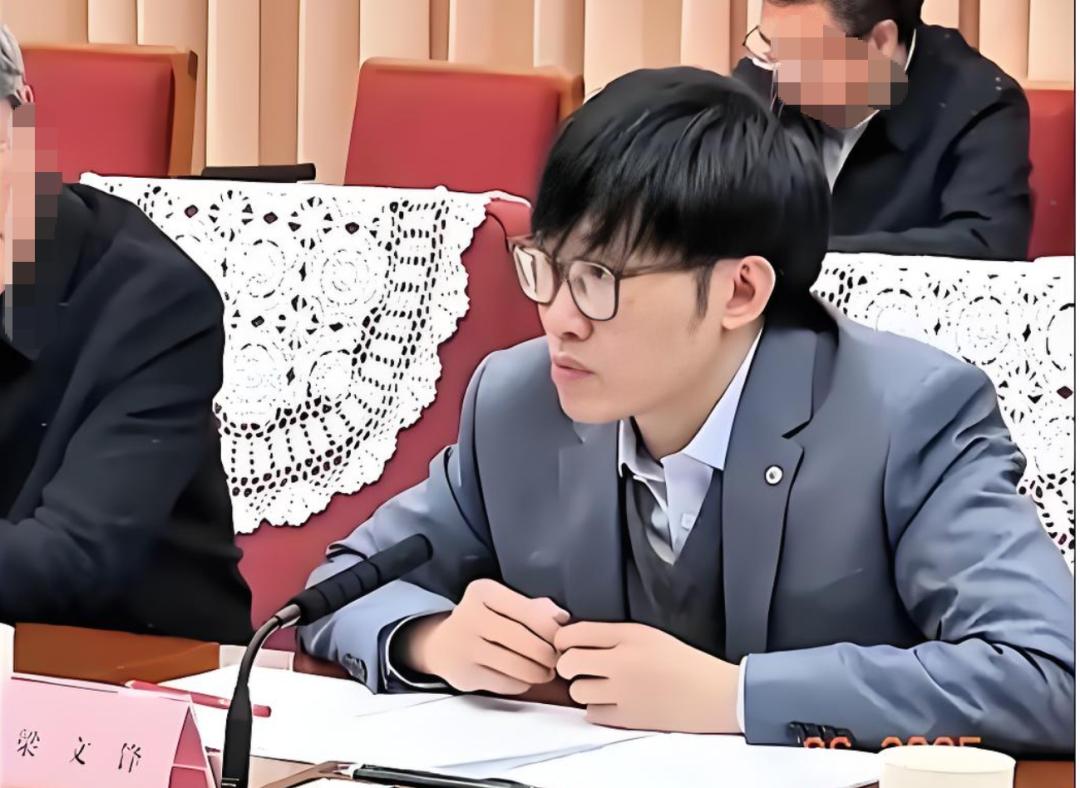
He wrote "not welcoming quick - money seekers" into the financing terms. A five - year lock - up period and in - depth verification of LP identities. This is not the usual way of playing for capital. Liang Wenfeng is telling everyone: My company is not your arbitrage tool.
Some say this is "the victory of the founder over capital". The author thinks a more accurate way to put it is that this is a story of a person who has never been short of money from the beginning and still refuses to give up the company's control when he needs money.
The uniqueness of DeepSeek lies in that it has never been a company that survived by VC. The cash flow of Magic Square Quantitative gave Liang Wenfeng enough confidence to be picky, set thresholds, and make rules in the matter of financing. Ordinary entrepreneurs don't have this condition, but Liang Wenfeng does.
So the significance of this - round financing is far more than just "DeepSeek has money".
It sends a signal to the entire industry: Financing doesn't necessarily mean losing control, as long as you have enough chips and a clear bottom line.
Of course, every coin has two sides. The introduction of external capital will inevitably bring changes to the governance structure, even though Liang Wenfeng has set up multiple defenses.
DeepSeek previously established itself in the industry as a "research - oriented model laboratory". After introducing commercial capital, whether it can continue to maintain the color of technological idealism is a question that needs time to answer.