Elon Musk is ringing the bell tonight, and we have sorted out 21 new players in China's commercial aerospace sector
Tonight, the largest IPO in human history is about to land on the capital market.
SpaceX, under Elon Musk, is listed for trading at an issue price of $135 per share and a fundraising scale of $75 billion. Calculated at the issue price, the company's valuation is approaching $1.8 trillion, surpassing Tesla, Meta, and Berkshire Hathaway at once, and entering the list of the seventh - largest listed companies in the US stock market.
Without accident, Elon Musk's personal net worth will exceed $1 trillion, making him the first "trillionaire" in human history. About 4,400 current and former employees of SpaceX will become millionaires, and about 400 of them have equity worth more than $100 million.
Of course, there is also a long list of investors behind SpaceX who have gotten rich. This scene makes domestic peers extremely envious.
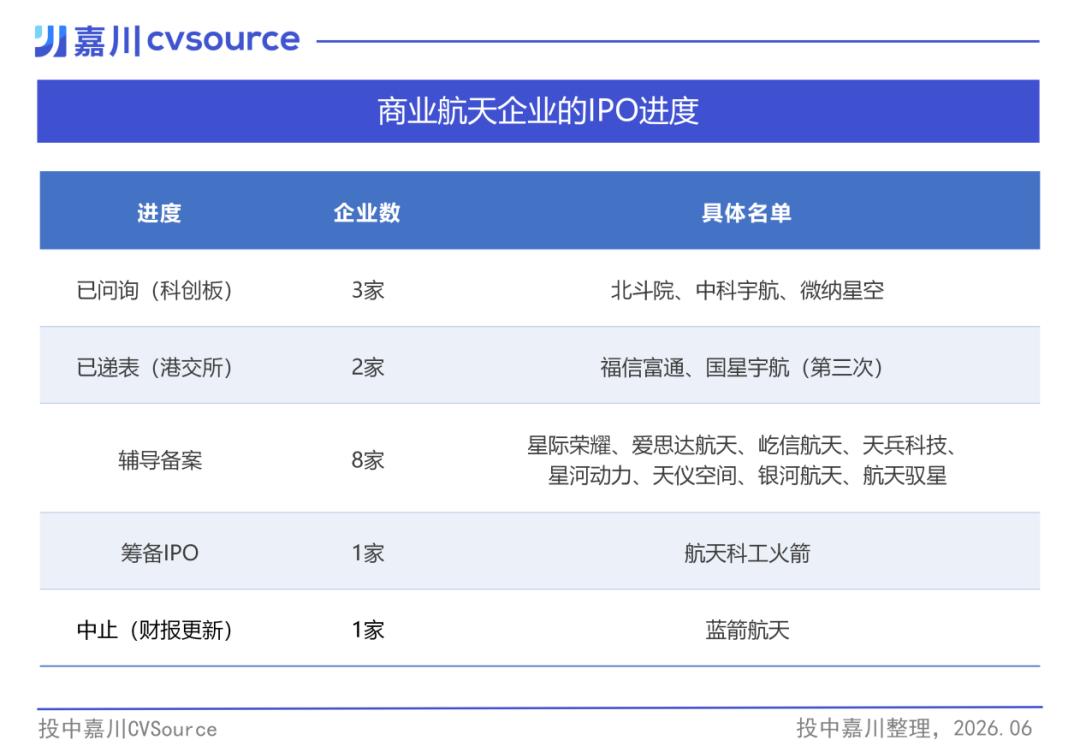
However, the good days for domestic investors may also be coming. According to statistics from Touzhong Jiachuan, as of now, at least 15 commercial aerospace companies have launched their IPO processes. Among them, Zhongke Yuhang and Weina Xingkong have both entered the inquiry stage of the Science and Technology Innovation Board. It's not an overstatement to say that the Chinese commercial aerospace industry is experiencing its "pre - explosion period".
Moreover, different from the situation in the US market where a few companies dominate, the Chinese commercial aerospace track is still one of the most active tracks. According to the data from Touzhong Jiachuan CVSource, in the whole year of 2025, a total of 112 commercial aerospace enterprises completed financing of 22.6 billion yuan. From January to May this year, the investment enthusiasm remained undiminished, and 46 companies obtained 15 billion yuan.
Among the above investment data, perhaps the most worthy of attention is not the late - stage financing of unicorns, but the early - stage opportunities for new players. The data from Touzhong Jiachuan CVSource shows that since 2025, 21 new companies have been established in the entire market. Some of them are from traditional Internet companies for cross - border entrepreneurship, some are genius teenagers born in the 2000s, some are industrial alliances set up by local governments, and some are the transformation of scientific and technological achievements by university professors.
We have investigated all these 21 companies and found that the "new faces" in the Chinese commercial aerospace industry are quietly rewriting the competitive landscape of this track with completely different technical routes, business models, and resource endowments. They have contributed new opportunities for investors who have not "boarded the train" yet.
The following data is sourced from Touzhong Jiachuan CVSource.
01. Stellar Power, the Space Bet of the Former Vice - President of JD Digits
Stellar Power was established in December 2025. In less than half a year, it completed over 100 million yuan in angel - round financing. This company uses perovskite materials to make aerospace solar cells to power the solar wings of satellites.
Currently, the solar wings mainly use rigid gallium arsenide batteries, which have good performance but high costs. The advantages of perovskite are light weight, flexibility, and low theoretical cost. If perovskite can really reduce the cost of space power generation by an order of magnitude, it will gain a huge market. The number of Chinese in - orbit satellites exceeded 1,000 in 2025 and will double in the next few years. Those in need of solar wings include not only commercial satellites but also space stations, deep - space probes, and future space power stations.
Let's take a look at the technical strength of Stellar Power. The company's core technology actually comes from an international perovskite team at Beijing Institute of Technology. The company's founder, Xu Ling, obtained the authorization for the transformation of scientific and technological achievements from Beijing Institute of Technology and assembled a team of people with diverse backgrounds.
Interestingly, Xu Ling's previous position was the vice - president of JD Digits. In the eyes of investors, cross - border experience may be a plus. Institutions such as Houxue Capital, Cathay Capital, Beijing Future Science City Fund, Inno Angel, and Guotai Haitong participated in the investment. The lineup is no worse than that of any star aerospace company.
Stellar Power is moving fast. In May 2026, Tianzhou 10 sent their second batch of perovskite samples to the Tiangong Space Station. Also in May, Stellar Power started the construction of the world's first perovskite space photovoltaic pilot line in Beijing Future Science City, with a planned production start in August and a total investment of 150 million yuan. This pilot line will lay the foundation for the subsequent financing process.
02. Star Constellation Union, How People in Wuxi Build Satellites
Star Constellation Union was established in March 2026 with a registered capital of 2 billion yuan and 15 shareholders.
This scale is quite prominent in the commercial aerospace circle. Not only because of the large amount of money but also because it has gathered 15 shareholders at once, including local state - owned assets such as Liangxi Aerospace Technology, commercial aerospace companies such as Tianyi Space and Dongfang Space, and market institutions such as Bohua Capital and IDG Capital.
Obviously, this is not a traditional startup. It is more like the materialization of an industrial alliance. Current public information shows that Star Constellation Union does not build rockets or launch satellites but focuses on integration.
It integrates the 8 constellation projects that have been launched in Liangxi District into an operation platform. The essence of this model is that local governments provide resources and policies, commercial aerospace companies provide technology and products, and capital provides funds, and then create value within an entity.
The core project is called the "Tianyuan Constellation", which is planned to consist of 1 high - orbit satellite and 216 low - orbit satellites, focusing on narrow - band Internet of Things. The Tianyuan Constellation plans to complete the first - phase networking in 2028 and achieve a revenue of 5.6 billion yuan in 2031.
03. Spark Space, a Rocket Company Backed by Hefei State - Owned Assets
Spark Space was established in January 2025 and is located in Hefei.
This company has chosen a very different engine route. The mainstream rocket engines use gas turbine pumps. The principle is to burn a little fuel to generate high - temperature gas, which drives the turbine to rotate and then drives the pump to supply fuel to the main combustion chamber. The advantage is that the technology is mature, but the disadvantage is that the structure is complex, and the manufacturing and assembly costs cannot be reduced.
Spark Space takes the electric cycle route: using an electric motor instead of a gas turbine. It's like replacing the "heart" of the rocket from a steam engine with an electric motor. The advantage of this technical route is that the structure is simple. 70% of the valves and 80% of the pipelines are directly eliminated, and the number of parts of an engine is reduced by an order of magnitude. The manufacturing cost is halved, and the energy consumption is reduced by 30%. The disadvantage is that the electric cycle has extremely high requirements for the motor power and battery energy density, which is why no one has succeeded in this route for so many years.
The average age of the team is 35. The founding members are alumni of Beihang University, and there are also engineering backbones from China Aerospace Science and Technology Corporation, China Aerospace Science and Industry Corporation, and the Chinese Academy of Sciences. The advantage of this configuration is that it has the technical foundation from the state - owned system without the process constraints of the state - owned system.
The company has completed four rounds of financing. In 2025, it completed the seed round and angel round with 55 million yuan, led by Jinsha Capital and Hefei Industrial Investment. In February 2026, it completed the angel + round with tens of millions of yuan, led by Xingtai Capital. In June 2026, it completed the Pre - A round with nearly 100 million yuan, jointly invested by Yunze Capital and Orbital Chenguang. Four consecutive rounds within a year, with a very tight rhythm.
Currently, the product parameters are out. The "Evolution 1" rocket is 27.5 meters long, with a take - off thrust of 90 tons and a low - Earth - orbit payload capacity of 1.5 tons. This payload capacity is about one - tenth of that of the Falcon 9, but its strategy is the "express special offer" - the goal is to reduce the cost of a single launch from the level of hundreds of millions of yuan to tens of millions of yuan. Xie Heng made a very vivid analogy: it can send 10 adult giant pandas into space at a time.
There are other companies in China working on electric - cycle rockets, but Spark Space is the fastest. In the first half of 2026, the engine of the Evolution 1 has passed multiple ignition tests, and the team is promoting the overall assembly and joint training of the whole rocket.
04. Zhiyu Aerospace, a Rocket Entrepreneur Born in 2003
When Zhiyu Aerospace completed its angel - round financing, its founder, Zhang Zihan, was 23 and still an undergraduate student.
This is the youngest face in the 2026 commercial aerospace industry. Born in 2003, he is a student majoring in Aerospace Engineering at the Hong Kong Polytechnic University. His core team consists of 4 people, all his classmates. The company was registered in July 2025 and completed two rounds of financing within half a year. The latest round was led by Minyin International, with Century Huatong, Songhe Innovation, and Beidou Group following the investment.
It sounds like a gimmick in science - and - technology media reports that a few undergraduates are building rockets. But looking closely at their product parameters, things are not that simple.
Zhiyu Aerospace takes the route of electric - pump cycle plus liquid oxygen methane. The engine is called "Hantian", with a sea - level thrust of 3.2 tons, a vacuum thrust of 3.7 tons, and a maximum specific impulse of 345 seconds. The core selling point is a very wide thrust adjustment range, from 18% to 105%, which is crucial for rocket recovery and reuse. Their first rocket, the "Fission - A", is 24 meters high, 1.6 meters in diameter, with a low - Earth - orbit payload capacity of 450 kilograms and a sun - synchronous - orbit payload capacity of 300 kilograms. The first stage is designed to be recoverable and reusable.
Of course, doubts are inevitable. The average age of the team is in their early 20s, and they have almost no engineering experience. Zhang Zihan recruited several experienced veterans from companies like Xinghe Power as technical advisors. The core engine design was done by himself and his classmates, and it is reported that several rounds of ignition tests have been completed. However, there is still more than two years to go before the first orbital flight.
05. Qingbo Aerospace, a Tsinghua Doctor as the "Traffic Police" in Space
What Qingbo Aerospace does is very special. It doesn't build rockets or satellites but specializes in "traffic safety" in space. Specifically, it does three things: cataloging space debris, providing collision warnings for cooperative satellites, and detecting abnormal events in space. Simply put, Qingbo Aerospace is responsible for the monitoring and early warning of space junk and satellites.
The two co - founders, Zeng Yiqiang and Ban Caohuo, are "Sanqing" doctors from the Tsinghua Aerospace Dynamics and Control Laboratory. The company was established in August 2025, completed a nearly 10 - million - yuan seed round in November 2025, and completed an over - 10 - million - yuan angel round in April 2026, exclusively invested by Linge Venture Capital.
The demand in the "space traffic" track is rapidly expanding. As of 2026, the number of in - orbit satellites has exceeded 10,000, and with SpaceX's Starlink still being deployed on a large scale, the demand for space traffic management is no longer a science - fiction topic but a real - world necessity. In the United States, SpaceX and NASA have their own collision - avoidance systems. In China, this area is mainly undertaken by the national team, and few commercial companies are involved. Qingbo Aerospace is one of the very few private companies in China with space safety as its main business.
According to their plan, in 2026, they will start the development of the "Tianlu 1" in - orbit verification system. If it succeeds, the next step will be to provide "space traffic management" subscription services for commercial satellite operators.
However, compared with rocket manufacturing and satellite communication, this market in China is still in an earlier stage. Most satellite operators are not used to paying for collision warnings, and there is no mandatory requirement on the policy side. This means that it will take longer for Qingbo Aerospace to form a commercial closed - loop.
06. Weiguang Qihang, the Radical in Full - Flow Staged Combustion
Weiguang Qihang has chosen the most complex technical route in the field of rocket engines: full - flow staged combustion cycle.
Currently, there is only one rocket in the world that actually uses this scheme - SpaceX's Raptor engine. Its principle is to let all the propellants pass through the pre - combustion chamber and then enter the main combustion chamber, with extremely high combustion efficiency and achieving the best thrust - to - weight ratio and specific impulse. The price is an extremely complex system with extremely high requirements for materials, processes, and control. It took SpaceX more than a decade to make the Raptor work, and Blue Origin's BE - 4 only achieved oxygen - rich staged combustion.
Weiguang Qihang not only chose the full - flow staged combustion route but also combined carbon - fiber composite materials and the liquid oxygen methane scheme. Their rocket is called "Weiguang 1", a medium - sized liquid reusable launch vehicle, with the goal of reducing the launch cost to 20,000 yuan per kilogram.
The founder, Gao Huan, once served as the person - in - charge of the general assembly project at the China Academy of Launch Vehicle Technology and is an expert in rocket general assembly process technology/skills. Before starting the business, Gao Huan had accumulated rich experience in rocket overall design, material application, and manufacturing processes, and had led or participated in the flight tests of more than 50 key - model rockets.
The company was established in March 2025 and completed several tens of millions of yuan in angel - round financing in August 2025, led by Hebei Dingling Qianhang Technology Development Co., Ltd.
07. Xiandeng Aerospace, Building Special Rockets for Small Satellites
Xiandeng Aerospace was established less than a year ago, and nearly 100 million yuan in financing has been in place. Its goal is to build special rockets for small satellites in the 100 - to 500 - kilogram class.
The company was established in Shenzhen in August 2025. All of its core members come from aerospace research institutes and leading private aerospace companies, covering nine professional directions such as power, control, aerodynamics, and structure. The average aerospace work experience of the team is 22 years, and it is led by an expert who graduated from Beihang University with a bachelor's and master's degree and once served as the deputy chief designer of a model. This resume is among the top - tier in the new rocket companies established in 2025.
The core product is called "Xiandeng 3" (XD - 3), a small - sized liquid launch vehicle with a take - off weight of 104 tons and a low - Earth - orbit payload capacity of 1.5 tons. The first stage is equipped with 2 liquid oxygen kerosene engines, and it is planned to make its first flight in the third quarter of 2027.
Currently, the medium - sized rocket track in China is crowded with companies like LandSpace, Tianbing, Xinghe, and Interstellar Glory, and each is competing for the payload capacity in the range of 3 to 10 tons. However, in the market for small satellites in the 100 - to 500 - kilogram class, there is a lack of special rockets. Small satellites either have to hitch a ride on large rockets (waiting for a schedule and being restricted by orbits) or spend a large amount of money to charter a medium - sized rocket (wasting payload capacity). What Xiandeng Aerospace wants to do is to build a rocket of just the right size for these satellites.
The cost target is 20,000 yuan per kilogram, which is one - fourth to one - fifth of that of traditional solid rockets.