Zhiyuan Baimai solves the problem of domestic substitution in interventional therapy through material innovation
Recently, the Center for Medical Device Technology Evaluation of the National Medical Products Administration (NMPA) released the "Public Notice of Examination Results for Applications Under the Special Review Procedure for Innovative Medical Devices (Announcement No. 8 of 2026)".
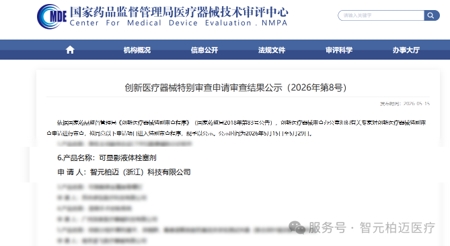
The "Radiopaque Liquid Embolic Agent" independently developed by Zhiyuan Baimai has successfully passed the application review public notice period with its outstanding clinical innovation value and advanced, superior technology, and has officially been admitted to the national Special Review Procedure for Innovative Medical Devices.
The Special Review Procedure for Innovative Medical Devices is an extremely high-threshold core evaluation channel established by the National Medical Products Administration, aimed at encouraging R&D and innovation of medical devices and promoting the development of the modern medical device industry. Products eligible for this procedure must simultaneously meet strict requirements and core invention patent indicators, including "domestically pioneering working principles and mechanisms, internationally leading technology, and significant clinical application value".
This approval for entry into the innovation channel marks the recognition of Zhiyuan Baimai's radiopaque liquid embolic agent by authoritative regulatory bodies and top industry experts in terms of its innovation, technological leadership, and clinical value.
The launch of this product will break the long-term reliance on imports for high-performance liquid embolic materials, providing a more precise, safe new material option with independent intellectual property rights for the domestic interventional therapy field.
I. Core Technology: An Innovative Radiopaque Liquid Embolic Agent That Fills the Clinical Gap
Primary liver cancer is a highly prevalent malignant tumor in China. According to data released by the National Cancer Center, there were 367,700 new cases in 2022, ranking 4th among all cancer types in terms of new case count, with its incidence ranking 5th; there were 316,500 deaths, with both the death toll and mortality rate ranking 2nd.
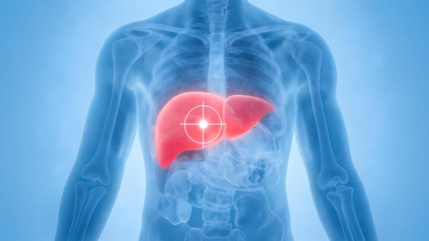
Due to the insidious onset and high malignancy of liver cancer, most patients are already in the middle or advanced stage when diagnosed. For patients with unresectable disease, the interventional therapy of "Transcatheter Arterial Chemoembolization (TACE)", with its leading advantages of minimal invasiveness, precise positioning, high safety, and reusability, has become the clinically recognized first-line treatment for middle and advanced liver cancer, especially suitable for elderly, frail patients and those with surgical contraindications.
The radiopaque liquid embolic agent approved for entry into the innovation channel this time is the first domestically developed liquid embolic material that achieves self-visualization through covalently bound iodine groups. It is mainly indicated for the treatment of malignant tumors in hypervascular parenchymal organs, aiming to address core pain points and performance limitations of existing clinical embolic agents in complex lesions, including difficult flow control, incomplete embolization, high risk of ectopic embolization, and lack of radiopacity. It features the following innovations:
1. The first domestically developed liquid embolic material that achieves self-visualization and long-term embolization through covalently bound iodine groups
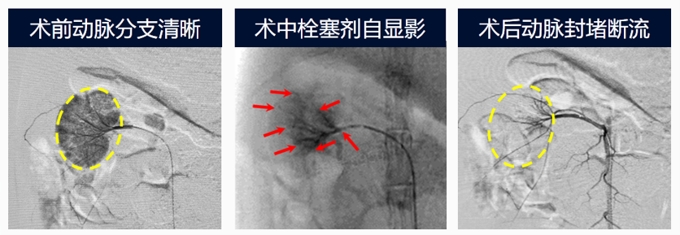
Through stably bound iodine-containing groups in the material, the product realizes real-time intraoperative visualization without additional contrast agent mixing, and is fully visible under X-ray/CT, which helps physicians directly observe the embolization process under DSA fluoroscopy, improving the controllability and safety of the operation.
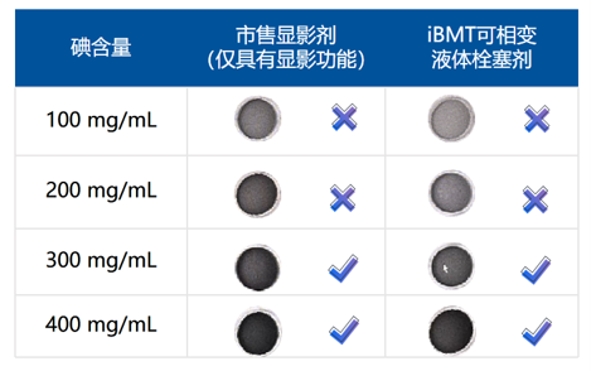
The radiopacity of the product under DSA is close to that of commercially available contrast agents
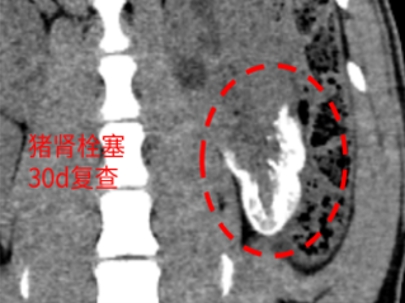
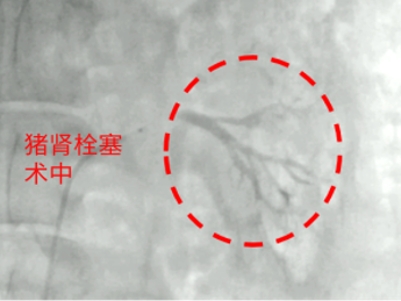
Self-visualization, no contrast agent mixing required, enabling real-time intraoperative tracking and continuous postoperative visualization
2. Solvent exchange solidification mechanism with excellent rheological properties adapted to microcatheters
This product has excellent delivery performance in microcatheters, can pass through tiny blood vessels above 40μm, fits tightly with the vessel wall, and is not prone to displacement.
The embolic agent is injected into blood vessels in liquid form and rapidly undergoes phase transition after contacting with blood, turning from liquid into semi-solid gel, thus achieving rapid and stable physical embolization in the target vessel. This property allows it to follow the blood flow path and adapt to the morphology of lesional vessels, enabling gradual and dense embolization of tumor vessels.
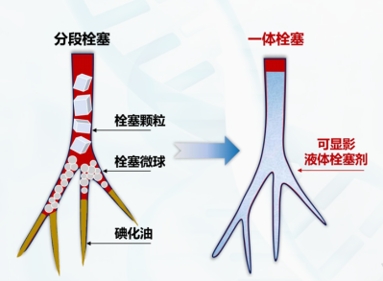
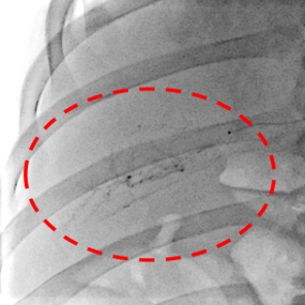
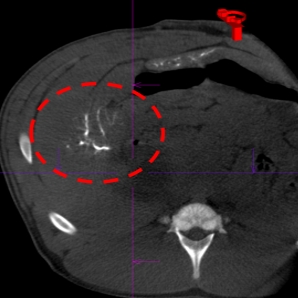
Vascular cast embolization: capable of adaptive embolization for vessels of various shapes and sizes
Embolization performance in animal arteries (rabbit renal artery)
3. Stable retention to prevent recanalization
Stably retained in target vessels for ≥6 months, significantly reducing recurrence; with good biocompatibility and no obvious inflammatory reaction.
4. Excellent drug-loading performance, realizing dual effects of embolization and local chemotherapy
① Broad-spectrum drug compatibility: It can not only efficiently load doxorubicin (DOX), but studies have also confirmed its good compatibility with raltitrexed and gemcitabine hydrochloride.
② Stable and efficient drug-loading process: Similar to the preparation method of clinical iodized oil emulsion, drug loading can be completed through simple three-way mixing, achieving 100% drug loading with easy and fast operation.
③ Excellent drug release performance: No burst release effect, showing a stable and long-lasting sustained-release profile, far exceeding the release rate of less than 40% of some existing technologies, which is expected to establish a more durable effective drug concentration in the local tumor area.
II. Building on Past Achievements, Marking Zhiyuan Baimai's Entry into a New Stage of Leapfrog Development
Focusing on its material platform capabilities, Zhiyuan Baimai has formed three business segments.
The first is precision interventional therapy devices. The radiopaque liquid embolic agent is the core product under this platform, and more products will be developed in the future for tumor and vascular disease scenarios based on brand-new underlying material design.
The second is drug delivery materials, developing sustained-release materials and local delivery materials for scenarios such as ophthalmology, gynecology, and cavity administration.
The third is high-value medical materials. Zhiyuan Baimai focuses on high-end medical raw materials, providing material-to-process solutions for medical device enterprises.
Since its establishment three years ago, Zhiyuan Baimai has completed three rounds of financing, accumulating nearly 100 million yuan in social financing. This successful entry into the national Special Review Procedure for Innovative Medical Devices is not only a recognition, but also means that Zhiyuan Baimai's development has entered a new milestone of comprehensive leapfrogging.
Zhiyuan Baimai has always adhered to the mission of "breaking the boundaries of diagnosis and treatment through material innovation". In the future, it will promote the subsequent evaluation of the radiopaque liquid embolic agent with a scientific, rigorous, and efficient attitude, striving to get this disruptive innovative product approved for marketing at an early date to benefit the vast number of patients.