Infiltrating the fan groups of post-2010 internet celebrities, I witnessed children "doing data"
When it comes to surfing the Internet, children sometimes find it difficult to communicate with their parents. Compared with their parents, the way they perceive and describe the world has changed significantly.
Those who can still be called "children" nowadays were all born after 2010. Along with them came smartphones and the booming mobile Internet. From then on, the world could be composed of different apps.
Zhang Yana, a 42-year-old middle school English teacher, once logged into her daughter's short video account to see what this 13-year-old girl was watching during the two days she was allowed to use the tablet every week. Zhang Yana knew that her daughter had favorite bloggers and would like some fan-made videos. From an adult's perspective, these videos were not well-produced, and many of them were just a splicing of materials, but her daughter seemed to enjoy these contents.
In this Internet ocean, her daughter busily roamed among different videos, leaving behind some vague words like "clearing followings" (i.e., unfollowing and unfriending) and "expanding friend list with my favorite ××" (i.e., adding friends who have the same favorite idols/characters as herself), waiting to be discovered and recognized by those of the same kind.
This is a world exclusive to children, with its own rules and power distribution. It centers around a certain internet celebrity, just like throwing a stone into the center of a lake, and the ripples spread out layer by layer. Children connect, accept, and exclude each other. What remains on the lake surface are the children's needs and anxieties, which may have little to do with the internet celebrity themselves.
01
The Inevitable "Touching the Internet"
In the accounts of parents and children, a child's first time on the Internet always starts with having their own device. But in fact, those born after 2010 are a generation that coexists completely with social media, and their real "touching the Internet" time is often earlier.
Before having her own device and account, 14-year-old Muyan had already mastered the usage rules of platforms like Douyin and Kuaishou. Since primary school, she was occasionally allowed to play with her parents' phones. Just one or two short hours were enough for Muyan to find the contents and bloggers she was interested in.
Zhang Yana was more conservative when it came to letting her child access the Internet because her family had seen too many "children ruined by mobile phones." In her and her husband's plan, their daughter was not allowed to play with mobile phones, and the progress of her accessing the online world needed to be controlled to minimize the interference caused by Internet addiction.

On November 18, 2025, in Melbourne, Australia. 12-year-old internet celebrity Ava Chanel Jones is with her mother. According to local policies, people under 16 will be prohibited from using social media websites starting from December 2025. (Photo /AFP/CFP)
This concern is not unfounded. Data research by Jane Twenge, a psychology professor at San Diego State University in the United States, found that 2011 - 2012, when smartphones were widely popularized, was an important turning point in the mental health of teenagers. The depression rate, suicide rate, and sense of loneliness among teenagers soared during these two years.
The rhythm of parents' strict prevention of their children's Internet access was first disrupted by online classes. During the era of online classes, children suddenly had unprecedented justifications for having their own electronic devices. Qiqi, who was in junior high school at that time, also got her own mobile phone under such circumstances. The school Qiqi attended not only required students to be online during class hours but also to keep the camera on throughout the evening self - study.
Adults still try to strictly distinguish between "Internet time" and "study time" for children on the screen, but for children, this boundary is quickly blurring.

(Photo/Unsplash)
Both Muyan and Qiqi, who got mobile phones because of online classes, quickly registered their own social media accounts. In this way, they had independent personalities and identities in the online world, as well as their own undisturbed algorithms.
Although in the eyes of adults, their expressions bear obvious childish imprints, they secretly believe that on the Internet, no one will know that there are minors behind the accounts, and their comments and creations will be treated more seriously and fairly.
In Muyan's account, she believes in this fairness and is willing to put in the effort for it. Muyan manages an account for a dance student support club, mainly organizing and reposting the dynamics and daily lives of well - known dance students and making video montages. These dance students are about the same age as her, with the number of fans ranging from a few thousand to hundreds of thousands. Most of them are preparing to apply for or have already been admitted to the affiliated middle schools of professional dance colleges, where they mainly study dance courses during the six - year middle school period.
What Muyan has to do is to extract segments from the videos updated by these dance students on social media, add music, captions, and special effects, and create montage videos through secondary creation. She is also very familiar with dance training institutions in the market. When there are not enough materials from the dance students' own accounts, Muyan will look for the students' segments in the accounts of their institutions and teachers and add them to her montage videos.
Muyan has pinned a montage video of a girl who was just admitted to the affiliated middle school of a dance college this year on her homepage. This is also one of the videos with the highest number of likes on her homepage, receiving 136 likes. The girl in the video has 250,000 fans, and her account is managed by her mother. The girl is also a star student at the dance institution. The "Road to the Dance Entrance Exam" video that Muyan made for her is 4 minutes long, starting from the girl's childhood dancing scenes, with continuous overlapping and transitions until the last updated segment before "getting admitted."
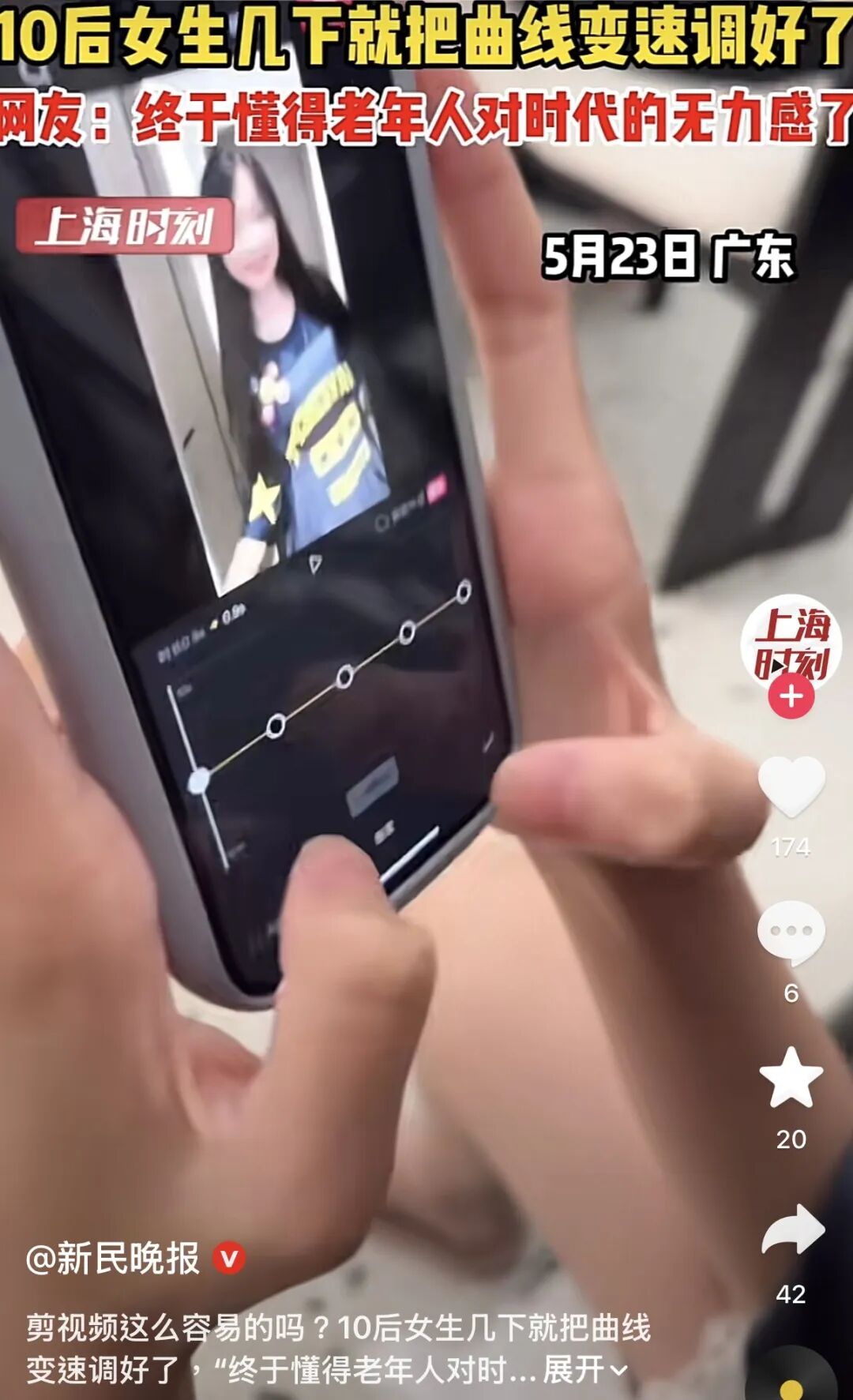
Post - 2010 kids are proficient in video editing. (Photo/Xinmin Evening News)
Muyan explains the shooting period of each segment in the video captions. To write these short captions, she needs to find key information from a large amount of information such as the blogger's replies to fans and passers - by's comments. Muyan said that it took her a whole day to edit this video to handle these details.
This kind of growth record video of small bloggers is one of the content types with the highest traffic in the circle. Qiqi, who is now in college, is a fan of a small blogger with 600,000 fans. Qiqi's account has been operating since her high school entrance examination and now has 22,000 fans. She updates videos synchronously on Douyin and Xiaohongshu. Initially, most of the topics were "growing up while dancing," and the number of fans quickly exceeded a thousand within three months.
Perhaps because she is already an adult, Qiqi has a more calm and objective view of topics, fans, and traffic. She said that the high traffic of this kind of growth - oriented video is largely because the small blogger is relatively well - known; on the other hand, in addition to fans in the circle, some passers - by will also be touched by a little girl's growth and perseverance. Under the intuitive comparison of montage videos, many people will also sigh that "it takes a lot of money and effort to raise such a child."
14 - year - old Muyan doesn't seem to be so calm. In her account, the traffic of her account is closely related to many factors: editing techniques, production time, update frequency, and her maintenance of the relationship between the account and fans.
She emphasized to me that each video was "manually edited" by her, and she found all the materials by herself without using AI. However, under each carefully - made video, Muyan will leave a comment, such as "The pursuit of dreams is hard. Witness the growth. Promise to accompany." The writing style is similar, with emojis commonly used in AI - generated captions, like a series of publicly - released support letters. Muyan will also post another comment, "@" all her mutual - follow friends to ask for likes and comments.
02
"Expanding Friend List," "Personally Selected," "Clearing Followings,"
Children's Social Grammar
Muyan's account has 3,325 fans. Judging from the account style, most of them are her peers. The number of people on her following list is even larger, with 3,624 people. I asked her: Can you keep up with so many updates? Muyan said that because of school, everyone's update frequency is calculated on a weekly basis, and besides, "they will '@' me when they update."
This seems to be the online social rule among this generation. Under Muyan's original videos, the most common comments are "Here I am" or "11," mostly from the accounts she "@" in the comment section. This simple act of contributing data for mutual - follow friends is their "traffic - mutual - assistance contract."
But no one can tell how much this kind of mutual assistance can affect the video data. Qiqi mentioned that the few videos that "went viral" since she started her account were all due to the platform's push, "Passers - by also saw them, and the videos just hit the public's emotions."
Another rule in the online world of post - 2010 kids is the extremely strict protection of original copyright. Muyan clearly states "No Reposting" in her ID, and each of her videos is marked with original protection. Another girl, Dangdang, asked Muyan to publicly apologize on her homepage because Muyan used a video segment of a dance student blogger in her secondary - creation video. This segment was posted by the blogger in a group chat but was declared not to be authorized to anyone except Dangdang.
There are undercurrents behind the mutual - assistance contract. Under the video that Muyan spent a whole day making, she posted three comments "@" more than 30 of her fans and friends, saying "Guys, give it a like, thank you." In the midst of the atmosphere - building comments, one comment stood out - "Don't '@' me again after I've already liked it," accompanied by an "explosion" emoji. Behind this friendly mutual - assistance contract, there seems to be an inexpressible social pressure, and straightforward people will speak out about it.
I clicked into the commenter's homepage and found that she was also a dance enthusiast. Different from Muyan, her videos were all about herself, showing her basic dance skills or rehearsal routines. She had slightly fewer fans than Muyan, but there were more enthusiastic people in her comment section sending friend - making requests: "Wanna be friends?"
"Wanna be friends?" means "Do you want to make friends?" and "You 1, I 2" means "The order of making friends is: You follow me first, and then I'll follow you back." Their language system is very concise and has not been taken over and deciphered by AI. Newcomers need to spend some time and effort to understand it.
Under the video where Dangdang asked Muyan to publicly apologize, many people left messages like "Support you" and "Support fff" (used to express support). Someone also commented: "Baby, you're my personally - selected, and I've pinned you on my homepage." The so - called "personally - selected" is a kind of online mark with a sense of belonging: the account owner publicly indicates who their most recognized creator is and states their position in the profile.
Robin Dunbar, a British anthropologist, proposed the concept of the "Dunbar number" when studying human social interactions. That is, the upper limit of the number of social relationships a person can maintain is 150, and the number of people with whom one can maintain regular interactions will not exceed 50. Beyond this number, the neocortex of the human brain cannot function normally, and the overall quality of social interactions will decline.
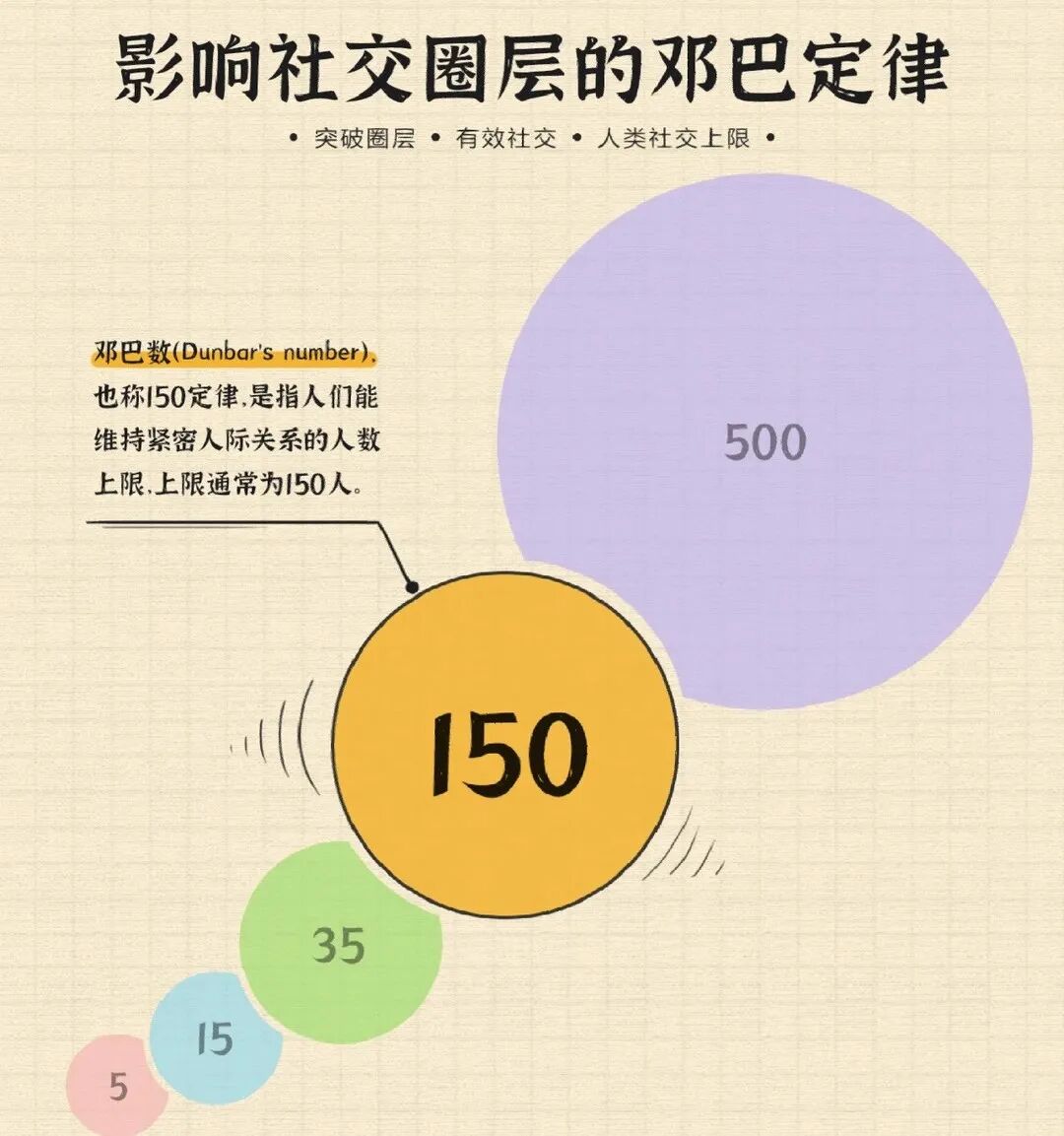
According to the concept of the "Dunbar number," the upper limit of the number of social relationships a person can maintain is 150. (Photo/Xiaohongshu @Chen An'an's Growth Notes)
Muyan and her friends' friend lists clearly far exceed the upper limit of the Dunbar number. The massive "weak - connection" relationships in the list will bring great social pressure, and some people will choose to "clear followings" regularly to reduce the relationships that need to be maintained. An unwritten rule is that before "clearing followings," one needs to post a notice in advance. If the other party doesn't want to be unfollowed, they need to leave a message to explain.
Sometimes, a person who was still calling each other "baby" a month ago finds themselves unfollowed and will question the other person in their comment section: "Why unfollow me without saying a word?" The person replied: "I posted about it before, but I deleted the post later."
Parting is not a heavy concept for children. The other person seemed to accept the permanent farewell quickly and calmly: "Oh, okay. I was at school and didn't have my phone, so I didn't see it."
03
What Are Children Pursuing When They Generate Data for Internet Celebrities?
After immersively experiencing the children's social discourse system, I realized that when a piece of content goes viral, the video's traffic may be related to whether it enters the platform's push pool. But in the children's social network world, the feedback within the small circle is often more important than the traffic, and this is often the dividing line of power.
Each circle has different standards. Take the dance enthusiast circle where Muyan is in as an example. Comprehensive collections and secondary creations are never as popular as original videos with the person themselves in the frame.
Muyan told me that another popular circle among post - 2010 kids is group live - streaming: well - made - up and slender boys and girls line up. Depending on the different amounts of rewards from the audience in the live - streaming room, they decide how to sing, dance, or just read out the audience's IDs through voice - over.
I entered a group live - streaming room and watched for an hour. The cheapest voice - over consumption is to buy a fan light card. After the audience buys it, the designated anchor will stand in the C - position, read out the purchaser's ID, and do a gesture dance. The ID link of the consumer will pop up on the public screen. Judging from the homepage information, most of the people who buy fan light cards for voice - over consumption are minors.

Group live - streaming support. (Photo/Xiaohongshu)
In Muyan's following list, I saw another