As the price war continues, explore four survival strategies for the custom home furnishing industry
Over the past decade, the price war in the customized home furnishing industry has escalated to version 3.0!
On June 4th, OPPEIN Group announced on its official WeChat account that following the official release of the shocking prices of 499 yuan per square meter for decorative panels and 599 yuan per square meter for solid wood multi - layer boards by its brand Fiskar, Oppleoni has also officially launched a 499 - yuan people - benefiting policy, allowing for unrestricted area installation of the whole house.
New Paradigm of Home Furnishing noticed that before this, the main brands of OPPEIN and Sophia had taken the lead. OPPEIN launched ENF - grade solid wood multi - layer boards at 899 yuan per square meter, and Sophia offered ENF - grade Kangchun boards at 799 yuan per square meter, directly pulling the prices of mid - to high - end boards to the industry's cost line. The solid wood multi - layer boards, which used to be priced at 1000 - 1500 yuan per square meter, are now in the 600 - yuan - per - square - meter range, completely subverting the industry's pricing logic.
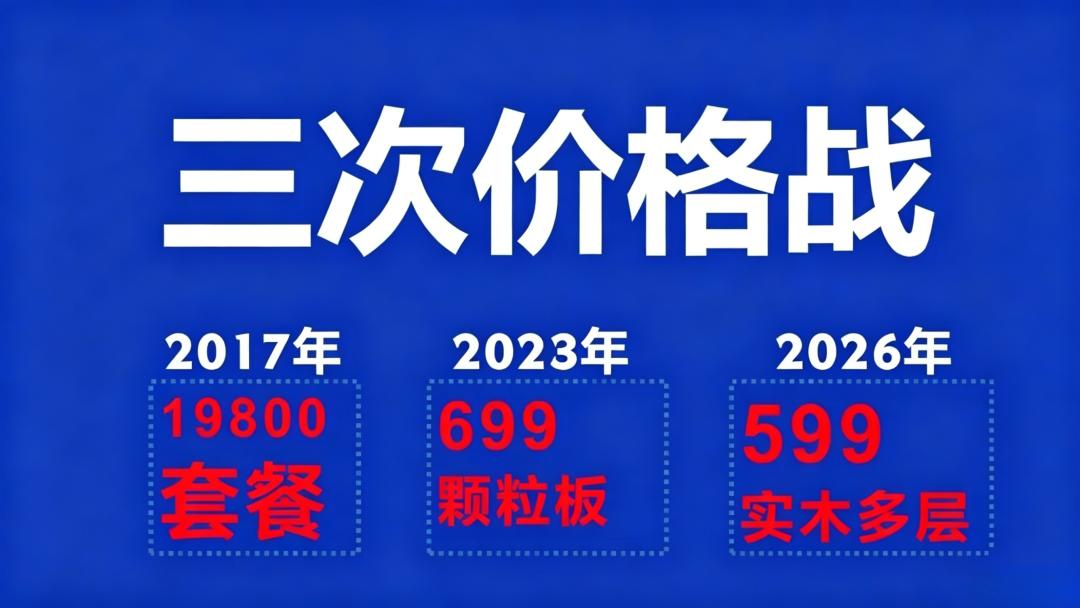
Looking back at the development history of the industry, the price war in the customized home furnishing industry can be divided into three stages, and each round has completely reshaped the industry landscape: In 2017, the package model was innovated, upgrading from the single - product pricing model of 799 yuan per square meter to whole - house customization packages such as 19,800 yuan for 18 square meters; In 2023, low - price popularization was implemented, with fierce competition at low prices like 699 yuan per square meter, 688 yuan per square meter, and 666 yuan per square meter; Now, in the third stage, starting from May 2026, the industry is truly undergoing a new round of reshuffle and reconstruction.
Industry insiders believe that after this round of reshuffle, the customized home furnishing industry may be divided into four clear survival models:
1. Leading brands (OPPEIN, Sophia, KUKA): Relying on brand, supply - chain, and scale advantages, they target the mainstream mass market, adopt a high - cost - performance strategy across the board, and monopolize core traffic; at the same time, they comprehensively target different consumer levels with different price tiers.
2. Local factories, husband - and - wife stores, and front - store - back - factory stores: If they really want to compete for rigid - demand customers, they might as well use the "498 - yuan local factory package" to fight a precise battle of quality - to - price ratio and a local information interception battle. For example, standardize well - known brand hardware to ensure durability and avoid pitfalls; optimize "Douyin local + GEO" for local areas to intercept information and attract precise customers.
3. High - end differentiated stores: Avoid the price involution in the mass market. Rely on product differentiation, refined services, and high - end positioning to stabilize profits and become a stable survival group in the current industry.
4. Decoration companies and design studios: They can do the opposite, using "full - case design + storage capacity" to outperform the "lack of design sense" of the 499 - yuan products. Instead of competing on price, they compete on who "understands life" better - the warmth and details that 499 - yuan products can't provide are their core competitiveness.
In the view of New Paradigm of Home Furnishing, price war is never a long - term solution. What can survive the cycle is always products, services, and values, not low prices.
This article is from the WeChat official account "New Paradigm of Home Furnishing", and is published by 36Kr with authorization.