Valued at 3.1 billion, a 1-billion-level beauty brand has been sold again
On June 1st, Waldencast issued an announcement on its official website, announcing that it had reached a final agreement to sell its brand Obagi Medical (hereinafter referred to as "Obagi") to the investment institution Bridgepoint. It is reported that the valuation of this transaction is as high as $460 million (approximately RMB 3.1 billion), and the completion of the transaction is expected in the third quarter of 2026.
The completion of this transaction marks an important step for Waldencast in strengthening its balance sheet and focusing on accelerating the global growth of Milk Makeup. At the same time, it also means that Obagi has changed hands for the fourth time since its listing.
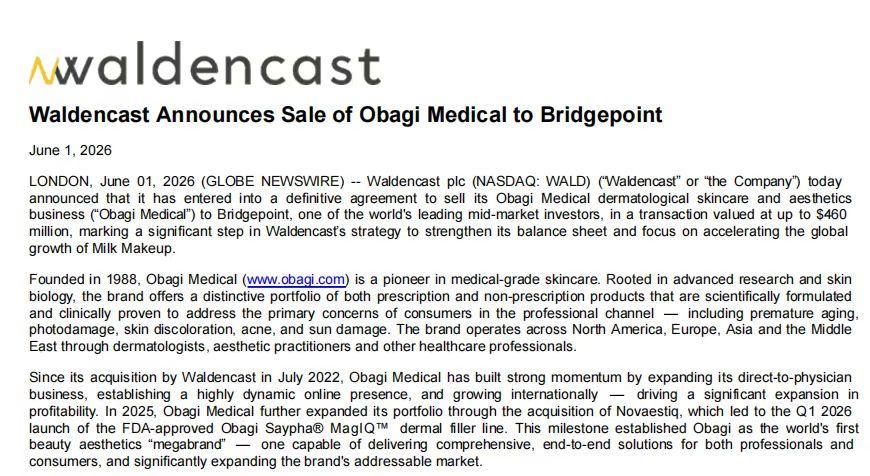
Screenshot from Waldencast's official website
Obagi Sold Again Four Years After Acquisition
Public information shows that Obagi was founded in 1988 by American dermatologist Zein E. Obagi and is a pioneer in the professional skincare track for cinemas. The brand mainly focuses on cutting - edge scientific research and skin biology, with a complete product matrix of prescription and non - prescription products. It specializes in solving the core skin problems of consumers in the professional cinema channel and is known as one of the three giants of American efficacy skincare along with SkinCeuticals and ZO Skin Health. At the same time, with the influence of medical professionals such as dermatologists and medical aestheticians, Obagi's business covers multiple regions including North America, Europe, Asia, and the Middle East.
According to public information, Waldencast is an American SPAC (Special Purpose Acquisition Company) founded by three former executives of L'Oréal Group. The initial idea was to build a global beauty and health platform by developing, acquiring, accelerating, and scaling high - growth brands. It was listed on the NASDAQ on July 28, 2022. Before this transaction, Waldencast had two major brands, Obagi and Milk Makeup.
Since being acquired by Waldencast, Obagi's business has developed steadily, and its profitability has been significantly improved. According to the financial report, in the fiscal year 2025 (as of December 31, 2025), Obagi achieved net sales of $162 million (approximately RMB 1.1 billion), a year - on - year increase of 8.3%; the adjusted gross profit reached $123 million (approximately RMB 800 million), a year - on - year increase of 3.9%.
It is worth mentioning that in July last year, Waldencast announced the acquisition of the beauty and medical skin innovation company Novaestiq and obtained the exclusive sales right of the Saypha® series of hyaluronic acid (HA) injection gel products in the US market.
At that time, Waldencast said that after the acquisition, the above - mentioned business would be integrated into Obagi's operation system and officially enter the "medical device" field. Soon after, Obagi launched the FDA - approved injection filler product line Obagi® saypha® MagIQ™, further expanding the market and putting forward the slogan of a "super brand" in beauty and medical aesthetics. From this, it is not difficult to see Waldencast's forward - looking planning and emphasis on Obagi's business.
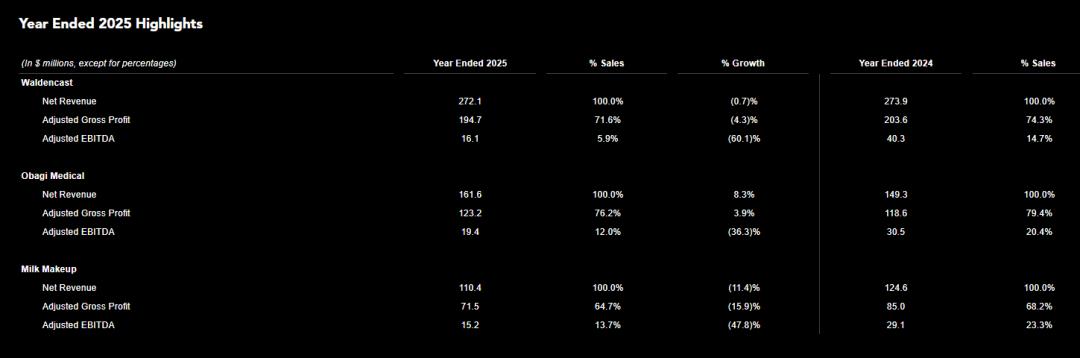
Screenshot from Waldencast's financial report
But why did Waldencast choose to sell Obagi just one year later?
The most obvious reason is the company's financial pressure. On the one hand, the shortage of goods and the reduction of the distribution network of Obagi and Milk Makeup have increased the company's operating pressure. In order to relieve the financial burden, before selling Obagi this time, Waldencast had already started to disassemble its assets. In November last year, Waldencast sold Obagi's trademark in Japan to Rohto Pharmaceutical for $82.5 million (approximately RMB 594 million).
On the other hand, Waldencast's overall business growth is slow, and its profit performance is difficult to offset the debt. In the fiscal year 2025, the company achieved net sales of $272 million (approximately RMB 1.96 billion), and the adjusted EBITDA was only $16.1 million (approximately RMB 116 million). At the same time, Waldencast also carried a debt of about $149 million (approximately RMB 1.07 billion) and urgently needed to relieve the cash - flow pressure and improve the balance sheet.
The announcement shows that after the transaction is completed, Waldencast co - founders Michel Brousset and Hind Sebti, as well as some members of the management team, will leave the company and cooperate with Bridgepoint to lead the operation of Obagi. Waldencast plans to repay all its outstanding senior term loans and focus on operating Milk Makeup in the future to build it into a leading makeup brand.
Four Ownership Changes Since Listing
During its development of more than 30 years, Obagi has changed hands several times.
In 1997, Obagi founder Zein E. Obagi chose to sell the company's business and changed the company name from "WorldWide Products, Inc." to "Obagi Medical Products (OMP)", but retained the shares and served as the medical director. In 2006, Obagi completed an IPO and was successfully listed on the NASDAQ in the United States. In the same year, Zein E. Obagi sold his shares.
In 2013, Canadian pharmaceutical giant Valeant acquired Obagi for approximately $344 million (approximately RMB 2.326 billion) and completed the privatization and delisting.
In 2017, in order to simplify the business and reduce the debt, Valeant sold Obagi to the Chinese capital side Haitong International China M&A Fund for $190 million (approximately RMB 1.284 billion). Obagi thus became a skincare brand led by Chinese capital.
In 2021, Waldencast announced the acquisition of Milk Makeup and Obagi, with a total transaction value of $1.2 billion (approximately RMB 8.115 billion). On July 20 of the following year, Waldencast added $5 million (approximately RMB 33.81 million) to support the merger of Milk Makeup and Obagi and officially listed on the NASDAQ on July 28 of the same year.
It is worth mentioning that this business merger does not include Obagi's business in the Chinese market. Waldencast has clearly mentioned in its financial reports many times that its net income does not include Obagi's business in the Chinese market because this part of the business was not acquired when the Obagi and Milk Makeup brands were merged. According to public information, as of the end of 2024, Dai Sicong, a Chinese - Hong Kong citizen and the CEO of Obagi Greater China, indirectly holds the equity of Waldencast and is the largest shareholder of the listed company.
File photo
In the year after being acquired by Chinese capital, in 2018, Obagi entered the Chinese market by opening a Tmall overseas flagship store and entered professional beauty channels such as Chinese dermatology and medical aesthetic clinics in 2020. At present, Obagi has also opened flagship stores on mainstream e - commerce platforms such as Taobao, Douyin, JD.com, and Xiaohongshu. However, its performance is not very impressive.
Taking the Douyin platform as an example, currently, Obagi's official Douyin flagship store has 18 product links on the shelves. The products are mainly essences, and the prices are mostly between RMB 200 and RMB 600. The best - selling product is a "Vitamin C Whitening and Brightening Essence", with a sales volume of more than 7,000. According to Qingyan Intelligence data, in 2025, the cumulative GMV of this store reached more than 45 million.
In fact, Obagi has not achieved impressive results in the Chinese market so far, which may be related to the company's operating problems such as lagging operating ability, chaotic price control, and chaotic channels.
According to publicly disclosed information, in 2024, Obagi's business revenue in China was only $2.804 million (approximately RMB 18.96 million). In addition, Obagi's Chinese operating company OBAGI HOLDINGS COMPANY LIMITED and its subsidiaries have been sued by companies such as Kaichun Co., Ltd. and Sinopharm Group Distribution Center. Some subsidiaries have been listed as dishonest executors, and their equity has been frozen. (See the article "It's Difficult to Be the Next 'SkinCeuticals'" in Qingyan for details.)
Generally speaking, as a professional medical skincare brand, the reason for Obagi's multiple transfers is not the lack of brand power. The value of its single brand even once exceeded the market value of its parent company Waldencast. More reasons lie in the debt problems of its previous parent companies. After being acquired by Bridgepoint, Obagi may also form a synergistic effect with the French filler company Laboratoires Vivacy and the skincare brand RoC Skincare previously invested by Bridgepoint, releasing greater development potential.
Beauty Giants Target the Professional Skin Medicine Track
In fact, as consumers shift from "emotional marketing" to "ingredients and clinical evidence" rationally, the professional skin medicine field targeted by the Obagi brand is also the direction that beauty giants have been increasing their investment in in recent years.
At the beginning of 2023, L'Oréal changed the name of its Active Cosmetics Division to the Dermatological Beauty Division. In subsequent financial reports, this part of the business, including brands such as La Roche - Posay, SkinCeuticals, and CeraVe, has become a strong growth point for the group's performance. According to L'Oréal's 2025 financial report, the Dermatological Beauty Division has achieved growth in all regions and led the global skin cosmetics market.
The Estée Lauder Companies is also not willing to lag behind. In 2024, Estée Lauder completed the acquisition of the remaining shares of Deciem and fully acquired the "ingredient - focused" benchmark The Ordinary. It officially entered the Chinese market by opening a store on Tmall in June 2025. In subsequent financial reports, The Ordinary has been frequently "praised" by Estée Lauder. According to the latest financial report, in the first quarter of 2026, in the skincare business, The Ordinary, together with La Mer, supported the growth of The Estée Lauder Companies and even achieved double - digit growth in China.
Beiersdorf has achieved strong growth through its Derma business, and Eucerin and Aquaphor have continued their growth momentum in various markets. According to the financial report, in the third quarter of last year, in the Chinese domestic market, Eucerin once achieved an organic sales growth of up to 86%.
Behind these actions is the beauty giants' keen sense of the market: efficacy skincare brands with medical endorsements or founded by professional dermatologists have the characteristics of high customer unit price, high repurchase rate, and strong user stickiness, and the high R & D barriers can effectively resist price wars. More importantly, the natural connection with medical aesthetics and dermatology clinics makes them a key point for seizing the "medical + beauty" ecological closed - loop and a new growth point for beauty giants in the stock market.
This article is from the WeChat official account "Qingyan", author: Guaji. It is published by 36Kr with authorization.