AI takes the lead, 618 adopts a new strategy
Compete on AI, not low prices: platforms change their strategies for this year's 618
At 8 p.m. on May 30th, JD.com's 618 shopping festival officially kicked off. A set of data began to spread across the internet - not a sharp increase in GMV, but a surge in AI-related indicators: the number of merchants using digital humans for live streaming increased by 6 times year-on-year, the turnover from live streaming sales exceeded 70 million yuan, and the service volume of the AI customer service large model increased by 14 times year-on-year.
Meanwhile, Taobao's "Qianwen AI Shopping Assistant" is taking on the entire decision-making process of product selection, price comparison, and order placement. On the Douyin platform, Doubao's "Help You Choose" function embedded in the navigation bar enables transactions to be completed within the app without any redirects.
In this year's 618, the real competition lies in the depth and breadth of AI intervention.
Platforms deploy AI with different strategies
During this year's 618, major platforms have different focuses in their AI strategies, but they share the same goal.
First, let's look at Alibaba. AI becomes the "entry point" for shopping.
On May 11th, the full integration of Qianwen and Taobao was one of the most attention-grabbing industry events of this year's 618. Qianwen App has full access to 4 billion products on Taobao and Tmall, and its skill library can coordinate e-commerce service capabilities such as logistics and after-sales. Users can also call the AI assistant in the Taobao App to experience functions like AI try-on, discount calculation, and AI-assisted low-price snatching. By opening the Qianwen App and directly stating their needs, users can have the AI screen products, compare configurations and prices, and calculate the final price after national subsidies, all without redirecting to Taobao.
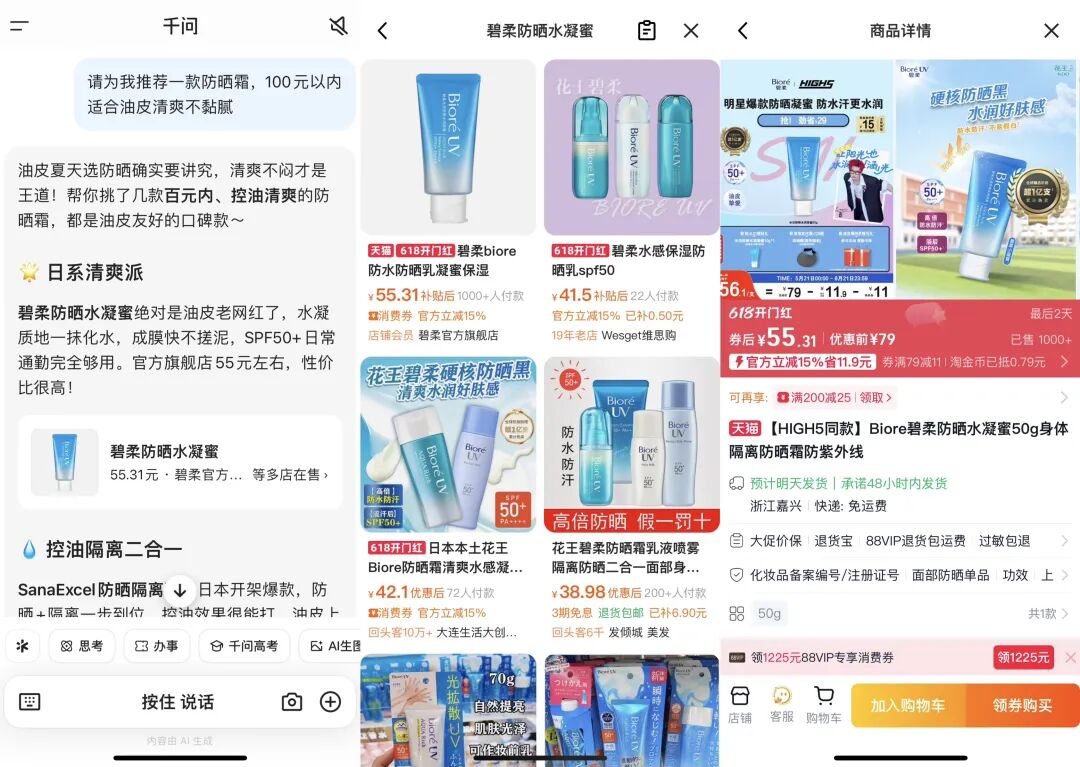
Source: Qianwen APP/Taobao APP
Qianwen is positioned as the "control center" of the entire Alibaba ecosystem, connecting core businesses such as e-commerce, cloud computing, local services, and transportation.
In addition, on the merchant side, Alibaba's "Super Marketing Intelligence Engine" - AI Wanxiang, launched in March, was fully applied during the 618 promotion. Through the coordinated operation of four agents - Wanxiang Zhishi, Wanxiang Zhipin, Wanxiang Zhizao, and Wanxiang Zhitou, the entire link from intention recognition to advertising optimization was connected. Previously, Alibaba had already integrated AI into product operation, live streaming conversion, customer service, and after-sales. This has enabled Alibaba to form a closed-loop from the consumer end to the merchant end in the AI e-commerce track.
JD.com: AI penetrates the entire value chain, from consumers to the supply chain.
JD.com has embedded AI into the entire process from procurement, warehousing, and distribution to sales and after-sales. Cao Peng, the chairman of JD.com's Technology Committee, previously proposed the formula "AI value = model × experience × industrial thickness²" at a press conference, emphasizing the squared amplification effect of the 20-year supply chain accumulation on AI efficiency. JD.com's R & D investment related to AI will increase by over 200%, and the computing power investment will reach tens of billions of yuan.
On the consumer side, JD.com's in-app AI assistant, "Jingyan", served nearly 80 million users in the first quarter, a year-on-year increase of over 200%. Users can state their needs in natural language, and the system will automatically recommend products, compare them, and assist in placing orders, significantly reducing the time cost of traditional search and browsing.
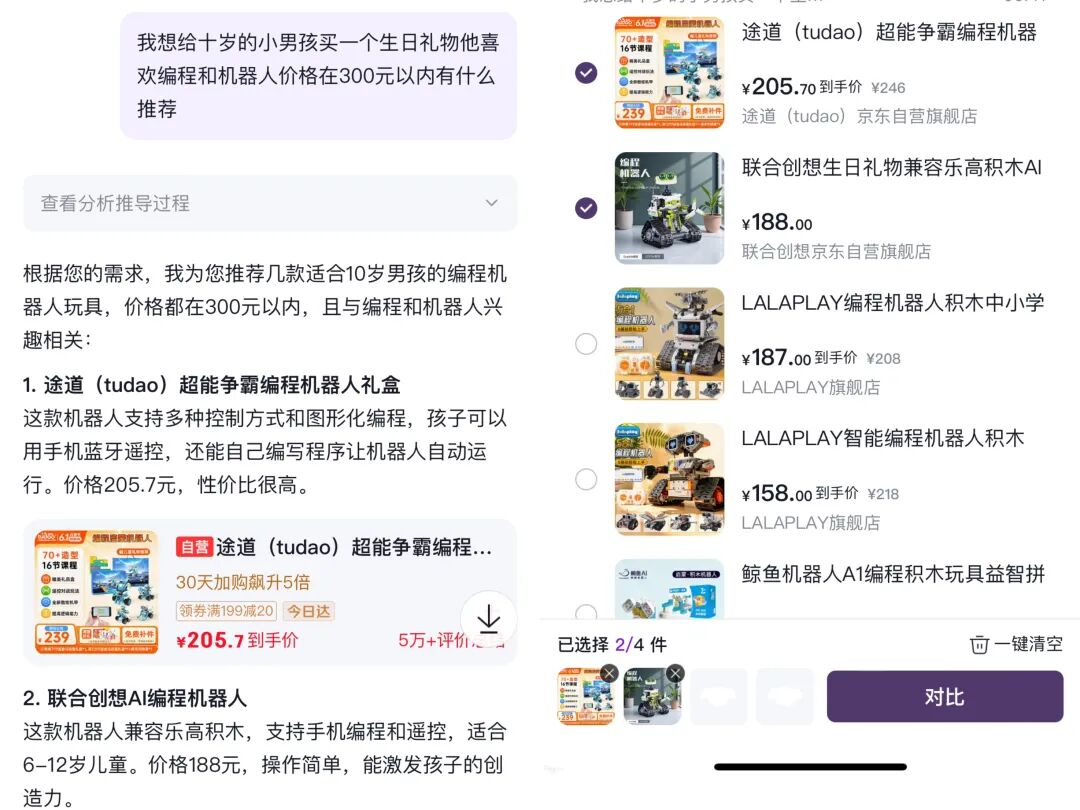
Source: JD APP
On the merchant side, JD.com's digital human live streaming service, JoyStreamer, has been freely available to over 70,000 merchants. The number of live streaming sessions in the first quarter increased by 10 times year-on-year. During the first four hours of the promotion, the number of merchants using JoyStreamer increased by 6 times year-on-year, and the turnover from live streaming sales exceeded 70 million yuan. JD.com's AI customer service, "Jing Xiaozhi", served over one million merchants, and the service volume of its large model increased by 14 times year-on-year.
Digital humans have evolved from simply "streaming and answering" to "planning, presenting, controlling the live stream, promoting sales, and conducting post-event reviews". A large home appliance merchant calculated that "reducing the time of human live streaming and using digital humans for the rest of the time can significantly lower the annual cost compared to hiring human anchors."
At the backend, JD.com's logistics "Super Brain Large Model" has been put into practical use, covering over 1,000 core supply chain scenarios. It dynamically plans the optimal transportation routes for tens of millions of order packages, reducing empty driving rates and transfer costs. AI has also been integrated into over 3,000 industrial scenarios such as health, food delivery, housekeeping, and finance.
Douyin E-commerce: An AI shopping closed-loop in the content ecosystem.
ByteDance's approach is different from that of Alibaba and JD.com. Doubao has been gradually integrated into Douyin E-commerce since October 2025. In April 2026, the "Help You Choose" function was embedded in the app's navigation bar, allowing users to directly complete product selection and order placement within Doubao without redirecting to the main Douyin site. Data from Q1 2026 shows that Doubao's monthly active users have reached 345 million.
Doubao's logic is more in line with the "content ecosystem" nature of Douyin. When users are influenced by short videos or live streams, the AI immediately conducts price comparison, discount calculation, and order placement guidance. The closed-loop of "content attraction - AI decision-making - one-click purchase" is ByteDance's core competitive advantage.
On the merchant side, Douyin E-commerce has launched the one-stop intelligent marketing system, "Qianchuan · Chengfang", which includes three modules: "Qiance" (automatic budget allocation, bidding, and product selection by the system), "Qianyi" (AIGC creation, AI business diagnosis, etc.), and "Qianxun" (full - domain precise recommendation), achieving AI - enabled intelligent marketing across all scenarios. Douyin also offers its Feige intelligent customer service to merchants for free, which can save approximately 70% of human resource costs.
In our view, AI is pushing e-commerce from the long - search "people looking for goods" era to the intelligent era of "AI understanding people and goods finding people". The outcome of this competition depends not only on the technology itself but also on who can integrate AI more deeply and practically into the essence of business - either by extremely improving transaction efficiency or by completely reshaping the consumer experience.
Why has AI become the decisive factor this year?
If we shift our perspective from the strategies of individual platforms, the most significant aspect of this year's 618 is not which platform's AI performs better, but the fundamental shift in the industry's competitive logic.
In the past three years, the main theme of e-commerce promotions has been "price competition". Platforms competed to offer deeper subsidies, forcing merchants to squeeze their profit margins and exhausting consumers with complex discount rules. However, the situation has changed this year.
A research report from Huatai Securities pointed out that the core trend of the 2026 618 e-commerce festival is "the normalization of the promotion period, and the focus of platform competition has shifted from simple price subsidies to the competition for operational efficiency, ecological synergy, and long - term user value." Guosheng Securities further clarified that this year's 618 marks the first time that AI has achieved in - depth penetration across the entire e-commerce value chain and all scenarios.
The underlying reason for this change is not hard to understand. With Pinduoduo offering monthly billion - yuan subsidies, live - streamers offering daily discounted prices, and instant retail services delivering within 30 minutes, price and delivery speed have become the norm, diluting the sense of scarcity associated with traditional promotions.
Consumers are no longer impulsively buying for the sake of "low prices" but are looking for a more efficient and hassle - free decision - making method. Beyond discounts, the platform that can help consumers find the right products fastest and help merchants complete transactions at the lowest cost will stand firmer in the competition for the existing market.
The battle for the entry point has begun in this year's 618. A more profound trend is emerging during this 618: AI shopping assistants are moving the starting point of consumers' decision - making from the "search bar" to the "dialog box". In the past, consumers' shopping path was "decide what to buy → open an e - commerce platform → search → compare prices → place an order". Now, AI shopping assistants can compress this path into "state the need in natural language → AI recommends and generates an order".
The "China Consumer Insights" report released by Accenture shows that as of January 2026, the proportion of consumers in mainland China using AI tools at least once a week has soared to 86%, far higher than the global average of about 57%. Data from Nielsen IQ also confirms this trend, with 42% of consumers already using AI tools for shopping.
Some industry experts believe that AI may be changing the underlying logic of e - commerce competition from "traffic competition" to "decision - making power competition". The platform that becomes the first access point for consumers before making a purchase will have stronger control. What Alibaba's Qianwen and ByteDance's Doubao are competing for is the "first words before placing an order" from users. Once this access point is locked by AI, the platform's distribution and bargaining power will be re - allocated.
Of course, the full - scale explosion of AI shopping capabilities will not happen overnight. Consumers' AI shopping habits are still in the slow - cultivation stage and far from the inflection point of large - scale growth.
Many industry insiders believe that the direct GMV boost brought by AI during this year's 618 is actually limited - it is not an immediate sales catalyst. The real value lies more in the background: a slight increase in conversion rates, a reduction in customer service labor costs, an improvement in the accuracy of advertising placement, and the optimization of the fulfillment path from the warehouse to delivery. These "invisible increments" are the most practical contributions of AI at this stage.
From a practical experience perspective, currently, the AI shopping functions of various platforms are mainly applied to categories with low decision - making thresholds, such as takeout and daily necessities. When it comes to products that require sensory judgment or in - depth trust, such as clothing matching, makeup color selection, and high - value electrical appliances, AI is far from being able to "take over" - there are obvious gaps in the accuracy of recommendation results and consumers' psychological sense of security.
In our view, for AI shopping to continuously create real incremental value, it needs to overcome at least three challenges: First, the recommendation logic must truly serve the interests of users; second, the threshold for using AI tools should be low enough for small and medium - sized merchants to afford and achieve results; third, consumers need to build trust through actual purchases, rather than regarding AI as just an advanced version of "guess what you like". At present, all three aspects are still in the development stage.
The greatest industry value of this year's 618 does not lie in the sales figures of a single platform, but in the fact that the "price war" in e - commerce promotions is coming to an end, and the "AI war" has begun. AI is not about "buying cheaper" but about "buying more accurately, quickly, and hassle - free".
This article is from the WeChat official account "Retail Business Review" (ID: lssync), author: Retail Business Review, published by 36Kr with permission.