Die KI übernimmt das Kommando – der 618-Verkaufsstart bekommt eine neue Strategie
Competition over artificial intelligence instead of low prices: The platforms are changing their strategies for this year's 618 Shopping Festival
At 8:00 p.m. on May 30th, JD.com's 618 Shopping Festival officially kicked off. At the same time, a series of data began to circulate across the internet - not the sudden increase in GMV, but the frequent appearance of AI-related indicators: The number of merchants conducting live-streaming with digital personas increased sixfold year-on-year. The sales revenue from live-stream sales reached over 70 million yuan. The service scope of the large-model AI customer service increased fourteenfold year-on-year.
Meanwhile, the "Qianwen AI Shopping Assistant" in the Taobao app takes over the entire decision-making process for product selection, price comparison, and ordering. On the Douyin platform, the "Helps You Select" function integrated into the navigation bar of Doubao conducts transaction after transaction within the app without the need to switch pages.
For this year's 618 Shopping Festival, the real point of competition has shifted to the depth and breadth of AI application.
The platforms are heavily investing in AI, but with different strategies
For this year's 618 Shopping Festival, the major platforms have different focuses in their AI strategies. The paths are different, but the goal is the same.
Let's first take a look at Alibaba: AI becomes the "entrance" for shopping.
On May 11th, Qianwen was fully integrated with Taobao for the first time, becoming one of the most watched industry events for this year's 618 Shopping Festival. The Qianwen app has access to 4 billion products on Taobao and Tmall. The skill library can uniformly control the e-commerce service capabilities in terms of logistics and after-sales. Users can also call up the AI assistant in the Taobao app and use functions such as AI try-on, discount calculation, and AI support for quick purchases. When users open the Qianwen app and directly state their requirements, the AI can select products, compare configurations and prices, and calculate the final price after government subsidies without the need to switch to the Taobao page.
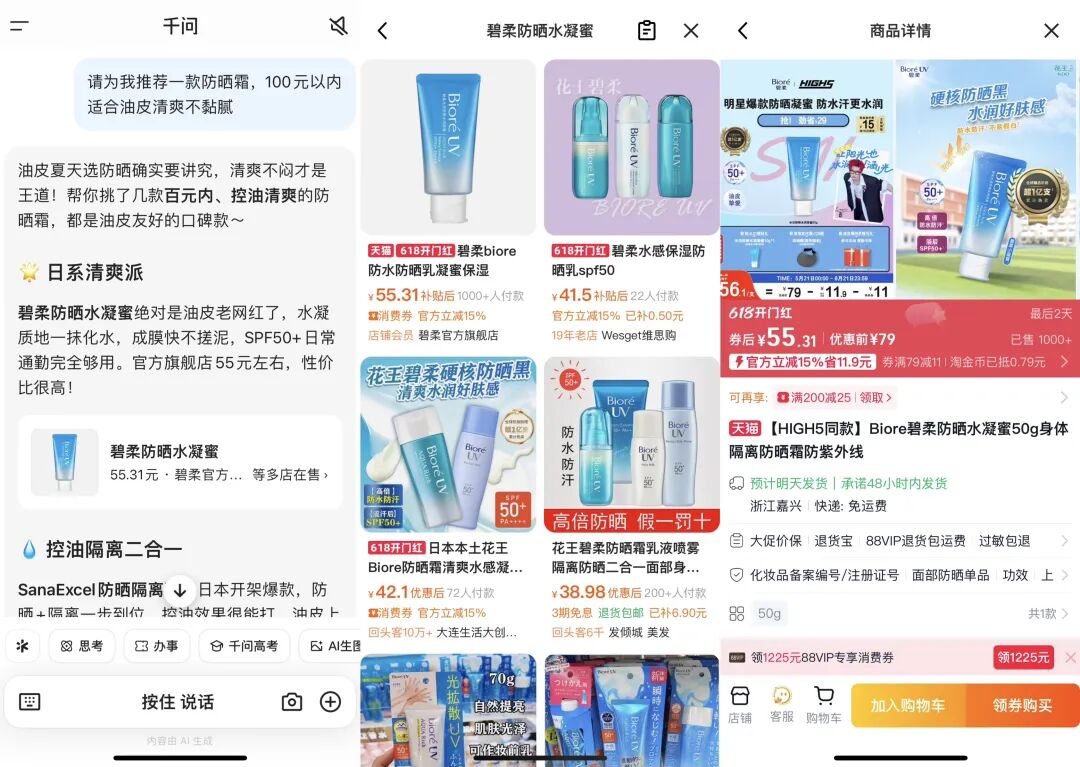
Source: Qianwen app/Taobao app
Qianwen is positioned as the "control center" of the entire Alibaba ecosystem - it connects core business areas such as e-commerce, cloud computing, local life services, and mobility.
In addition, the "Super Business Intelligence Engine" KI Wanxiang, released by Alibaba Mama in March, will be fully utilized during the 618 special event. Through the coordinated work of the four agents Wanxiang Zhishi, Wanxiang Zhipin, Wanxiang Zhizao, and Wanxiang Zhitou, the entire value chain from intention recognition to advertising placement optimization is broken through. So far, Alibaba Mama has integrated AI into areas such as product management, live-stream conversion, and after-sales customer service. This has enabled Alibaba to form a closed loop from the consumer side to the merchant side in the AI e-commerce track.
JD.com: AI penetrates the entire value chain, from the consumer side to the supply chain.
JD.com integrates AI into the entire process from procurement, warehousing, delivery to marketing and after-sales. Cao Peng, the chairman of the Technical Committee of the JD Group, presented the formula "AI value = model × experience × industry depth²" at an earlier press conference and emphasized the quadratic amplification effect of the 20-year presence in the supply chain on AI efficiency. The R & D expenditures related to AI of the JD Group will increase by over 200%, and the investment in computing power will reach an order of magnitude of tens of billions of yuan.
On the consumer side, the AI assistant "Jingyan" integrated in the JD app served nearly 80 million users in the first quarter, an increase of over 200% year-on-year. Users can state their requirements in natural language, and the system will automatically recommend products, compare and support ordering, significantly reducing the time cost of traditional searching and browsing.
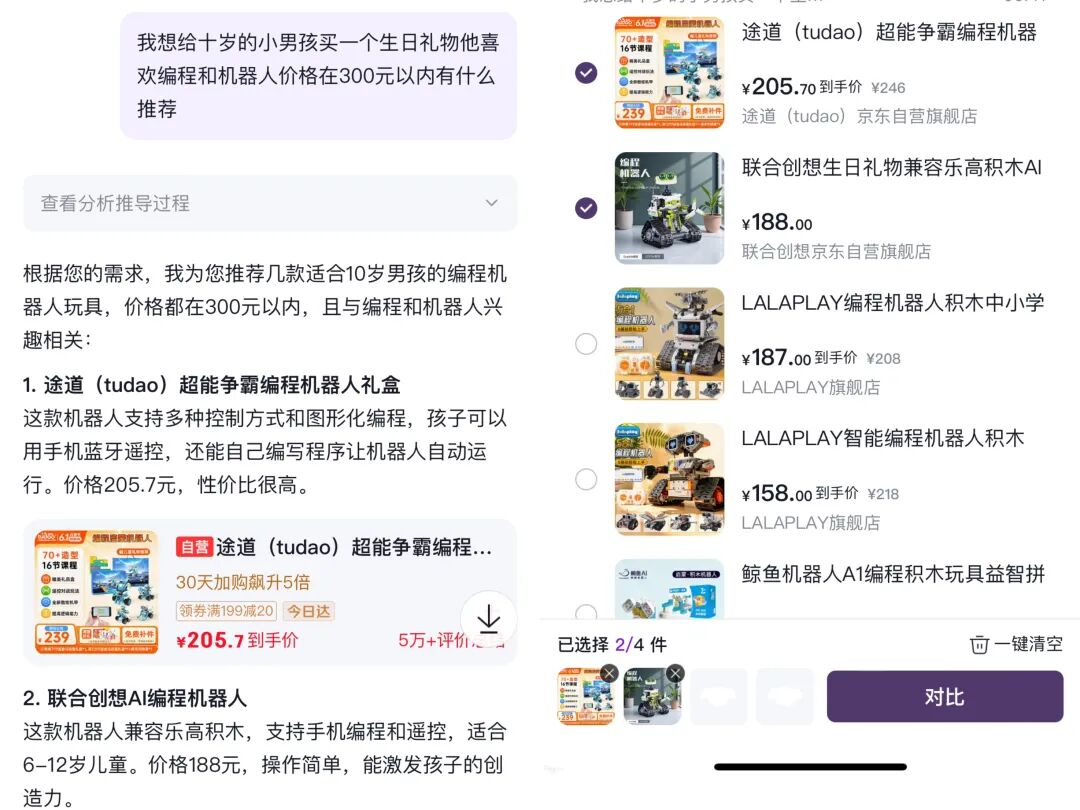
Source: JD app
On the merchant side, JD.com's digital live-stream service JoyStreamer is already freely available to over 70,000 merchants. The number of live-streamings in the first quarter increased tenfold year-on-year. In the first four hours of the special event, the number of merchants using JoyStreamer increased sixfold year-on-year, and the sales revenue from live-stream sales reached over 70 million yuan. The AI customer service "Jing Xiaozhi" serves over one million merchants, and the service scope of its large model increased fourteenfold year-on-year.
The digital personas have evolved from "live-streaming and answering" to "planning, presenting, hosting, promoting sales, and analyzing". A large merchant has calculated: "If you reduce the time for live-streaming with real people and cover the remaining time with digital personas, the annual fee is much lower than the cost of hiring a live-streamer."
In the backend, JD Logistics' "Super Brain Big Model" is put into practice, covering over 1,000 core supply chain scenarios and dynamically planning the optimal transportation route for millions of order packages to reduce the empty running rate and rerouting costs. AI is also integrated into over 3,000 industry scenarios such as healthcare, delivery service, household service, and financial services.
Douyin E-commerce: A closed AI shopping loop in the content field.
ByteDance's approach is different from that of Alibaba and JD.com. Doubao has been gradually integrated into Douyin E-commerce since October 2025. In April 2026, the "Helps You Select" function was integrated into the app's navigation bar. Users can directly handle product selection and ordering in Doubao without the need to switch to the Douyin main page. Data from the first quarter of 2026 shows that the monthly active user number of Doubao has already reached 345 million.
Doubao's logic is more suitable for Douyin's "content field". When users become curious while surfing short videos or live-streamings, the AI immediately conducts price comparison, discount calculation, and ordering prompts. The closed loop of "content attraction - AI decision - one-click purchase" is the most important barrier for the Byte segment.
On the merchant side, Douyin E-commerce has introduced the unified intelligent marketing system "Qianchuan · Chengfang", which consists of three modules: "Qiance" (automatic budget allocation, pricing, and product selection by the system), "Qianyi" (AIGC creation, AI business diagnosis, etc.), and "Qianxun" (comprehensive and precise recommendation) to achieve intelligent marketing in all scenarios with AI. Douyin also offers the intelligent customer service Feige for merchants for free, which can save about 70% of labor costs.
In our opinion, AI leads e-commerce from the long search of "people search for products" to the intelligent era of "AI understands people, products search for people". The outcome of this competition depends not only on the technology itself but also on who can integrate AI more deeply and realistically into the essence of the business - either maximize the transaction efficiency or completely reshape the consumer experience.
Why is AI the decisive factor this year?
If we shift our focus from the strategies of individual platforms, the greatest significance of this year's 618 Shopping Festival lies not in which platform advances faster with its AI, but in the fundamental shift in the competition logic of the entire industry.
In the past three years, the main theme of e-commerce special events has been the "price war". The platforms competed to offer higher subsidies, merchants were forced to reduce their profits, and consumers were completely overwhelmed by the complicated discount rules. But this year, the situation has changed.
A study by Huatai Securities shows that the core trend of the 618 special events in 2026 is that the special event period is normalized, and the competition between platforms is continuously shifting from pure price subsidies to improving operational efficiency, ecosystem cooperation, and long-term user values. Guosheng Securities has also made it clear that at this year's 618 Shopping Festival, AI has achieved deep penetration into the entire e-commerce value chain and all scenarios for the first time.
The underlying reason for this change is not hard to understand. When Pinduoduo offers hundreds of millions in subsidies every month, live-streamers break prices every day, and the instant delivery service delivers within 30 minutes, price and delivery time become "everyday things", and the rarity of traditional special events is quickly diluted.
Consumers no longer make impulsive purchases because of the "low price" but are looking for a more efficient and convenient decision-making method. In addition to discounts, the one who can find the right products for consumers the fastest and enable merchants to conduct transactions at the lowest cost can stand more stably in the existing competition.
At this year's 618 Shopping Festival, the battle for the entrance has begun. At this 618 special event, a more profound trend is emerging: The AI shopping assistant shifts the decision-making starting point of consumers from the "search bar" to the "dialog box". In the past, the shopping path of consumers was "decide what to buy → open the e-commerce platform → search → compare prices → place an order"; now, the AI shopping assistant can shorten this path to "state requirements in natural language → AI recommends and creates the order".
A study called "Chinese Consumer Insights" by Accenture shows that by January 2026, the proportion of Chinese consumers who use an AI tool at least once a week has risen to 86%, far higher than the global average of about 57%. Nielsen IQ data also confirms this trend: 42% of consumers have already used AI tools for shopping.
Some industry experts believe that AI may change the underlying logic of e-commerce competition from "traffic competition" to "decision-making power competition". The one who becomes the first entrance for consumers before purchasing has a stronger leading role. What Alibaba's Qianwen and ByteDance's Doubao are aiming for is the "first word from consumers before placing an order" - once this entrance is set by AI, the distribution and negotiation capabilities of the platform will be redistributed.
Of course, the full development of AI shopping capabilities will not happen overnight. Consumers' AI shopping habits are still in the slow cultivation phase and are far from the turning point of mass development.
Several industry insiders believe that the direct GMV increase brought by AI during this year's 618 Shopping Festival is actually limited - it is not an immediate sales catalyst. The real value lies more in the background: a slight increase in the conversion rate, a reduction in customer service labor costs, higher precision in advertising placement, and a gradual optimization of the performance paths from warehousing to delivery. These "invisible increases" are the most realistic contributions of AI at the current stage.
Based on actual experience, the AI shopping functions of various platforms are currently mainly used for delivery services, standard daily-use products, and other categories with low decision-making thresholds. When it comes to clothing combinations, cosmetic colors, expensive electrical appliances, and other products that require sensory evaluation or deeper trust, AI is still far from being able to "take over the work" - both the accuracy of recommendations and the psychological sense of security of users have significant gaps.
In our opinion, AI shopping must overcome at least three hurdles to truly create additional value: First, the recommendation logic must truly serve the interests of users; second, the threshold for AI tools must be low enough so that small and medium-sized merchants can use them and achieve results; third, consumers must build trust through a series of actual purchases instead of regarding AI as an "enhanced version of 'what you like'". At present, all three aspects are still in the upward phase.
The greatest industry value of this year's 618 Shopping Festival lies not in the sales figures of a single platform, but in the fact that the "price war" in e-commerce special events is coming to an end and the "AI race" is beginning. AI does not solve the problem of "buying cheaper" but the problem of "buying more accurately, quickly, and conveniently".