Is it a good sign that AI glasses with "no consensus" are seeking differentiation?
The most delicate aspect of AI glasses at present is that they seem capable of doing everything, yet users find it even harder to explain why they need them.
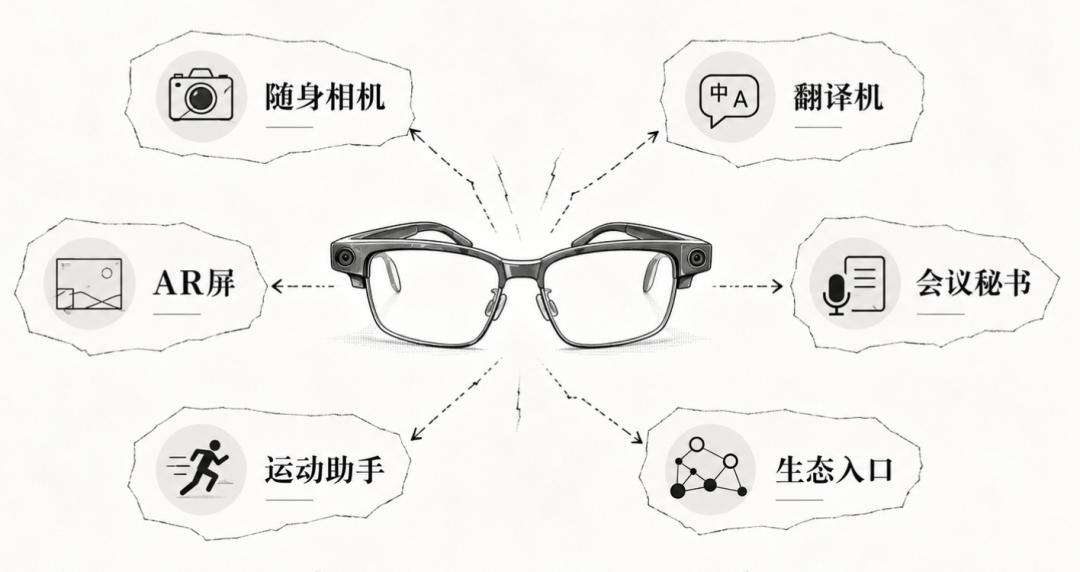
Manufacturers have envisioned numerous identities for them: a portable camera, a translator, a meeting secretary, a sports assistant, an AR gateway, and a new screen after the mobile phone. Each direction sounds reasonable, but when put together, it's as if a pair of glasses has been prematurely split into too many personas.
"In the past two years, the industry overestimated the performance capabilities of AI in glasses. In 2025 alone, at least 200 new functions were launched for various AI glasses, but the long - term usage rate of these new functions is less than 6%." Li Hongwei, the CEO of Thunderbird Innovation, said straightforwardly at a recent new product launch event.
This highly contrasting figure almost lays bare the current awkward situation of AI glasses.
This sense of misalignment may not stem from a lack of differentiation.
On the contrary, AI glasses are too eager to prove their uniqueness. For a new product category that has not been truly understood by the public, entering the differentiation competition too early may not make its profile clearer. Instead, it may cover up the most fundamental question:
What kind of glasses is it first, and then what can it become?
01 The Track Is Crowded, While Users Are Still Trying Them On
The popularity of AI glasses is no longer just a pure concept.
Overseas, samples like Ray - Ban Meta have emerged. EssilorLuxottica once disclosed that since its launch in September 2023, the sales volume of Ray - Ban Meta has exceeded 2 million pairs. Reuters also reported this year that Meta and EssilorLuxottica once considered increasing the annual production capacity of Ray - Ban smart glasses to 20 million pairs by the end of 2026, provided that the demand continues to grow.

Image source: Ray - Ban Meta
Looking at the domestic market, the global shipments of smart glasses are expected to reach 12.8 million units in 2025, a year - on - year increase of 26%; the Chinese market is expected to reach 2.75 million units, a year - on - year increase of 107%. Players such as Xiaomi, Quark, Rokid, Thunderbird, Xiaodu, and Huawei have successively entered the market. AI glasses have changed from a concept that "can be discussed" to an increasingly crowded track.
Data is the best barometer, indicating that smart glasses are not a completely illusory imagination. Some products have entered the real consumer market.
This also explains why the industry is excited. Glasses are one of the most familiar wearables to humans. Now, with the addition of cameras, microphones, voice interaction, and large models, it's easy to spark imagination.
For large manufacturers, AI glasses are like an admission ticket that they can't afford to miss. Models can compete in the cloud, and apps can attract users on mobile phones. But if the next - generation AI services really need a more personal entry point, no one wants to find themselves without a place at that time.
The form of glasses is quite appealing. It is close to people's eyes, as well as to sounds, the environment, movement routes, and real - world data. Mobile phones need to be taken out, speakers are confined to rooms, headphones lack visual information, and watch screens are too small. Glasses seem to stand in a delicate position: close enough to people and easy enough to be portrayed as the future.
However, the popularity only means that manufacturers see opportunities, which does not mean that users have figured it out.
Before purchasing, users are easily attracted by functions such as shooting, translation, meeting minutes, navigation, and payment. After buying, the real factors affecting usage often become a set of more practical problems: whether it can be worn for a long time and used stably, whether it will disturb themselves, and whether it will make others uncomfortable.
In other words, AI glasses can translate, navigate, record, shoot, and answer questions. The real trouble is that many products are still at the "usable" stage and are still far from being "good enough to be worn every day".
A slower voice wake - up, a delayed translation, a warmer temple piece, a faster battery drain, or a longer - lasting pressure on the nose bridge will gradually erode the sense of the future.
Many media have cited XR Vision data, stating that the return rate of AI glasses on platforms such as JD.com and Tmall is about 30%, and it can reach 40% to 50% on live - streaming channels such as Douyin. Regardless of the specific caliber of this data, it points to a very real gap at the consumer end: users are not reluctant to try new things. Many people are willing to place an order for a new thing that "seems to have a great future". The real difficulty is, after trying it out, whether this pair of glasses can be worn on the second, third, or tenth day.
Before these problems are stabilized enough, it is difficult for AI glasses to reach a consensus. But before users wait for a reason to wear them with peace of mind, manufacturers have already started the differentiation battle.
This also adds a layer of delicacy to the current popularity of AI glasses: the industry is already eager to answer "how I am different from others", but the most fundamental question for users has not really been answered.
02 Many Differentiations Are Still at the "Tempting Points"
The differentiation of AI glasses is not a bad thing in itself.
It is easy for early - stage product functions to overlap. Functions such as shooting, recording, translation, Q&A, navigation, and meeting minutes look similar at first glance. No manufacturer wants to make "another pair of similar glasses", so they start to target niche groups, niche scenarios, and niche forms.

Shooting and recording are one direction. First - person shooting, open - audio, and voice assistants make glasses like a more natural portable camera.
Office work and meetings are another direction. Recording transcription, meeting minutes, and efficiency tools make it seem capable of sharing some of the work tasks in mobile phones and computers.
Translation and travel are also a direction. Real - time translation, navigation, and travel assistance are naturally easy for users to understand.
AR display and portable screens are yet another direction. Some people describe glasses as lightweight display devices, portable office screens, or spatial screens.
As for ecological capabilities such as payment, maps, e - commerce price comparison, and travel reminders, it's more like large manufacturers are moving their service systems into glasses. They can enrich the product, but they also make it easier to portray a pair of glasses as another mobile phone entry point.
These directions are all valuable. However, most of the time, they are still answering "what else can this pair of glasses do", and have not jointly answered "what exactly are AI glasses".
It sometimes seems like a camera, sometimes like a pair of headphones, sometimes like a translator, sometimes like a meeting tool, and sometimes like a secondary screen for a mobile phone. Each identity is valid, but with too many identities, it becomes even more difficult for users to remember its truly irreplaceable part.
"The AI glasses industry has passed the technology verification stage. The real bottleneck lies not in the number of functions, but in whether the scenarios are high - frequency, essential, and irreplaceable." This judgment by a relevant person in charge of Liangliang Vision is just right to explain the hollowness behind the current popularity of AI glasses.
Shooting, translation, meeting minutes, and cycling navigation may really be useful at certain moments. They can create points for dissemination and make a product easier to remember.
However, these are not enough to be the answer for a new product category.
For a new product category to truly gain a foothold, it usually needs to first let users form a stable understanding. Mobile phones can later be divided into imaging phones, gaming phones, and foldable - screen phones because users have accepted that mobile phones are portable computing terminals; smart watches can be divided into outdoor watches, professional sports watches, and business watches because "health, sports, and notification devices worn on the wrist" have been accepted by many people.
AI glasses have not fully reached that stage yet.
The common answer is not stable yet, but the branches are growing rapidly. Everyone wants to prove their uniqueness first, but they may jointly scatter the things that users should understand first.
Compared with adding one more scenario, what AI glasses lack more may be a strong enough common reason: at which moments is it more natural than mobile phones, headphones, and watches, and why must that thing happen on a pair of glasses.
Shooting, translation, meetings, sports, and AR screens can make the product easier to promote and create reasons for users to try new things. But for AI glasses to form a basic answer that the public can understand, they finally have to return to those less glamorous but unavoidable common problems.
It's not that no one is moving forward with AI glasses, but they are not on the same path. Standing at the crossroads, users don't see the answer, but a bunch of direction signs.
Tempting points make people want to try, while pain points determine whether this category can stay.
03 A Pair of Glasses First Needs to Reconcile with the Face
AI glasses ultimately have to return to the essence of glasses.
This statement may sound a bit convoluted, but it may be the most easily overlooked aspect of this product category.
AI glasses are different from mobile phones, headphones, and watches. Mobile phones can be put back in the pocket, headphones can be hidden in the ears, and watches can be slipped into the cuffs, but glasses are always on the face. Its pain points will not just stay on the parameter page but will be felt on the nose bridge, beside the temples, behind the temple pieces, and also in the eyes of the person opposite.
Many problems that determine the fate of AI glasses are not suitable to be written on posters.
What is often magnified first is the physical feeling.
Weight, heat generation, nose pads, temple pieces, and myopia adaptation are not small details. For things worn on the face, the nose bridge and ears are more honest than the parameter table. A difference of a few dozen grams doesn't matter much in the pocket, but when hung on the face, it will gradually become noticeable during commuting, meetings, walking, and looking down.
For myopic users, it has to outperform a pair of lighter and more comfortable ordinary glasses; for non - myopic users, it has to make a person who doesn't usually wear glasses accept something that will stay on the face for a long time. This is much more difficult than persuading users to download an app.
This is why AI glasses can't just stay on the digital shelves. Rokid and Maoyuanchang Glasses opened a smart glasses fitting concept store in Hangzhou's Grand Gateway 66, integrating smart glasses experience, professional fitting, and customized glasses in the same space. This small approach can well illustrate the problem: for AI glasses to enter daily life, they will sooner or later enter the slower process of optometry, glasses fitting, trying on, and adjustment.
Beyond the physical aspect, the stability in daily use will also gradually become apparent.
Whether the battery life is sufficient, whether the display is clear, whether it can be seen in strong outdoor light, whether the app connection keeps jumping, and whether the voice wake - up is stable all determine whether it can move from being "usable" to being "commonly used".
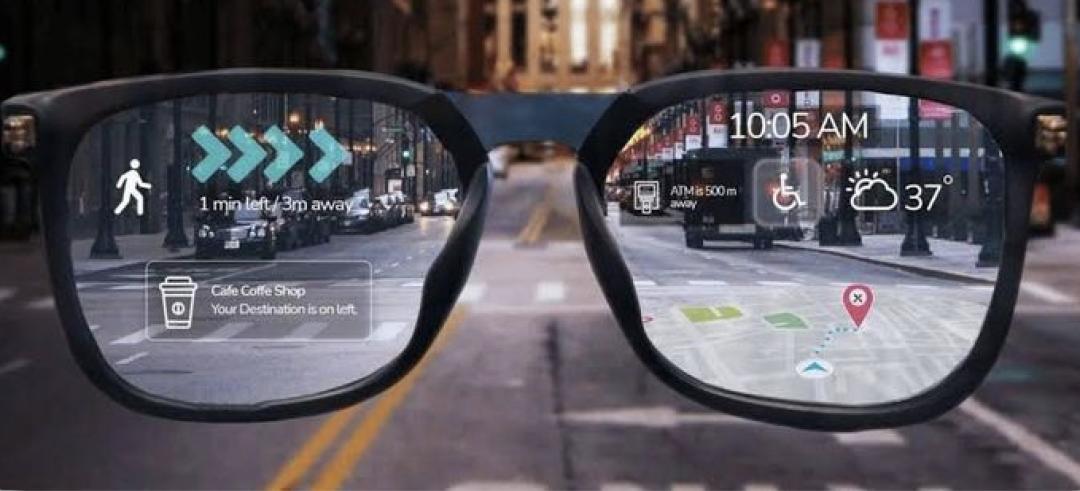
Image source: pinterest
The weight of AI glasses is not just about grams. Every wait, wake - up, touch of the temple piece, and re - connection will make it a bit heavier. If a function that could originally be completed by taking out the mobile phone now requires relay between glasses, the mobile phone, and the app, the so - called "hands - free" will become a new hassle.
What really matters is not whether a function has been moved to the face, but whether it has made that thing easier.
What is more likely to be underestimated is that it has entered the space between people.
When AI glasses are worn on the face, they also enter the boundaries of others being seen, photographed, and recorded. Privacy is not an additional issue but a part of whether it can be accepted in public spaces. Whether users are willing to wear them is the first hurdle; whether others are willing to coexist with them is the second hurdle.
These problems may not seem as exciting as "200 new functions", but they determine whether AI glasses can become a stable product category.
For AI glasses, weight, battery life, appearance, and privacy are never just details of the experience. They are the foundation of the category.
When the foundation is not stable enough, AI glasses don't have to be in a hurry to escape all homogenization.
Some homogenization is actually verifying what users are willing to pay for. When an industry repeatedly develops certain basic capabilities in the early stage, it is not necessarily due to a lack of imagination but rather an exploration of the same difficult problem: what functions will be used repeatedly, and what kind of experience will make users willing to keep wearing them.
The primary nature of AI glasses may not be AI, but glasses.
This is also the inspiration from Ray - Ban Meta.
Its significance does not lie in having the most functions or answering all the questions. It is more like a reference: by leveraging the brand image of Ray - Ban glasses, it allows intelligent capabilities to enter a more acceptable daily form. It didn't pile complex displays on the face at the beginning but first used shooting, open - audio, and voice AI to lower the threshold of entering people's lives.
This doesn't mean that all manufacturers have to follow Meta. Chinese manufacturers have their own supply chains, model capabilities, consumption scenarios, and product paths. However, Ray - Ban Meta at least reminds the industry of one thing: for AI glasses to enter the public's life, the first step may not be to stack functions but to make it look like a pair of glasses that can be worn for a long time.
First, let users feel that "this is just a pair of glasses that can be worn when going out", and then intelligent capabilities will have the opportunity to gradually develop.
There is not much room on the face for excessive ambition.
Each additional module may bring problems such as weight, battery life, heat generation, visual interference, and aesthetic costs. The real difficulty is not to come up with another scenario for the glasses but to judge which capabilities are worth keeping on the face and which should stay in the mobile phone within the limited space.
The basic answer for a pair of AI glasses may not necessarily be found in a grand narrative like "the next - generation mobile phone entry point".
It may first need to prove three smaller things:
It is a pair of glasses that users are willing to wear for a long time;
It is more natural than mobile phones in a few high - frequency scenarios;
Its AI capabilities are not for show but can stably reduce a real hassle.
These three things may not sound as exciting as "the next - generation entry point", but before they are stabilized, differentiation