The Chasers Behind Pop Mart: The Battle of "Exclusive IPs" in the Second Half of the Trendy Toy Market
In the first quarter of 2026, the financial reports of the trendy toy industry presented a polarized picture.
Mingchuang Youpin is expected to see a profit growth of 195% - 200% during the period. However, more than 70% of this growth comes from the investment income of the AI company MiniMax. After excluding this part of the income, the profit of the main business increased by 7% - 10%. Qimengdao earned nearly 90 million yuan in a single quarter with its WAKUKU IP, a quarter-on-quarter increase of 93.3%. The net profit attributable to the parent company of Brook fell by 76.5% year-on-year. The non-recurring profit of Aofei Entertainment decreased by 21.48%, and its operating cash flow was negative.
Just a few months ago, Pop Mart just presented a report card in 2025 that made the industry envious: The annual revenue was 37.12 billion yuan. The LABUBU IP alone sold 14.16 billion yuan, with a gross profit margin as high as 72.1%. In 2026, Pop Mart's overall revenue in Q1 increased by 75% - 80% year-on-year, and the revenue in the Chinese market increased by 100% - 105%.
The data of Q1 in 2026 laid bare the dilemmas of the companies chasing after Pop Mart. Brook's sharp profit decline shows that the "licensed IP + 9.9 yuan" model is vulnerable in the price war. The single-digit growth of TOP TOY's main business indicates that the marginal benefit of store expansion is decreasing. Aofei Entertainment's decline in non-recurring profit despite having the Pleasant Goat IP shows that having an IP and being able to develop an IP are two different things.
These dilemmas point to three more fundamental questions: Without Pop Mart's model, how can trendy toy companies survive? What changes have actually taken place in each company's self-owned IPs? If they have to learn from Pop Mart, who can learn the most effectively?
All are developing self-owned IPs, but the "wealth gap" is huge
The proportion of self-owned IP revenue of TOP TOY increased significantly in the second half of 2025 - it soared from 0.5% in June to 5.7% in December. Although the overall proportion is still relatively low, the annual sales of its flagship self-owned IP "Nommi" exceeded 200 million yuan in 2025. As of March 2026, the number of self-owned IPs has increased to 24.
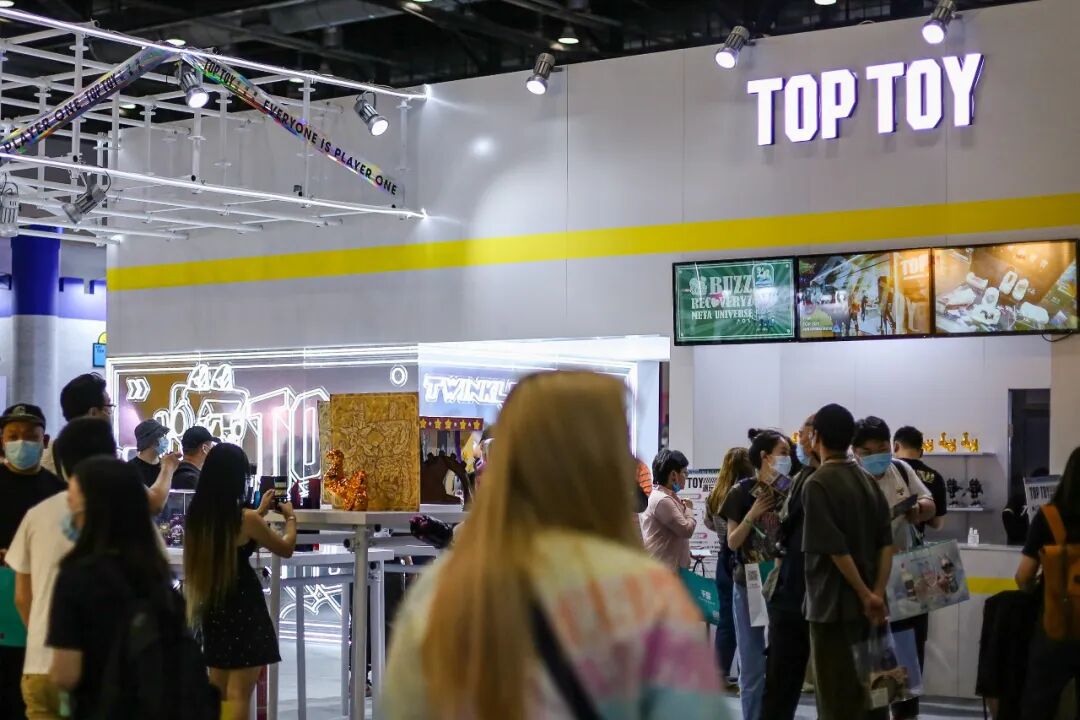
This means that although more than 94% of TOP TOY's current revenue still comes from non-self-owned IPs, the strategy of "using channels to nurture IPs" has begun to show results.
According to the data in TOP TOY's prospectus in 2025, its annual revenue in 2025 was 3.587 billion yuan, a year-on-year increase of 87.9%. The adjusted net profit was 522 million yuan, a year-on-year increase of 77.5%. As of the end of 2025, it had 334 stores globally, and the number of overseas stores increased to 39 in March 2026.
TOP TOY did not separately release its Q1 financial report for 2026. The latest data of its parent company, Mingchuang Youpin, revealed a key signal: In the first quarter of 2026, Mingchuang Youpin is expected to have an income of about 5.678 billion to 5.728 billion yuan, a year-on-year increase of about 28% to 29%. After excluding exchange gains and losses and investment income, Mingchuang Youpin's adjusted net profit is about 624 million to 644 million yuan, a year-on-year increase of only 7% to 10%. This means that the growth of the retail main business of Mingchuang Youpin and TOP TOY has significantly slowed down.
The flagship IP "WAKUKU" of Qimengdao had a single-quarter revenue of 89.73 million yuan, accounting for more than 70% of the total revenue. The revenue of the Chinese-style IP "ZIYULI" was 20.76 million yuan. The revenue of "SIINONO", which was launched in mid to late July, was 12.89 million yuan.
Qimengdao does not produce traditional blind boxes. Its products have entered nearly 20 countries in North America, Europe, Southeast Asia, and the Middle East through its distribution network. In terms of the supply chain, the monthly production of plush blind boxes exceeded 1 million pieces in August 2025, more than 20 times the production at the beginning of the year.
Although Qimengdao is not large in scale, it is growing rapidly. In the first quarter of fiscal year 2026 (from July 1, 2025, to September 30, 2025), the total revenue of its trendy toy business was 127.1 million yuan, a quarter-on-quarter increase of 93.3%, exceeding the upper limit of the performance guidance range. The company expects its revenue in Q2 of fiscal year 2026 to be 150 million - 160 million yuan.
Brook's self-owned IP "Hero Infinite" has been in operation for many years. In 2025, its revenue was 264 million yuan, accounting for less than 10% of the total revenue.
Brook's overall performance was poor in Q1 of 2026: Its revenue was 5.95 billion yuan, a year-on-year increase of 2.7%. The net profit attributable to the parent company was 28.9 million yuan, a year-on-year decline of 76.5%. The gross profit margin decreased from 48.8% to 46.1%, and the net sales profit margin was only 1.91%. In just three months, the "good story" of turning losses into profits in 2025 has become "bad news" of a sharp profit decline, revealing the vulnerability of the "license dependence + low-price volume" model when industry competition intensifies.
The prospectus submitted by 52TOYS in May 2025 showed that self-owned IPs accounted for 24.5%, and licensed IPs accounted for 64.5%.
As of March 2026, 52TOYS had more than 35 self-owned IPs such as Nook, Beast Box, and Pangda You, as well as licensed IPs such as Crayon Shin-chan, Disney, and Sanrio. Just the Crayon Shin-chan IP alone drove a GMV of more than 600 million yuan from 2022 to 2024.
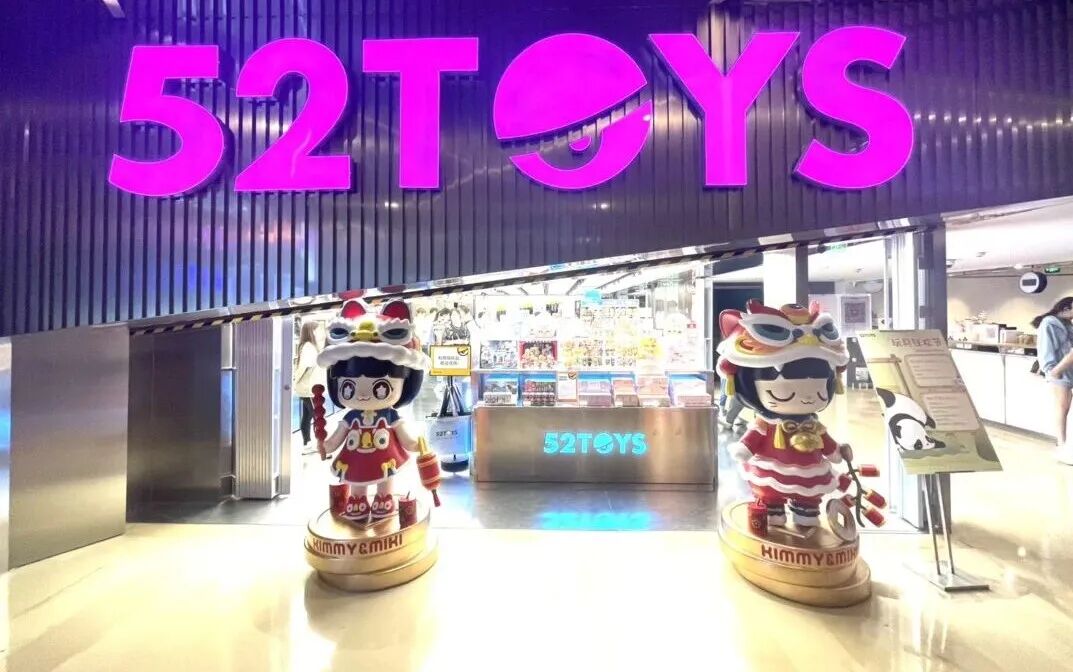
Self-owned IPs have not brought higher profits to 52TOYS. In 2024, 52TOYS' revenue was 630 million yuan, the adjusted profit was about 32.01 million yuan, and the net profit margin was only 4.7%. A net profit margin of 4.7% means almost no ability to resist risks - a 10% increase in licensing fees, a 5% increase in supply chain costs, or the unsalable of a single SKU could directly wipe out the profits.
Aofei Entertainment, which owns two national-level self-owned IPs, "Pleasant Goat and Big Big Wolf" and "Super Wings", has been slow to act in the trendy toy era and has not achieved the desired growth despite having these IPs.
In the first quarter of 2026, Aofei Entertainment's total operating revenue was 654 million yuan, a year-on-year decrease of 0.54%. The net profit attributable to the parent company was 54.7179 million yuan, a year-on-year increase of 11.44%. However, the non-recurring net profit was only 36.1078 million yuan, a year-on-year decrease of 21.48%. The net cash flow from operating activities was -40.7158 million yuan, indicating pressure on its hematopoietic ability.
In May 2026, Aofei finally took action: It announced the strategic upgrade of its trendy toy business with a dual-brand strategy. "Wandian Wuxian" will continue to focus on small particle building blocks, and the cumulative sales of the "Stacking Series" have exceeded 80 million pieces. The newly launched MIEMIE WORLD is positioned as an original artist lifestyle brand. At the same time, it launched the Pleasant Goat trendy toy plan.
Yuewen is a player in another field, but it has achieved "trendy toy-style growth" in terms of IP. It entered the AI comic drama field in the second half of 2025. In just half a year, the revenue from AI comic dramas exceeded 100 million yuan, with nearly a thousand works launched and more than a hundred of them having a playback volume of over 10 million. In 2025, the GMV of its IP derivative business exceeded 1.1 billion yuan, more than twice that of 2024.
Hou Xiaonan, the CEO of Yuewen, said, "AI is the super productivity for mining the rich IP resources." Yuewen's model is not mutually exclusive with Pop Mart's - Yuewen is good at creating IP content from scratch, while Pop Mart is good at turning existing IPs into toys for sale.
Three ways of survival: The divergence of the survival logics of trendy toy companies
The data of Q1 in 2026 laid bare the cards of each company. However, if we only look at the profit fluctuations, it is easy to draw a simple conclusion of "who is good and who is bad". What really deserves to be questioned is: What is their logic of making money? How long can this logic last?
From the current situations of the six companies, we can clearly see three completely different survival logics.
▎Logic 1: IP retailization - Making money from channels
TOP TOY is the most typical representative of this path. In essence, it is not an IP company but a trendy toy retailer.
334 global stores, 12 million members, and more than 700 SKUs - these are TOP TOY's core assets. When consumers enter TOP TOY, they see Sanrio, Disney, Crayon Shin-chan, and the blind box displays of various other brands and licensed IPs. TOP TOY makes money by "putting these products in front of consumers".
The advantages of this model are obvious: fast expansion, risk dispersion, and stable cash flow. If one IP doesn't work, just replace it with another. In 2025, TOP TOY's revenue increased by 87.9%, and its adjusted net profit increased by 77.5%, which proves that this model is very effective during the scale expansion period.
However, the problem lies in the ceiling: The gross profit margin is 32.1%, far lower than Pop Mart's 72.1%. This means that in essence, TOP TOY makes meager profits from retail rather than the premium of IPs. When the store expansion reaches a certain density and the revenue per store starts to decline, the growth will slow down - In Q1 of 2026, the main business of its parent company, Mingchuang Youpin, only increased by 7% - 10% after excluding investment income, which is already a dangerous signal.
TOP TOY's coping strategy is "using channels to nurture IPs" - using the cash flow and user data from stores to support the incubation of self-owned IPs. However, more than 94% of its revenue still comes from non-self-owned IPs, which means it is still far from "becoming Pop Mart".
TOP TOY's survival logic can be summarized as: First, be the "Android" of trendy toys, and then use the money earned to nurture its own "iOS". The question is, can the profit margin of Android support iOS?
▎Logic 2: High-volume sales with cost-effectiveness - Making meager profits
Brook is the most extreme example of this path. Its business model can be simplified into a formula: Super licensed IP + 9.9 yuan low price + Building block category barrier.
This model worked in 2025 - the revenue was 2.913 billion yuan, and it turned losses into profits. The three licensed IPs, Ultraman, Transformers, and Kamen Rider, supported a story of a market value of tens of billions.
However, the data of Q1 in 2026 exposed all the loopholes in this story: The revenue only increased by 2.7%, the net profit attributable to the parent company plummeted by 76.5%, and the net sales profit margin was only 1.91%.
What happened? The dual squeeze of licensing fees and price war broke out simultaneously. On the one hand, the licensing fees of top IPs such as Ultraman and Transformers are increasing every year. On the other hand, when competitors also launch products at 9.9 yuan, Brook has no bargaining power. The self-owned IP "Hero Infinite" accounts for less than 10%, which is far from enough to hedge the risks of licensed IPs.
52TOYS is another example of this path, but its situation is more embarrassing. The licenses of its core IPs will expire concentratedly from 2025 to 2027. If the copyright holders raise the prices when renewing the licenses, a net profit margin of 4.7% means almost no ability to resist risks.
The core dilemma of the high-volume sales with cost-effectiveness logic is that you make meager profits, but users don't recognize you. When the cost increases or the competition intensifies, the profit margin is the first to be squeezed.
▎Logic 3: IP assetization - Making money from IPs
Aofei Entertainment is a potential player on this path and also the most regrettable case.
It has two national-level self-owned IPs, "Pleasant Goat and Big Big Wolf" and "Super Wings". Logically, it should be the company most qualified to take the "IP assetization" route. However, in 2025, the revenue of its toy business was only 953 million yuan and showed a downward trend. Pleasant Goat has been around for 17 years, but Aofei has not developed a decent derivative system for it.
In May 2026, Aofei launched the original artist brand MIEMIE WORLD and started the Pleasant Goat trendy toy plan. Whether it can succeed depends on its execution ability in the next year.
Yuewen's logic is that an IP can be adapted into comics, animations, short dramas, games, and derivatives. For each additional form, there will be an additional source of income. This is not the logic of selling toys but the logic of selling IP assets.
The core challenge of the IP assetization logic is that having an IP and being able to develop an IP are two different things. Aofei has IPs but doesn't know how to develop them. Yuewen can develop IPs but needs to realize the value through downstream companies. Whoever can do both things well has the opportunity to become the next Pop Mart.
The advantage of this model is the highest profit margin and the longest IP life cycle. The disadvantage is that the threshold is also the highest - it requires continuous content production ability, which cannot be solved by simply investing money.
Qimengdao's path is difficult to be classified into any of the above three logics. Its core asset is the "emotional resonance" conveyed by WAKUKU, and the real engine of its popularity is "star endorsement + fan economy" - The artists of Lehua Entertainment bombarded through the whole matrix, with more than 1 billion social media exposures, and the star's same-style products were speculated to several times the original price. Without almost any physical stores, WAKUKU achieved a quarterly revenue of nearly 90 million yuan with this asset-light approach and even exceeded LABUBU in sales on JD.com for a while.
Qimengdao has proved one thing: In Pop Mart's territory, the asset-light approach of "star endorsement + fan economy" can still quickly break