Write certainty into agriculture: The answers bought with three million in tuition fees, two failures, and four outsiders | 2026 AI Partner · Beijing Yizhuang AI + Industry Conference
Two failures and 30 million yuan in tuition fees - there is no easy script for entrepreneurship. This is the real "ticket" for Luyu Technology to delve into agricultural AI. While 99% of people are still using AI to write copy and do design, some have thrown it into fish ponds, just to solve the most basic problem: uncertainty.
Lu Min's experience of transforming from an 18-year IT professional into a "new farmer" reveals the cruelest truth of aquaculture: in a 1.38 trillion yuan market, the digital penetration rate is less than 5%. A small pond can wipe out millions. This sharing doesn't involve grand narratives, only the hard lessons learned from moving from the unknown to the known, from relying on luck to calculating data: what agriculture needs is not speed, but certainty.
The following is the speech content of Lu Min, the co-founder and CTO of Luyu Technology, edited by 36Kr:
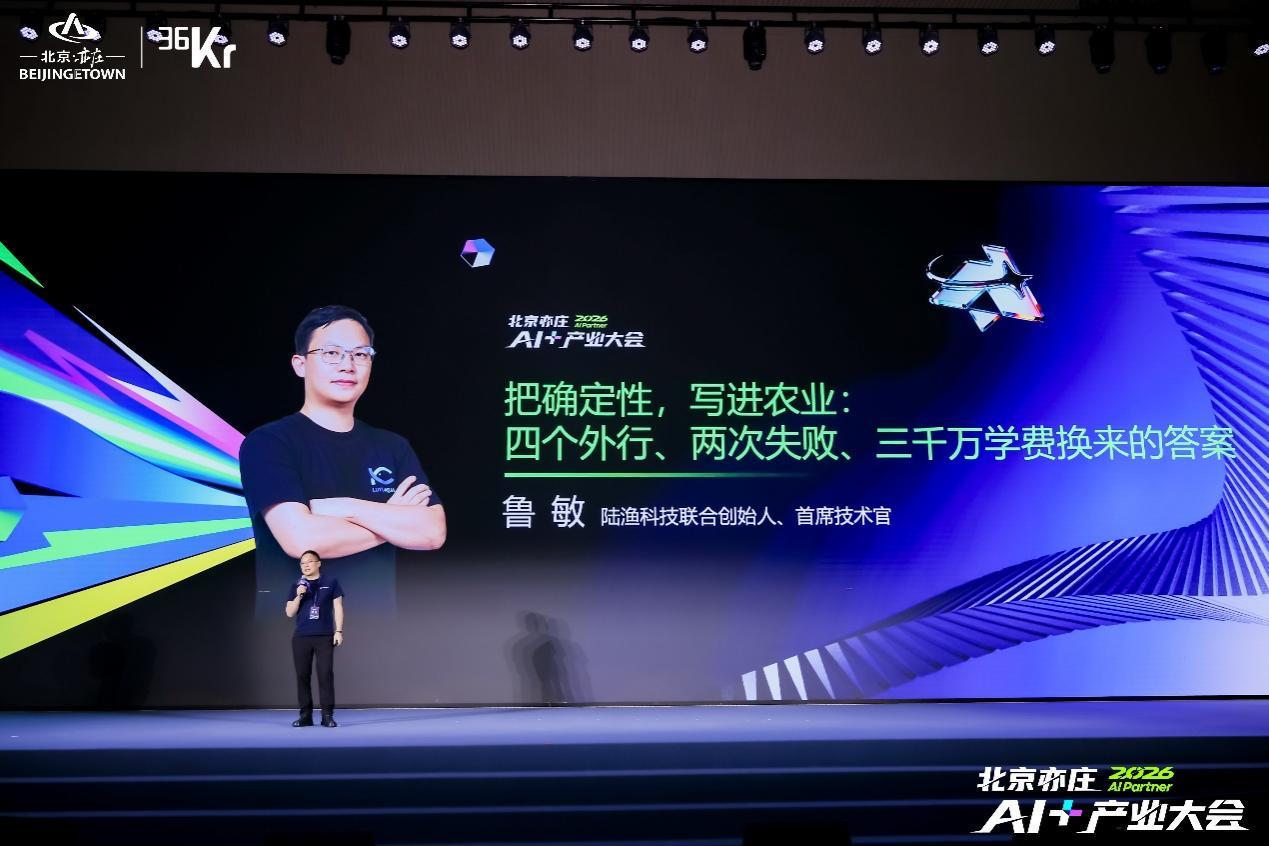
Lu Min | Co-founder and CTO of Luyu Technology
First of all, I'd like to thank 36Kr for inviting me to participate in the AI Partner Industry Conference held in Yizhuang, Beijing. I'm Lu Min from Luyu Technology. I'm what's called a "new farmer" who raises fish. Before getting to the topic, I'd like to tell you our entrepreneurship story. It might be the least professional story here. Through this story, you can understand what we do.
There were four of us: a programmer who writes code, a product manager, a real - estate seller, and a guy who provides electronic chip solutions. None of us had any connection with agriculture. I'm that programmer, an IT professional who had worked in the front - line of the Internet industry for 18 years. In our circle of friends at that time, we had occupations that others envied. The Internet, real estate, and high - end chips were all glamorous and promising industries. By chance, at a dinner, we met a friend who was in the fish - farming business. He told us about hatching perch fry, raising the tiny fry from small fishing villages to about 10 cm long. We were very curious. At that time, the Internet and real - estate markets were quite saturated, with few opportunities. So we decided to invest 130,000 yuan to try fry hatching. To our great surprise, in just 42 days, our investment of over 100,000 yuan yielded a return of over 400,000 yuan. We did a simple calculation. The gross profit of a single fry was nearly 300%. We thought that if we raised tens of millions of fry, we'd achieve financial freedom in no time. The profit margin was extremely high, and it was a high - frequency demand. So the four of us impulsively jumped into the aquaculture industry.
Entrepreneurship is not a smooth ride. What followed were a series of heavy blows. Looking back now, our initial success had only two reasons: good market conditions and good luck. We didn't encounter natural disasters like typhoons, high temperatures, or heavy rains, and there were no viruses. At that time, we didn't understand what it meant to rely on the weather. And so our journey began.
Later, our first formal investment was 1.5 million yuan, and it was a complete failure. We built our own factory, thinking it would be more reliable than raising fish in open ponds exposed to the elements. However, the equipment was poor, and our aquaculture technology was almost non - existent. In the end, we lost both the fish and the money. We were not willing to give up. We heard that recirculating aquaculture systems (RAS) could solve this problem. It was factory - based and controllable, not dependent on the weather. So we started over. In our second attempt at entrepreneurship, we rented a factory, bought equipment, and built a recirculating aquaculture base, investing 1.5 million yuan at once. But it failed again. The equipment we bought was not suitable for fish farming at all. Traditional pond aquaculture techniques were completely inapplicable in RAS. RAS involves a lot of knowledge in various fields, such as equipment structure, fluid mechanics, microbiology, biology, chemistry, and mechatronics. It was extremely difficult to raise fish successfully. There were fundamental problems, but we still refused to give up. We calculated the profit margin and believed that if we succeeded, we could make a lot of money. In our third attempt, we bet everything. In total, we invested over 30 million yuan before we finally developed a stable recirculating aquaculture system that could successfully raise fish, or rather, we figured out a successful aquaculture system. We started from various fields, including aquaculture equipment R & D, equipment operation technology, aquaculture techniques, pest control, fry, feed, and animal health products, and gradually solved problems through trial and error. Only then did we realize that this industry is not about a single point but an entire ecosystem, a problem of the whole industrial chain.
After spending 30 million yuan on trial and error, so far, we have completed the construction and operation of more than a dozen large - scale aquaculture bases covering regions such as South China, Southwest China, North China, and East China. We have also helped many aquaculture enterprises and farmers complete the construction and transformation of modern recirculating aquaculture bases. These are the situations of our bases across the country, including direct - operated and cooperatively - operated ones. At the same time, we have received angel investment from a local state - owned capital platform in the capital market and are gradually being recognized by the capital market. They have also seen the potential of this market. Before that, agriculture was always an industry full of uncertainties and was not favored by capital.
We are not here to show off our success in aquaculture. Instead, we want to share with you what we have learned in this process.
First of all, the enemy of aquaculture is neither the market nor the price. It has never been these factors. The real enemy is uncertainty. In a biological environment, there are too many variable factors that are impossible to determine. Our first failure was not due to a wrong decision. We didn't know when the equipment would break down, when the water quality would deteriorate, or why the fish would suddenly die. All the information was in a black box. Decisions were based on the experience of old - time farmers. In open - pond aquaculture, those who can succeed and make money must have experienced farmers. They rely on the apprenticeship system to solve problems. This process is like opening a blind box, and the result is like gambling on stones or coins. We often joke that a small pond can wipe out millions. Too many small lives are lost in this process.
Secondly, in the 1.38 - trillion - yuan market, there is almost no digitalization. People from the Internet industry are surprised to find that they thought agricultural informatization was already at its peak, but in fact, there is hardly any digitalization. According to the Digital Economy Development Research Report of the China Academy of Information and Communications Technology, the overall digital penetration rate in agriculture is only 10.5%, while in the service industry, it is 44.7%. In aquaculture, it may be less than 5%. In a 1.38 - trillion - yuan market, 90% of the operations rely on experience, intuition, and luck.
By the end of 2024, DeepSeek became extremely popular. The capabilities of large - language models have developed rapidly. Large - language model providers at home and abroad are competing in terms of parameters and multimodality. Various AI applications are emerging one after another, greatly improving productivity. More than 90% of you here have greatly improved your productivity through AI. When we realized that large - language models were shining in AIGC, we started to think about what they could bring to traditional industries. For example, will the fish lack oxygen in the morning? Will the entire pond of fish die due to changes in water quality? How can AI empower the aquaculture industry? These are the questions we are thinking about.
With the popularity of AI in 2024, how can we use modern AI technology to solve the problems in our field? Let's look at the differences between general AI and agricultural AI. Just now, General Manager Yang mentioned a key point about health data diagnosis and the decision - making process after diagnosis. In the health field, there is a lot of non - traditional key knowledge and experience. After diagnosis, we make decisions. It's the same in agriculture. In terms of data dimensions, there is no open - source data at all. Each fish pond is an isolated island. We can't simply copy the traditional farming methods. There are too many variable factors in traditional fish ponds, making it impossible to standardize or scale up. General AI crawls data from the Internet or uses industry - specific data formats for training. No one does this in agriculture, and it's impossible to do it in open - pond aquaculture. But in recirculating aquaculture, we can do it because it has a standardized system, standardized equipment, and standardized production processes.
Regarding safety, it's like the diagnosis in Baidu Health. The content generated by AIGC can be corrected, and the "last mile" can be used to improve the solution and make the profit model more perfect. However, the guiding diagnosis and suggestions we provide are irreversible and must not be wrong. A mistake could lead to the death of a fish. Coupled with physical problems in water, electricity, biology, and chemistry, data is just cold numbers. How can we truly connect data with the industry? Moreover, the fish species and local regions are all different. This difficulty is our deepest moat.
The 30 - million - yuan tuition fee has finally taught us one thing: we are not aiming to build better equipment. Instead, we want to use the capabilities of AI and large - language models to gradually eliminate uncertainty from the industry. This is the full - stack solution that Luyu AI provides for the agricultural and fishery sectors, consisting of four layers: data, decision - making, execution, and the data flywheel. Each layer corresponds to the pitfalls we've encountered and the experience we've gained.
In the data layer, the biggest problem we faced was not knowing what was going on in the system. So we developed "Fish Overview", which has 17 types of data closed - loops, including water quality, pH, ammonia nitrogen, water temperature, facilities, fish behavior, feeding conditions, oxygen generator status, and the rotation speed of circulating water pumps. It enables real - time data collection and automatic analysis, and generates a panoramic report every morning. The second problem is that equipment can break down, and we never know when it will happen. We either have to keep a close eye on it or rely on experience to judge. In the recirculating aquaculture system, the water pump is the cheapest but the most core part, like the heart of the system. We developed a PdM (Predictive Maintenance) system that can predict pump failures five to ten days in advance. The principle is simple: as long as the circulation system is working, the fish will have the most basic guarantee for survival, and we will have enough time to solve the problem. Some might think this is just about big data, collecting various data through sensors and production data and presenting it on a data dashboard. That's what was called intelligentization at that time. I've worked on countless intelligent dashboard projects. The most important function is to display data, and only then can we make macro - decisions. I believe many of you have the same experience.
When it comes to real - time decision - making, we still need human beings and experience. However, AI gives data a soul and vitality, enabling real autonomous decision - making and intelligentization.
For "Fish Strategy", our product uses AI to make calculations. By inputting the fish species, scale, and budget, it can output the implementation plan for the project, calculate the ROI of the entire investment, and estimate the cost structure and risk map. You don't have to invest 1.5 million or tens of millions like we did to verify a project. You can first run it in the AI system. This is how we use the technology of large - language models and our experience to quickly help our customers diagnose whether they are suitable for this industry, this sector, and whether they have the ability to solve problems.
The second layer of decision - making is the AIC decision - making system, the so - called "AI Aquaculture Master". In fish farming, experience is crucial. For example, if an experienced farmer takes a vacation or retires, the capabilities of the system may be severely affected. Many decisions rely on their judgment. With so many large - scale bases, it's impossible to find enough experienced people to achieve true standardization and digitalization. What we're doing is not to replace experienced farmers. We want to integrate decades of aquaculture experience into the AI brain. The AI brain can make decisions based on sensor data and human - operation data in real - time. It can determine whether there are problems with the water data and whether the fish are sick. We need to turn these rules into executable code. The AIC intelligent control system can collect real - time data on water quality, equipment, and facilities, learn the growth curve of fish populations, and metabolic intensity, etc., and automatically generate executable decision - making suggestions. Most systems only give an early warning, such as a high - temperature warning for the water pump, but there is no systematic decision - making system. The AIC system will tell you to increase the speed of the oxygen generator by 15 Hz for two hours to restore the dissolved oxygen level to above 7.5. This series of experience is the most important nutrient for this industry and for AI. This data is the real core asset and the most crucial factor for us to enter different industries.
In the execution layer, we have developed what is probably the most powerful and advanced aquaculture system in the country, the RCU600 series. It includes physical filtration, biological degradation, and a super - oxidation system. It can restore water quality to a high - quality level within 6 hours and quickly bring the virus TC value back to a safe level. Our RCU600 - ONE system is the smallest verification unit. We learned the hard way that investing in a large - scale system right from the start in this industry can be a disaster. The cost of failure is devastating. The logic of the RCU600 - ONE is to first test the technology and the market with a 60 - ton system, and then scale it up to 600 or 6000 tons. This lowers the entry threshold for the industry and minimizes the risk cost. Of course, we also have the RCU600 - STANDARD version, which is a larger - scale production unit that greatly improves productivity. So far, more than 100 sets have been put on the market.
Finally, there is the data flywheel, a living system that becomes smarter with use. Each deployed system collects real - world data and uploads it. The data feeds back into the model, which attracts more users. More users generate more data, and AI is not a one - time - delivery product. It is continuously fed during each aquaculture cycle.
In terms of implementation, our main customers fall into three categories. The first category is ordinary farmers or small - scale B - end customers. They have some funds and land but are afraid to invest because their risk - bearing capacity is limited. How can we solve this problem? Through the simulation of "Fish Strategy", small - scale trials with the RCU600 - ONE, AIC cycle - long protection, and data - weight tracing, we provide a platform for those who are hesitant to take risks and allow for low - cost trial - and - error. This shortens the decision - making cycle by 60%, and the repurchase rate of signed customers is 100%.
The second category of customers has water areas, a certain scale, and experience but lack technology and have been losing money. There are many such farms. Our solution is to use AI diagnosis to identify where the losses are occurring. We conduct low - cost transformation trials with the RCU600 - ONE product, use the PDM system to safeguard the lifeline of the farm, standardize the aquaculture SOP, and launch a "Water Area Revival Plan". This helps those who have been losing money to turn things around. Some farms can recover in six months, double their production capacity, reduce transformation costs, and recoup their investment in 18 months.
The third category of customers, which is also a large group for industry development, includes local governments, state - owned capital platforms, and local leading enterprises. They have policies, funds, and water areas but lack a large - scale replication system and a mature operation system. Our solution is to provide advanced aquaculture equipment, strong operation capabilities, and full - cycle project management. We have built industrial parks in many places such as Anhui, Guizhou, Hubei, and Shanxi. It only takes 4 months from project establishment to construction start, while the traditional process takes at least 8 months. These three types of customers all face the same problem of being helpless in the face of uncertainty, and our answer is just three words: certainty.
Why is it feasible? In this field, in recent years, since the release of the "14th Five - Year Plan" and "15th Five - Year Plan", large Internet companies such as Alibaba and JD.com have entered the recirculating aquaculture industry. Large state - owned enterprises and overseas benchmark enterprises are also involved. The core capabilities of Luyu Technology lie in its four - layer architecture, the ability to implement large - scale projects, the AI decision - making system, and the AI - based