After producing one million lawn mowing robots, the CEO of Weilan Continent decided to make himself "unimportant" | Hard Krypton Exclusive Interview
Author | Huang Nan
Editor | Yuan Silai
Ren Guanjiao, CEO of Weilan Continent, waited for seven years until the industry boomed.
He still remembers that when he first entered the boundary - less intelligent lawn mowing robot market in 2019, he "just thought this direction would definitely become popular." When the first - generation product was launched in 2021, they could only be sure that this was an industry with a potential scale of 1 - 2 billion.
It wasn't until 2025 that the growth rate exceeded his expectations. IDC data shows that in 2025, the global shipment volume of boundary - less lawn mowing robots reached 1.318 million units, a year - on - year increase of 182.4%, accounting for 66.2% of the total shipment volume of the lawn mowing robot market. Weilan Continent itself achieved mass production, and the cumulative production volume exceeded 1 million units this year, with the company's revenue entering the billions - level scale.
However, at the same time, behind the high - speed growth, Ren Guanjiao was forced to complete a crucial cognitive breakthrough.
Ren Guanjiao realized that the iteration speed of the industry was accelerating continuously, and the relatively conservative business operation mode in the past obviously couldn't keep up with the pace.
He forced himself to grow from an engineer to the helmsman of the company. In the past year, Ren Guanjiao stepped out of the trivial front - line work, learned strategic analysis, and gradually adapted to the most difficult lesson for entrepreneurs - learning to let go.
He no longer handles everything personally. Instead, he introduced the IPD system (Integrated Product Development Process) internally and cultivated a product team capable of independent decision - making and taking independent responsibility.
Ren Guanjiao's goal is clear. He wants to reduce the dependence on individual single - point decision - making, transform personal capabilities into organizational capabilities, and gradually make himself "less important."
Currently, the popularity of the intelligent lawn mowing robot market continues to rise, and the market window period is rapidly narrowing. The industry competition is shifting from incremental expansion to refined competition. Whether Weilan Continent can understand the overseas differentiated markets, build a solid technological barrier, and complete the systematic capability upgrade has become the key question for its next - stage development.
We had a chat with Ren Guanjiao, CEO of Weilan Continent, about the differences between the European and American markets, product iteration strategies, and the identity transformation behind learning to let go.
The following is the transcript of the conversation between Yingke and Ren Guanjiao, with the content edited:
Systematic product insight ability
Yingke: It took Weilan Continent five years from the release of the first boundary - less intelligent lawn mowing robot in 2021 to the cumulative mass production exceeding 1 million units in 2026. Has your work content changed at each stage?
Ren Guanjiao: In 2019, we saw the opportunity in the lawn mowing robot market. In the beginning, many things were not perfect, so I initially had to take on multiple responsibilities, including product definition and overall project coordination. From 2021 to 2022, it was the R & D stage of the first - generation product. I visited almost all the suppliers in the supply chain. I visited and talked with chip suppliers for components worth more than 5 yuan one by one, so I basically knew all the early suppliers of Weilan Continent.
Later, after the product was launched, my work shifted to market expansion and business development. I often went to the front - line of business with the marketing and service team. Since 2022, I have spent several months in Europe every year, and I spent more time in the United States in 2025.
In the second half of last year, I focused more time on strategic - level work, with the focus on direction analysis and business decision - making.
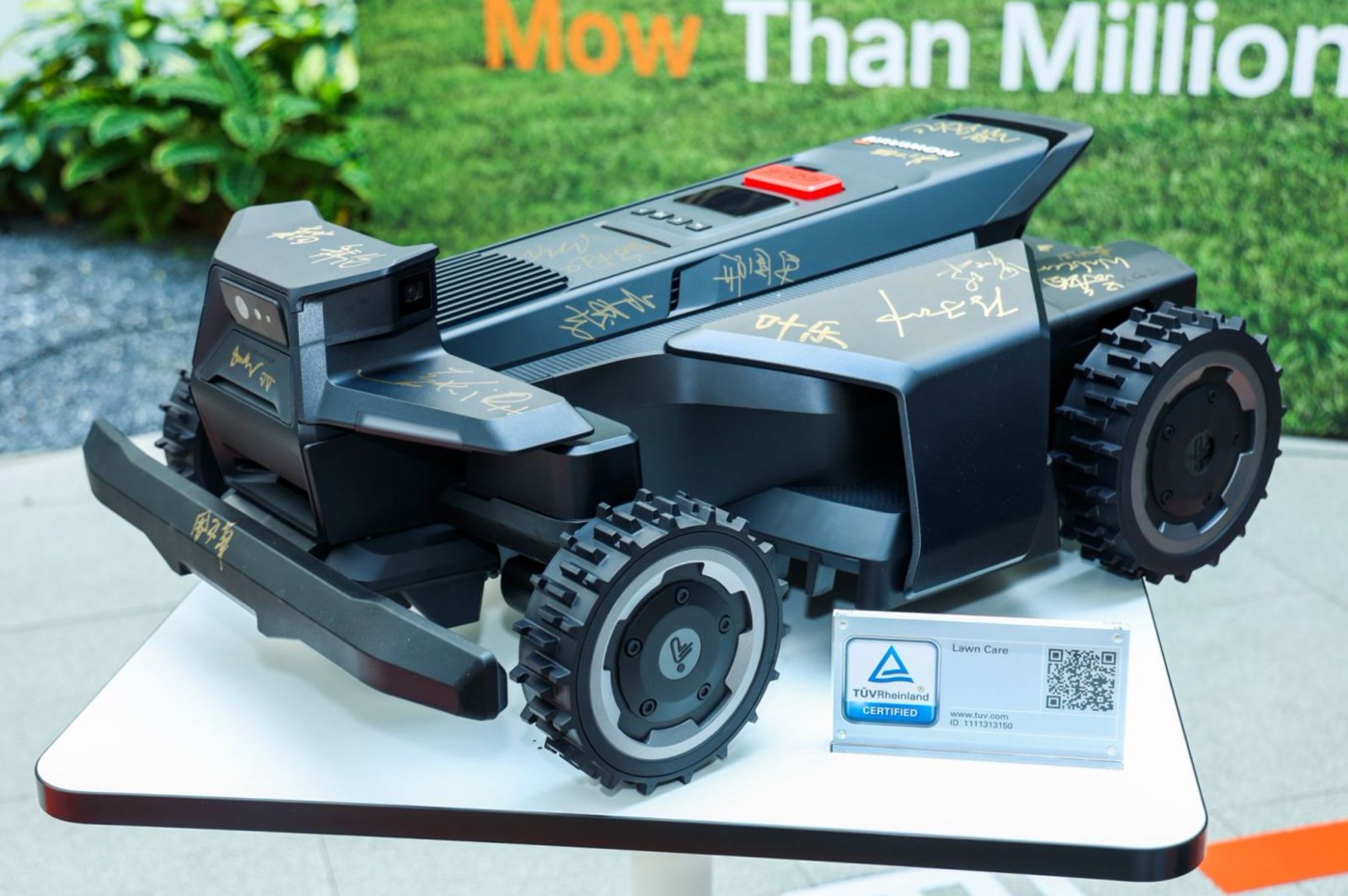
The 1 millionth intelligent lawn mowing robot of Weilan Continent rolled off the production line (Source/Enterprise)
Yingke: When did you start to realize that "strategy" is very important?
Ren Guanjiao: I used to think that strategy was a very abstract thing, and as long as the product was good, the channels were good, and the marketing was good, it was enough. But actually, it's not. Each enterprise has different genes and different visions. An enterprise must choose the most valuable direction based on its vision and current capabilities. So after realizing this, I started to selectively allocate my energy and make choices. I couldn't rush to the front for everything anymore.
Yingke: Is it more difficult to do strategy, or to do product and management?
Ren Guanjiao: Actually, every year is challenging. The core is that you will realize every year that there are bottlenecks in your past self, and you have to break through every year. When a person is in a very stable state, they are generally in the comfort zone; but when you feel in an uncomfortable stage, it is precisely the period when your personal growth rate is the fastest.
Last year, we indeed found some problems in business promotion. There was a deviation between the overall market performance and the previous expectations.
On the one hand, our understanding of online channels was insufficient in the past, so the team focused on online channels this year, and the current results are quite good. On the other hand, after entering the United States, we found that there were obvious differences in users' perceptions in different regions. Due to the lack of systematic insight before, we tried to copy the successful experience in Europe to the United States, but found that the adaptability was insufficient. Although there was a certain effect, the efficiency was not high.
Yingke: What are the specific manifestations of the demand differences between American and European users in products?
Ren Guanjiao: For example, the X4 series launched by Weilan Continent at CES 2026 is closely related to the team's research on American users' preferences at the beginning of 2025.
We found that American users have relatively insufficient understanding of boundary - less and boundary - based concepts. Instead, they are more sensitive to selling points such as powerful power, stronger passability, and four - wheel drive. They value the "Powerful" feeling of the product. At the same time, the product functions should also be simple and easy to use, fitting the consumption psychology of American users.
For example, American lawns are more open, and users have high requirements for safety, especially attaching great importance to the anti - loss function. Therefore, the X4 series also launched the Find My function, which is deeply integrated with Apple's iOS system's Find My. When the device goes beyond the boundary, it will automatically alarm, and users can also find the device through the positioning function if it is lost.
Yingke: In addition to the obvious functional requirements, does the geographical environment have a great impact on product design and performance adjustment?
Ren Guanjiao: The difference in grass species also affects our product design. For the characteristics of different grass species, we must conduct special adaptation and optimization of the cutting system and power system of the whole machine.
At the end of 2024, when Weilan Continent entered the American market, it received a lot of user feedback that the device couldn't cut the grass. We were very surprised because the product had sold more than 100,000 units in Europe at that time, and we hardly received similar after - sales problems. After investigation, we found that it was a kind of grass called St. Augustine grass, known as St. Augustine grass in the United States and buffalo grass in Australia. We had never encountered this kind of grass in our previous tests in China and Europe.
St. Augustine grass is a warm - season grass, which is only distributed in Hainan in China. The product tests of Weilan Continent were mainly conducted in Changzhou, Shenzhen, and northern regions. According to the Qinling - Huaihe line, the grass planted in the north is mainly cool - season grass, such as Kentucky bluegrass and tall fescue, and the device can cut it normally.
However, warm - season grasses are mostly soft and fine varieties, and many golf courses use them. Many people in the southern United States, mainly in Florida, plant St. Augustine grass. This kind of grass grows densely, with long stems and leaves, and has extremely high requirements for the cutting performance of the device, especially the quality of the blades. At the same time, the roots of this kind of lawn are well - developed, and the ground is easily muddy and soft. The robot is easy to sink and damage the grass roots during operation. The device must have sufficient cutting power and passability to be competent for this kind of environment.
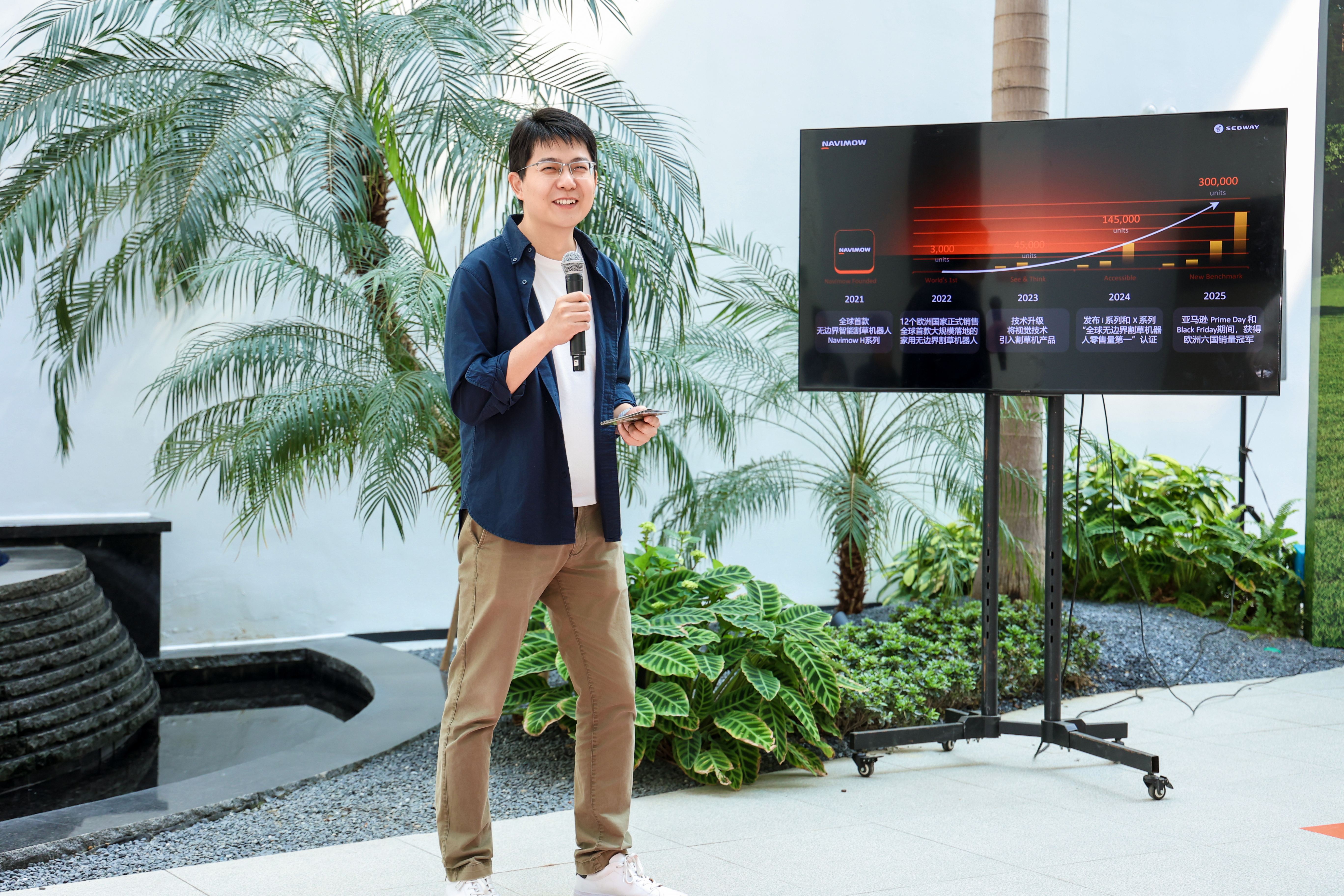
Ren Guanjiao, CEO of Weilan Continent, at the event of the 1 millionth lawn mower rolling off the production line (Source/Enterprise)
Yingke: What innovative designs have been made in the hardware structure?
Ren Guanjiao: We made the front - drive wheels steerable, which has multiple considerations.
In 2023, the R & D team conducted a full - scale survey of the European market and believed that four - wheel drive was not very valuable, especially for countries and regions with flat terrain such as the Netherlands and Germany. The two - wheel drive solution was sufficient. At that time, many users reported that there were steep slopes at home, but after our on - site inspection, we found that the slopes were not very large. Therefore, before 2025, Weilan Continent did not launch four - wheel drive products.
Until last year, four - wheel drive products had good performance in Europe and the United States, which was quite different from our survey results in previous years. For this reason, the team conducted in - depth investigations on the situation in each region: there are many mountains and large lawn slopes in Austria and Norway, so four - wheel drive products sell well; although there are not many mountains in the United States, users' pursuit of the "Powerful" feeling makes the four - wheel drive structure also very popular.
Yingke: What is the difference between it and the existing four - wheel drive solutions in the market?
Ren Guanjiao: We noticed that many users reported that some four - wheel drive products had problems with damaging the lawn, which is also the core pain point that the X4's structural solution aims to solve.
From a technical principle perspective, the robot body has six degrees of freedom in space, including three translational degrees of freedom (forward, translation, and steering) and three rotational degrees of freedom (roll, pitch, and yaw). If we want to achieve full - directional motion in the plane with three degrees of freedom, simply using a four - wheel structure will cause motion interference in principle.
Therefore, we can see several types of solutions. The first is the Ackermann steering structure, which is the same as the steering principle of a car. It controls the differential steering angles of the left and right wheels through the chassis linkage mechanism to avoid lateral slippage. However, its disadvantage is that the turning radius is large, and reverse control is inconvenient, so it has poor adaptability in the lawn operation scenario. The second is the crawler structure, which can achieve zero - radius turning in place, but the crawler will produce lateral slippage during the turning process, which is easy to damage the lawn.
The conventional ordinary four - wheel drive structure can be regarded as a simplified form of the crawler, and it also has the problems of steering lateral movement and grass damage. Some products use Mecanum wheels on the front wheels or add a horizontal rotation structure to relieve the slippage problem, but they have not fundamentally solved the user's pain points.
It can be said that four - wheel drive is a necessary configuration for lawn robots, and steering without damaging the grass is also a core user requirement.
How to solve it completely? In the four - wheel drive solution of the X4, we added two independent steering motors to the front wheels. It can achieve zero - radius turning, and the wheels can be turned into an inverted V shape and rotate around the center of the body, reducing the turning radius. Moreover, when the device turns at any angle, it can also simulate Ackermann steering without lateral movement. The wheels only move in the rolling direction, thus minimizing the lateral tearing of the lawn and having a good protective effect on the lawn.
The only disadvantage of this solution is the high cost. But from the perspective of user interests, zero - radius turning and not damaging the grass are very important, so we finally chose this solution.
Yingke: Is the multi - sensor fusion route of RTK, lidar, and vision currently a consensus in the navigation solution?
Ren Guanjiao: Navigation and positioning are the most core technical modules. In the long run, it will definitely converge to the fusion solution of "RTK + vision + lidar", which we have been clear about several years ago.
Currently, the difference is that lidar is still relatively expensive. The cost of RTK has decreased, so Weilan Continent officially changed all base - station RTK to network - based NRTK this year. The vision solution itself is relatively simple. The combination of the three still accounts for a large part of the overall cost of the machine.
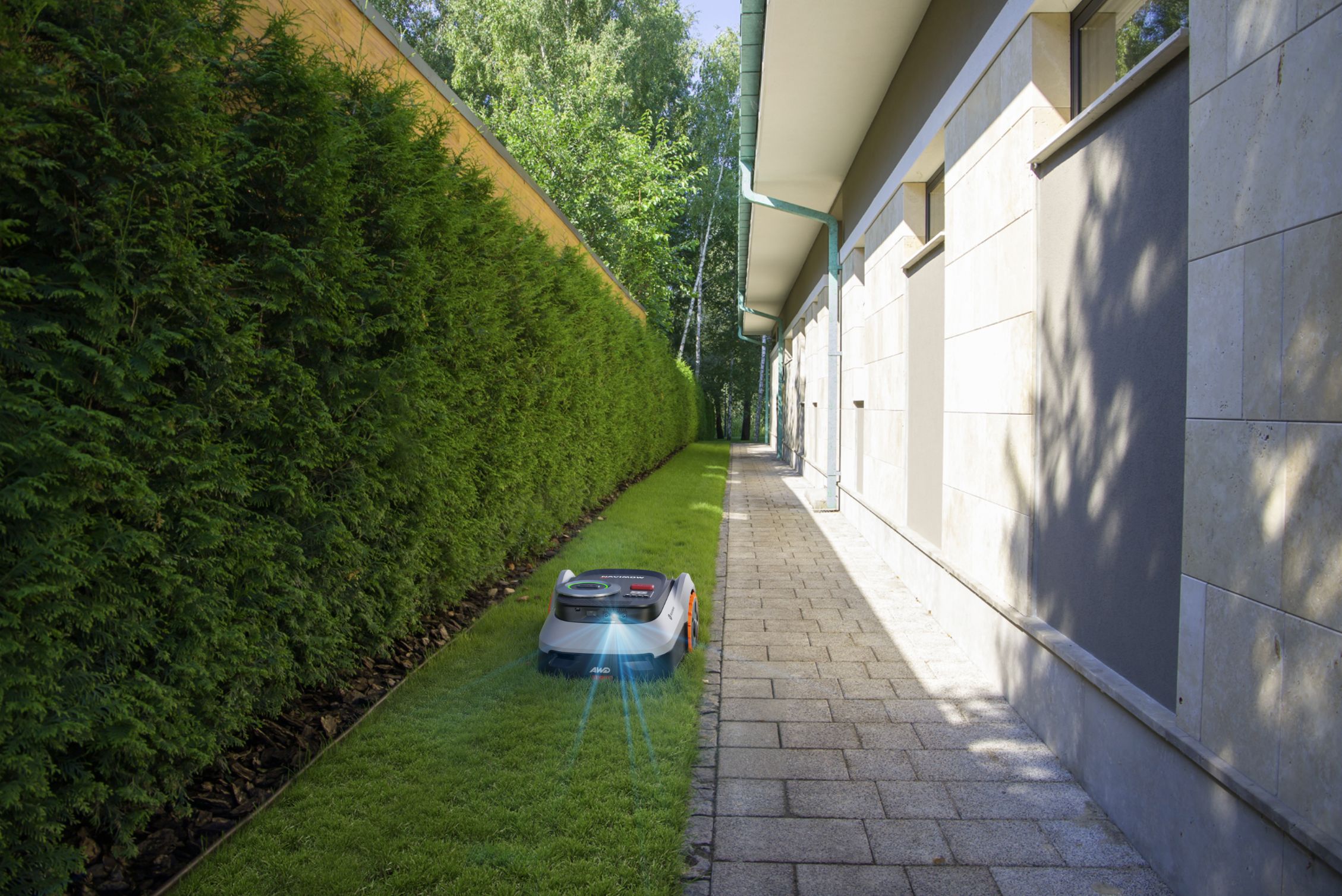
Multi - sensor fusion route (Source/Enterprise)
In the case of the same general trend, our difference lies in "deep coupling", that is, instead of fusing the RTK coordinates, vision results, and lidar results separately, we directly extract the original data of lidar and vision for deeper coupling.
For example, in the past, we calculated the position through speed fusion. Now, we directly use acceleration information fusion, and the position of the device can be obtained by integrating the acceleration twice. This makes the processing of corner scenarios more stable. Users will continuously feel this improvement during long - term use.
These technical details are difficult to convey at the marketing level, but users can naturally feel the strength of the product and the brand during long - term use.
Entering the commercial market
Yingke: How was the growth of Weilan Continent's core overseas markets in 2025?
Ren Guanjiao: The scale of specific regions increased several times compared with last year. For example, in the United States, the local business base is still relatively small, so it is reasonable for it to increase several times.
Yingke: The commercial market is another independent scenario. What is the biggest difference from the consumer - grade product line?
Ren Guanjiao: We observed that there are also mowing needs in many public green spaces, football fields, golf courses, municipal parks and other scenarios overseas, but their usage habits are completely different from those of household use.
For example, the commercial scenario requires a formation function; for household use, one household has one device, and one APP can meet the interaction experience. However, commercial customers may purchase 20 devices at a time, and even a garden service provider may own dozens of machines. They need a client - side system for real - time monitoring, which can remotely restart or control the device to get out of trouble.
In terms of device form, commercial products can reuse the technical platform of household products, and it is also necessary to develop exclusive professional models. For this reason, we also established an independent team internally, which is specifically responsible for the product definition, design, R & D, and delivery of commercial business.
Yingke: Why did you enter the