Kuaishou cuts off Keling AI's "milk supply". What's the strategy behind its $20 billion valuation?
In the past two days, a piece of news has caused a stir in the venture capital circle: KS plans to spin off its AI video large model "Kling", initiate Pre-IPO financing at a valuation of $20 billion, with the goal of going public in 2027.
Within two days, details emerged: This round of financing is planned to raise $2 billion, and TX is reported to be the potential lead investor. On May 12, KS issued an official announcement, admitting that the board of directors is evaluating a plan to restructure the assets and business related to Kling AI, which may involve introducing external financing. But it also clearly stated that "the plan is still in the preliminary stage, and no final agreement has been signed."
The most eye-catching data is the valuation itself, $20 billion. Kling AI, a business unit established less than two years ago, has a valuation close to 70% of the market value of the entire parent company of KS. KS's basic business has 400 million daily active users and 700 million monthly active users, with an annual revenue of 142.8 billion yuan, yet the total market value is only a little over $30 billion.
For an AI project with quarterly revenue of less than $100 million and still unprofitable, the capital market is willing to give a 70% premium. What's the logic behind this?
KS's Basic Business
To understand why KS wants to "spin off" Kling, we first need to understand what challenges KS's fundamentals are facing.
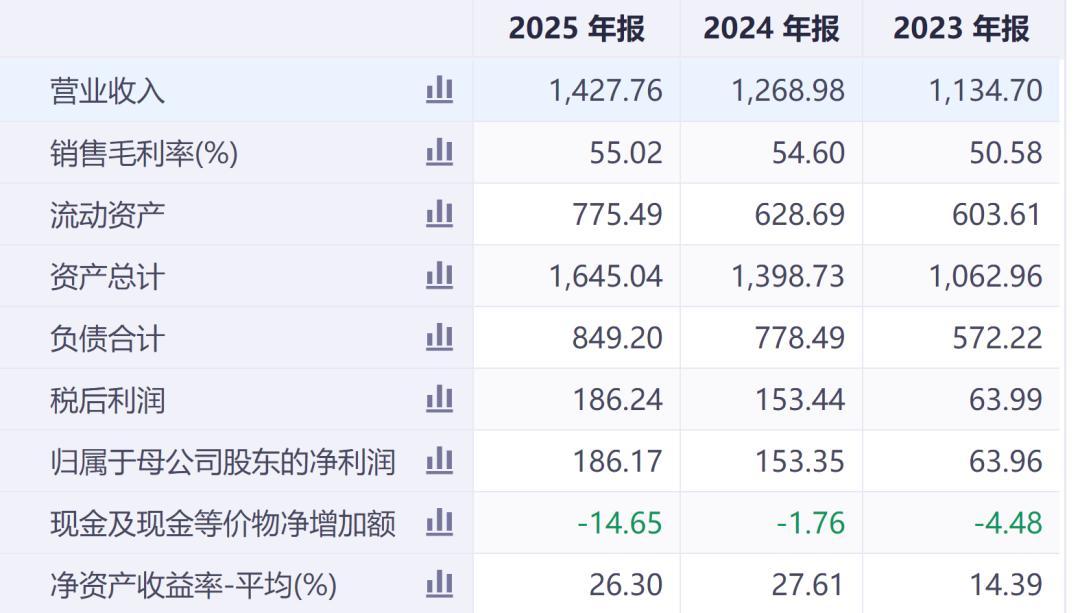
The figures in the 2025 annual report are not bad: the annual revenue was 142.8 billion yuan, a year-on-year increase of 12.5%; the adjusted net profit was 20.6 billion yuan, a year-on-year increase of 16.5%. Both revenue and profit reached record highs. These figures would be considered "stable" for any mature Internet company.
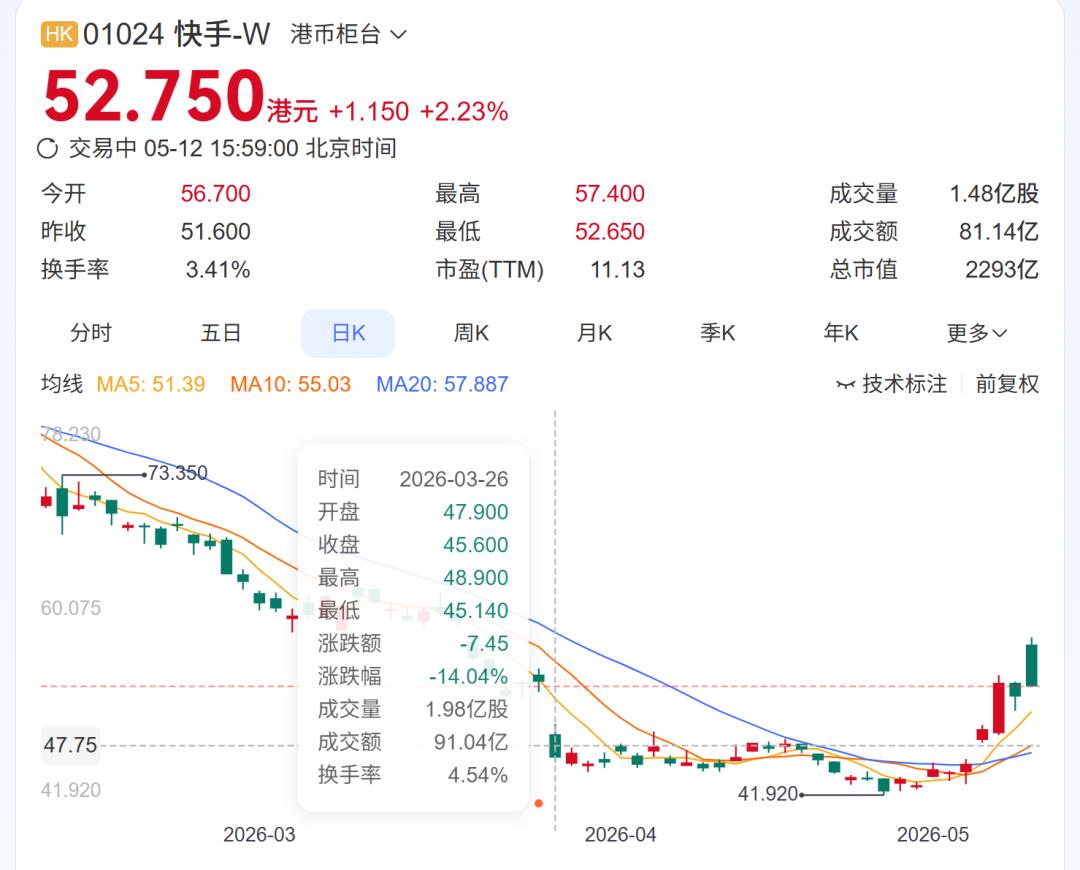
However, after the release of the financial report on March 25, 2026, KS's stock price plummeted by 14% the next day, and the market value evaporated by more than HK$32 billion in one day. Why did the market not buy it when the profit reached a new high?
Because in the eyes of investors, the ceiling of KS's traditional business is clearly visible.
First, look at the users. In 2025, KS had an average of 410 million daily active users and 725 million monthly active users, with year-on-year growth rates of only 2.7% and 2.1% respectively.
Looking at the five - year period, the growth rate of daily active users dropped from 15.58% in 2021 to 2.76%, and the growth rate of monthly active users dropped from 12.68% to 2.11%. The traffic pool of China's mobile Internet is almost exhausted. KS has reached all the users it can, and the incremental growth is almost zero.
Next, look at the three major revenue engines.
Online marketing services (i.e., advertising) used to be KS's "cash cow", but in 2025, with a revenue of 81.5 billion yuan and a growth rate of 12.5%, it was significantly lower than 20.1% in 2024 and 22.97% in 2023. The growth momentum is decreasing.
The live - streaming business had a revenue of 39.1 billion yuan in 2025, with only a 5.5% year - on - year increase. In the fourth quarter, there was even a year - on - year decline. The reward economy that once supported countless users has entered the end of the stock game.
The growth rate of e - commerce GMV has declined from 78% in 2021 to 15% in 2025. KS even announced that it would stop separately disclosing GMV data from 2026. In the context of capital, not disclosing often means there is no good news.
For investment capital, all this points to one conclusion: KS's main business is a well - run but unimaginative "money - printing machine".
For such a company, the capital market uses a valuation system of a single - digit price - to - earnings ratio and a price - to - sales ratio of only 1.5 times, following the logic of a "traditional enterprise". And Kling is exactly the "new species" that needs a high valuation multiple to support it.
2% of the Scale vs. $130 Billion Valuation
The most direct motivation for KS to promote the spin - off of Kling is the valuation.
Since 2026, large - model companies such as Zhipu AI and MiniMax have performed strongly after listing on the Hong Kong Stock Exchange, and their market values have all exceeded HK$200 billion. Although KS has a layout in both the short - video and video large - model tracks, its overall market value has always hovered around HK$200 billion.
The market did not price it according to the logic of an "AI company", but measured all its assets with the yardstick of a "short - video and e - commerce company". The value of Kling has been severely underestimated.
In fact, the "pricing" of Kling by the capital market before was really ridiculously low. According to Goldman Sachs' calculation at the beginning of the year, the implied valuation of Kling in KS's stock price was only about $5 billion. Now Kling is going to raise funds independently, and the target valuation has jumped to $20 billion. This is not an inflation of numbers, but a switch of the valuation system, from being an "appendage of a short - video company" to an "independent track of a pure AI company".
Judging from Kling's own growth rhythm, this narrative is not a castle in the air. In 2025, Kling AI's quarterly revenues were 150 million yuan, 250 million yuan, 300 million yuan, and 340 million yuan respectively, with a total annual revenue of about 1.04 billion yuan, far exceeding the initial target of $60 million.
In December 2025, the monthly revenue exceeded $20 million, and the annual recurring revenue (ARR) reached $240 million. In January 2026, the ARR further climbed to over $300 million. By the end of April, this figure was reported to have doubled to $500 million. KS CEO Cheng Yixiao said at the earnings conference that it is expected that Kling's revenue will double in 2026.
In the context of KS's overall business with tens of billions in revenue, Kling, with an annual revenue in the billions, currently accounts for less than 1%. It's like a hummingbird trapped in an elephant's body. It flaps its wings hard, but still seems insignificant against the backdrop of the huge body.
This precisely explains the urgency of the spin - off. If Kling continues to stay within KS, the capital market will value it with the company's 1.5 times price - to - sales ratio. Even if Kling really achieves an annualized revenue of $1.3 billion next year, it will only be valued at less than $2 billion.
But as an independent entity, it can get a 40 - times price - to - sales ratio. The same asset can be sold at a price several times different on different platforms.
However, if we only look at the capital game, we narrow the meaning of this spin - off. The fierce external competitive pressure is the most realistic reason for KS to quickly "package" Kling into an independent company.
The Battle Among the Three Giants
The competition in the AI video track is entering the most brutal stage.
In terms of user scale, Jimeng AI's monthly active users reached 13.525 million in the first quarter of 2026, exceeding Kling.
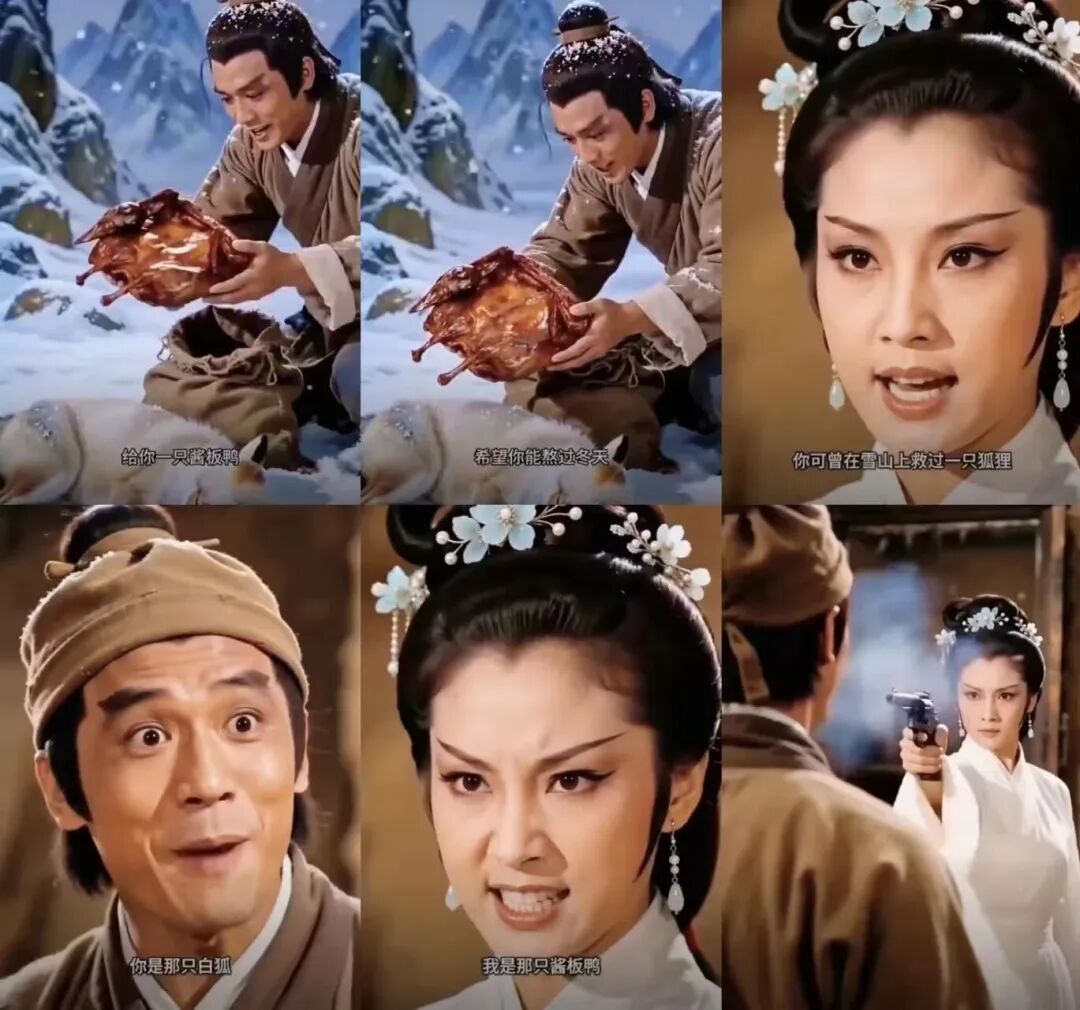
ByteDance's Seedance 2.0 has created a phenomenal spread effect. A Guizhou sauce - duck brand team used Seedance to generate an AI short film, which only took 5 hours and cost 40 yuan, detonating the whole network with over 5 billion views. Even Musk reposted the relevant video on X and sighed: "This is all happening so fast."
In terms of technical indicators, the competition is equally intense. According to the latest list of ArtificialAnalysis, in the text - to - video ranking without audio, Kling 3.0 ranks third, with Alibaba's HappyHorse 1.0 and ByteDance's Seedance 2.0 in the top two positions.
What's more troublesome is the flow of talent. The underlying architecture and early R & D of Kling were built by Zhang Di, the former technical leader. In August 2025, he stepped down from his position at Kling. After a short break, he officially returned to Alibaba in November and became the head of the Future Life Laboratory of Taotian Group.
In April 2026, Alibaba officially launched HappyHorse, which surpassed both Seedance 2.0 and Kling in multiple evaluations. This scenario of the former technical leader leading a team to encircle the former employer is definitely not a decent technical competition in the AI world.
It reflects a deeper risk: the loss of technical talent may be masked by commercial performance in the short term, but its erosion of the technical moat is slow and fatal.
The core variable in the competition is the supply of computing power resources. In 2026, ByteDance plans a capital expenditure of up to 200 billion yuan, nearly 8 times that of KS.
When the competitors can "spare no expense" in piling up computing power, it is very difficult for KS to withstand this AI money - burning war with only its traditional group cash flow. Spinning off and raising funds independently is, to some extent, providing Kling with a more sufficient ammunition depot.
How Did the $20 Billion Market Value Come About?
So the question is: Is Kling AI really worth $20 billion? It depends on how you calculate.
If you only look at the current financial data, this valuation is really ridiculously high. Based on the $20 billion valuation corresponding to the current annualized revenue of about $500 million, the price - to - sales ratio reaches 40 times.
Currently, Kling is not independently profitable. Although its C - end subscription model can generate positive cash flow, large - scale computing power investment and R & D expenditure are still continuously driving up costs. According to the estimated capital expenditure of 26 billion yuan of the KS Group in 2026, just the depreciation of fixed assets, amortized over five years, will consume about 5.2 billion yuan in profit each year.

The $20 billion valuation is actually an early discount on the future. The capital market is betting on two things.
First, the explosive potential of the AI video track itself. In 2025, the domestic AI comic drama market scale reached 16.8 billion yuan, and it is expected to exceed 24 billion yuan in 2026.
The shutdown of Sora has released a large market space, and Kling has become one of the main alternative solutions for global user migration, topping the overseas art and design app download list many times.
Second, the "forcing logic" of KS's fundamentals. By the end of 2025, Kling AI had generated over 600 million videos in total and served over 30,000 enterprise customers. About 70% of its revenue comes from subscriptions and API services of overseas users, forming a relatively independent growth curve from KS's main website.
If Kling can really achieve an annualized revenue of $1.3 billion next year and continue to maintain a high - growth trend, then in the long run, a 40 - times PS may not be a bubble, but a premium based on the certainty of the track.
In - Depth Review
The spin - off of Kling is essentially a story about "changing the yardstick". The same asset can only be undervalued in the "Lao Tie economy" ledger; in the coordinate system of the AI narrative, the pricing method given by the capital market is completely different - the market no longer looks at past profits, but at future possibilities.
However, the other side of the coin cannot be ignored. After the spin - off, Kling will lose the natural nourishment of the parent company's traffic ecosystem.
Behind ByteDance's Seedance is the complete commercial closed - loop of the entire Douyin system: from the model to the product, from the application to the ecosystem, from free traffic to paid conversion, every step is connected to the entire ByteDance matrix.
Once Kling is separated from KS, it is a big question mark whether it can maintain its previous rhythm in terms of technology iteration speed, data feedback efficiency, and commercial collaboration.
What's more worthy of consideration is the logical relationship between AI and the main business. The essence of AI video is a production and creation tool, while KS's foundation has always been consumption and social interaction. Their genes are completely different.
If the AI narrative completely overwhelms the main - business narrative, KS will face a more fundamental crisis: Can an AI startup grow independently and still support the parent company?
Cheng Yixiao gave a figure at the 2025 earnings conference: In the fourth quarter of 2025, the generative recommendation large model and the intelligent bidding model promoted a nearly 5% increase in domestic online marketing service revenue. This figure is not large, but it shows a direction that the empowerment of AI to the main business is changing from a "story" to a "number".
The real test for KS and Kling is not at the moment of the spin - off, but in the long - distance race after the spin - off: Will an AI company break out on its own, or will it wither without the support of the parent company?
This is what is most worthy of attention in this capital story.
Disclaimer: This article is only an analysis of financial hotspots. The views are for reference only and do not constitute any investment or consumption advice.
This article is from the WeChat public account "Investment Banking Circle", author: Frontier Jun. It is published by 36Kr with authorization.