Valuations soar as domestic large models accelerate financing
The AI circle has been in an uproar in the past two days. Yesterday morning, the National Integrated Circuit Industry Investment Fund was reported to be in talks with DeepSeek for its first - round financing, with a valuation heading straight for $45 billion. Later in the afternoon, LatePost exclusively reported that Dark Side of the Moon was about to complete a $2 - billion financing, with a post - investment valuation exceeding $20 billion.
On the same day, two Chinese large - model giants, one with a valuation of $45 billion and the other with $20 billion, have seen their valuations skyrocket in just a few months.
One is the entry of the national team, and the other is the increased investment from industrial capital. These two pieces of news are like two bombs, completely igniting the AI track in 2026.
01 Kimi's Spectacular Financing of $3.9 Billion in Half a Year
Let's first see where Kimi got this money.
Recently, according to multiple media reports, Dark Side of the Moon recently completed a new round of financing of about $2 billion, with a post - investment valuation exceeding $20 billion. This is the largest single - round financing since the establishment of Dark Side of the Moon and one of the highest - amount private financings for domestic large - model startups to date.
This round was led by Meituan Longzhu, with China Mobile, CPE Yuanfeng, etc. participating. In addition, old shareholders such as Sequoia China, ZhenFund, Source Code Capital, and Wuyuan Capital also followed up with additional investments. Among them, Longzhu alone invested more than $200 million, which shows Meituan's confidence in this track.
This is not Kimi's first time to raise funds, but the scale of this financing is enough to refresh the industry's perception.
Looking at Kimi's financing timeline, we can see a near - sprint rhythm: more than $1 billion in February 2024, more than $300 million in August, and a $500 - million Series C in December 2025. In the first two months of this year, it completed three rounds of financing of $500 million, $700 million, and $700 million in a row, and its valuation soared from $10 billion to $18 billion.
With the latest financing, Kimi has raised more than $3.9 billion (about 37.6 billion RMB) in less than half a year. Its valuation has soared from $4.3 billion in November 2025 to $20 billion, nearly five times the original. This speed has no precedent among Chinese AI startups.
For a horizontal comparison: Zhipu and MiniMax had cumulative pre - listing financings of about 13 billion and 15 billion RMB respectively (including IPO fundraising). Kimi's cumulative financing has already exceeded the sum of the other two before and after their listings.
Why can Kimi raise so much money?
Technological iteration and commercial explosion have jointly raised Kimi's ceiling. On April 20th, Dark Side of the Moon released and open - sourced the KimiK2.6 model, with a 1T parameter MoE architecture, 32B activation, capable of continuous encoding for 13 hours, and the Agent can run autonomously for 5 days.
On the open - source model list of the ArtificialAnalysis Intelligence Index, K2.6 scored 54 points, ranking first in the world and regaining the global first place for open - source models.
The revenue side is also impressive. In February this year, Kimi revealed in communication with investors that its overseas revenue had exceeded domestic revenue. At the beginning of March, the ARR (Annual Recurring Revenue) exceeded $100 million, and in April, it exceeded $200 million, with paid subscriptions and API revenues growing rapidly.
02 Behind the Industry's Financing Boom, Who is Paying the Bill?
Kimi's financing is not an isolated case. The entire domestic large - model circle is in a white - hot stage of burning money.
Jieyue Xingchen refreshed the single - round financing record with 5 billion RMB. Its pre - investment valuation in the Pre - IPO round increased from $4 billion to $5 - 6 billion. Zhipu was listed on the Hong Kong Stock Exchange on January 8th, and MiniMax followed suit on January 9th. As of the close on May 6th, MiniMax's market value was about 210 billion RMB, and Zhipu's market value was about 347 billion RMB.
The flow of capital is very clear. According to Xiniu Data, in January 2026, there were 240 investment and financing events in the artificial intelligence field in China, with a disclosed financing amount of 18.768 billion RMB, ranking second in the entire industry.
For the whole year, the total AI financing amount reached 69.23 billion RMB. But the real characteristic of this wave of enthusiasm is not extensive investment but extreme concentration at the top. Model - layer companies only completed 22 rounds of financing in 2025, with a total amount of 9.416 billion RMB, while Kimi alone has raised nearly 40 billion in just half a year in 2026.
It is worth noting that DeepSeek is finally opening its doors to the outside world. This company, which has always refused financing, is being scrambled for by investors to buy shares. Liang Wenfeng's phone has been bombarded by investors.
About two weeks ago, DeepSeek was still seeking financing at a valuation of $20 billion, and its valuation has doubled within a few days. Reuters reported that its valuation could reach up to $50 billion.
DeepSeek's attractiveness is related to its unique growth path. The company was established in July 2023, incubated by Magic Square Quant. Its R & D and operation funds previously relied entirely on internal support from Magic Square and it has never conducted any external equity financing.
Now, it may introduce external capital through the lead investment of the "national team" large - scale fund. Behind this is not only the need for computing power expansion but also the response to talent competition. Since the second half of last year, at least 5 core R & D members of DeepSeek have confirmed their departure.
03 Intensified Industry Differentiation
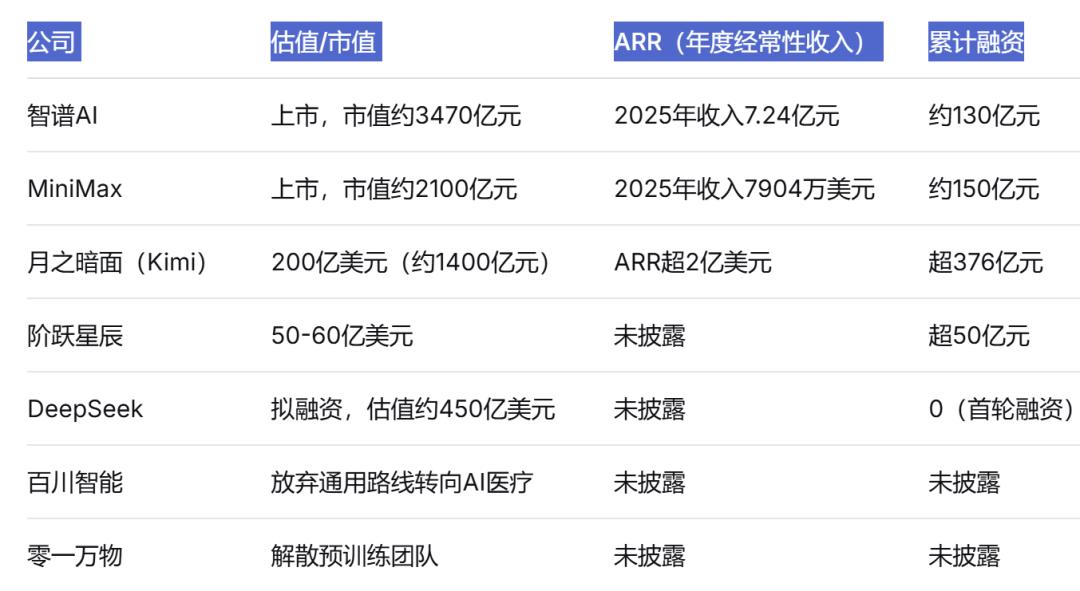
Looking at the valuations and financing situations of several major domestic large - model companies together, the differentiation is very obvious. The "Six Little Dragons" of domestic large models, namely Zhipu, MiniMax, Dark Side of the Moon, Jieyue Xingchen, Baichuan Intelligence, and Lingyi Wanwu, have taken very different paths.
As of May 7th, 2026:
Data source: Public inquiry
There are several points in the valuation table that are worth pondering.
First, the financing amount does not match the valuation. Kimi has raised a cumulative 37.6 billion RMB, with a valuation of 140 billion RMB. Roughly, 3.7 RMB of financing drives 1 RMB of valuation. Zhipu has raised a cumulative 13 billion RMB, with a market value of 347 billion RMB. 1 RMB of financing drives 26.7 RMB of valuation. MiniMax is even more exaggerated. 15 billion RMB of financing corresponds to a market value of 210 billion RMB, and 1 RMB of financing drives 14 RMB of valuation. It is clear who is more efficient.
Second, there is a large gap between revenue and valuation. Zhipu's annual revenue in 2025 was only 724 million RMB, but it supported a market value of 347 billion RMB, with a price - to - sales ratio of nearly 480 times. Kimi's ARR has just exceeded $200 million, corresponding to a valuation of $20 billion, with a price - to - sales ratio of about 100 times. In today's AI market, this is actually considered "cheap".
Third, the capital is highly concentrated at the top. Kimi's financing amount of 37.6 billion RMB in half a year is more than the cumulative financing of Zhipu and MiniMax before and after their listings. Jieyue Xingchen's 5 - billion RMB Series B+ financing follows closely.
After Baichuan Intelligence and Lingyi Wanwu announced their transformation, there has been no public financing information, and the equity held by early - stage investors has lost a clear valuation anchor. Capital is voting with real money, and the winner - takes - all pattern is in sight.
04 Benchmarking Against the Industry Leaders
If we compare domestic large - model companies with their American counterparts, the gap is not on the same order of magnitude.
OpenAI's valuation is about $880 billion and it is close to completing a new round of financing of over $100 billion. Anthropic completed a $30 - billion Series G financing in February 2026, and its valuation soared to $380 billion. On the private placement platform, Anthropic's valuation even once approached $1 trillion, exceeding OpenAI's $880 billion.
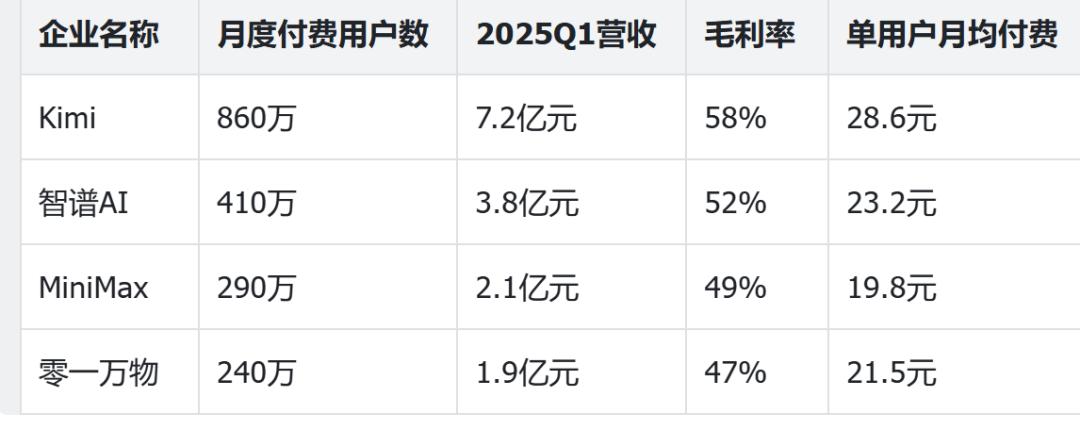
But what is more worthy of attention is the difference in performance on the revenue side. Anthropic's ARR soared from $9 billion at the end of 2025 to over $44 billion at the beginning of May, and its gross profit margin also increased from 38% to over 70%.
Data source: Public inquiry, currently available public data
What about domestic counterparts? Zhipu's annual revenue is 724 million RMB, and MiniMax's annual revenue is less than $80 million. Even though Kimi is the most promising, with an ARR of over $200 million, it is only one - two - hundredth of Anthropic's.
The valuations of American AI companies are more than ten times those of their Chinese counterparts, but the revenue gap is truly shocking. This has two sides: on the one hand, it shows that American capital is really pouring in crazily, and market sentiment has pushed up the valuation bubble; on the other hand, it also shows that the commercialization of Chinese large models is still in the early stage, and there is still a long way to go before achieving large - scale revenue.
Behind this valuation gap reflects the completely different pricing logics of the two markets.
Silicon Valley has a very high willingness to pay for enterprise - level AI applications. Large companies are willing to sign contracts worth tens of millions of dollars for programming tools like ClaudeCode. Eight out of the top ten Fortune companies of Anthropic have become customers, and the number of customers with an annual expenditure of over $1 million has increased from a dozen to more than 1,000.
In the domestic market, C - end users are still hesitant about paid subscriptions. The recent charging of Doubao even triggered a huge outcry from netizens. Doubao's charging hit the hot search!
The AI budget of B - end enterprises has not yet increased significantly. This is the root cause of the valuation gap. Chinese large - model companies are not short of technology but lack the revenue to support high valuations.
05 Where is the Moat?
Kimi has more than 10 billion RMB in cash on its books and has raised 37.6 billion RMB in half a year. It is not short of money. But having a lot of money does not mean winning.
The stock price performance of its peers has already shown the problem. After Zhipu and MiniMax were listed, their market values reached the levels of 300 billion and 200 billion respectively, while Kimi is still waiting in the primary market. The industry is shifting from the "story - telling" stage to the "financial - statement - looking" stage, and investors' patience will not last indefinitely.
More importantly, the industry pattern has changed. ByteDance's Doubao has a monthly active user base approaching 350 million, and Alibaba and Tencent are also seizing the C - end entrance with promotion budgets in the billions. Kimi has neither the traffic pool of large companies nor the extreme cost structure and open - source ecosystem integration ability like DeepSeek, and is facing double pressure in the domestic market.
Kimi's biggest highlight is actually the overseas market. In February, Kimi revealed that its overseas revenue had exceeded domestic revenue. After the release of K2.5, the number of global paid users increased fourfold. K2.6 ranked first in the global open - source models in the ArtificialAnalysis evaluation, and Kimi and DeepSeek dominated the list.
In the global API call volume, the weekly Token call volume of Chinese open - source large models accounts for more than 60%. The Stanford "AI Index Report 2026" points out that the gap between Chinese and American models has fluctuated in the range of being nearly equal to single - digit differences.
Chinese AI is changing from a follower to a rule - maker, and this trend is real. Kimi should bet its resources on the areas where Chinese AI is most likely to win, namely the open - source ecosystem and going global.
Kimi is now at a crossroads. On one hand, there is a countdown to the listing window. Zhipu and MiniMax have already succeeded. Yang Zhilin's words at the end of 2025, "Not in a hurry to go public in the short term", now seem to have come at a high cost. On the other hand, there is a choice of technological route. Should it continue to invest heavily in the arms race of general large models or look for a differentiated breakthrough?
DeepSeek's advantages lie in extreme cost, open - source ecosystem, and domestic chip adaptation. Zhipu and MiniMax have taken root in the secondary market, and large companies are suppressing from all aspects with traffic and capital.
Where are Kimi's core competitiveness and differentiated moat? The long - text ability is becoming the industry standard, and the story of "the best in long - text" has been told. This company needs a second story to prove its irreplaceability and the rationality of its valuation. The breakthroughs of K2.6 in programming ability and Agent automatic execution, as well as the rapid growth of the overseas market, may be the answers.
But to continue the story, it needs real - money revenue as support. An ARR of $200 million is far from enough on the scale of a $20 - billion valuation.
Kimi is not short of money. What it lacks is time and a new reason for investors to believe in it again.
And these two things are much harder to get than $2 billion.
On the Chinese AI playing field, the chips are being concentrated in the hands of two or three players. This is the best of times and the most dangerous of times for domestic large models.
This article is from the WeChat official account "Investment Banking Circle", written by the Senior Sister of Investment Banking. It is published by 36Kr with authorization.