Apple: Can It Still Enjoy a "Steady Happiness" Despite the Absence of AI and Rising Storage Prices?
Apple (AAPL.O) released its financial report for the second quarter of fiscal year 2026 (ending in March 2026) after the U.S. stock market closed at 9:30 a.m. Beijing time on May 1, 2026. The key points are as follows:
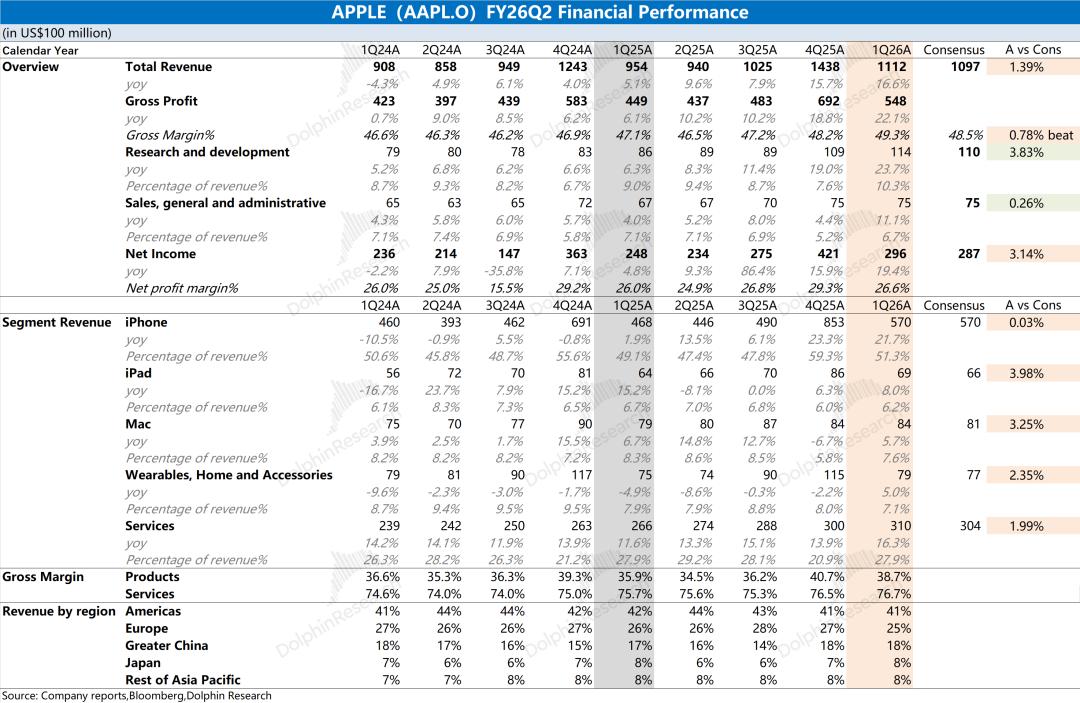
1. Overall performance: This quarter, Apple achieved revenue of $111.2 billion, a year-on-year increase of 16.6%, better than the market expectation ($109.7 billion). The revenue growth this quarter was mainly driven by the growth of the iPhone and software service businesses.
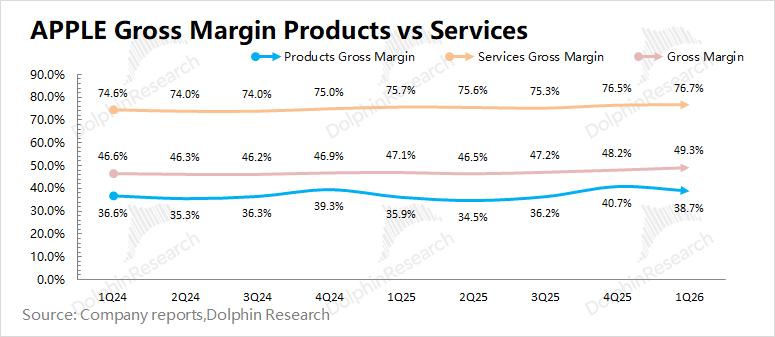
Apple's gross profit margin was 49.3%, a year-on-year increase of 2.2 percentage points, better than the market expectation (48.5%). Among them, the gross profit margin of the software service business increased to 76.7%, and the gross profit margin of the hardware segment was 38.7% (a year-on-year increase of 2.8 percentage points). The increase in the hardware gross profit margin this quarter was mainly affected by the increase in the sales volume of the iPhone 17 series and the depreciation of the U.S. dollar against the Chinese yuan.
2. iPhone: This quarter, the company's iPhone business achieved revenue of $57 billion, a year-on-year increase of 21.7%, in line with the market expectation ($57 billion). The growth of the mobile phone business this quarter was mainly driven by the strong sales of the iPhone 17 series in China and the depreciation of the U.S. dollar against the Chinese yuan. For this quarter, Dolphin Research estimates that the overall iPhone shipments increased by 5.5% year-on-year, and the average selling price increased by 15.3% year-on-year.
3. Other hardware besides the iPhone: All showed varying degrees of growth. The company's iPad business achieved an 8% year-on-year increase this quarter, mainly driven by the growth of the M5 Pro and A16 models; The company launched the MacBook Neo this quarter, with the starting price reduced to $599, covering a wider range of consumer groups and driving the Mac business to resume growth this quarter.
4. Software services: The company's software service revenue reached $31 billion this quarter, better than the market expectation ($30.4 billion), a year-on-year increase of 16%. With a high gross profit margin of 76.7%, the company's software business accounted for 28% of the revenue and generated 43% of the gross profit.
5. Revenue by region: Among them, the Americas region remains the company's mainstay, with the revenue share remaining above 40%, and achieving a 12% year-on-year increase this quarter; Greater China was the region with the best performance this quarter. With the iPhone 17 256G also eligible for the national subsidy policy, it drove the sales volume of the iPhone in the Chinese mainland to increase by 33% year-on-year this quarter (according to IDC data).
Dolphin Research's overall view: The iPhone 17 is extremely popular. Pay attention to whether the new Siri can make up for the AI shortcoming
Apple's performance this quarter was quite good overall. Both the revenue and gross profit margin were better than the market expectations. This was mainly driven by the iPhone 17 series and the depreciation of the U.S. dollar against the Chinese yuan.
① Revenue growth: It was mainly driven by the strong sales of the iPhone 17 series. This quarter, the iPhone business increased by 22% year-on-year. In particular, the shipments of the iPhone in the Chinese market increased by 33% year-on-year. Although there were not many innovations in the iPhone 17 series, this model achieved obvious success in the Chinese market. While the iPhone 17 256G enjoyed the national subsidy policy, it seized the market share of Android brands in the Chinese market;
② Gross profit margin improvement: Against the headwind of rising storage prices, the company's hardware gross profit margin increased again year-on-year, mainly driven by the scale effect of the increase in iPhone shipments, the depreciation of the U.S. dollar against the Chinese yuan, etc. Since the company's products such as the iPhone are mainly targeted at the mid - to high - end market, the impact of rising storage prices on the cost side is relatively smaller than that of its competitors, and the company can also better digest this part of the pressure.
In addition to this quarter's data, the company's management also gave guidance for the next quarter: The company's revenue in the next quarter is expected to increase by 14 - 17% year-on-year, corresponding to $107.1 - $110 billion; the gross profit margin in the next quarter is expected to be 47.5 - 48.5%. The iPhone business will still be the main driving force for growth in the next quarter. Even facing the pressure of a significant increase in storage prices, the company still gave a good gross profit margin guidance, which reflects the company's excellent supply chain management ability.
Besides Apple's current financial report, the market also focuses on the following aspects:
a) CEO change: Apple officially announced a senior management reshuffle. Tim Cook will step down as CEO on September 1 and become the executive chairman, and John Ternus, the senior vice president of hardware engineering, will take over as CEO.
The new CEO, Ternus, has a hardware engineering background, which meets the competitive needs of the next - generation smartphones and AI terminals. Cook will remain as the executive chairman to ensure the connection of global policy affairs and the smooth transition of the strategy.
The market generally believes that the company's current reshuffle is an arrangement after long - term consideration, and the personnel adjustment will not lead to a major change in Apple's strategic direction. Apple will still focus on the strategic balance between the hardware and service businesses and maintain the growth of products and services with its vertical integration and supply chain advantages. We can pay attention to the specific statements of the company's management in the communication meeting.
b) Recovery in the Chinese market: The company's performance recovery this quarter was mainly driven by the increase in iPhone sales in the Chinese market. Specifically, the iPhone shipments in the Chinese market increased by 33% year-on-year this quarter, while the shipments in other markets (outside China) remained basically flat year-on-year.
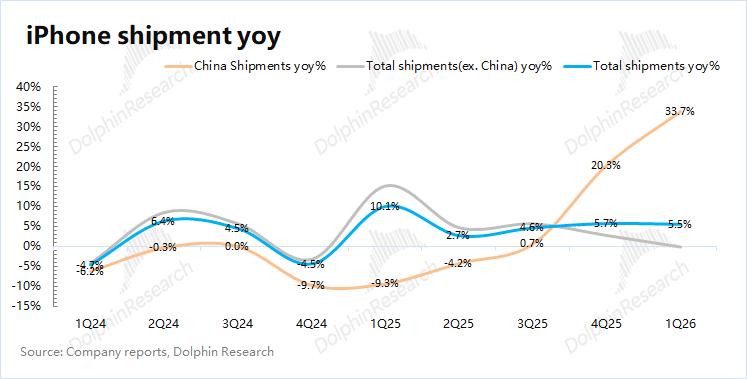
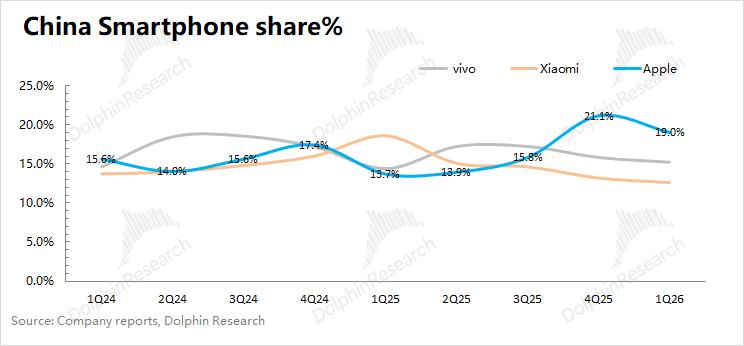
The iPhone 17 series performed well in the Chinese market. On the one hand, the impact of "rising storage prices" on the iPhone was relatively small. On the other hand, the iPhone 17 256G's eligibility for the national subsidy policy brought obvious competitive pressure to Android brands. This quarter, the iPhone's market share in the Chinese market reached 19%, a year-on-year increase of 5.3 percentage points.
c) Measures to deal with "rising storage prices": ① Sign long - term memory procurement agreements to lock in costs. Use the scale advantage to lock in the preferential memory contract price and buffer with advance inventory; ② While developing self - developed basebands, reduce the costs of other non - memory components; ③ Optimize the product structure or appropriately increase the price to increase the company's average product price. Judging from the company's gross profit margin guidance for the next quarter, the company still has the ability to alleviate the impact of rising storage prices through supply chain management.
Driven by the high growth of the iPhone 17 series, Apple's short - term performance is quite good. As for the impact of rising storage prices, the market can also see that the company can dilute or digest the cost - side pressure through long - term contracts, supply chain management, product structure adjustment, etc.
However, the recent "outstanding" performance cannot dispel the market's doubts about the company's sustainable high - growth. This also keeps the company's valuation within the traditional range. In the context of the continuous advancement of AI and large models, the market expects more innovation and breakthroughs from Apple in the field of AI or the new Siri, which is the key growth point in the medium and long term.
Apple has a large base of hardware users, which gives the company a relatively sufficient "buffer preparation period". However, if the company fails to make breakthroughs in the AI field for a long time, it may also face competition from other players. Recently, the market has reported that OpenAI plans to launch an AI smartphone that breaks away from the traditional "App model".
Overall, Apple's short - term performance is quite good, mainly reflecting the strong sales of the iPhone 17 and the company's excellent supply chain management ability, and still has relatively obvious "barrier" advantages.
Behind the "stable" performance, the market expects more innovation and breakthroughs from the company, so as to break through the traditional valuation range. The recent change in management is also a manifestation of the company's "search for change". We can pay attention to the management's outlook on future operations and strategic planning.
The following is a detailed analysis
1. Apple's foundation remains "strong"!
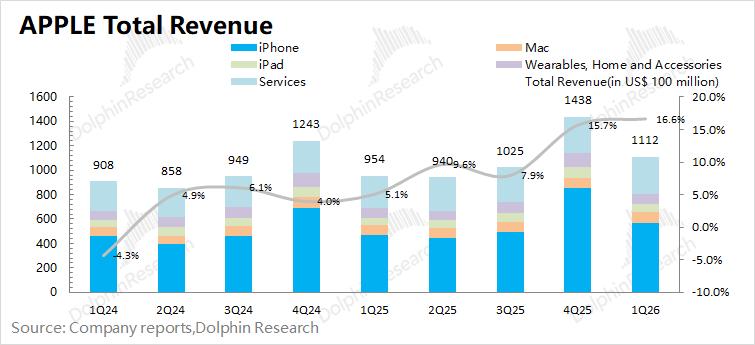
1.1 Revenue: In the second quarter of fiscal year 2026 (i.e., 1Q26), Apple achieved revenue of $111.2 billion, a year-on-year increase of 16.6%, better than the market expectation ($109.7 billion). All of the company's businesses showed varying degrees of growth this quarter, especially benefiting from the accelerated growth of the iPhone business.
From the perspectives of hardware and software:
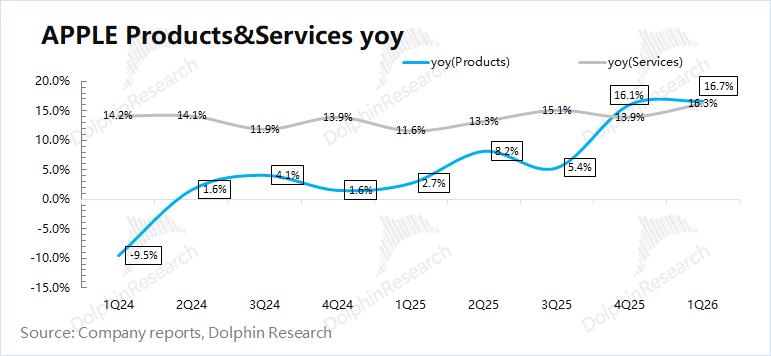
① The growth rate of Apple's hardware business this quarter was 16.7%. The growth of the hardware business accelerated this quarter, mainly driven by the growth of the iPhone business. Driven by the strong sales of the iPhone 17 series, the growth rate of the iPhone business has remained above 20% for two consecutive quarters;
② The growth rate of Apple's software business this quarter was 16.3%, maintaining double - digit growth. The settlement of the Google lawsuit previously released the risks of the company's software business. As more models are integrated into AI applications, even if the growth of the APP Store is in single digits, the growth momentum of the company's software business is still expected to continue.
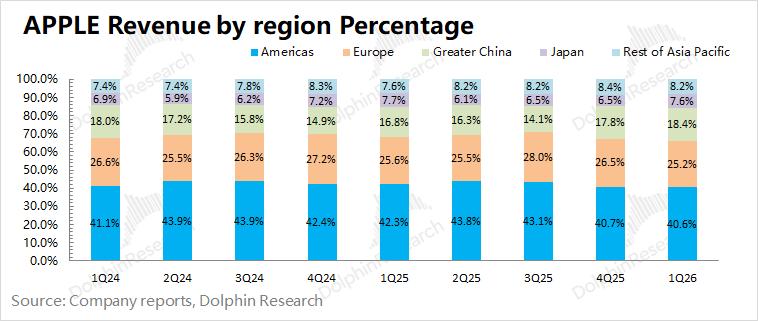
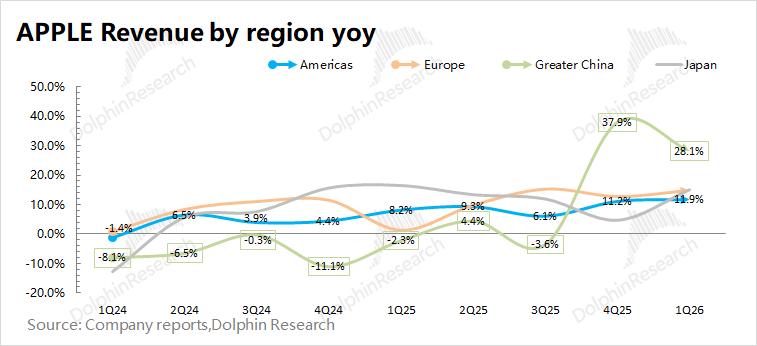
From the perspective of different regions: The revenue increased year-on-year to varying degrees. The Americas, Europe, and Greater China are the company's three main sources of revenue. Specifically, the revenue share of the Americas region remained above 40%, with a 12% growth this quarter; the growth rate in Europe remained at 14.7% this quarter.
Greater China was the region with the best performance this quarter, with a growth rate of 28% this quarter. This is because the iPhone 17 256G is also eligible for the national subsidy policy, directly driving the sales volume of the iPhone in the Chinese mainland to increase by 33% year-on-year this quarter.
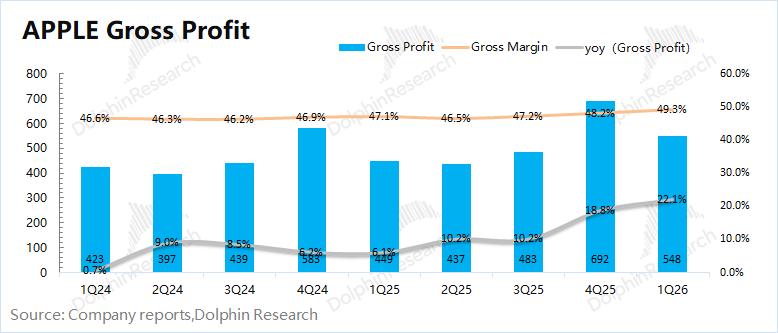
1.2 Gross profit margin: In the second quarter of fiscal year 2026 (i.e., 1Q26), Apple's gross profit margin was 49.3%, a year-on-year increase of 2.2 percentage points, better than the market expectation (48.5%). The increase in the company's gross profit margin was mainly driven by the gross profit margins of the hardware and software businesses.
Dolphin Research analyzed the gross profit margins of hardware and software: Apple's software gross profit margin continued to increase to 76.7% this quarter; the gross profit margin of the hardware segment increased to 38.7% year-on-year, mainly benefiting from the scale effect brought by the strong sales of the iPhone 17 series, the decrease in tariff costs, and the depreciation of the U.S. dollar against the Chinese yuan.
1.3 Operating profit: In the second quarter of fiscal year 2026 (i.e., 1Q26), Apple's operating profit was $35.9 billion, a year-on-year increase of 21%. The growth of Apple's operating profit this quarter was driven by both revenue growth and gross profit margin improvement.
This quarter, Apple's operating expense ratio was 17%, a year-on-year increase of 1 percentage point. This was mainly because the company increased its R & D investment in both products and services. The R & D expenses this quarter increased by 23% year-on-year.
In terms of capital expenditure, compared with the quarterly investment of hundreds of billions by giants, Apple's single - quarter capital expenditure was only $1.97 billion, a significant year-on-year decline of 36%. While other major companies are increasing their