Before the explosion of AI games, Aippy got the flywheel spinning first.
Every change in the user interaction mode gives rise to a new round of application opportunities.
In the PC era, mouse clicks defined portals and search engines; in the mobile era, swiping the screen gave birth to short - video platforms. And when AI starts to write code and generate content, a new possibility of interaction emerges - users are not just "watching" content but can "play" with it.
Since last year, a batch of products known as the "AI Douyin" have emerged in large numbers - Aippy, Sekai, Rezona, Loopit... replicated the intense competition in the short - video market.
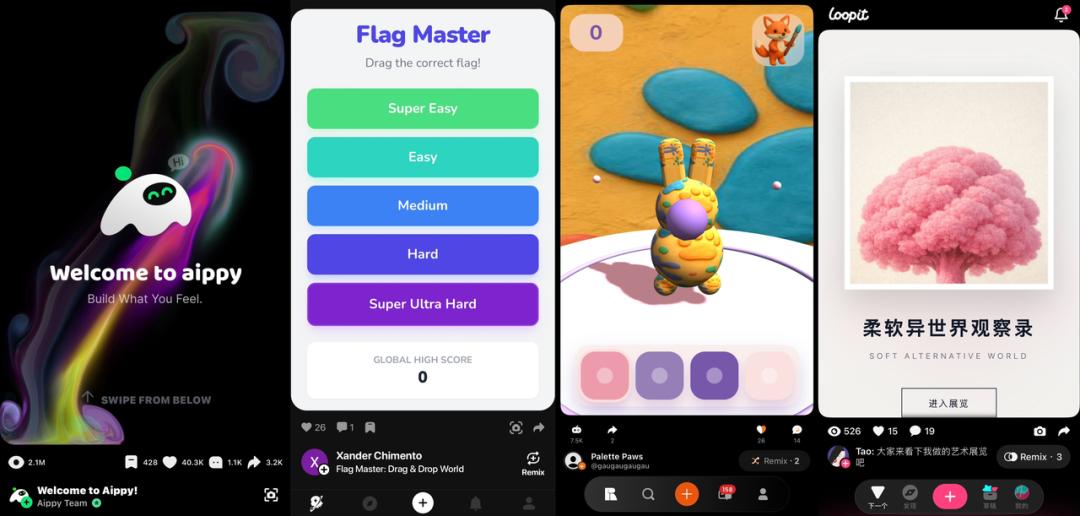
The above images are Aippy, Sekai, Rezona, and Loopit respectively.
Their gameplay is very simple: creators describe an idea in natural language, and AI automatically generates an interactive mini - game. Other users swipe up and down like they do with short videos, but each item is not a video that you "watch and leave" but a game that you can click, control, and participate in.
This route excites the market and capital because it hits two proven trends simultaneously. On the user side, from bullet comments to secondary creations to interactive dramas, the evolution direction of To C content has always pointed to a deeper sense of user participation. On the technology side, the coding ability of large models has crossed the practical threshold in the past year - the code written by AI is already sufficient to support a "playable" mini - game, not just a "viewable" demo.
Although most current products are still in the user - growth stage and have not been commercialized, this does not prevent the "AI game community" from becoming a popular track pursued by both Silicon Valley and the Chinese investment circle. In the eyes of most people, its potential has already been proven.
However, the validation of a track and a company's success in it are two completely different things. With similar products emerging continuously, when the generation capabilities will eventually converge, what is truly irreproducible?
Aippy gives an answer with nearly one year of operation data - the community.
Is the tool doomed? Then build a community
Since its launch in mid - 2025, Aippy has been in operation for one year.
According to Aippy, the DAU growth curve of the product has been steep in the past three months, and the users mainly come from core T1 English - speaking markets such as the United States, the United Kingdom, and Canada, with a very high "purity" in Europe and the United States. GenZ and Gen Alpha have a prominent proportion, including a large number of young users under 17 years old.
This user profile itself is a signal.
Looking back at every successful content platform in the past two decades, almost all follow the same rule - young users come first, and the mainstream market follows.
Facebook started from Harvard dormitories, TikTok started with lip - syncing among high - school students, and Bilibili started from the anime section. The cultural tone of entertainment platforms grows from the bottom up and is defined by the most active and least - burdened group. If a community is "for everyone" from the start, it often ends up being for no one.
The high concentration of GenZ in Aippy indicates that it is going through the same process: a group of young users who are most sensitive to new interaction methods and have the strongest creative desire are shaping the culture of this community.
When you open Aippy, you will see a vertical - screen information stream similar to TikTok. Swipe up and down, and each piece of content is an interactive mini - game that you can play directly.
Switching to the creation side, something more interesting happens: users describe a game idea in natural language, and AI turns it into a complete game that can be run, shared, and modified by others within dozens of seconds. There is no need to write code, draw materials, or understand the engine.
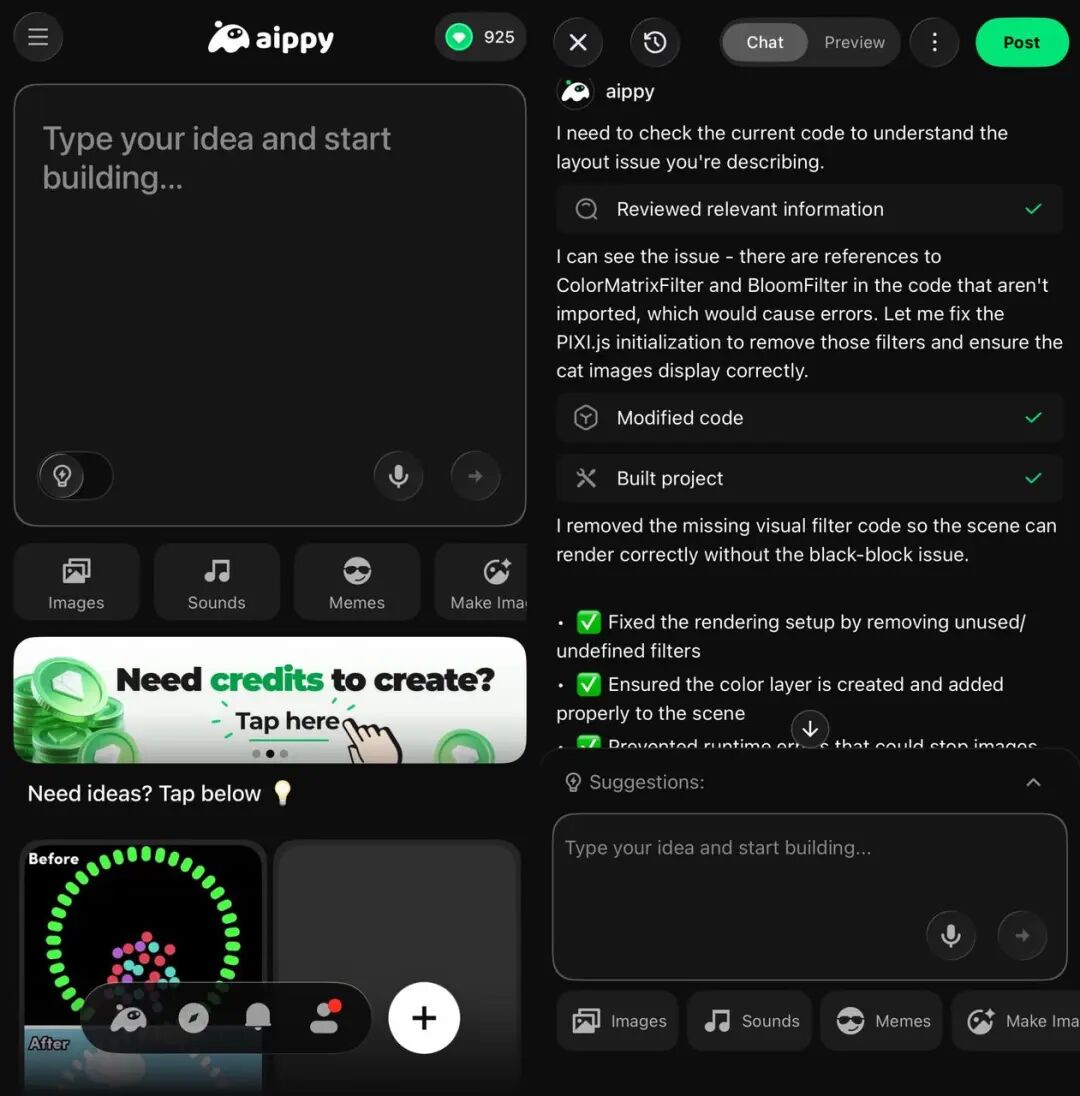
A person who was just browsing games can become a creator the next second. Consumption and creation form a continuous cycle here - this is the core condition for a UGC community to operate self - sustainably.
As the earliest product in this track, Aippy has gone through a typical process of "users defining the product" to reach its current form.
To test "whether users are willing to play AI - generated content", the earliest version of Aippy did not provide much specific guidance. It only launched an AI - generation function and a basic feed stream, allowing users to create various interactive contents.
Subsequent retention data showed that there was a group of users who were browsing and repeatedly playing, especially the AI interactive game content. Their stay time and activity were significantly higher than other forms. Users began to spontaneously call the works on the platform "games", and "make games" became the most core behavior in the community.
Based on this user base, Aippy started to build the overall product form around the positioning of an "AI interactive game community". This product path starting from user behavior is itself a sign of Product - Market Fit.
Although the product form was chosen by users, the decision to build a community from the first day was a consistent judgment of ChiZiCheng Technology, the company behind Aippy.
ChiZiCheng is a listed company that has been deeply involved in global consumer - oriented social entertainment for many years. Its products such as MICO and TopTop have accumulated solid community - operation experience overseas. Looking back at ChiZiCheng's path, we can find that the company started with tools. In the mobile - Internet era, it personally experienced the harsh reality that "tools cannot retain users" and even publicly stated the judgment that "tools are doomed". No matter how good the function is, users are just passers - by and will leave after use. Later, ChiZiCheng completely shifted to social and community and formed a product creed that has persisted to this day: Only a community can make users stay.
This judgment projects a different direction from the mainstream narrative at that time onto the AI track.
In the spring of 2025, vibe coding was the most appealing narrative. The valuation of Cursor soared, Replit was targeting the consumer - grade market, and all large - model manufacturers were developing programming assistants. "Replacing code with natural language" became the most exciting startup direction that quarter.
Almost at the same time, the Aippy team at ChiZiCheng began to prepare the product form. In their view, the greatest potential of AI is to enable people who cannot program to create. And the things created by these users need a community to receive, distribute, and activate them. In addition, tools improve efficiency for existing creators and serve the existing market. Turning "non - creators" into "creators" represents a much larger incremental opportunity.
On the other hand, ChiZiCheng used audio - video social products to compete for the market share of text - image social platforms like Tinder by seizing the opportunity of the evolution of Internet media forms and production tools. In the AI era, interactive games are becoming a newer media form, and the tool capabilities of vibe coding are increasing exponentially. This is the underlying ability to build the Internet. All upper - layer forms are likely to be transformed accordingly.
From this perspective, Aippy is an extension of ChiZiCheng's product philosophy in the AI era.
The underestimated technical barrier: not "generating games" but "making the community work"
The direction is chosen, and the community is built. The next question lies in the foundation: How can AI - generated games support a community?
An inspiring analogy is the relationship between "Jianying - like apps" and Douyin. The rise of Douyin and TikTok essentially lowered the threshold for short - video creation. Through apps like Jianying and special - effect templates, they eliminated the psychological barrier of "ordinary people can't shoot videos" and expanded the creator ecosystem.
The proposition Aippy faces is exactly the same, but the complexity has increased several times. The "Jianying" for AI games is the collaboration of multiple modules, including large - language models, image - generation models, game engines, and code generation. The ability to generate is the baseline, and the ability to generate interesting games is the competitive edge.
In terms of generating interesting games, the style of the creation tools themselves affects the tone of the community from the production end. The intense competition in the short - video market has proven this - different platforms have diverged at the content - production stage.
From the beginning, Douyin has bet on the "trendy" in creation tools: Xingtu for face - retouching, Jianying's rhythm - setting templates, and one - key application of popular BGMs. Each function pushes the content towards a more refined, cool, and designed direction. Kuaishou, on the other hand, makes the creation tools lighter and more native, without deliberate modification, presenting a rough and real sense of "just pick up the phone and shoot".
For Aippy, the users are GenZ and Gen Alpha. This group has a very clear standard for "fun": having memes, interactivity, and a sense of surprise.
Aippy's technological investment is essentially locking in this tone from the production end, which can be understood from two aspects.
One is product intuition - following the aesthetic coordinates of GenZ to make users "want to play and create".
The most typical example is the design of the creation entrance. The starting point of most AI creation tools is a blank text box with the prompt "Please describe your requirements". Aippy has a light - bulb button. When clicked, it pops up a large number of preset game ideas, including interesting, creative, and even funny concepts.
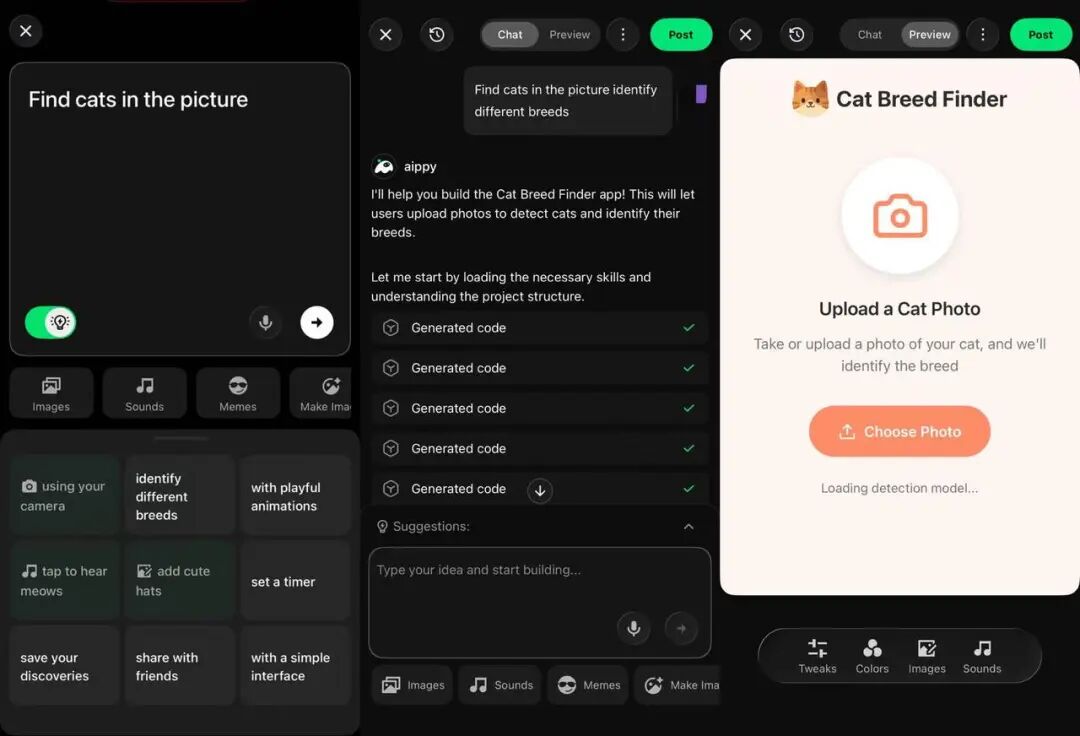
The optimization of these prompt words conveys a signal: there are more ways to make games.
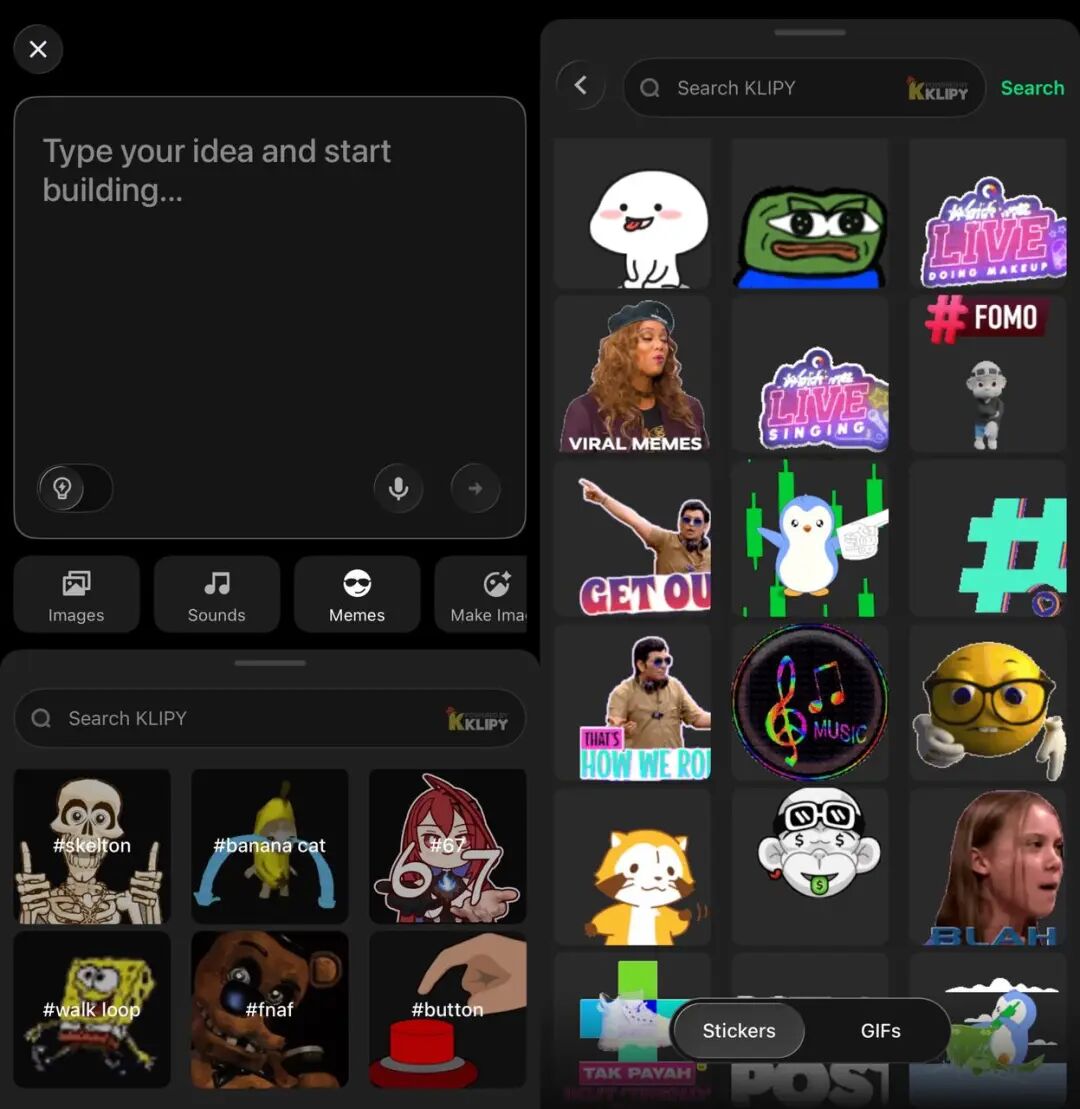
The same logic runs through other functional decisions. Aippy has accessed a large number of GIF and emoji material libraries, allowing creators to directly use popular memes in games. For GenZ and Gen Alpha, memes are not decorations but a form of language. The spread of a mini - game embedded with popular emojis is completely different from that of a game with a refined but meme - less screen in this community.
Even the error - reporting experience has been redesigned. It is normal for AI - generated games to have bugs. The traditional way is to pop up a cold error message, and most people will leave when they see it. Aippy makes the FixError pop - up window have a friendly tone and provides the option of "Try Remix". Got a bug? Make some changes on this basis, and you might create a more interesting version.
These functions are scattered throughout the product, pointing to the same design philosophy: lower the psychological threshold for creation and protect the "fun" experience.
The other aspect is engineering infrastructure, ensuring that the games created by users through Aippy "work".
After a creator publishes a game, Aippy's system automatically conducts multiple rounds of content - quality inspections: code - health checks, performance tests, function - integrity verifications, and runtime monitoring. It invests a large amount of engineering resources to intercept problematic games before they are widely exposed, ensuring that each game users see in the feed can run, be played, and not crash.
Meanwhile, the build success rate is the core optimization indicator of the product. By continuously monitoring each link in the build funnel and using real user data for training and calibration, a data flywheel is formed to maintain the success rate at a high level.
From this point of view, Aippy's technological investment never solves a purely engineering problem but a community problem. Product intuition determines who is willing to create, and engineering infrastructure determines whether the things they create can be consumed. The combination of the two shapes the content aesthetics and creative culture of the community.
How does the community flywheel start to turn?
Technology and functions solve the problem of "how good the things are", but the community needs to solve a more fundamental problem: how does the content "reproduce itself"? How are the connections between people established?
In this larger dimension, the answer Aippy found is Remix.
When you see a fun game, click the Remix button to modify it on its basis - change the theme, rules, or add a dialogue. After the modification, it becomes a new "your" game.
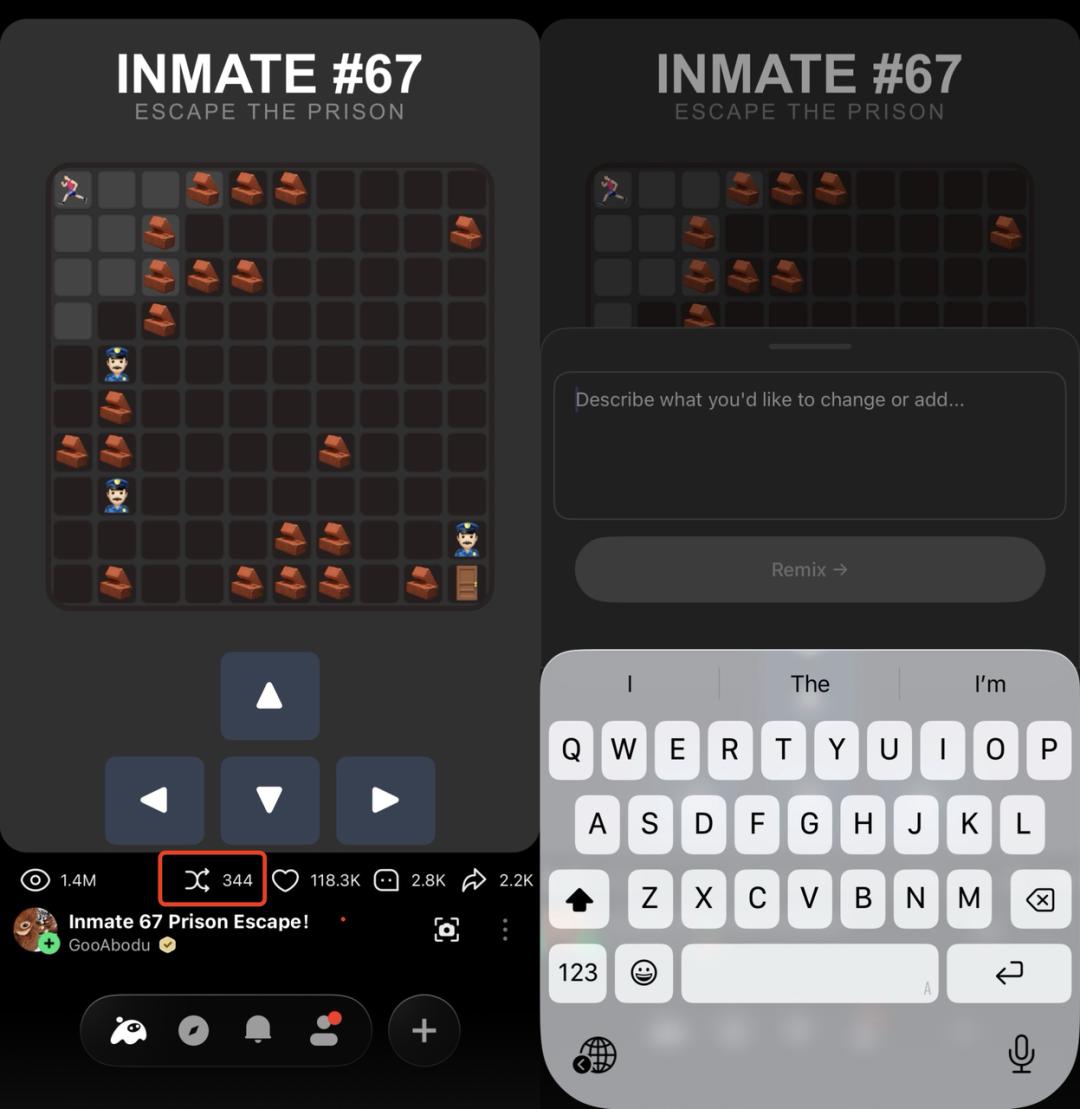
This mechanism may seem simple, but it does three things simultaneously: it lowers the creation threshold from "conceiving a complete game from scratch" to "making modifications on others' basis"; it ensures that each game will not "expire" but continuously reproduce new versions, providing a continuous supply of content; more importantly, when a creator sees their work being remixed by others, the experience of "being recognized and re - created" is ten times stronger than getting a like.
This creates a sense of relay among creators, which is the fertile ground for the growth of community culture.
Data validates this judgment: According to Aippy, about 40% of Aippy's content comes from the Remix path. The quality score of Remix works is higher than that of original works, and the retention rate of Remix users is also significantly higher than that of ordinary users. Many people intuitively think that secondary creations dilute the quality of original works, but Aippy's data proves the opposite - with good underlying works as a starting point, the quality of secondary creations is actually higher.
Remix is the engine, but the engine needs someone to start it.
Aippy did not follow the old path of "piling up traffic first and then looking at retention" for its cold start. Before the launch, the team started with the creator operation they were good at. With the help of a group of European and American creators, they pre - stored a batch of high - quality benchmark works covering different categories to support the first - week feed, ensuring that early users would