Bevor die AI-Spieleexplosion losging, hat Aippy bereits das Rädchen in Gang gesetzt.
Every change in the user interaction model brings new application possibilities.
In the era of PCs, portals and search engines were defined by mouse clicks. In the mobile era, swiping on the screen led to the emergence of short - video platforms. And now, when AI is capable of writing code and generating content, a new interaction possibility has emerged - users can not only “watch” content but also interact “with” it.
Since last year, a large number of so - called “AI - TikTok” products have emerged - Aippy, Sekai, Rezona, Loopit... Once again, a kind of “hundred villages battle” like that of short - videos has broken out.
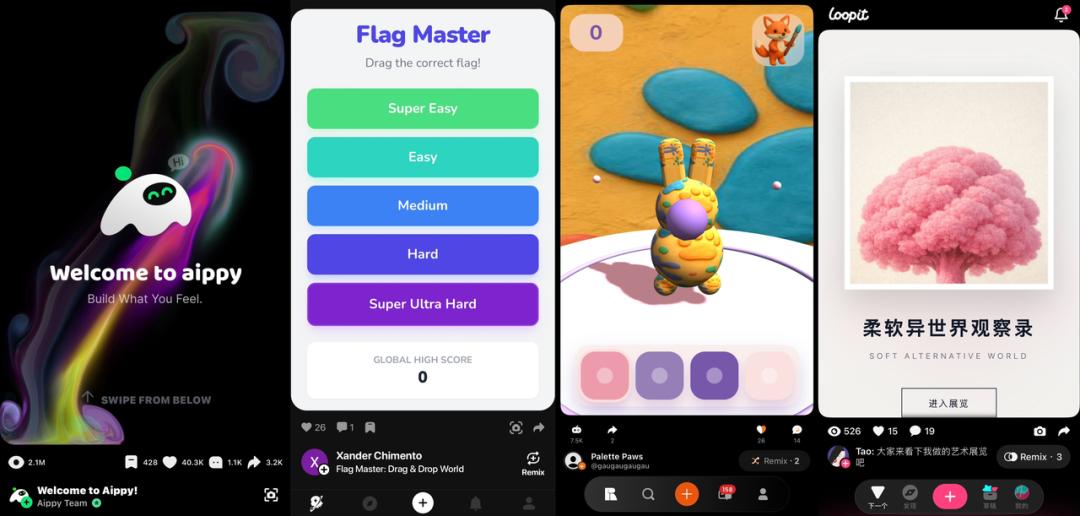
The above pictures show Aippy, Sekai, Rezona and Loopit.
Their gameplay mechanics are simple: A creator describes an idea in natural language, and the AI automatically generates an interactive game. Other users swipe up and down like with short - videos, but instead of just “watching and clicking next”, they can click on, control and participate in games here.
This approach excites the market and capital because it hits two proven trends: On the user side, the development of To - C content from barriers to fan creations and interactive dramas is always moving towards greater user participation. On the technical side, the coding ability of large models exceeded the threshold for practical application last year - the code generated by AI is now sufficient to create a playable game, not just a “watchable” demo.
Although most products are currently still in the user growth phase and not conducting commercial activities, the “AI - game community” has developed into a popular investment area in Silicon Valley and Chinese investment circles - for most, it already seems proven that it is a promising direction.
However, validating a business field and the success of a company are two completely different things. In a world where more and more similar products appear and the generation capabilities eventually become the same, what is then the truly distinctive element?
Aippy gives an answer with almost a year of operating data - the community.
Will tools die? Then build a community
Since its release in mid - 2025, Aippy has been running for a year.
According to Aippy, the daily active user count (DAU) has increased significantly in the last three months. The users mainly come from core T1 English - speaking markets such as the United States, the United Kingdom and Canada, which means a very high “purity” in the Western market. GenZ and Gen Alpha are strongly represented, and there are many young users under 17 years old.
This user profile is in itself a signal.
If you look at the successful content platforms of the last twenty years, you will notice that almost all follow the same pattern - first come the young users, then the mainstream market.
Facebook started in Harvard dormitories, TikTok with lip - sync videos of high - school students and Bilibili with animated anime series. The cultural atmosphere of entertainment platforms grows from the bottom up and is shaped by the most active and uninhibited group. A community that is designed for “everyone” from the start often ends up being of little value to anyone.
The high engagement of GenZ on Aippy shows that it is going through the same process: A group of young users who are most sensitive to new forms of interaction and have the greatest desire to create shapes the culture of this community.
When you open Aippy, you see a vertical content stream like on TikTok. When swiping up and down, each element is a directly playable interactive game.
When you switch to the creation page, something interesting happens: The user describes a game idea in natural language, and the AI transforms it into a playable, shareable and modifiable game by others in just a few seconds. No coding, no graphic design and no knowledge of game engines are required.
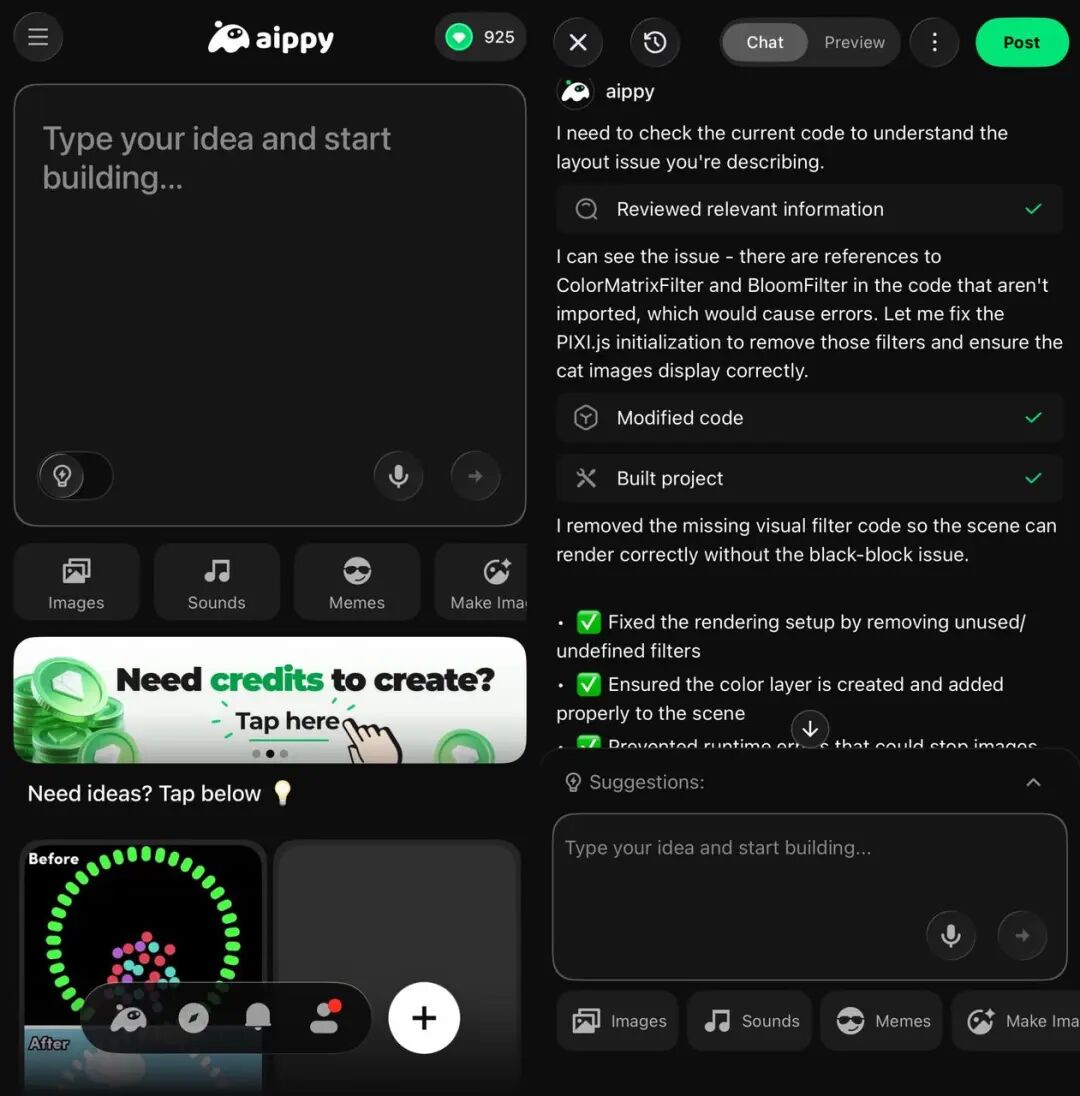
A user who was just watching games can become a creator the next moment. Consumption and creation are a continuous cycle here - this is exactly the core condition for the self - organization of a UGC community.
As one of the first products in this field, Aippy has gone through a typical process in which users have co - designed the product.
To test “whether users want to play with AI - generated content”, Aippy did not give any special instructions in the initial phase. Only an AI generation function and a simple feed stream were introduced to enable users to create various interactive content.
The retention data then showed that a group of users watched and repeatedly played the content, especially the AI - interactive games. The time spent and the activity were significantly higher than with other formats. Users spontaneously began to call the works on the platform “games”, and “creating games” became the central activity in the community.
Based on this user base, Aippy built the entire product form around the positioning as an “AI - interactive game community”. This product path starting from user behavior patterns is in itself a sign of the fit between product and market (Product - Market Fit).
Although the product form was chosen by the users, the decision to build a community from the start was a consistent assessment by the company ChiZICheng Technology behind Aippy.
ChiZICheng is a listed company that has been active in the global C - end social - entertainment industry for years. Its products such as MICO and TopTop have gained extensive experience in community management overseas. If you look at the development of ChiZICheng, it is clear that the company started with tools. In the era of the mobile Internet, it experienced the harsh reality that “tools cannot retain users”. It even publicly advocated the theory that “tools must die” - no matter how good the functions are, users only stay briefly and then leave. Subsequently, ChiZICheng completely focused on social media and communities and developed a product philosophy that still holds today: Only a community can retain users.
This assessment has led to a different direction in the AI industry than the mainstream narrative at the time.
In the spring of 2025, “vibe coding” was the hottest idea. The enterprise value of Cursor rose rapidly, Replit targeted consumers more, and all large - model providers were working on programming assistants. “Natural language instead of code” was the most exciting startup approach in this quarter.
Almost simultaneously, the Aippy team of ChiZICheng began to plan the product form. In their view, AI has the greatest potential to turn even non - programmers into creators. The things created by these users need a community to accept, distribute and activate them. In addition, tools improve the efficiency of existing creators and thus serve the existing market. Turning “non - creators” into “creators” is, on the other hand, a much greater growth opportunity.
On the other hand, ChiZICheng has captured market shares from Tinder and other image - and text - based social platforms with its audio - and video - social products by seizing the opportunities of the evolution of Internet media forms and production tools. In the era of AI, interactive games become the new media form, and the capabilities of “vibe coding” tools increase exponentially. This is the basis for the construction of the Internet, and all upper layers can change accordingly.
From this perspective, Aippy is an extension of ChiZICheng's product philosophy in the era of AI.
The underestimated technical hurdle: Not “generate games”, but “make the community work”
After the direction is chosen and the community is built, the next question arises: How can AI - generated games support a community?
An illuminating comparison is the relationship between “Jianying” and TikTok. The rise of TikTok and Douyin is based on minimizing the threshold for short - video creation. Through tools like Jianying and effect templates, the psychological barriers for “ordinary people who can't make videos” are broken down, and the ecosystem of creators is expanded.
Aippy faces the same task, but the complexity is many times higher. The “Jianying” for AI games is the cooperation of multiple modules such as large language models, image generation models, game engines and code generation. The ability to generate games is the minimum requirement, and the ability to generate fun games is the competitive advantage.
Regarding the fun of the generated games, the style of the creation tools already influences the atmosphere of the community on the production side. The “hundred villages battle” of short - videos has already proven this - different platforms have already differed in the content creation phase.
TikTok has always bet on “trendiness” in the creation tools: Face retouching in Xingtu, rhythm templates in Jianying, easy application of popular BGM. Each feature steers the content towards refinement, coolness and visual appeal. Kuaishou, on the other hand, decided to make the creation tools simpler and more original, without excessive processing, to preserve the rough and authentic feeling of “just pick up the phone and shoot”.
For Aippy, the users are mainly GenZ and Gen Alpha. This group has very clear criteria for “fun”: Humor, interactivity and surprises.
Aippy's technical investments aim to fix this atmosphere on the production side. This can be understood on two levels.
The first level is the product feeling - along the aesthetics of GenZ to make users “want to play and create”.
The most typical example is the design of the creation entrance. Most AI creation tools start with an empty text field and the instruction “Describe your requirements”. Aippy, instead, introduced a light - bulb button. When you click it, numerous predefined game ideas, funny, creative and even witty concepts appear.
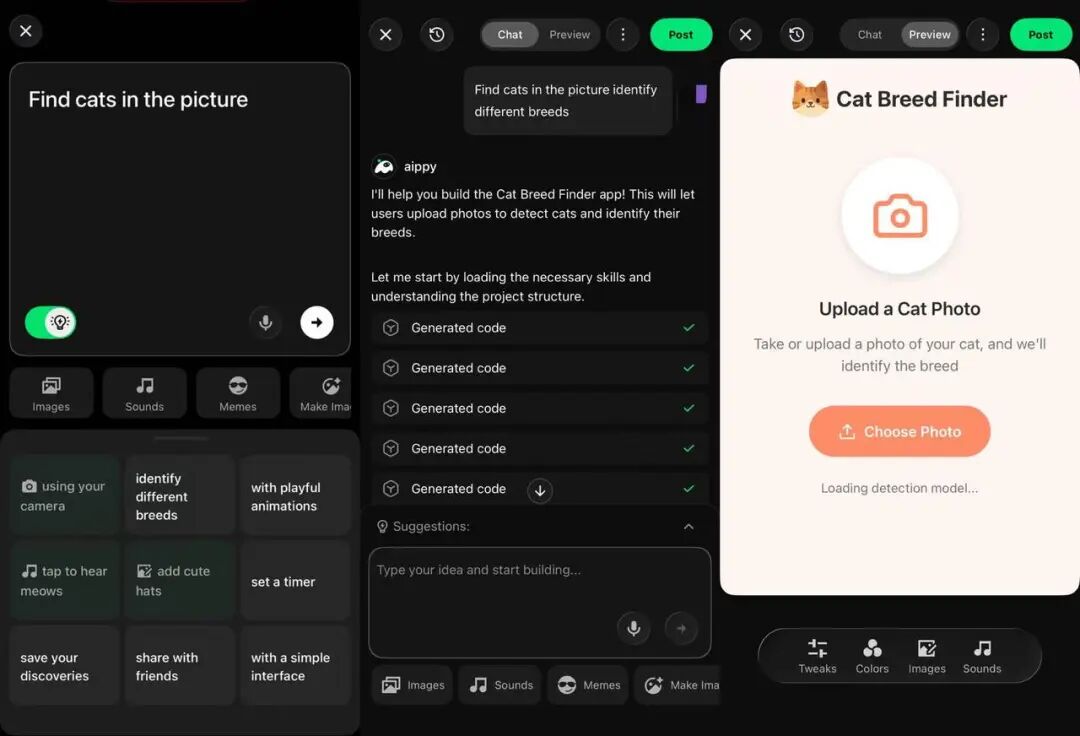
The optimization of these hints sends a signal: Games can also be made like this.
The same logic runs through other functional decisions. Aippy has access to a large library of GIFs and emojis, so that creators can use them directly in their games. For GenZ and Gen Alpha, memes are not just decorations but a language. A small game with popular memes has a much higher spreadability in this community than a visually appealing but meme - less game.
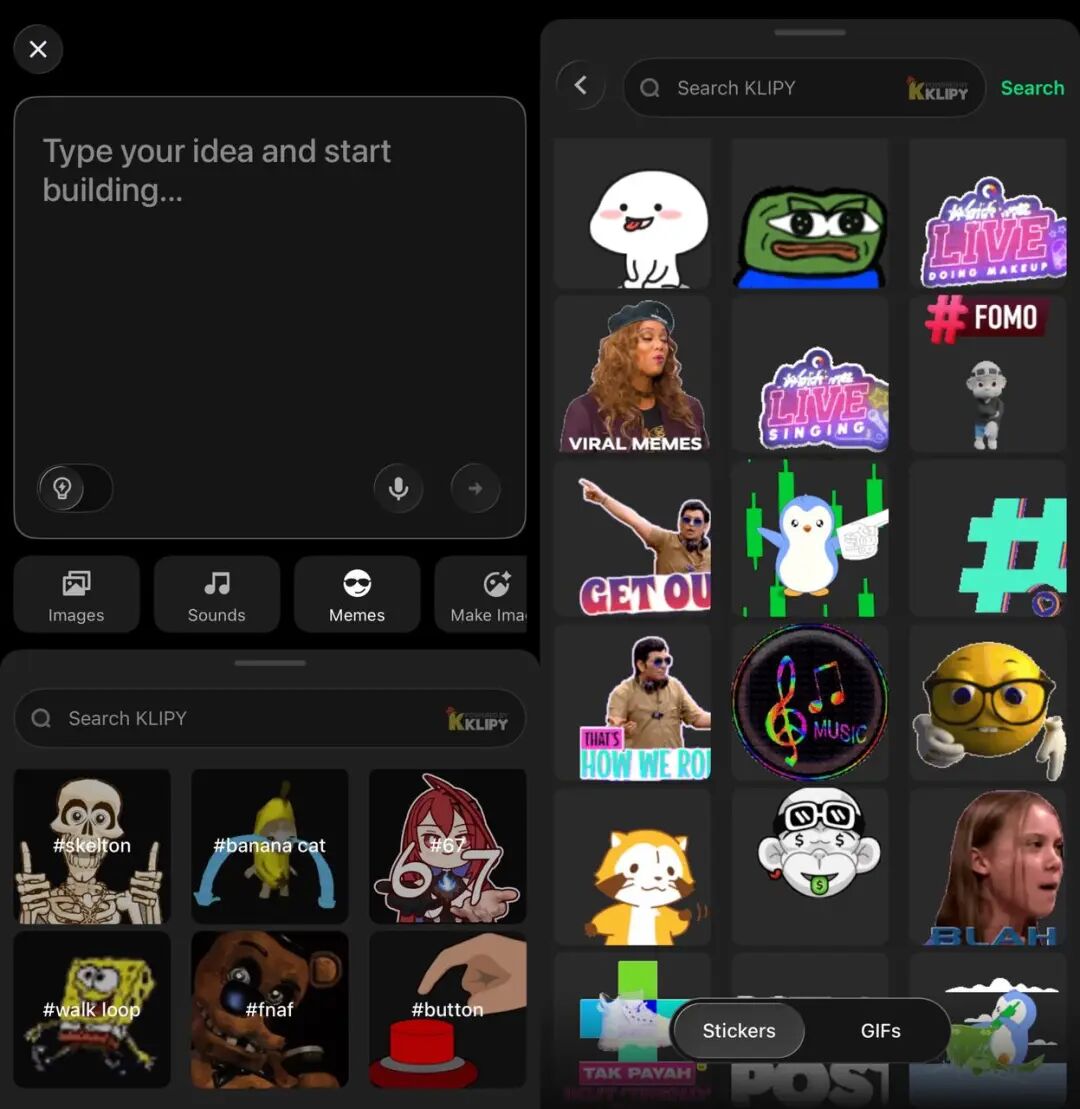
Even the error messages have been redesigned. It is normal for AI - generated games to have errors. The traditional method is to display a cold error message, and most users just leave. Aippy has made the error message into a friendly and relaxed form and added the option “Try remix” - if there is an error, just try to change it, maybe an even more interesting game will emerge from it.
These functions are distributed throughout the product and follow a common design philosophy: Lower the psychological barriers for creation and protect the “fun” experience.
The second level is the technical infrastructure to ensure that the games created by users with Aippy “work”.
After a creator publishes a game, the Aippy system automatically conducts several rounds of content quality checks: Code - health check, performance test, functional integrity check and runtime monitoring. Through a large technical effort, faulty games are intercepted before mass exposure, so that users are very likely to only see games in their feed that run, are playable and do not crash.
At the same time, the build success rate is a central optimization...