WalMart's private label, Marketside, launches "Matcha Season" and steps into the "deep end"
In the spring of 2026, customers entering Walmart stores will first be caught by a large expanse of bright green. From matcha cream puffs in the bakery section, extra-strong matcha in the beverage section, to jasmine matcha corn chips in the snack section, and even the thousand-mesh matcha red bean spread in the seasoning section, matcha elements cover the shelves with a wonderful density and breadth.
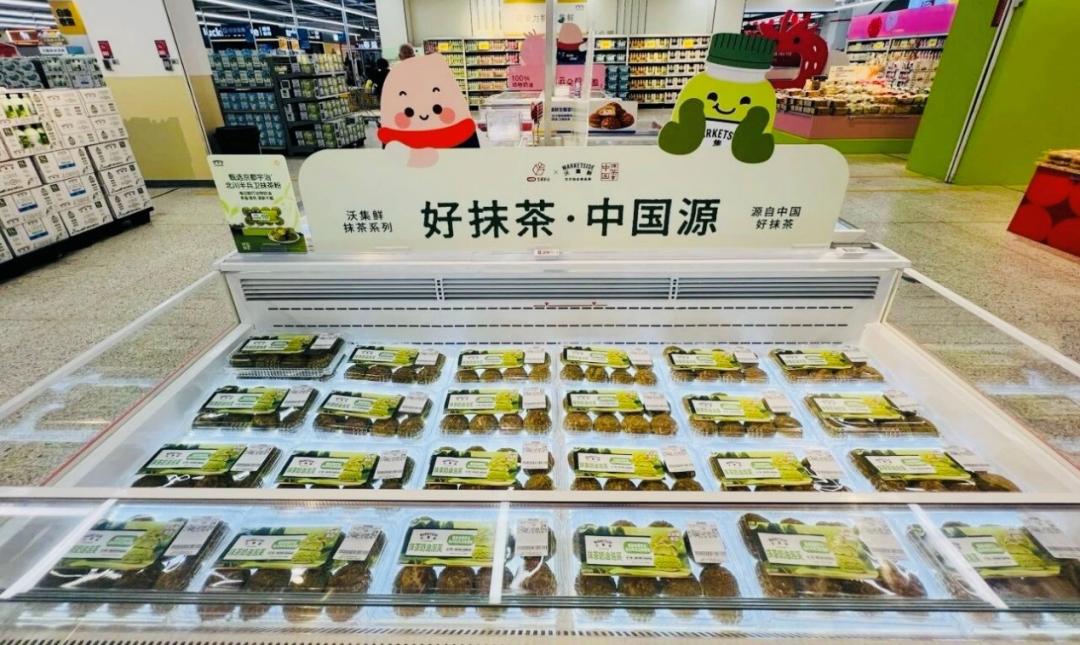
This is the "Matcha Season" launched by Walmart's private label "Marketside". With the concept of "Simplicity for Freshness", Marketside has made the seasonal matcha into an entire series - from baked goods to snacks, from beverages to sauces, with dozens of new products hitting the shelves at the same time.
Against the backdrop of the retail industry generally regarding private labels as "low-cost alternatives", Walmart is trying to prove one thing with Marketside: the value of private labels goes far beyond price. It can be the core manifestation of a retailer's product strength and can also become an emotional bond connecting Chinese local specialties with customers' daily consumption.
1. "Simplicity for Freshness" is a weighty commitment
Since Walmart initiated its transformation, the strategic origin of "customers first" has been frequently mentioned. Zhu Jun, the senior vice president of Walmart China and the chief procurement officer of the Walmart format, has repeatedly stated on multiple occasions that "the people we serve are urban middle-class families and single individuals", and their demands for quality, health, and convenience are becoming more and more specific.
As an important part of the transformation strategy, the mission of Marketside is to transform these abstract demands into tangible products. Zhu Jun has also emphasized many times that Marketside is not about creating "Walmart's private label", but about "creating a differentiated product strength that meets the needs of the target customer group".
The difference between these two statements lies in that the former is a channel mindset - because I am a retailer, so I want to create a private label; the latter is a customer mindset - because customers have unmet needs, so I use the private label to create better products to fill the needs and thus create a better life for customers.
Taking the "Matcha Season" as an example, Walmart did not simply "take" the existing matcha products on the market. Instead, it systematically sorted out the high-quality matcha production areas in China from the source. Finally, they chose Tongren in Guizhou and Jingshan in Zhejiang.
Among them, Tongren matcha is known for its rich tea color and bright green color. It is suitable for blending with flavors such as cheese, milk, and chocolate, and serves as the base for popular matcha products. As one of the birthplaces of Chinese matcha, Jingshan matcha has a purer flavor and is more suitable for creating products to meet high-end needs.
This "dual-source parallel" strategy essentially transforms the value of the origin into commercial value. When customers see clearly marked on the product label "Selected thousand-mesh matcha from Tongren, Guizhou" or "From the organic tea garden in Jingshan, Zhejiang", the origin is no longer just a procurement address but becomes a narrative language for the brand to communicate with customers.
The brand proposition of Marketside is only four words: Simplicity for Freshness. But in today's retail environment, turning a slogan into a perceptible experience for customers tests the retailer's product development skills. Breaking it down, "simplicity" means reducing the ingredients in the ingredient list, and "freshness" means that the raw materials, origin, and experience must be convincing.
This set of standards has also been translated into a series of specific actions during the "Matcha Season". For example, the room-temperature matcha pudding does not contain preservatives; the matcha sandwich rice cakes use trehalose instead of white sugar and adopt the production process for infants; the matcha latte powder contains only four ingredients: matcha, milk powder, sugar, and cheese; the low-sugar matcha fresh milk latte coffee uses monk fruit sugar for sweetness.
This product development approach of "subtracting" and pursuing perfection precisely hits the core demands of the current urban middle-class population - a clean ingredient list, traceable raw materials, and no compromise on health.
Today, from raw materials to processes and then to formulas, the "Simplicity for Freshness" concept of Marketside has been translated into a series of executable and verifiable product standards. This is where Walmart's private label sets itself apart from many traditional retailers. It doesn't just stay at the conceptual level but truly embeds a slogan into the entire product development chain.
2. Only by infinitely approaching or even exceeding customer needs can we create a sense of surprise
Another highlight of Marketside's "Matcha Season" is the breadth of its category coverage.
Walmart did not limit matcha to the two traditional categories of baked goods and beverages. Instead, it extended it to more scenarios such as snacks, ice cream, and table sauces. The launch of these non-traditional matcha categories, including matcha jasmine corn chips, dark chocolate matcha brittle, thousand-mesh matcha red bean spread, and thousand-mesh matcha granule pistachio jam, has greatly broadened consumers' imagination of matcha.
But breadth only constitutes half of the sense of surprise. The other half comes from the retailer's in-depth hierarchical exploration of customer needs.
Walmart found that although matcha-based products have a certain level of public awareness, customers' acceptance of matcha is highly stratified. Some people like "light matcha" and use it as a fresh embellishment; others are "heavy matcha" lovers, pursuing the ultimate tea aroma and aftertaste. However, most matcha beverages on the market are mainly for flavoring and difficult to satisfy professional palates. If only one form of matcha product is provided, it obviously cannot meet the expectations of all customers.
Therefore, for entry-level customers or those who prefer a light taste, Marketside combines matcha with ingredients that are widely accepted by the public, such as jasmine, dark chocolate, and cheese, making it easy for first-time customers to accept.
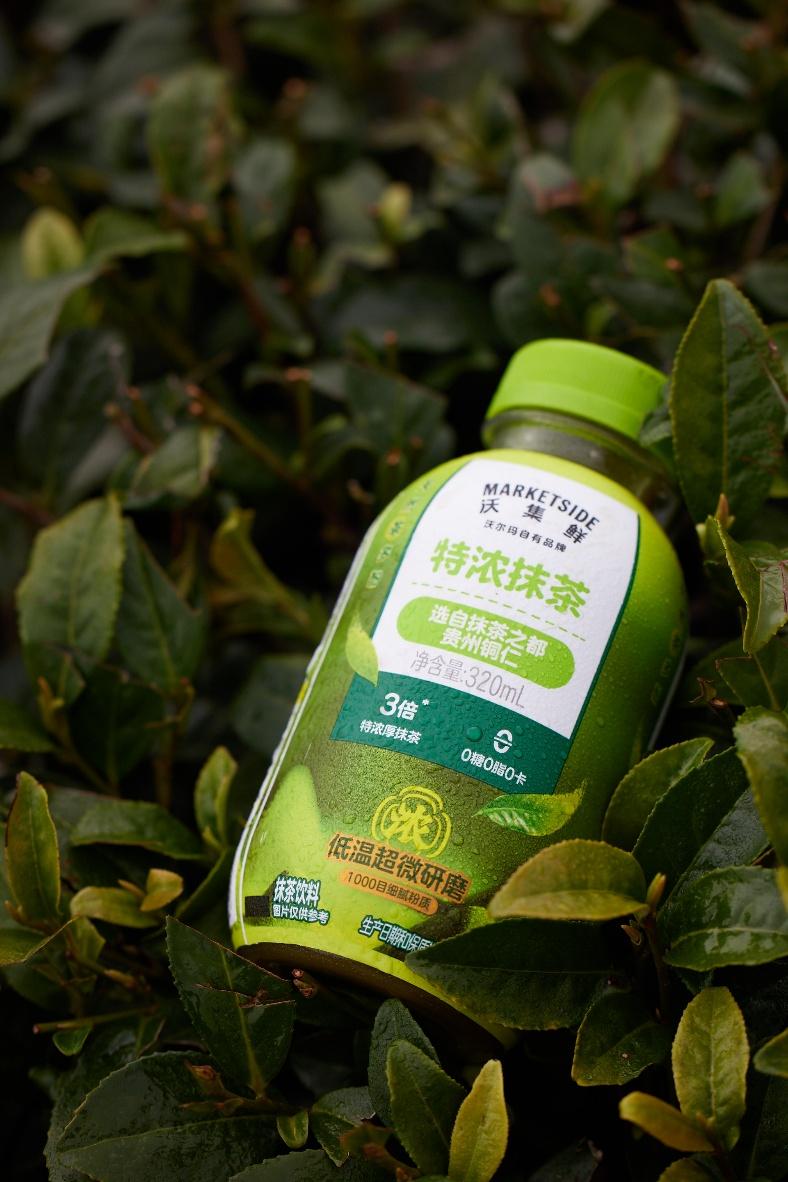
For senior matcha lovers, Marketside lets matcha take the lead. It launched extra-strong matcha, selecting thousand-mesh matcha from the Fanjing Mountain area in Tongren, Guizhou. Through strict standards such as selecting "one bud and two leaves" and going through eleven processes, it maximally retains the authentic aroma of matcha.
This extremely elaborate hierarchical design is essentially the result of putting aside the channel identity and standing from the customer's perspective, digging deeper and deeper into the real needs.
In the retail industry, when most brands develop new products, they often only focus on the "greatest common divisor" - which flavor has the widest audience and which price range has the largest sales volume. As a result, product homogenization is serious, and it doesn't matter which brand consumers buy.
Walmart's approach is equivalent to a "reverse operation": first identify the segmented needs at different levels, then develop products targeted at these needs, and finally form a matrix. Customers with different levels of acceptance and different consumption scenarios can all find their own products in this matrix.
This ability to "always have a product for you" is not achieved overnight. It is supported by a complete and unique product development system.
First of all, Walmart has an independent procurement team. According to 36Kr, this is a professional procurement team that has been honed over the years during Walmart's format transformation. This team includes both senior procurement experts with professional supply chain development and management capabilities and product manager-type talents who are good at product innovation and development. Under the value proposition of "Simplicity for Freshness" of Marketside, they conduct original development closely around the needs of the target customer group of urban middle-class small families and single individuals. This means that its development concept, product selection logic, flavor direction, and packaging design all need to form their own systems.
Secondly, it has the ability to launch new products at a fast pace. During a "Matcha Season", it can launch dozens of new products, covering multiple categories such as baked goods, beverages, snacks, ice cream, and table sauces. This density of new product launches and category span is not common in retailers' seasonal themes. It tests not the ability to create a single hit product but an organization's ability to quickly respond to seasonal trends, flexibly schedule the supply chain, and manage the parallel R & D of multiple categories.
Finally, it has a precise small-packaging strategy. Marketside targets urban middle-class small families and single individuals - they have relatively compact living spaces and fast-paced lives and often do not want to bear the pressure of storage and waste because of "large quantities at a good price". Small-packaged snacks, small cakes, and small bottled beverages... These designs allow single individuals or couples to easily taste a variety of flavors. This is not just a difference in packaging specifications but a deep understanding of the target customer group's living scenarios.
The combination of these three aspects constitutes the unique gene of Marketside that differentiates it from traditional private labels: it is not an appendage of the channel but a brand with independent product strength that truly takes customer needs as the origin.
The market response has, to some extent, verified Marketside's deep understanding of customer needs. A retail industry practitioner commented after visiting the store, "The products in the Matcha Season are very outstanding. They are visually clean and appealing, and the product selection also has characteristics. Walmart has become more enjoyable to shop at." On social media, many consumers have also spontaneously shared. Some said, "Marketside's extra-strong matcha is simply my favorite", and others specifically mentioned, "The small packages are so friendly. I bought five or six kinds of matcha snacks to try."
For consumers, the product richness and interesting, high-frequency new product launches of Marketside are the ultimate source of the "sense of surprise". It does not rely on the accidental popularity of a single hit product but is the inevitable result of systematic product planning.
In the past, retailers competed on who could offer lower product prices; today, the industry competes on who understands their customers better. Marketside's "Matcha Season" provides a sample: even for relatively niche and highly segmented flavors, scale can be achieved through hierarchical design, and more "intimate" emotional value can be created. If this methodology is replicated in more categories, it is bound to establish a systematic differential advantage in the field of seasonal products.
3. The core of a private label lies in the "brand", not the "private" aspect
The launch of Marketside's "Matcha Season" is easily interpreted as another category expansion of Walmart's private label. However, if we only focus on this, we may overlook a more fundamental change.
For a long time, there has been a misunderstanding in the retail industry's perception of private labels. People regarded "private" as the core value, and practices such as OEM, low prices, and imitating big brands once became the mainstream. This approach worked in the past because consumers had few choices. But today, when price information is highly transparent both online and offline, simple low prices no longer form a barrier. Consumers can easily compare prices, and loyalty built solely on price is out of the question.
Looking back at the many actions of Marketside since its launch, from continuously developing new products around personalized needs, upgrading the brand, cooperating with Xiaohongshu, to this "Matcha Season", its focus has always been on building a real "brand".
The difference between brand thinking and channel thinking is also specifically reflected in the "Matcha Season". If it were a channel mindset, Walmart would only need to find a few matcha powder suppliers, produce a few best-selling products with a label, set a low price, and put them on the shelves. However, its approach is to go deep into the tea gardens in Tongren and Jingshan to customize matcha powder that meets the requirements; cooperate with leading factories for R & D instead of simply selecting products and putting on labels; reduce the formula and process while increasing the "freshness" of the raw materials instead of covering up raw material defects with additives; for example, it adheres to using customized thousand-mesh matcha in matcha ice cream and fresh milk instead of reconstituted milk.
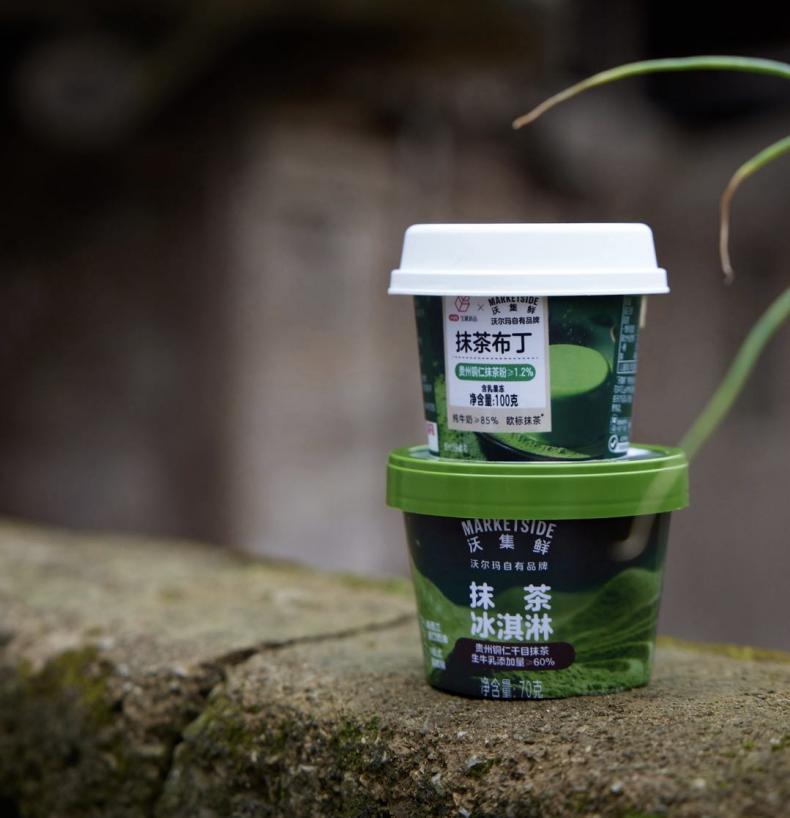
To date, Marketside has developed its own characteristic - taking high-quality Chinese local production areas and the ingredient list revolution as the core narrative, which not only responds to customers' cultural identity of Chinese style and new Chinese style but also builds a raw material barrier and a clean ingredient mental barrier that differentiates it from competitors.
The path to branding is not easy. It places higher requirements on retailers, who need to have both procurement capabilities and understand the internal logic of product development.
Walmart has formed a composite team for this purpose. For example, in Marketside's bakery procurement team, there are both senior supply chain experts with decades of experience and R & D professionals who have served as head bakers in Michelin restaurants. This kind of talent configuration is not common in traditional retail enterprises, but it is precisely the organizational guarantee for Marketside to continuously produce high-quality and highly differentiated products.
The "Matcha Season" shows that Walmart is doing its private label in a different way from before: not in a hurry to talk about scale or speed, but using a simple proposition like "Simplicity for Freshness" to respond to those increasingly picky customers.
In the product development of Marketside, a clear path has emerged: Walmart integrates its global supply chain capabilities with high-quality Chinese local ingredients. On the one hand, it goes deep into core domestic production areas such as Tongren in Guizhou and Jingshan in Zhejiang to transform landmark ingredients into the competitiveness of products; on the other hand, globally selected raw materials such as directly imported chocolate from Belgium, imported nuts from Vietnam, and cherries from Chile also enter the product system of Marketside with the same "Simplicity for Freshness" standard. The breadth of the global supply chain and the depth of Chinese local ingredients are not an either - or relationship but two parallel paths.
This is not only the upgrade path of Walmart's private label but also provides a worthy transformation direction for the entire retail industry - when low prices are no longer a moat, real brand power comes from the ability to integrate global high - quality resources and from a deep understanding of local resources.
4. Conclusion: The end - goal of retail is to win customers with value
In the current situation where private labels are increasingly crowded and highly homogeneous, they are no longer just a simple low - cost supplement but the core for retailers to build a differential moat. A typical example is that more and more netizens on social media are sharing that they have fallen in love with shopping at Walmart because of Marketside.
Marketside's "Matcha Season" is undoubtedly a cutting - edge exploration that delves deeper. It attempts to answer a rather forward - looking question - how deep and how detailed can a private label go.
The significance of the "Matcha Season" ultimately does not lie in how many new products are sold but in proving to the market that when a retailer truly calms down to listen to customers, understand trends, and uses professional capabilities to integrate the supply chain, refine processes, and innovate categories, it is fully capable of creating good products that exceed customers' expectations.
From Tongren to Jingshan, from a pure matcha product to a can of sauce, Walmart's "taste - seeking journey" has just begun. As it continues to go deeper into more Chinese production areas and transforms more high - quality local ingredients into "Simplicity for Freshness" products, a new Walmart brand image centered on product strength is being quietly reshaped.
—————— Special Release ——————