The first robot to go to the International Space Station has emerged. Is Mars the next stop?
Icarus Robotics' Joy robot will carry out its first mission, "Joyride", in 2027.
Icarus Robotics said today that it plans to test its free-flying robot Joy on the International Space Station (ISS) in 2027. The startup has signed a mission management contract with Voyager Technologies Inc.
Voyager operates the only commercial airlock on the ISS.
Under the agreement, the company will be responsible for payload integration, safety certification, launch coordination, on-orbit operation planning, and real-time mission execution support.
Icarus Robotics said that this will enable it to focus on addressing the challenges of operating robots in a zero-gravity environment around humans.
Ethan Barajas, co-founder and CEO of Icarus, said, "Voyager allows us to focus on the core of the robotic problems we're solving." He added that Voyager, based in San Diego, is the kind of company that can turn ideal solutions into practical on-orbit systems.
Scott Rodriguez, vice president of government programs at Voyager, asserted that Joy will have a real impact on the ISS.
He believes that this technology could be of great benefit to the company's future commercial space exploration.
"Here, our job should be relatively easy. We're just the implementing partner, providing support for the plans they want to achieve," Rodriguez said. "They focus on their research, science, and technology, while we're responsible for getting them up there and assisting with execution."
Last year, the New York-based startup raised $6.1 million in a seed round. Since then, Icarus has been working on transforming its system into a scalable, production-ready robot.
01
Icarus Designs Joy to Assist Astronauts
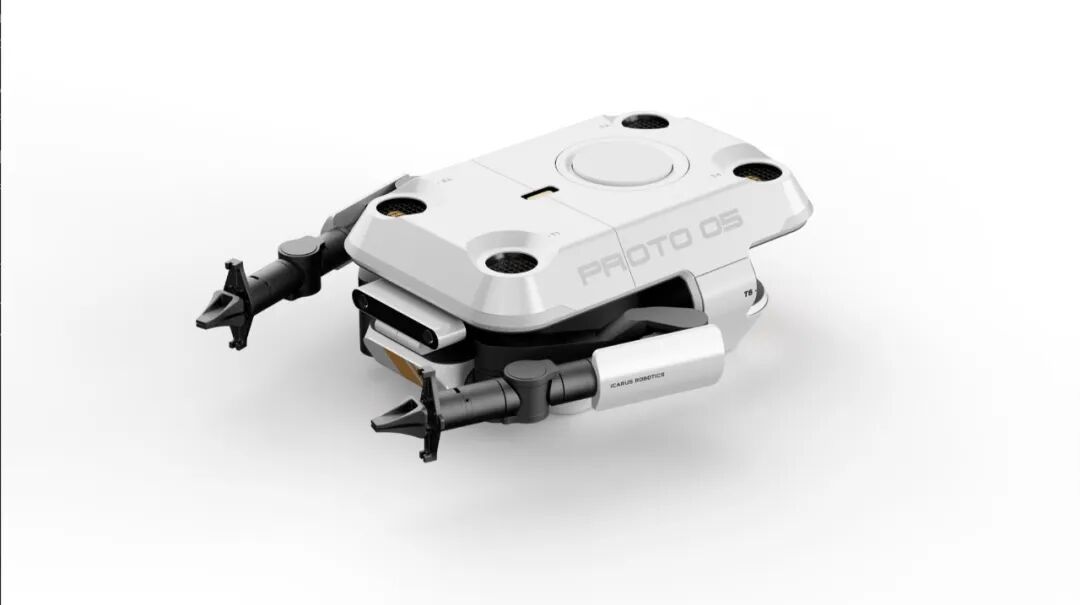
Joy uses fan thrusters to navigate through the pressurized space inside the ISS. It has two robotic arms that the Icarus team can control from the ground.
Icarus said it plans to start by remotely operating the robot, which will allow the company to collect crucial data to build an autonomous system. This will also enable the team to send the robot into space as quickly as possible.
Jaime Palmer, co-founder and chief technology officer of Icarus, said, "The goal of the mission is to really enter that environment, test our hardware in it, and then collect extremely valuable expert human demonstration data. Because it means a lot to us. The core idea is to have a well-trained, autonomous, and learning 'robot brain', and it can start with obtaining real data in a real environment."
Palmer said that Icarus has been collaborating with experts in the field to create a better remote operation system. This includes adding people with remote operation expertise to the team and collaborating with different fields such as the medical industry.
"In my opinion, surgical robots are one of the frontiers of robotic remote operation," Palmer said. "So, we're really trying to think about the possibilities of achieving this in many different ways."
02
What Missions Will Joy Perform on the ISS?
Icarus Robotics aims to handle many different tasks on the ISS. Astronauts have to complete a large number of repetitive tasks every day, which distracts them from more important research projects.
"First, in terms of cargo and logistics, moving cargo bags from point A to point B is extremely time-consuming," Barajas said. "You have to deal with the changing mass in these bags, and you may not know what's inside. This is a very tricky control problem. After that, there are the operational actions, such as actually opening these bags and handling the logistics distribution of the internal cargo and where it goes."
Even during scientific experiments, there are many opportunities for the robot to take over the work of astronauts.
"For example, if you're conducting a tower experiment, about three-quarters of the work might just be setting up, finding tools, and unpacking. This is where Joy wants to change the situation,"
Rodriguez said, "We can free up astronauts' time for scientific research and complex troubleshooting by having the robot perform repetitive tasks, prepare the workspace, and set up experiments."
03
What Help Does Voyager Provide?
Barajas said that Voyager has provided assistance to Icarus in mission management, designing the interface between the ISS National Laboratory, and dealing with ISS components that require special access from other agencies such as the Japan Aerospace Exploration Agency (JAXA). Voyager has also provided specific design considerations.
"You'll learn things like: if you send tinned solder into space, it will grow 'whiskers'," Barajas said. "So, it's these tiny details that they've accumulated through years of experience in deploying thousands of payloads in space."
Voyager has also assisted in verifying whether Icarus' robot is safe enough to operate on the ISS. "When you go to the ISS, you have to go through NASA's safety and certification process. They tend to deal with 'possibilities' rather than 'probabilities'," Rodriguez said.
NASA is interested in exploring any possible ways things could go wrong, which means any experimental technology (such as robots) has to go through strict safety certification.
"NASA is very helpful and provides resources throughout, but their primary goal is to maintain the operation of the space station and ensure the safety of astronauts," Rodriguez said. This is where Voyager can help Icarus reduce the burden.
"We've learned a lot over the years, and a large part of it is from real-world tests and mistakes," Rodriguez said. "So, we're happy to share any experience we've learned and try to help them avoid repeating the same mistakes, although I don't think they need much help."
04
What Are Icarus' Next Plans?
Voyager and Icarus plan to send Joy to the ISS in early 2027. The length of time the robot will stay in space and when it will start operating are currently uncertain. The start time of the robot's operation will depend on the availability of astronauts.

In addition, flights back from the ISS are less frequent than flights to the station, so Joy's return will depend on Voyager's schedule.
Before sending Joy to the ISS, Icarus still needs to do some preparatory work.
"One of the most exciting things is preparing for parabolic test flights (weightless flight tests), which will give us the opportunity to complete the last step before really going into space," Palmer said. "I think this will give us an advantage and allow us to experience the basic work of performing such tasks before conducting this extremely important ISS test."
Looking further into the future, Icarus is interested in creating more forms of robots to operate inside and outside the space station.
"I think we'll have many opportunities to expand from this free-flying vehicle that operates inside the space station and works alongside the astronaut team to some very exciting areas outside the station. At that time, we'll have a variety of robot forms," Palmer said. "I think the real 'secret' is that they can all share the same basic robot brain designed for the microgravity environment."
Outside the space station, robots can perform orbital maintenance, satellite servicing, assembly, and refueling. Eventually, they can be used for infrastructure construction tasks on the moon or Mars.
"You can't complete all this construction by human power alone," Rodriguez said. "To some extent, it has to be driven by robots, and this is a solid step in that direction."
This article is from The Robot Report, written by Brianna Wessling. The copyright belongs to the original author. If there is any infringement, please contact us to delete it.
This article is from the WeChat official account "Machine Preface". The author is Machine Preface. 36Kr is authorized to publish it.