Xiaohongshu is accused of "maliciously reaping" the certification fees of real estate agents. The rules changed overnight. Is it a system bug or a case of changing orders from one day to the next?
01
“It made me laugh. I spent over 1,200 yuan, and before even a month passed, my account was gone, and I couldn't even appeal.”
This is a comment left by a real - estate blogger with an IP in Anhui below the official announcement on Xiaohongshu. This complaint is a microcosm of the recent “account - banning wave” that the real - estate industry has encountered on the Xiaohongshu platform.
The cause of this incident stems from the sudden change in the certification rules for professional accounts in the real - estate industry on the Xiaohongshu platform.
According to several real - estate agents, between February 25th and March 11th, a single business license on Xiaohongshu could be used to certify 10 accounts. A large number of agents paid the fees according to the process and passed the certification. The certification fee is 600 yuan per year, with a promise to unlock rights such as property listing and traffic support.
Starting from March 12th, Xiaohongshu suddenly reduced the number of accounts that can be certified with a single business license to two and banned the accounts certified in the past half - month.
Accounts certified between February 25th and March 11th in excess of the limit were permanently banned in batches without warning, without a rectification period, and without an effective appeal channel.
Some real - estate self - media said that this incident involves 30,000 - 40,000 agents. Although there is no official data to support this, no less than hundreds of people have posted and left comments on different social media platforms expressing their experiences.
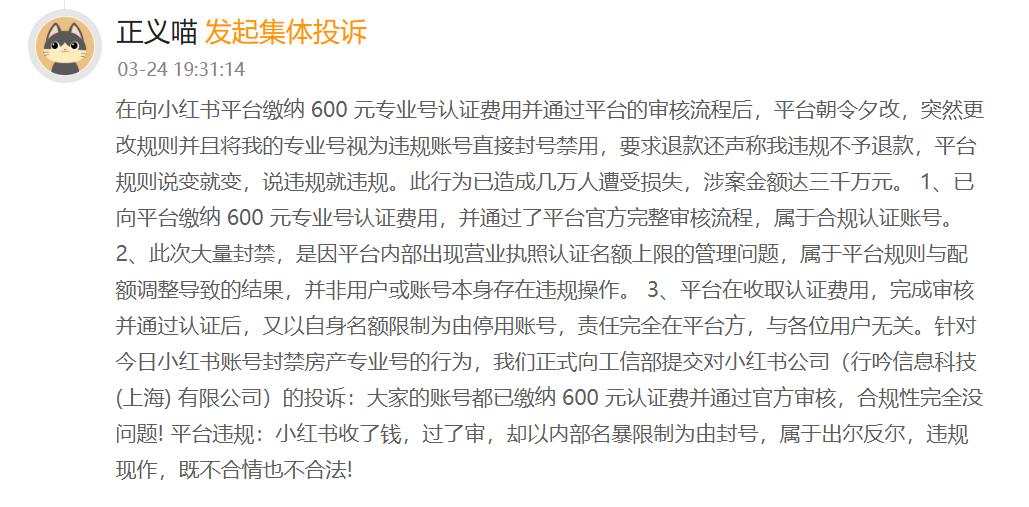
Screenshot from HeiMao Complaint
This operation of collecting money first and then banning accounts quickly triggered suspicions of “malicious harvesting” among practitioners.
Currently, discussions by “affected” practitioners can be found in the comment sections of various platforms. After having no way to appeal on the platform, they choose to use channels such as HeiMao Complaint, 12315, and the Internet Information Service Complaint Platform to safeguard their rights.
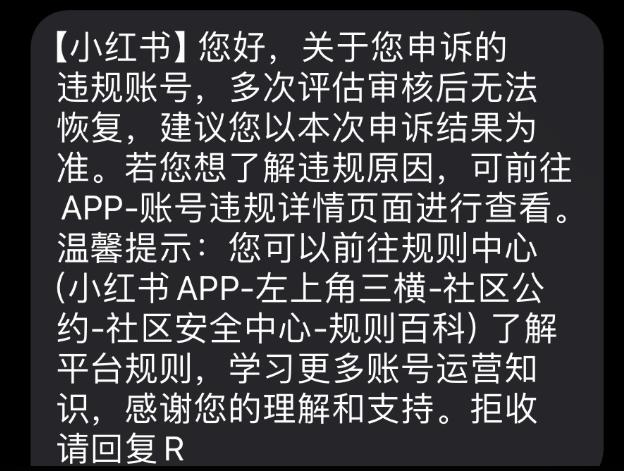
Platform appeal feedback
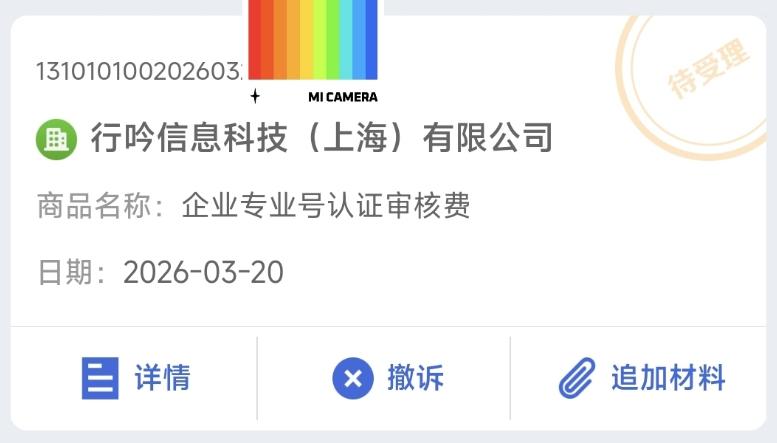
Complaint records on 12315 posted by practitioners in the Douyin comment section
The agents' suspicions mainly focus on the following aspects:
1. One - size - fits - all punishment implementation
No warning: The rule change was not announced in advance and was applied retroactively.
No rectification opportunity: Accounts were directly and permanently banned. Agents were not allowed to cancel redundant accounts, supplement materials, or given any rectification suggestions.
No distinction: Regardless of whether the accounts were operated in compliance, newly certified, or had enjoyed the services, accounts in excess of the limit were banned.
2. Refusing to refund without exception
Unified statement: All customer service and email responses were: “The certification fee is a review service fee. Once the review is passed, it will not be refunded.”
Legal basis: The platform cited the standard clause in the user agreement that “the fee will not be refunded after successful certification.”
3. Meaningless appeal channels
Mechanical review: The appeal entry only allows the submission of materials, without manual review, and the system automatically rejects the appeal instantly.
No manual channel: It is impossible to contact the exclusive customer service or management. All issues are responded to with a unified script.
Most importantly, after paying the fee, the accounts “passed the certification instantly,” but were banned in a short time on the grounds of “violating new rules.” This is a case of going back on one's words and changing policies frequently. If the account qualifications are non - compliant, the review should have rejected the application instead of collecting the fee and then taking action later.
02
However, as the scale of the discussion continues to expand, more details have been supplemented by relevant practitioners, and this incident seems to involve more than just the issue of “malicious harvesting.”
In the comment section of relevant articles, a real - estate agent pointed out a phenomenon that puzzles many peers and consumers:
“There is one thing about Xiaohongshu certification that I really don't understand. That is, you can use the qualifications of real - estate agencies from other regions for certification. For example, if I'm in Wuhu, Anhui, I can use the real - estate companies from Zhejiang, Guangzhou, or Xinjiang for certification. In fact, these companies have no connection with Wuhu at all. In short, it's just about paying for affiliation.”
This agent further revealed that when he checked the Xiaohongshu certification information of local peers, he found that a large number of local agents were using business licenses from other provinces.
“Should I believe it or not?”
Another real - estate agent from Zhejiang said: “I'm also very confused. Our company's business license, which is officially registered with the housing management bureau, can't be used because they said the registered capital is not enough. Finally, I found an agency that has opened a Xiaohongshu port and used the business license of an out - of - town company.”
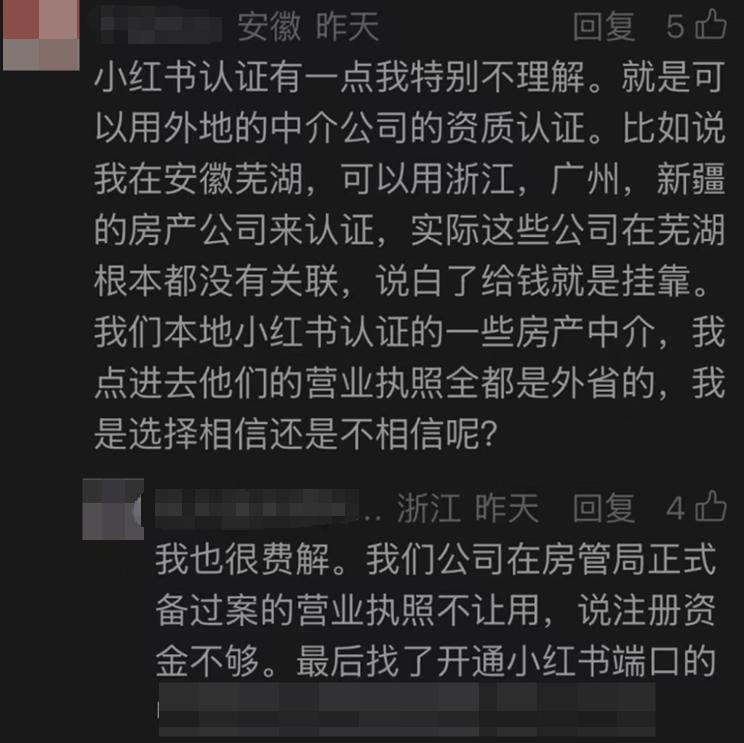
Screenshot from the comment section of relevant discussion articles
According to Xiaohongshu's current certification rules, to post property listings, one must certify as a blue V, and there are clear qualification thresholds: the company must be established for at least 3 months, the registered capital must be no less than 1 million yuan, and it must hold official qualifications such as the “Real - Estate Brokerage Institution Filing Certificate.”
Public information shows that as of September 25, 2024, there are 1.0103 million real - estate brokerage - related enterprises in China. Currently, when searching for “real - estate agency service” companies with the word “agency” in their names on relevant enterprise search platforms, there are 432,000 such companies.
Among them, only more than 80,000 have a registered capital of over 1 million yuan, accounting for less than 20%; while there are 215,000 companies with a registered capital of less than 100,000 yuan, accounting for almost 50%; and 166,000 with a registered capital of less than 30,000 yuan, accounting for more than 38%.
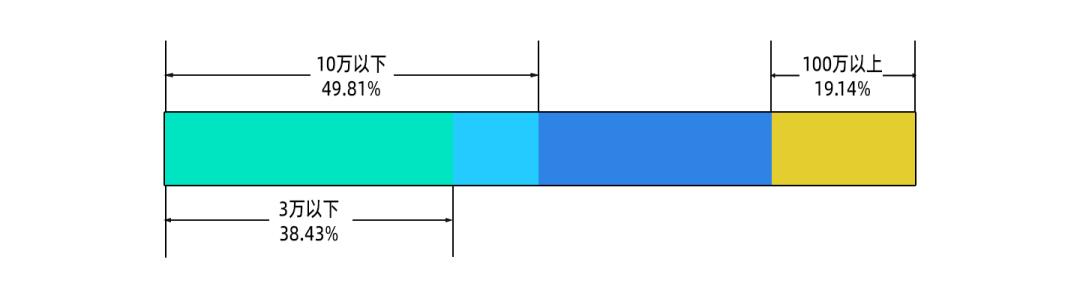
The proportion is shown in the figure, drawn by Future Keqi
Real - estate brokerage companies are naturally “small and micro.” For this kind of service institution with light - asset operation, the one - million - level entry threshold directly cuts off the entry qualifications of more than 80% of regular business entities.
Moreover, the restriction in the rules that “one business license can only register two blue V accounts” has also intensified the scarcity of accounts in actual operation.
The combination of these two restrictions has forced a large number of small and micro real - estate agencies operating in compliance to resort to “buying qualifications.”
A real - estate agent from Beijing told the author that his company encourages employees to operate their own Xiaohongshu accounts. Due to the limited number of blue V quotas under the company's business license, employees often need to apply for sub - accounts from the company, register their own companies to obtain business licenses, or seek affiliation with third - party real - estate agencies to obtain certification qualifications. And the monthly cost for the company to open a Xiaohongshu account is about 1,000 yuan, and registering a company or seeking affiliation also incurs considerable costs.
A real - estate agent from Anhui further confirmed this phenomenon during an interview. Since the registration quota of his company's business license was full, he finally chose to open an account by affiliating with an out - of - town real - estate agency.
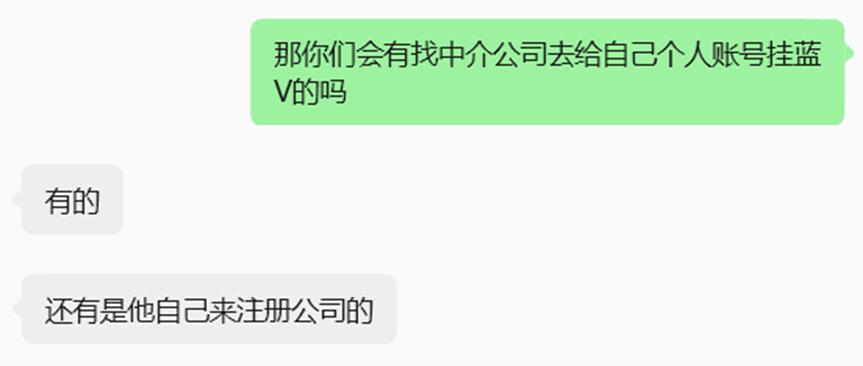
A real - estate agent from Beijing
These paths together form the current ecosystem for real - estate practitioners to obtain a “compliant identity” on the Xiaohongshu platform and have given rise to the industrial chain of “qualification affiliation.” This model of “out - of - town qualifications + local operation” has also made the blue V certification, which should represent the platform's endorsement and corporate credibility, be alienated into an admission ticket that can be bought at a marked price.
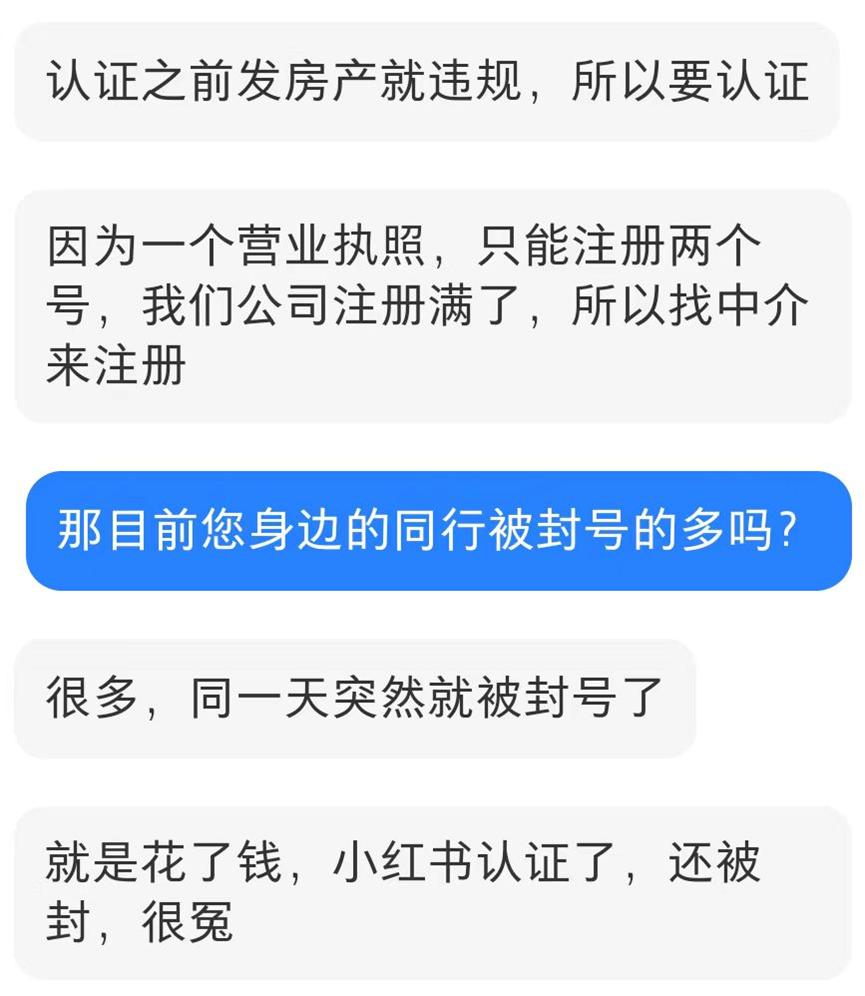
A real - estate agent from Anhui
03
In response to this incident, Future Keqi sent an interview letter to Xiaohongshu. Xiaohongshu stated that this disposal was “a normal governance of some black - and - gray industry accounts”, not a random account - banning of users, and provided a link to the “Announcement on the Suspension of Illegally Registered Professional Accounts in the Real - Estate Industry.”
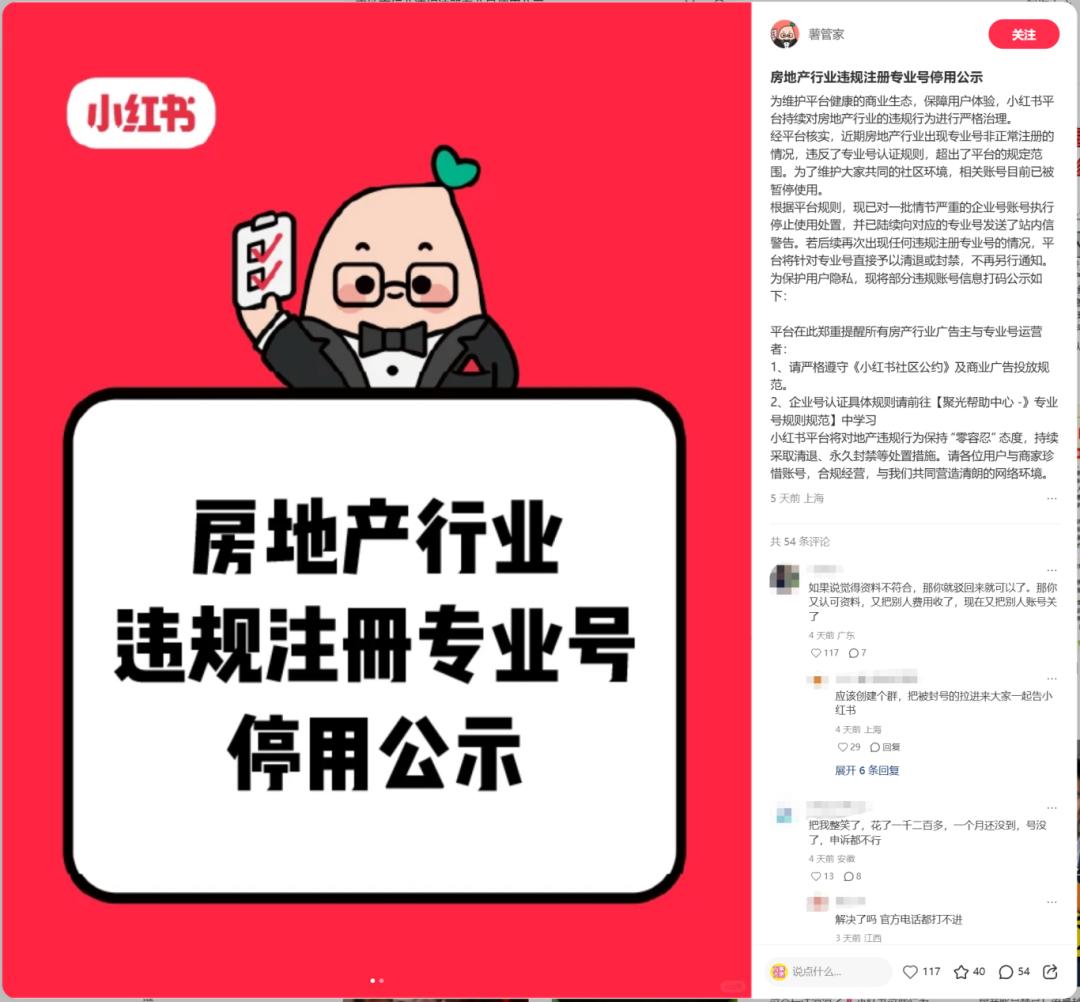
Screenshot from the relevant Xiaohongshu announcement
As of March 26th (two weeks after the incident broke out), Xiaohongshu has not issued any formal and complete public statement regarding the mass account - banning of real - estate agents and the refusal to refund certification fees. The only official reason given by the platform through system notifications and customer service is:
“Your account has abnormal registration behavior. The number of accounts registered under the same entity exceeds the platform's specified range, violating the 'Professional Account Certification Rules,' so it is permanently banned. Once the certification fee is paid, it will not be refunded.”
Xiaohongshu has not clearly explained whether the lenient review between February 25th and March 11th was a system bug or a repeated official policy.
Currently, on platforms such as Bilibili and Douyin, a large number of videos titled “Tutorials on Sueing Xiaohongshu for Account - Banning” have emerged, with view counts ranging from thousands to tens of thousands. Although the smallest amount involved is only 600 yuan, many agents have chosen to file lawsuits. However, some users have also shared that after submitting the lawsuit, Xiaohongshu proposed a solution of “unbanning the account if the lawsuit is withdrawn.”
Under these experience - sharing posts, many commenters say “just filed a lawsuit” or “seeking guidance.” For many practitioners, litigation has become an actionable path that has been repeatedly verified, rather than a distant means of safeguarding rights.
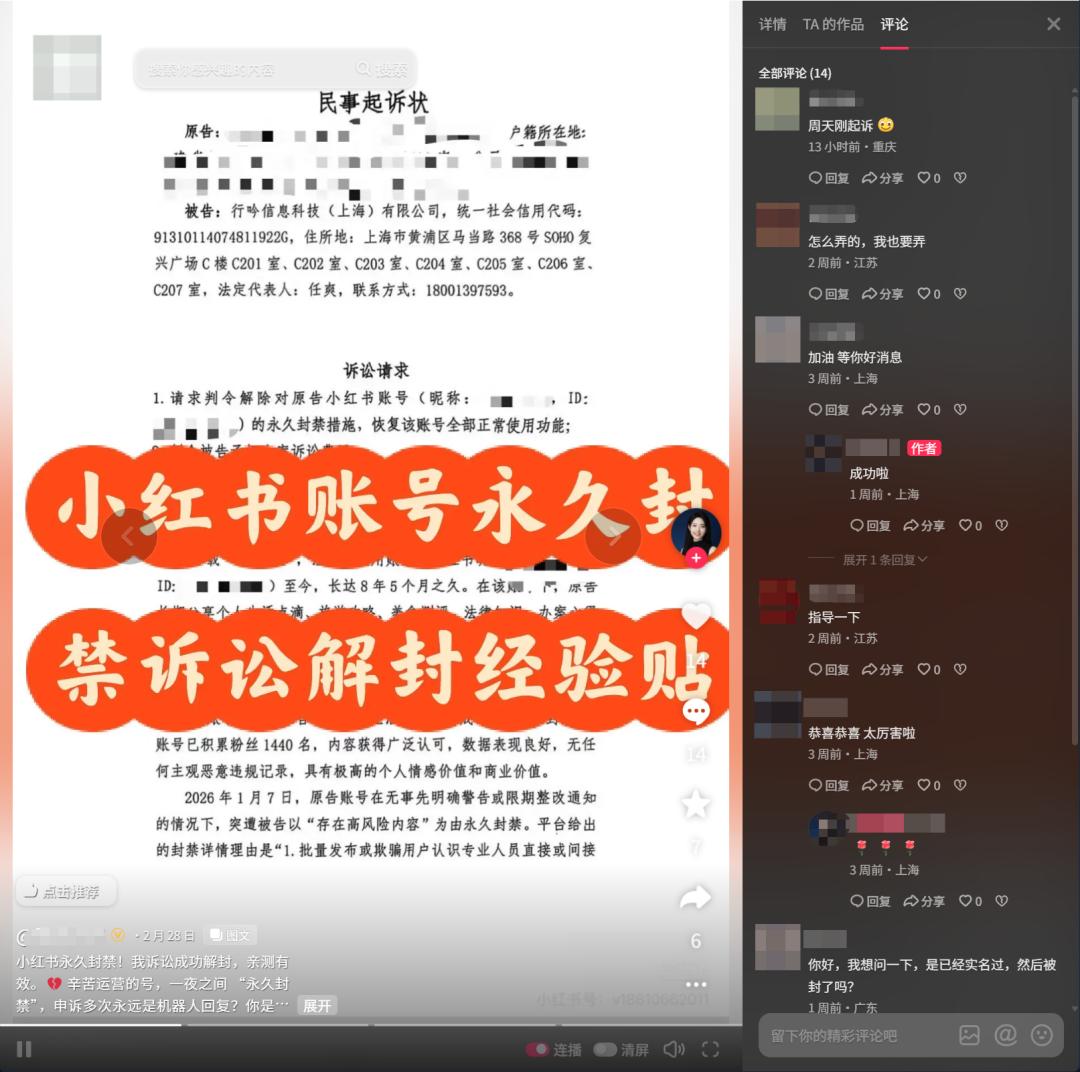
A user whose account was banned shares lawsuit - filing experience on Douyin
In judicial practice, it is not uncommon for users to win cases due to “arbitrary account - banning” or “service contract disputes” on platforms.
Previously, a user sued the platform for account - banning. After hearing the case, the court held that although the platform has the right to formulate community rules, as an Internet service provider, in the case where the user has not violated the mandatory provisions of laws and regulations, permanently banning the account and depriving the user of the right to use based solely on the platform's unilateral rules is an abuse of its dominant position. The court finally ruled that the platform should unban the account or compensate the user for losses.
Other cases show that when the platform unilaterally changes the service terms and triggers a lawsuit, the court tends to find that the platform has failed to fulfill the necessary notification obligation or provide a reasonable buffer period and needs to bear the liability for breach of contract.
Relevant legal practitioners analyze that according to Article 26 of the “Consumer Rights and Interests Protection Law,” the platform's unilateral provision that “the fee will not be refunded after successful certification” is an overbearing clause that excludes the consumer's main rights and unreasonably exempts the platform's own responsibilities, and is invalid.
This article is from the WeChat official account “Future Keqi”, author: Zhang Guohao, published by 36Kr with authorization.