Under siege, Insta360 takes off.
Recently, a patent lawsuit has once again pushed Insta360 into the spotlight.
It is reported that on March 23, DJI officially sued Insta360 at the Shenzhen Intermediate People's Court, involving disputes over the ownership of six patent rights. Several former core R & D personnel of DJI were alleged to be involved, and the court has officially accepted the case.
After the news was released, Insta360 quickly responded. Founder Liu Jingkang clearly stated that "the company has comprehensively investigated the relevant patents. Sufficient evidence shows that the creative concepts of all the involved patents originated within Insta360 and are the company's independent innovation achievements, having no connection with DJI. We fully understand the mentality of the industry giant being challenged in the market." At the same time, the person - in - charge of Insta360's China region pointed out that "previously, many media outlets have pointed out that Insta360's innovative functions and designs have been widely copied externally."
As the conflict between the two imaging giants intensifies, their competition has gradually extended from the product level to the patent field. Notably, a recent report from IDC demonstrates Insta360's high - growth certainty and confirms its independent innovation strength and industry competitiveness in the core technology field.
Data from IDC's "Global Handheld Smart Camera Tracking Report" shows that in 2025, the global general sports camera market significantly expanded, with its scale increasing by 72% year - on - year. Among them, the market scale of panoramic cameras exceeded $1.212 billion, a year - on - year increase of 88%, almost doubling.
As the industry leader, Insta360 consolidated its leading position in the global market, ranking first in the global panoramic camera market with a 66% market share. That means for every three panoramic cameras sold globally, two are from Insta360. In addition, in terms of sales volume, Insta360 ranked first and second globally in the thumb - sized camera and general sports camera markets with shares of 57% and 37% respectively.
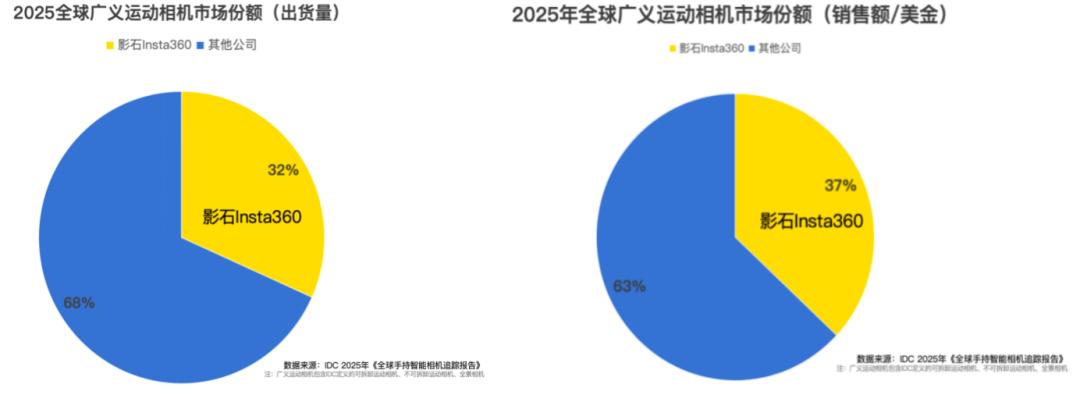
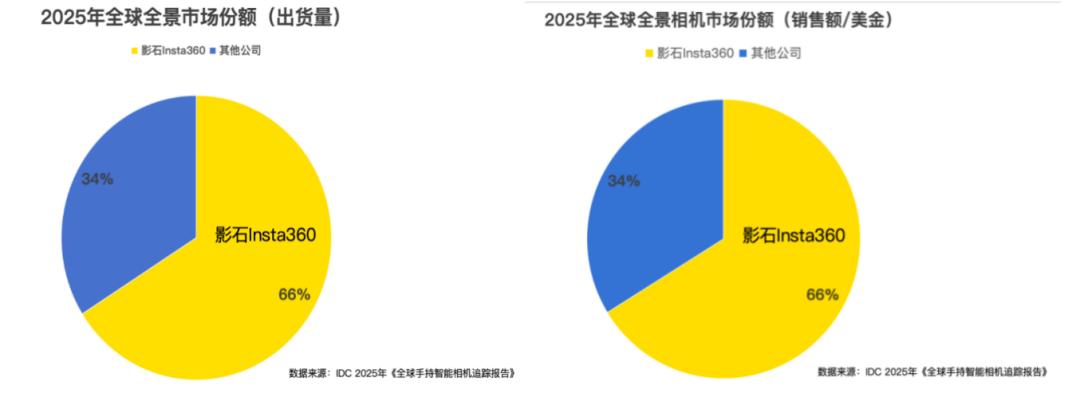
Meanwhile, an often - overlooked fact is that even in the center of the fierce competition, Insta360 still maintained a very high level of profitability. From the financial report data, its gross profit margin has long remained at a high level of around 50%, and it even shows competitiveness comparable to Apple in terms of profit quality.
So, under the high - pressure environment of the industry with giants' encirclement, what enables Insta360 to maintain a high gross profit margin? Where does the market's anxiety about Insta360 come from?
1. Where does the high gross profit come from?
From the financial report data, we can see that for a long time, Insta360's gross profit margin has always remained at a high level of around 50%, even more profitable than Apple, and is highly competitive in the consumer electronics industry. Behind the high gross profit is essentially the result of the deep coupling of "high - premium pricing power" and "large - scale shipments".
Different from traditional hardware manufacturers that rely on low - price and high - volume sales, since its establishment, Insta360 has focused on both ends of the "smiling curve" of consumer electronics. It drives product iteration through extreme R & D innovation and in - depth user insights, addresses industry pain points, and leads industry transformation.
Different from the component - stacking approach, Insta360's core advantage lies in building differentiated products through software + AI - driven systematic innovation to reshape the imaging experience. Through capabilities such as panoramic stitching algorithms, AI automatic framing, one - click video production, and creative video functions, it has significantly lowered the threshold for shooting and editing, transforming imaging devices from complex professional tools into powerful creative tools that ordinary people can easily handle.
This asymmetric technological gap enables it to capture consumers' minds and establish market dominance in a short period. Coupled with the high user stickiness brought by the software ecosystem, Insta360 has not only broken free from the shackles of the cost - based pricing method in traditional manufacturing but also obtained pricing initiative far beyond the industry average. It has also accumulated customer trust and formed brand premium.
On the basis of obtaining high pricing power, Insta360 further solves the common cost depreciation problem in the consumer electronics industry through an efficient product iteration rhythm and a diversified product matrix.
Through in - depth vertical technological exploration and horizontal category expansion, Insta360 has launched different products for different consumer groups. For example, the X5 is targeted at consumers who pursue ultimate image quality, and the X4 Air is the lightest 8K panoramic camera in the market. The diversified product matrix combined with the high - frequency product iteration forms a dynamic profit adjustment system. On the one hand, high - speed iteration ensures that new products are always in the technological dividend period, and the profit loss caused by the promotion of old products is accurately offset by the sales volume of new products. On the other hand, the multi - price range improves product penetration, drives a sharp increase in shipments, forms a significant scale effect, significantly reduces raw material costs and depreciation costs, and provides stable support for high gross profit margins.
2. In close - range competition, Insta360 breaks through with differentiation
Since its profitability is stable, where does the market's concern come from? Currently, the most direct pain point is that the market is worried that after Insta360 and its competitors shift from "differentiated competition" to "close - range competition", Insta360's core competitiveness will be weakened due to intensified industry competition, which will impact its future performance.
However, from the perspective of its business fundamentals, in fact, the current competition has a more obvious emotional impact on Insta360 than on its performance. According to IDC data, in 2025, Insta360 still maintained a strong growth momentum. The global sales of wide - angle cameras increased by 321% year - on - year, the sales of panoramic cameras increased by 61% year - on - year, the sales of thumb - sized cameras increased by 89%, and the overall sales of general sports cameras increased by 97.5% year - on - year.
This result is mainly due to the industry dividends brought by the rapid expansion. According to the report, in 2025, the global general sports camera market scale reached $3.865 billion, a year - on - year increase of 72%. Among them, the year - on - year growth rates of panoramic cameras, thumb - sized cameras, wide - angle cameras, and thumb + wide - angle cameras were 88%, 228%, 50.8%, and 66.1% respectively, and the whole market was in a period of rapid expansion. As one of the few high - growth tracks in the consumer electronics sector, the industry's growth dividends have left enough room for imagination for leading enterprises.
Meanwhile, in the past few years, the global competitive landscape of intelligent handheld imaging devices has been completely reshaped. Chinese brands have continuously eroded the market shares of GoPro and Ricoh with their advantages in technology, products, and supply chains. According to the report data, calculated by the shipment volume, GoPro's sales volume decreased by nearly 30% in 2025, while Insta360 maintained rapid expansion and its market share continued to increase.
In addition to the industry dividends, the deeper reason lies in the difference in Insta360's expansion genes. As a technology hardware enterprise with rapid growth in recent years, Insta360 starts from market demand, solves industry pain points through continuous technological innovation and product iteration, creates an incremental market through product upgrades, and consolidates user stickiness with software and ecological advantages.
From this perspective, Insta360 focuses on the user experience in the software ecosystem, and uses innovative hardware to improve the ecological closed - loop of imaging scenarios. Hardware is just the carrier of scenarios.
The difference in the industry development path leads to the fact that although the user portraits of participants overlap, their core demands are highly different. This also prevents the competition from falling into a homogeneous and inefficient price war in the short term. Instead, through the continuous exploration of segmented demands, the industry ceiling has been jointly raised. This win - win competition relationship is similar to that between Canon and Sony. The former focuses on color science and photosensitive latitude, while the latter focuses on focusing algorithms and video functions. Although they have some conflicts, both have achieved growth and jointly expanded the market.
3. What is the truth behind the profit contraction?
Another concern of the market about Insta360 is that while its revenue is expanding, its profit is constantly shrinking. According to the performance preview data, in 2025, the company achieved a revenue of 9.86 billion yuan, reaching a record high, a year - on - year increase of 76.9%. However, the net profit attributable to the parent company decreased by 3.08% year - on - year, and the corresponding net profit margin attributable to the parent company was 9.8%.
Breaking it down, the company's gross profit margin has remained at a high level of around 50% in the past three years, but the R & D expense ratio has climbed from around 12% to 16.7% in 2025. Therefore, the contraction of the company's profit does not come from the decline in profitability but from the company's active increase in R & D investment in chip customization, strategic projects, etc., which has squeezed the profit space. In the long run, the profit decline caused by pre - emptive R & D investment is not threatening but an inevitable choice for consumer electronics companies to maintain their leading position.
As we all know, the innovation of consumer electronics products is governed by the semiconductor cycle and Moore's Law. The hardware cost of the same performance will be halved every 18 - 24 months, which means that the life cycle of consumer electronics products is extremely short. For enterprises to survive, they either need to continuously reset the performance ceiling through continuous technological innovation to offset hardware deflation with technological premium, or define new product categories through category innovation to open up new growth points before the arrival of the red - ocean market.
What's more cruel is that the relationship between R & D investment and output in consumer electronics is not linear but has a "pre - emptive leverage effect". Leading enterprises need to invest a huge amount of R & D funds in advance to consolidate their technological advantages, complete product positioning before their competitors enter the market, continuously raise the entry threshold, and resist competition risks.
Because of the special attributes of "high investment and fast depreciation", the consumer electronics track is prone to produce the Matthew effect. Take smartphones as an example. Apple, with a 20% market share, captures nearly 80% of the industry's profit space. The underlying logic is that Apple continuously leads the transformation of the smartphone industry through technological innovation and disruptive product upgrades, reaps excess profits through scale effects and technological gaps, and then pre - emptively invests the profits in the next - generation technology development, forming a positive cycle of product iteration - excess profit - R & D feedback.
In the pattern where the strong get stronger, a simple price war may capture market share in the early stage, but once it enters the stalemate stage, its drawbacks will be quickly magnified. A price war is essentially an overdraft of a company's innovation resources. When an enterprise tries to compete in the existing market through component - stacking and low - price strategies, the compression of the gross profit space will cut off the funds needed for R & D, leading to an expansion of the technological gap. Subsequently, the brand image will be downgraded. Once users lock their perception of the brand with the "low - price" label, the enterprise will lose its premium ability and completely become a passive follower.
So, although the competition in consumer electronics is cruel, leading enterprises can always obtain a considerable profit space. In essence, the key to competition does not lie in low prices but in the irreplaceability of innovation, which enables them to maintain premium and expand more growth points during the cycle.
Back to Insta360 itself, as mentioned above, the contraction of net profit is essentially an active measure under the company's pre - emptive R & D investment. From the perspective of the specific expense flow, these costs are invested in four dimensions: (1) Vertical upgrade of panoramic cameras to consolidate the basic market; (2) Diversified development of innovative hardware such as sports cameras, thumb - sized cameras, and handheld gimbals; (3) Expansion of aerial scenarios represented by panoramic drones; (4) Investment in customized chips and software ecosystems to optimize strategic positioning.
It can be seen that Insta360's heavy investment is not a blind expansion but a deeper - level "moat defense war". Its strategic thinking is clear. On the premise of ensuring the basic market of panoramic cameras, it raises the competition barrier through in - depth vertical technological exploration and optimization of customized chip agreements. At the same time, it conducts horizontal category expansion, combines the advantages of software and hardware, defines new scenarios, and raises the ceiling of the company's performance growth.
This comprehensive upgrade from the underlying architecture to application scenarios is expected to trigger a re - evaluation of Insta360 in the capital market.
From the perspective of the secondary market, the current valuation potential of Insta360 mainly comes from two aspects: one is the performance explosion potential under the high - speed expansion dividend of the industry, and the other is the scarcity of Insta360's brand advantages and innovation genes.
Looking forward to the future, with the improvement of the hardware layout and the software ecosystem, the company is expected to achieve a second leap in valuation elasticity through the synergistic effect of software and hardware. The underlying logic is that the software business has the characteristics of high frequency, strong scalability, and high gross profit. It can not only effectively smooth out the periodic fluctuations of hardware but also promote hardware penetration through ecological stickiness, smooth the company's revenue and expand the profit boundary in the medium and long term.
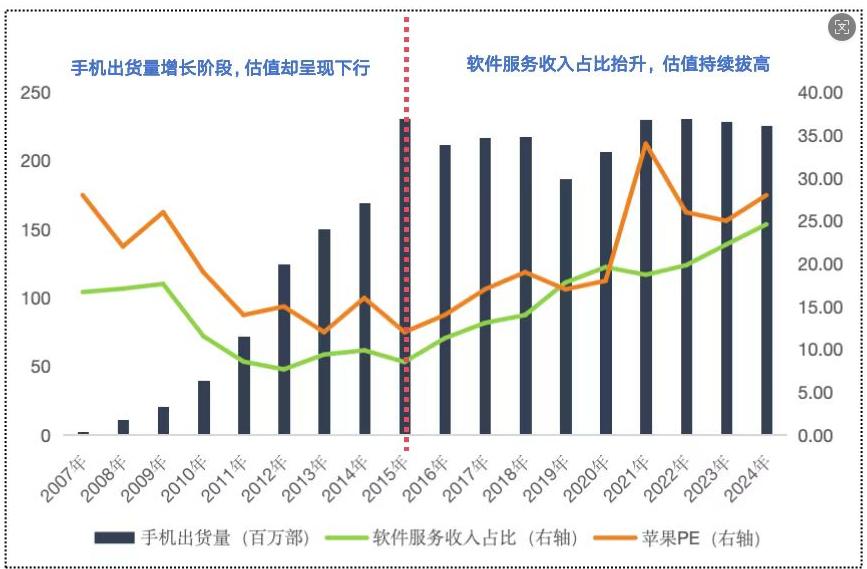
Apple is a typical example of this valuation logic switch. In the past, as a hardware - dominated company, Apple's valuation fluctuated with the sales cycle of the iPhone. With the increase in the proportion of software revenue, Apple's profit stability has been greatly enhanced. Affected by this, the market pricing logic has also changed from a simple hardware supplier to an "integrated software and hardware" ecosystem service provider, thus obtaining a higher valuation premium and standing out in the downward cycle of the smartphone industry.
*Disclaimer:
The content of this article only represents the author's views.
The market is risky, and investment should be cautious. In any case, the information in this article or the opinions expressed do not constitute investment advice to anyone. Before making an investment decision, if necessary, investors must consult professionals and make decisions carefully. We have no intention to provide underwriting services or any services that require specific qualifications or licenses to engage in for the parties to the transaction.