Li Auto and NIO are still in the red, while second-tier battery manufacturers have quietly made huge profits.
Gold diggers haven't made any money yet, but those selling shovels have already achieved financial freedom.
This kind of scenario is also playing out in the new energy industry.
The hot topic in the past few days was that CATL made a huge profit of 7.22 billion yuan in 2025, which exceeded the total profits of 13 car - making enterprises.
In 2025, GAC is expected to have a net loss of 8 to 9 billion yuan. Meanwhile, CALB, which supplies batteries to GAC, is expected to achieve a net profit of over 2 billion yuan, a year - on - year surge of 140% to 160%.
GAC is not the only one suffering losses. Leapmotor finally achieved an annual profit of 540 million yuan with great difficulty. However, Guoxuan High - tech, which supplies batteries to it, made a profit of 2.53 billion yuan in the first three quarters. Another battery supplier, ProLogium, saw its profit in 2025 increase by seven or eight times year - on - year.
Li Auto's net profit in 2025 was only 1.1 billion yuan, a year - on - year plunge of 85.8%. NIO has been established for 11 years. Although it finally achieved its first - ever quarterly profit in the fourth quarter, it still had an annual net loss of 15.57 billion yuan.
Car - selling companies are locked in a fierce price war, while battery - selling companies are making huge profits.
There was a time when CATL's dominant position was indisputable. People like He Xiaopeng and Li Bin complained about "suffering from CATL's dominance for a long time." Car - making enterprises were desperately trying to break away and embarked on the path of "reducing dependence on CATL."
The combined market share of CATL and BYD, the "two kings," was 65.02% in 2025, a contraction from the high of over 70% in 2023.
Now, second - tier battery manufacturers such as CALB, Guoxuan High - tech, ProLogium, and Honeycomb Energy have all joined the game and become the new generation of "shovel sellers."
However, the "reducing dependence on CATL" efforts of car - making enterprises have not changed their fate of making wedding dresses for battery factories.
01
The "hard - luck" GAC has contributed to CALB's success
In 2022, Zeng Qinghong, the chairman of GAC, said in front of the camera, "I'm working for CATL." This marked the beginning of car - making enterprises' efforts to "reduce dependence on CATL." In order not to be locked in by CATL in terms of profit, GAC spared no effort to support CALB, trying to regain the bargaining power.
Three years later, the dilemma in the new energy vehicle industry still exists: GAC is suffering huge losses, while CALB is making big profits.
GAC is expected to have a net loss of 8 to 9 billion yuan in 2025, turning from profit to loss year - on - year. The gross profit margin of its vehicle manufacturing business dropped to - 7.35%, which means it is losing money on every car sold.
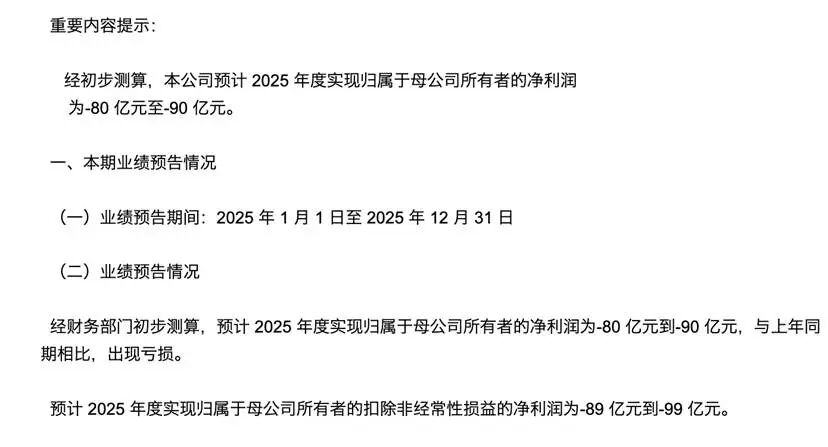
GAC's announcement
In contrast, CALB's net profit in 2025 reached 2.025 to 2.193 billion yuan, a year - on - year surge of 140% to 160%. Its annual global battery installation volume was 62.8GWh, a year - on - year increase of 52.6%, ranking among the top four globally and even entering the top three globally for the first time in October.
GAC's difficulties are all - round. On the revenue side, the decline in sales volume combined with increased promotional investment led to the growth rate of single - vehicle revenue being far lower than that of costs. On the profit side, the promotional investment could not be offset by economies of scale. On the cost side, the low capacity utilization rate pushed up the unit fixed cost, and the labor and depreciation and amortization costs per vehicle increased by more than 40% year - on - year.
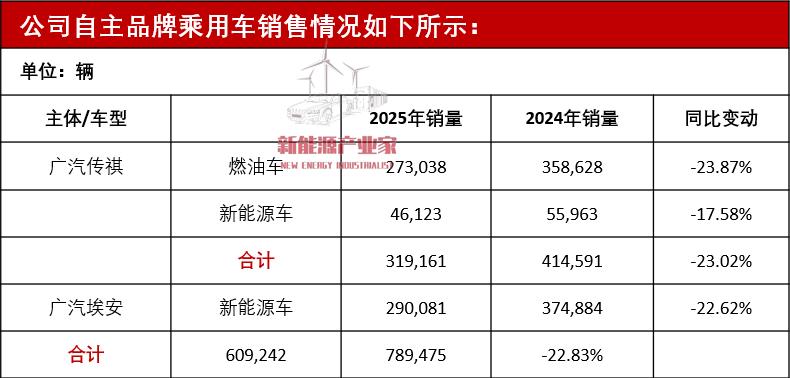
Sales situation of GAC Aion passenger cars
What's more distressing is that GAC Honda made a 700 - million - yuan impairment provision for idle production lines, and the cumulative impairment of intangible assets in the past three years exceeded 3 billion yuan. The technologies accumulated in the fuel - vehicle era are accelerating their depreciation in the wave of electrification.
In contrast, CALB is no longer the "spare tire" that relied solely on GAC's orders. In the passenger - vehicle field, it has won orders from XPeng, Leapmotor, Geely, Changan, and even international customers such as Toyota, Volkswagen, and Hyundai.
In the commercial - vehicle field, it has established extensive cooperation with Sinotruk and XCMG, and its annual vehicle - installation volume has increased exponentially. Its energy - storage business has doubled its shipments and entered the top four globally. It has even entered the low - altitude economy and cooperated with star eVTOL products.
Why does this situation occur?
On the surface, it is the historical choice of car - making enterprises to "reduce dependence on CATL." In 2018, due to CATL's tight production capacity, the delivery of GAC Aion was hindered. After painful reflection, GAC decided to fully support CALB.
Deeper down, in the fierce price war, car - making enterprises are always at the forefront. They need to cut prices to grab market share. Their profits are squeezed by sales volume, pricing power, brand premium, and upstream costs.
Battery manufacturers provide the most core and most costly component of new energy vehicles - the battery.
As long as they have leading technology, stable production capacity, and a diverse customer base, they can firmly take the largest share of the cake in the growth dividend of the entire industry.
There was a time when second - tier manufacturers were begging car - making enterprises to become their second or third suppliers. Last year, the situation reversed. Car - making enterprises were lining up at the doors of battery factories to lock in production capacity, fearing that they would not be able to get enough batteries.
02
Second - tier manufacturers are seizing opportunities and joining the game
CALB is not the only one feeling happy. Other battery manufacturers are also sharing this sweetness.
Guoxuan High - tech had a net profit of 2.533 billion yuan in the first three quarters, a year - on - year increase of 514%.
ProLogium is expected to record a net profit of 680 million to 820 million yuan in 2025, a year - on - year increase of 647.25% - 801.10%.
Ruipu Lanjun is expected to achieve a net profit of 630 million to 730 million yuan in 2025, successfully turning losses into profits.
Honeycomb Energy produced about 15GWh in Q4 of 2025 and achieved its first single - quarter profit.
Shenzhen Eve Energy had a net profit of 856 million yuan in the first half of the year, setting a new record for its semi - annual performance.
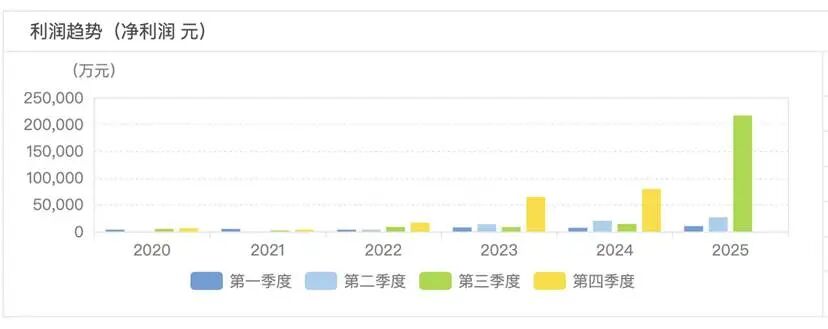
Net profit table of Guoxuan High - tech from 2020 to 2025
The market shares of these manufacturers are visibly rising, staging a "seizure of opportunities from the powerful."
In 2025, CATL's domestic market share declined by 1.67%, and BYD's declined by 3.17%. The two together lost nearly 5 percentage points of market share.
Guoxuan High - tech's market share increased by 1.07%. CALB firmly holds the third place in the industry. The market shares of second - tier manufacturers such as Ruipu Lanjun, ProLogium, and Chueneng New Energy have all increased.
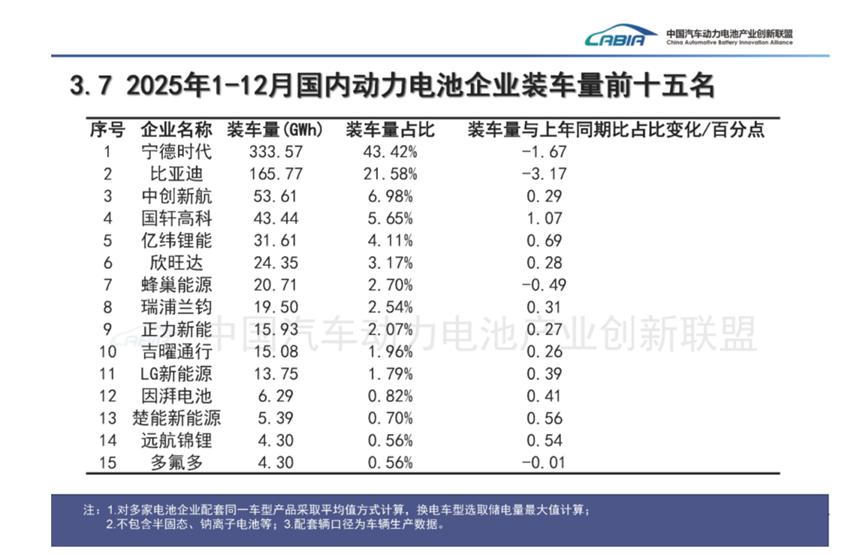
Source: China Automotive Power Battery Industry Innovation Alliance
Three years ago, this kind of scenario was unimaginable.
On the one hand, the orders brought by car - making enterprises' "reducing dependence on CATL" efforts. Car - making enterprises such as Li Auto, XPeng, Leapmotor, and GAC Aion have introduced second and third suppliers, actively giving second - tier manufacturers an entry ticket.
On the other hand, the breakthrough in lithium iron phosphate has given second - tier manufacturers an opportunity to overtake on the curve. In 2025, the installation volume of lithium iron phosphate batteries was 625.3GWh, accounting for 81.2% of the total installation volume, a year - on - year increase of 52.9%. The year - on - year increase of ternary batteries was only 3.7%. This cost - oriented technology - route switch has exactly narrowed the gap between the leading and second - tier manufacturers.
After the technological breakthrough of lithium iron phosphate, it can cover most vehicle - using scenarios. In this field, the competition is about cost - effectiveness and delivery, which is exactly the area where second - tier manufacturers are good at.
Take ProLogium for example. This second - tier factory, which was established in 2019 and once got into trouble due to its association with WM Motor, resolutely gave up the ternary route and fully bet on lithium iron phosphate. In 2024, lithium iron phosphate accounted for 64.4% of its power - battery revenue.
Relying on the positioning of "sufficient performance and lower price," ProLogium has won orders from car - making enterprises such as Leapmotor and SAIC - GM - Wuling, which focus on cost - effectiveness.
Another battlefield was ignited last year: energy storage.
In 2025, the demand for energy - storage batteries exploded completely. In the first half of the year, the export growth rate of energy - storage batteries in China exceeded 50%. The global demand for energy - storage batteries was revised upwards to 521GWh, a year - on - year increase of 60%. This has become the real second growth curve for second - tier manufacturers.
CALB's energy - storage business shipments doubled and entered the top four globally. Guoxuan High - tech's energy - storage battery shipments ranked eighth globally. EVE Energy's annual energy - storage shipments are expected to reach 80GWh, a year - on - year increase of 60%. The pattern of dual - wheel drive of power and energy - storage has basically taken shape.
The era when people like He Xiaopeng and Li Bin complained about "suffering from CATL's dominance for a long time" is slowly changing.
The narrowing of technological barriers, the cost - oriented route switch, and the explosion of multiple niche markets such as energy storage have jointly contributed to the collective rise of second - tier manufacturers.
For car - making enterprises, the real challenge may not lie in which supplier to introduce, but in how to become a "definer" with core premium ability in an era of rapid technological change and global flow of production capacity.
After all, in the gold - digging era, if you don't have an exclusive mine, you should at least learn to make a "golden shovel" that others can't.
This article is from the WeChat public account "New Energy Industry Expert". Author: Liu Ran, Editor: Fan Shuyu. Republished by 36Kr with permission.