Snatching up 5 billion yen, an "invisible champion" emerges in the global "incontinence care" market.
In elderly care, excretion problems have always been a "hidden chronic ailment": Caregivers are busy with endless and blind investigations, while the elderly dare not go out and refuse social interactions due to the fear of "sudden incontinence." This model that highly relies on manual experience not only keeps the labor cost high but also makes the dignity of the elderly passive.
While everyone was still focusing on "diapers," the Japanese company Triple W came up with a new idea: Instead of passively "absorbing," it's better to actively "detect."
The DFree it developed is the world's first wearable device that can "predict the time to go to the toilet." It uses medical-grade ultrasonic sensors to monitor bladder changes, helping elderly care institutions on the B side reduce "ineffective patrols" and "diaper waste"; it also restores the "courage to go out" and the freedom of social interaction for incontinent elderly people.
This seemingly "niche" but essential demand is showing amazing commercial explosive power globally.
- As of 2025, Triple W has a cumulative financing amount of about 5 billion yen (about 200 million RMB). Just in July 2025, it completed a new round of financing of 840 million yen.
- From the Japanese domestic market to the European and American markets, hundreds of elderly care institutions are paying for it.
Through what mechanism does Triple W transform the non-standard "physiological needs" into a standardized business? How does it make hundreds of institutions around the world pay for it? As the pioneer in the "excretion prediction" track, what inspiration does its success bring to China's silver economy in terms of the "dignity economy"?
o1 Product Reconstruction: Not Monitoring "Wetness" but Preventing "Incontinence"
Before the emergence of DFree, the excretion care market had long remained in the stage of "post-treatment": sensors could only alarm after the diaper was wet, and caregivers were always struggling to make up for the situation.
The core difference of DFree lies in "pre-prediction." It doesn't rely on the intuition of caregivers but translates the invisible bladder changes into visible data-driven decisions.
01 Technical Logic: Civilian Application of Medical Technology
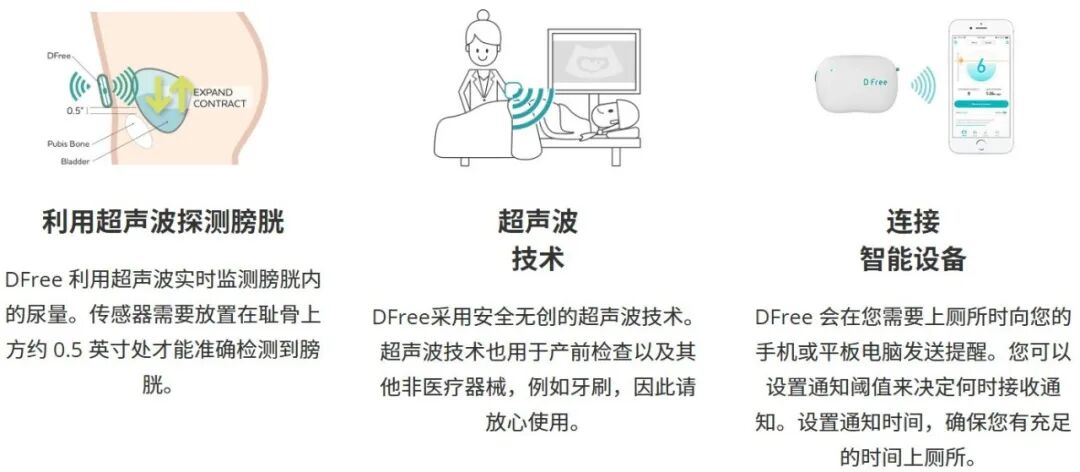
DFree didn't invent new technology but miniaturized and algorithmized the ultrasonic monitoring technology in the medical field and transferred it.
The hardware device only weighs dozens of grams and is attached to the user's lower abdomen with medical tape or a special strap. It emits ultrasonic waves to the bladder and measures the degree of bladder expansion (urine volume) through the echoes.
The hardware is the foundation, and the real barrier of DFree lies in the "personalized evolution" of the algorithm.
Establishing a "Safety Threshold": The system doesn't rigidly wait until the data reaches 8 or 9 (i.e., the bladder is full) to alarm. For the elderly with "urgent urinary incontinence," when the value just reaches 4 (about 40% of the urine volume), it may be their physiological limit.
Therefore, the essence of DFree's prediction is not "whether the bladder is full" but where the "safety threshold" is for this specific elderly person. Once the threshold of this elderly person is reached, the system will immediately send an early warning to the caregiver or family member: "You may need to go to the toilet in XX minutes."
Dynamically Adjusting the Threshold: To capture this individual difference, the system has established a set of "human-machine feedback cycle." When the caregiver records the real excretion or incontinence time on the app side, the system will automatically match the "recorded time" with the "ultrasonic monitoring value" at that time retrospectively.
For example, if the AI finds that an elderly person has incontinence three consecutive times when the value is 5, the algorithm will determine that "5 is the high-risk area for this elderly person" and automatically lower his alarm threshold to 4.
02 Core Value Highlights: Standardizing Non-Standard Physiological Needs
In the past, when the elderly went to the toilet was all "mystery," relying on the experience of caregivers. This product directly transforms the bladder state into standardized and visible data.
For mildly disabled elderly people who still have the ability to move, this kind of tool provides them with the "courage to go out." The elderly no longer need to wear diapers when going out, maintaining their social dignity.
o2 Product Philosophy: The Simpler the Product, the Stronger Its Vitality
The Dfree main unit only weighs dozens of grams (similar in size to a matchbox) and is fixed on the lower abdomen with medical tape or a special Velcro belt. It doesn't require inserting a catheter and doesn't contact the skin or mucous membranes, minimizing the psychological resistance of the elderly.
In the early tests, the team found that "too high-tech" is actually the Achilles' heel of elderly products. As long as the operation steps are more than two, caregivers and the elderly will give up using it.
DFree has made an almost paranoid "subtraction" in product design:
- Minimalist Operation Hardware: The sensor body only retains a minimalist power button. Press and hold it to turn on or off. There are no complicated debugging buttons, minimizing the learning cost.
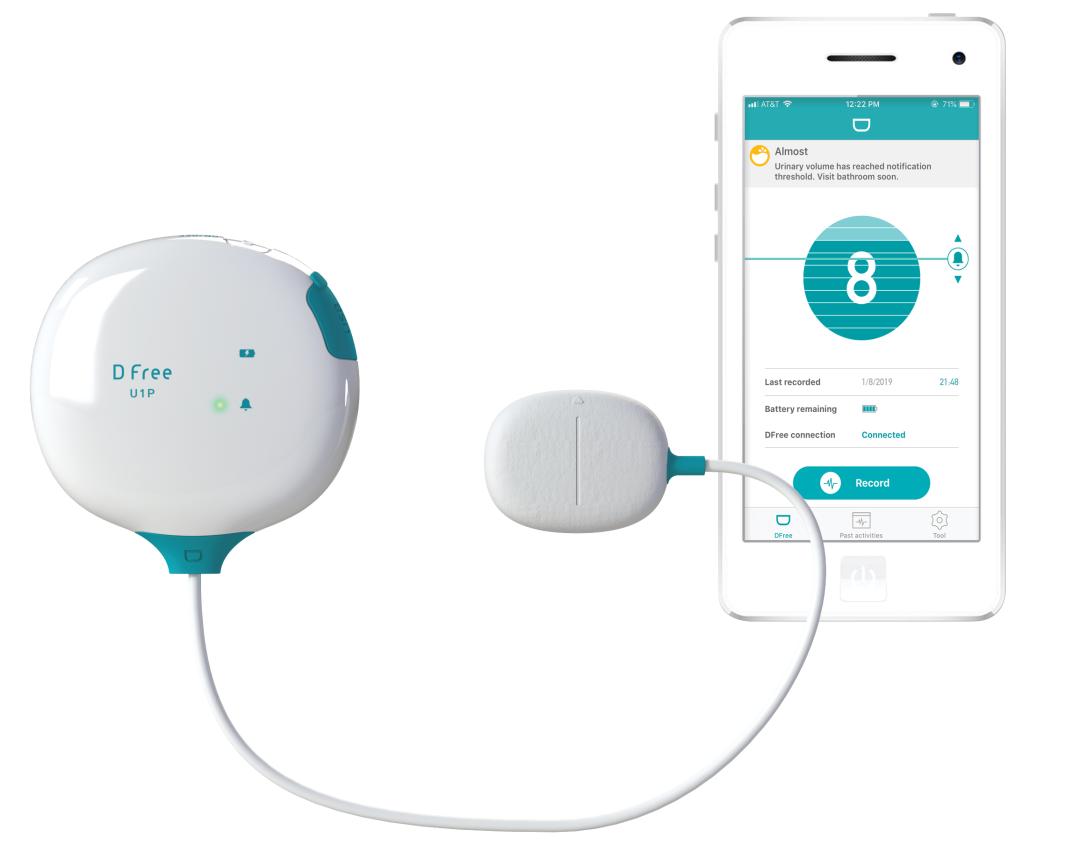
- De-Medicalized Interface: Abandoning the complicated medical waveform chart, the APP interface only shows a huge dashboard - yellow represents an early warning, and colorless represents safety. The urge to urinate is converted into a precise 0 - 10 numerical dashboard. This intuitive visual design allows caregivers and the elderly to understand immediately.
- High Tolerance for Wearing: To solve the problems that the ultrasonic probe must be coated with gel and is easy to shift, they developed a special "auxiliary wearing underwear" and "positioning sticker," turning the high-precision medical operation into something as simple as "putting on a band-aid."
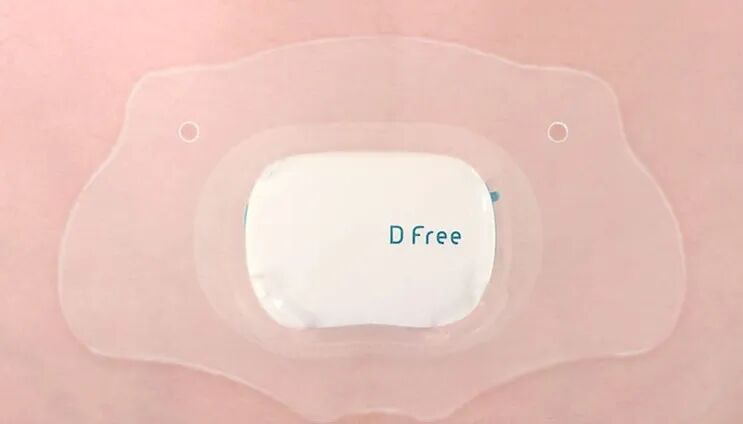
(Adhesive sticker to fix DFree about 1 cm above the pubis)
o3 Business Model: A "Subscription" Business in the Guise of Hardware
If DFree only sells hardware, its path will probably become narrower and narrower: the R & D cost of consumer-grade medical hardware is generally high, and the repurchase rate is low. For each unit sold, there is one less, and the enterprise has to keep burning money to find new customers.
Therefore, they offer two product lines: "DFree Personal" is for individuals; "DFree Pro" is for enterprises, including nursing homes, home care institutions, hospitals, and sanatoriums.
Hundreds of institutions around the world (in Japan, the United States, Europe, etc.) have adopted it, and the cumulative shipment volume for individuals has exceeded 10,000 units.
01 B-side (Institutions): Obtaining Stable Cash Flow through "Subscription System"
The B-side business (targeting nursing homes and rehabilitation hospitals) is currently the revenue pillar of DFree.
To dispel the concerns of elderly care institutions about "heavy asset investment," DFree mainly promotes the "leasing + monthly subscription" model in the Japanese market. Institutions pay a monthly fee per bed (about 10,000 - 20,000 yen per unit per month, equivalent to about 400 - 900 RMB per unit per month, including software service fees).
For nursing homes with limited budgets, the trial cost is extremely low - if they feel it's ineffective, they can stop using it at any time, shortening the decision - making cycle of B-side customers.
What institutions pay for each month is not just that small white box but DFree Pro (the professional - version background system).
- Visualized Dashboard: The large screen in the nursing station can display the bladder urine storage volume of dozens of elderly people in the whole hospital in real - time (shown as a score from 1 - 10). Caregivers don't need to patrol the rooms. They can know from the screen that "the elderly in Room XX is about to go to the toilet."
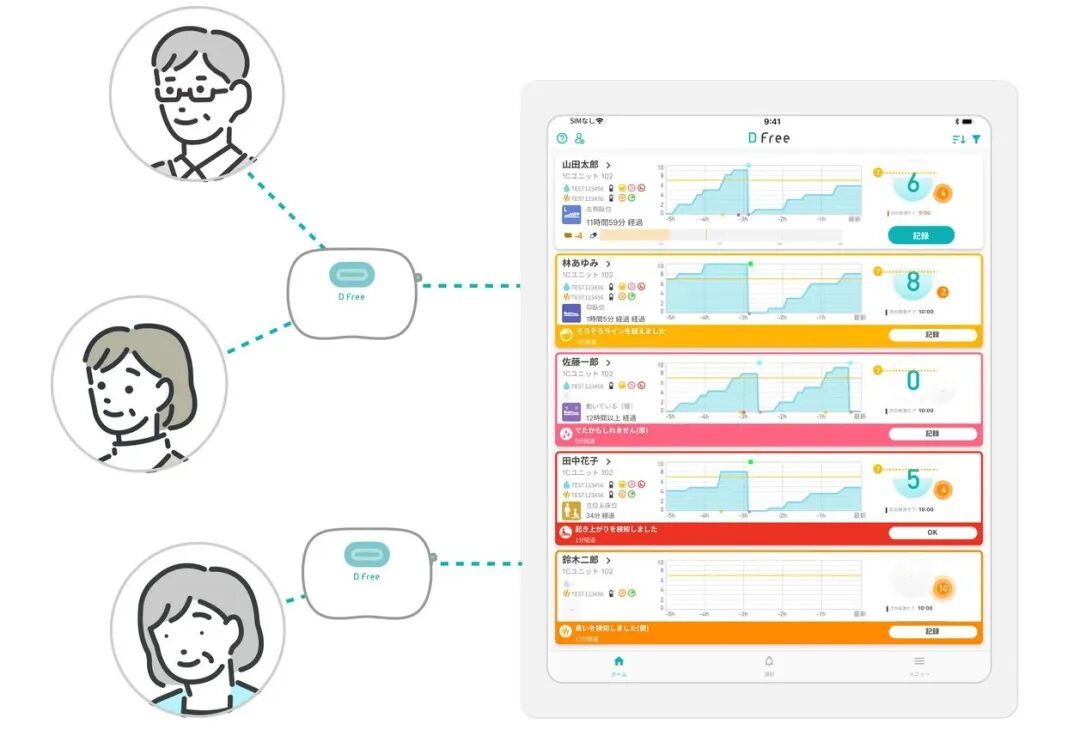
(It can track multiple patients simultaneously)
- Automated Recording: The system will automatically generate the "excretion log" and "incontinence trend chart" for each elderly person. The nursing records that used to be written manually are now all automatically generated.
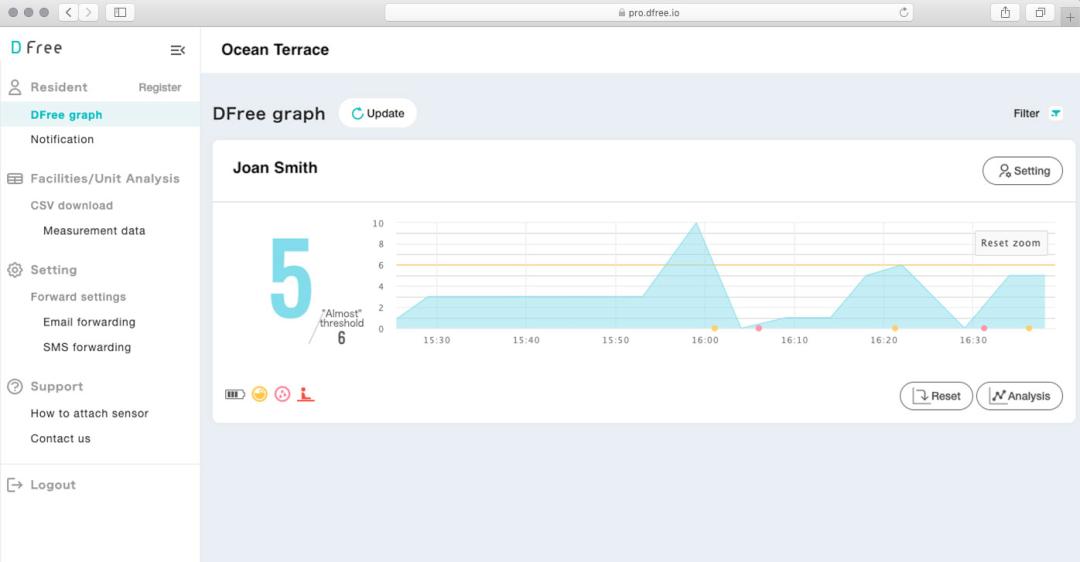
(The DFree Pro website can clearly show the urination time of patients/the elderly through charts)
02 C-side (Individuals): Leasing - Based, Profiting from Consumables
In the C-side market, DFree has experienced a painful transformation from "high - price sales" to "low - price leasing."
Early on, DFree tried to sell the hardware directly to consumers at a price of 30,000 - 50,000 yen (about 1,300 - 2,200 RMB), but the market response was cold. After all, for many families, this expenditure risk is too great.
After that, it launched the "DFree Personal" leasing plan. Users only need to pay a rent of about 2,000 - 3,000 yen per month (about 100 RMB per month) to use it.
The main purchasers are not all long - term disabled elderly people. Many are patients in the postoperative rehabilitation period (such as after prostate cancer surgery) or people in the recovery period after a stroke. Their needs are temporary (using for 3 - 6 months), and "leasing instead of buying" perfectly meets the pain points of this group.
Although the profit from hardware is not high, the ultrasonic sensor must work with special ultrasonic gel, and the device needs special medical hypoallergenic tape to be fixed on the abdomen.
As long as users use the device, they must buy the gel and tape. These high - frequency consumables are an important source of income for the C-side business.
03 The Imagination of Data Monetization
After DFree has accumulated a large amount of excretion data, it is no longer just a hardware company but has become a data company with the imagination of monetization.
For example, it can cooperate with diaper manufacturers or large - scale elderly care channels to promote the "excretion optimization plan." Instead of hard - selling "buy this most expensive one," it can tell the institutions based on DFree's monitoring data: "The data shows that the elderly XX has very little urine volume at night. There is no need to buy that expensive night - use type. This thin type is enough."
At the same time, the real excretion data of thousands of elderly people can also feed back into the new product R & D of diapers, helping to develop a new generation of products that fully conform to real physiological laws.
o4 Why Are Hundreds of Institutions Willing to Pay?
Just talking about "dignity," B-side institutions will not make large - scale purchases. The core reason why DFree can attract hundreds of institutions around the world (mainly in Japan, Europe, and the United States) is that it helps institutions save money and labor.
For elderly care institutions, the core value of this product does not lie in the hardware itself but in that it provides a "visual management tool for excretion care."
01 Saving "Ineffective Manpower": From Regular Room Patrols to On - Demand Care
In traditional elderly care, excretion care is a typical "low - efficiency and high - frequency" labor.
Traditional nursing homes usually adopt a mechanized process of "patrolling/replacing every few hours." Many times, the elderly haven't urinated, and the caregiver makes a useless trip; or the caregiver comes just after the elderly has urinated, and the sheets are already wet.
The value of DFree lies in:
"Regular room patrols" become "on - demand response": Caregivers see the "warning light" of an elderly person on the console large screen and then go to handle it.
Data shows that after introducing this system, the time spent on excretion care in institutions has decreased by an average of 30%. In Japan, where there is an extreme shortage of caregivers, the saved time is enough for caregivers to take a breath or take care of more elderly people, directly improving work efficiency.
Relieving Management Pressure: The system can automatically generate long - term "excretion logs" and "excretion reports." Institutional managers can clearly see whether the elderly's urination pattern has changed (which may be a precursor to urinary tract infection); whether the number of times getting up at night has decreased (as an evaluation indicator of the rehabilitation effect).
02 Cost Reduction
Data shows that Dfree can help institutions reduce the cost of using diapers/urine pads by up to 50%. Because guiding the elderly to go to the toilet reduces the number of incontinence cases, the cost of urine pads naturally decreases.
DFree will also assist institutions in re - examining the procurement standards of urine pads/diapers based on the specific urine volume data of each elderly person. Selecting products on demand based on data reduces excessive waste.
For example, for the elderly whose monitoring data shows "low urine volume at night," institutions no longer need to "blindly" use the expensive thick night - use type. Instead, they can choose a more economical and smaller - sized model.
03 The "Invisible Value" of Reducing the Turnover Rate
Although we can't absolutely say that excretion care is the "only" reason for turnover, it is definitely one of the "core pain points" leading to caregiver burnout and physical injuries.
Excretion care usually involves high - frequency shifting, turning over, and carrying. Reducing 30% of ineffective care means directly reducing the number of times caregivers bend over and exert force, which is crucial for reducing the incidence of occupational low - back pain.
In addition, dealing with incontinent dirt is the most stressful