Junlebao Aims for IPO: A Mutual Endeavor of Market and Performance
Cover source: Visual China
On January 19th, Junlebao officially submitted its prospectus to the Hong Kong Stock Exchange, quickly attracting market attention.
The domestic dairy industry is a track where "long - term growth potential" and "cyclical fluctuations" coexist. In the long run, in 2024, the per - capita dairy consumption in China was less than one - third of the global average, indicating significant room for improvement. In the short term, affected by the cyclical fluctuations in the dairy cattle breeding industry and lower - than - expected consumption growth, the industry's revenue is under pressure.
However, Junlebao has achieved a performance curve that transcends the cycle. In 2024 and the first three quarters of 2025, the company's revenue growth rates were 13% and 1.5% respectively, significantly outperforming the industry average. In terms of profit, from 2023 to the first three quarters of 2025, Junlebao's adjusted net profits reached 600 million yuan, 1.16 billion yuan, and 940 million yuan respectively, demonstrating strong profit - realization capabilities.
The company's founder and core team are also betting on future growth potential with "real money". Different from the capital operation methods of many enterprises, such as "sudden dividends" and cashing out before IPO, founder Wei Lihua and the core team have reinvested all the dividends received in the past three years back into the company.
Data shows that multiple employee shareholding platforms controlled by founder Wei Lihua increased their stake in the company by approximately 5.61% in December 2025, with an investment of over 1.1 billion yuan. This rare move also sends a clear signal to the capital market: the founder and the core team firmly recognize Junlebao's long - term value.
In addition, industrial and commercial information shows that new investors such as Maotai Jinshi (Guizhou) Biotechnology Industry Fund Partnership (Limited Partnership) funded by Maotai Group and Gongqingcheng Fuman Venture Capital Investment Partnership (Limited Partnership) managed by well - known investment institution Jinding Capital have been added to Junlebao's shareholder list. At the same time, several investment institutions such as Quanzhou Haisi Houjiu Equity Investment Partnership (Limited Partnership) managed by existing shareholder Housheng Capital have increased their stake in the company.
So, what makes Junlebao unique in the dairy industry? Why can it transcend the cycle and become the eager and firm choice of the founder, the core team, and external capital platforms?

Positioning in the High - Growth Track of Low - Temperature Liquid Milk
The direction of the market is the direction of capital.
In recent years, Junlebao's revenue scale has shown a steady expansion trend. The company's annual revenue increased from 17.546 billion yuan in 2023 to 19.832 billion yuan in 2024, and reached 15.134 billion yuan in the first three quarters of 2025 (compared to 14.908 billion yuan in the same period of the previous year).
Breaking down the revenue structure, low - temperature liquid milk has become the absolute core driving growth. In 2024 and the first three quarters of 2025, while the growth rates of room - temperature liquid milk and milk powder businesses slowed down or even showed negative growth, low - temperature liquid milk demonstrated strong resilience, with year - on - year growth rates of 21% and 12% respectively, driving the company's revenue to grow steadily.
Benefiting from this, low - temperature liquid milk has become the company's largest business. Its proportion has risen from 35.9% in 2023 to 42.5% in the first three quarters of 2025, corresponding to a revenue of 6.437 billion yuan. This means that low - temperature liquid milk has become an important label for Junlebao.
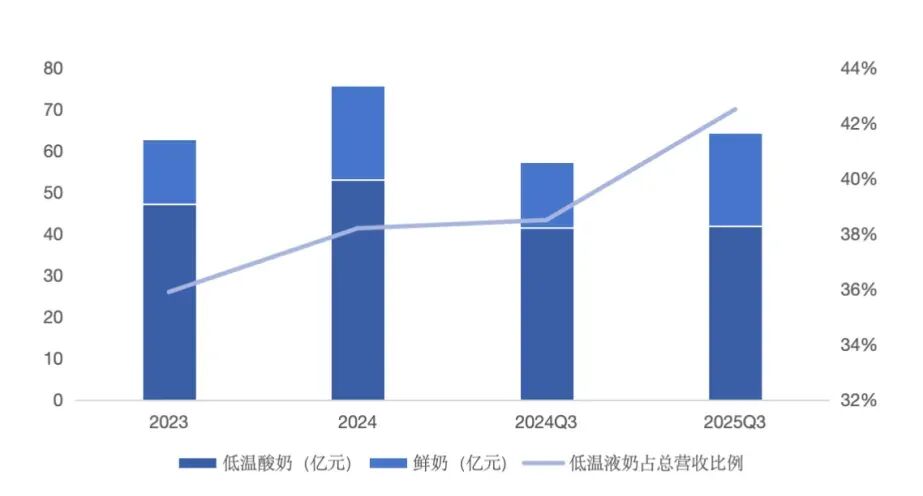
Chart: Revenue changes and proportion of low - temperature liquid milk in total revenue. Source: Prospectus, compiled by 36Kr
Liquid dairy products are the largest segment in the dairy market. Classified by storage conditions, liquid dairy products are mainly divided into low - temperature liquid dairy products and room - temperature liquid dairy products. Low - temperature liquid dairy products mainly include fresh milk and low - temperature yogurt. In terms of product advantages, low - temperature liquid milk can retain nutrients to the greatest extent. For example, the retention rate of some nutrients in fresh milk is 30 - 50 percentage points higher than that in room - temperature milk.
In recent years, with the improvement of domestic consumers' health awareness, the growth of the high - income group, and the upgrading of the cold - chain logistics system, the recognition and demand for low - temperature liquid milk in the terminal consumer market have also increased simultaneously.
According to Frost & Sullivan statistics, from 2019 to 2024, the compound annual growth rate of the low - temperature liquid milk market was approximately 3%. From 2025 to 2029, the compound growth rate will further increase to 7.2%, and the market space will reach 125.9 billion yuan, with a penetration rate of over 30%.
Looking at different products, the growth rate of fresh milk is significantly faster than that of low - temperature yogurt. The compound growth rate from 2025 to 2029 will exceed 10%, and the market space will exceed 60 billion yuan at most. Junlebao's revenue performance in low - temperature liquid milk is also better in fresh milk than in low - temperature yogurt. The operating revenue growth rate of the company's fresh milk exceeded 40% in the whole year of 2024 and the first three quarters of 2025.
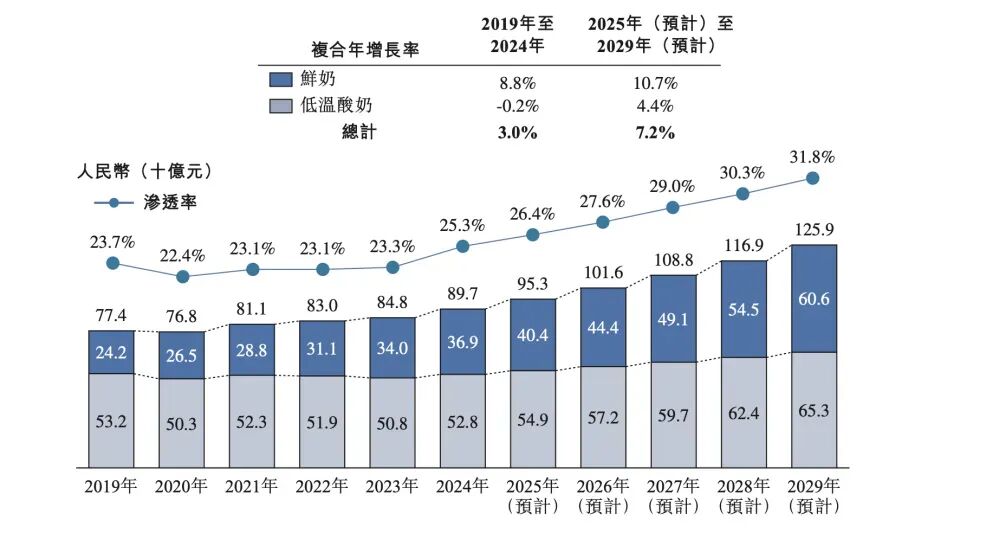
Chart: Estimation of the market space of low - temperature liquid milk. Source: Prospectus, compiled by 36Kr
With its forward - looking layout in the low - temperature liquid milk field and the advantages accumulated through years of perseverance, Junlebao has built a moat for brand awareness. This not only allows it to seize the opportunity in the early stage but also lays the foundation for its leading position in the second half of the market explosion.
In 2017, Junlebao launched the yogurt brand "Jianchun", which not only opened up the zero - sucrose yogurt track but also successfully entered the low - temperature yogurt field. In 2019, Junlebao further launched the fresh milk brand "Yuexianhuo", officially establishing two major low - temperature liquid milk business systems: low - temperature yogurt and fresh milk.
According to the Frost & Sullivan report, in terms of retail sales in the Chinese market, the two brands "Jianchun" and "Yuexianhuo" became the No. 1 brand in low - temperature yogurt and the No. 1 brand in high - end fresh milk respectively in the fifth year after their launch. In 2024, Yuexianhuo had a market share of 24% in the high - end fresh milk brand market, and Jianchun had a market share of 7.9% in the low - temperature yogurt brand market.
With the excellent performance of the two products, Junlebao's comprehensive market share in low - temperature liquid milk reached 14.5% in 2024, only 1.2 percentage points behind the first - ranked brand.

Continuous Release of Profits
As mentioned at the beginning of this article, Junlebao's profit release is particularly strong. From 2023 to the first three quarters of 2025, the company's adjusted net profit increased from 600 million yuan to 1.16 billion yuan (in 2024) and reached 940 million yuan in the first three quarters of 2025, corresponding to year - on - year growth rates of approximately 93% and 25% respectively. This profit growth rate, which significantly outperforms revenue, directly drives the optimization of the profit structure, enabling the adjusted net profit margin to rise from 3.4% to 6.2%.
The adjusted net profit excludes share - based payments and interest expenses on financial liabilities related to shareholders' special rights, which can more accurately reflect the company's operating performance. So, why can Junlebao achieve a continuous increase in the adjusted net profit margin?
First, the change in product structure stabilizes the gross profit margin.
In 2023, 2024, and the first three quarters of 2025, Junlebao's comprehensive gross profit margins were 34.2%, 34.7%, and 32% respectively, remaining basically stable. This is commendable against the background of downward pressure on dairy product prices. The most important reason is that the increasing proportion of low - temperature liquid milk revenue with high gross profit margins effectively offsets the impact of gross profit margin fluctuations in other businesses.
From a horizontal comparison, taking the financial data of the first three quarters of 2025 as an example, the comprehensive gross profit margin of Junlebao's low - temperature liquid milk products is 33.9%, while that of room - temperature liquid milk products is only 19.3%. Further, the gap in gross profit margins between fresh milk (36.3%) and room - temperature milk (14.2%) is even more significant. The gross profit margin of low - temperature liquid milk is significantly better.
From a vertical comparison, from 2023 to the first three quarters of 2025, Junlebao's gross profit margin of low - temperature liquid milk increased from 32.7% to 33.9%, while that of room - temperature liquid milk decreased from 24.9% to 19.3%. Low - temperature liquid milk has significantly supported the company's comprehensive gross profit margin.
In the long run, as the proportion of Junlebao's low - temperature liquid milk revenue continues to increase, this change in the revenue structure will contribute more to the optimization of the company's gross profit margin.
Second, the continuous optimization of the cost side directly contributes to the growth of the net profit margin.
The financial data disclosed in the prospectus shows that compared with 2023, Junlebao's sales expense ratio decreased by 3.8 percentage points, and the financial expense ratio decreased by approximately 0.8 percentage points. The decline in these two ratios is the core reason for the increase in the company's adjusted net profit margin.
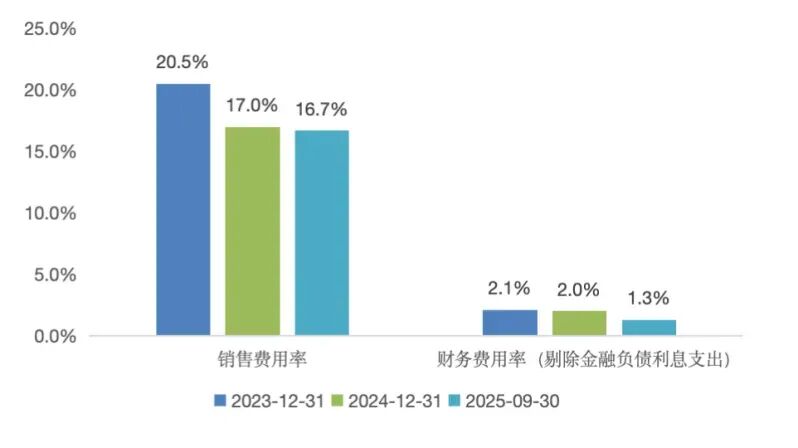
Chart: Junlebao's sales expense ratio and financial expense ratio. Source: Prospectus, compiled by 36Kr
The significant decrease in the sales expense ratio may be an important manifestation of the company's enhanced brand power. Looking at the specific composition of sales expenses, the advertising expenses, which account for the highest proportion, decreased from 1.55 billion yuan in 2023 to 1.11 billion yuan in 2024, and further decreased to 740 million yuan in the first three quarters of 2025 (compared to 1.04 billion yuan in the same period of the previous year). This means that Junlebao has achieved higher revenue conversion with lower marketing expenses.
There may be two factors behind this: one is the continuous increase in consumers' recognition of low - temperature liquid milk. Junlebao entered the market early and has successfully established brand awareness. The other is the improvement of the company's diversified sales channels, which naturally gives products "exposure" and replaces advertising expenses to a certain extent.
Generally speaking, Junlebao's strong profit release comes from its refined operations in both product structure and cost control. In the long run, the continuous increase in the proportion of low - temperature liquid milk revenue will still provide room for improvement in Junlebao's profit margin.

Foundation: Milk Source, Technology, and Supply Chain
Behind the impressive performance data, the capital market actually pays more attention to the source of Junlebao's competitive barriers and the sustainability of its growth.
Low - temperature liquid milk is limited by its short shelf - life and dependence on cold - chain logistics, with a natural physical sales radius. Different from the logic of "channel supremacy" in room - temperature milk, the key in the low - temperature milk industry is how to extend the shelf - life while ensuring quality, so as to break through the transportation radius limit and expand the market boundary. In response, Junlebao has built an all - industry - chain moat of "self - built milk sources + technological innovation + digital cold - chain logistics".
First, self - built milk sources establish dual advantages in quality and cost.
Low - temperature milk has extremely high requirements for raw materials. Traditional purchasing often cannot meet these strict standards. The advantage of self - built milk sources is that, on the one hand, Junlebao can standardize the whole process of feed, breeding, milking, etc., ensuring the quality of every drop of raw milk from the source; on the other hand, due to the obvious cyclical nature of the upstream dairy industry, a high proportion of self - owned milk sources can effectively reduce the impact of market price fluctuations on the company's costs. Data shows that as of the third quarter of 2025, Junlebao owns 33 pastures and 192,000 dairy cows,