Analysis of the Domestic Passenger Vehicle Market: Regional Perspective
Preface
Based on the terminal sales data of passenger cars in China, Chebai Think Tank analyzes the regional development path of new energy passenger car sales, the potential of the sinking market, and the development models of typical cities from the dimensions of regions, city tiers, and typical cities.
I
Regional Development Characteristics
The regional development context of China's new energy vehicle industry is clear, showing the characteristics of spreading from points to areas and regional diffusion. First, the southeastern coastal areas took the lead in starting. Subsequently, a multi - point development pattern was formed around the four major core economic zones of the Pearl River Delta, the Yangtze River Delta, the Beijing - Tianjin - Hebei region, and the Sichuan - Chongqing region. Finally, it gradually extended and popularized to inland provinces such as the Northeast and the Northwest.
In terms of regional distribution characteristics, the penetration rate of new energy vehicles in East and South China ranks among the top in the country, accounting for about 54%. North China and the Sichuan - Chongqing region in Southwest China follow closely, being in the second echelon of penetration rate. Affected by the cold winter climate, the overall penetration rate of new energy vehicles in the Northwest and the Northeast is relatively low. Among new energy vehicle models, consumers often prefer plug - in hybrid models with no range anxiety.
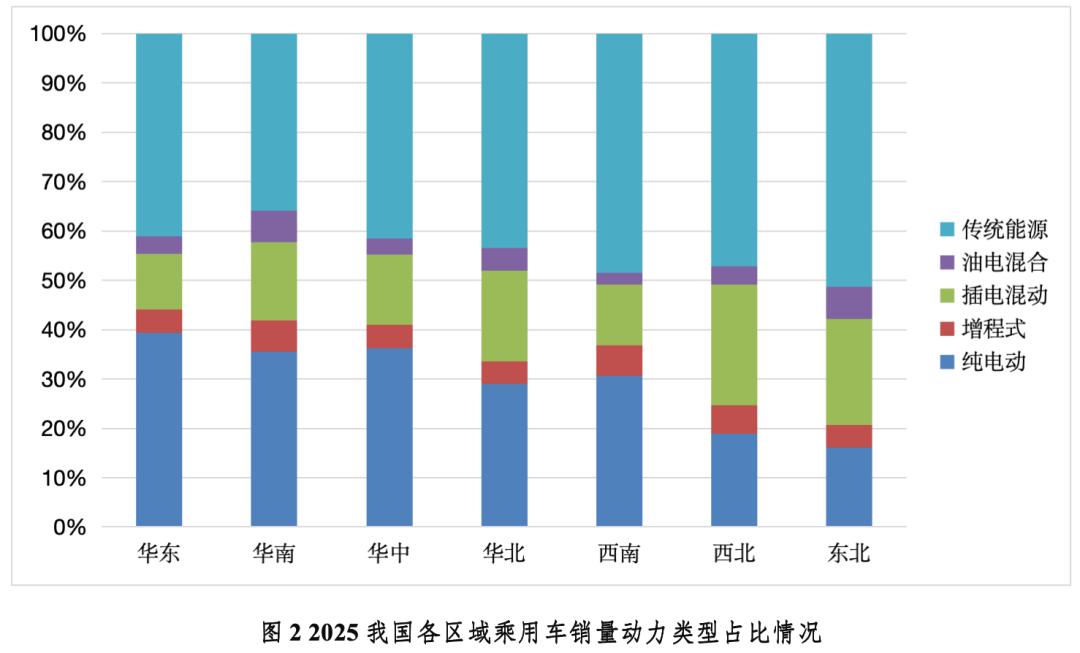
The new energy vehicle markets in the West and the Northeast still have great development potential. It is necessary to base on the regional resource endowment and climate characteristics and implement differentiated promotion strategies. In the western region, the new energy vehicle industries in Sichuan, Chongqing, and Shaanxi provinces are in the forefront. They can give full play to the advantages of their industrial clusters and the leading role of the market, forming a linkage development effect radiating to surrounding provinces and cities. Inner Mongolia and Xinjiang are rich in clean energy resources such as wind and solar power. They can focus on exploring the vehicle - grid interaction model, promoting new energy vehicles to participate deeply in power grid energy storage and peak shaving. At the same time, combined with the local tourism industry characteristics, they can expand application scenarios such as self - driving rental of new energy vehicles.
Range - extended electric vehicles are also more adaptable in high - altitude areas. In high - altitude areas, the thin oxygen can easily cause the power attenuation of traditional fuel engines. However, the range extender of range - extended models does not directly participate in vehicle driving, which can effectively avoid the impact of altitude on power performance and has the advantage of range guarantee. In the future, range - extended models with moderate prices and good passability will release considerable market potential in high - altitude areas.
The promotion of new energy vehicles in the Northeast is facing great challenges due to the dual constraints of the cold climate and the shortage of charging infrastructure. It can actively learn from the mature development experience of Norway. At the policy level, it is recommended to introduce incentive policies such as regional tax and fee reduction and priority in road rights. At the infrastructure level, it is necessary to promote the popularization of private charging piles and the climate - adaptive transformation of public charging piles simultaneously. At the technical level, it is necessary to optimize the adaptability technologies such as heat pump systems and cold - resistant power batteries to improve the range performance and reliability of new energy vehicles in cold weather.
For automobile enterprises, based on the environmental characteristics and usage requirements of different regions, increasing the R & D and launch of models in segmented fields, tapping the value of segmented markets, and making precise layout of regional products can effectively expand the space of segmented markets, help automobile enterprises form differentiated competitive advantages, and build brand reputation.
II
Development Potential of the Sinking Market
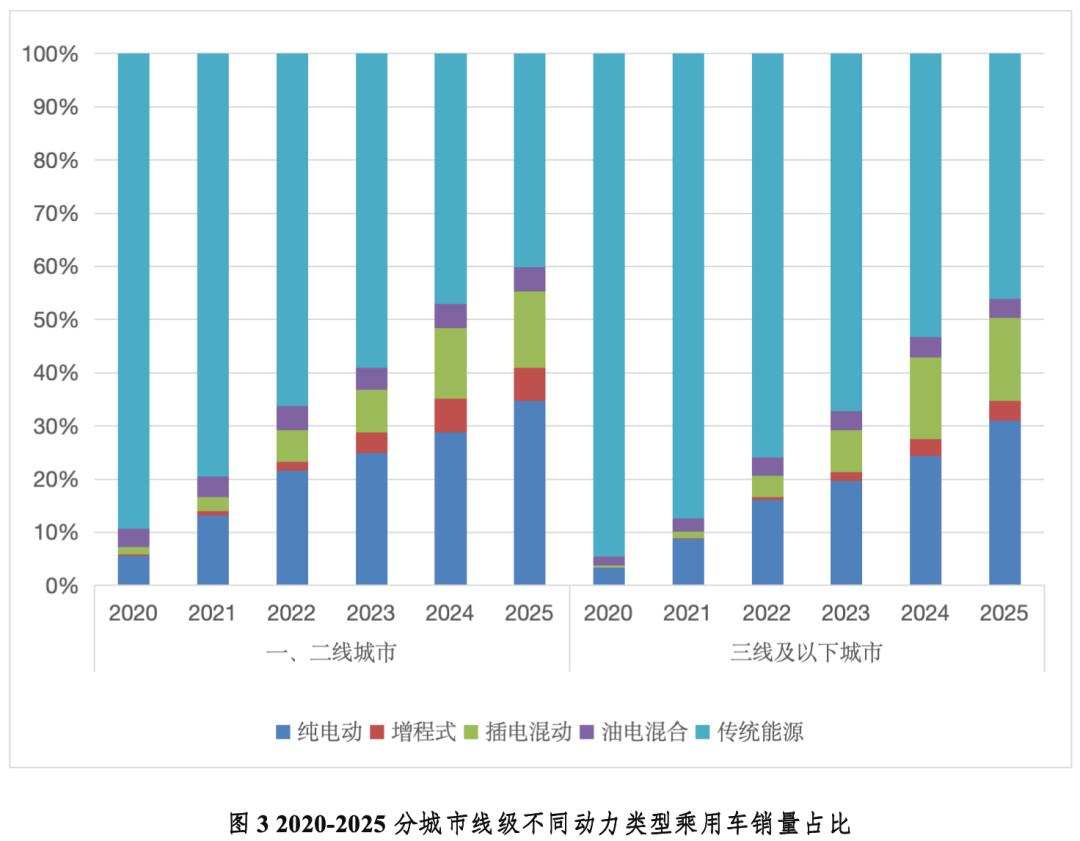
The sinking market is becoming the core engine driving the growth of the domestic new energy vehicle market. From the perspective of the total consumption of passenger cars, the new growth in the markets of first - and second - tier cities has tended to be saturated, and the growth space has gradually narrowed. Cities at the third - tier and below have become the main force driving sales growth. From the perspective of new energy vehicle penetration rate, the penetration rate of new energy vehicles in first - and second - tier cities has exceeded 55%. According to the market development law, its growth rate will gradually decline. The penetration rate in cities at the third - tier and below is below 40%, and it is still in the market popularization period, with strong high - speed growth potential.
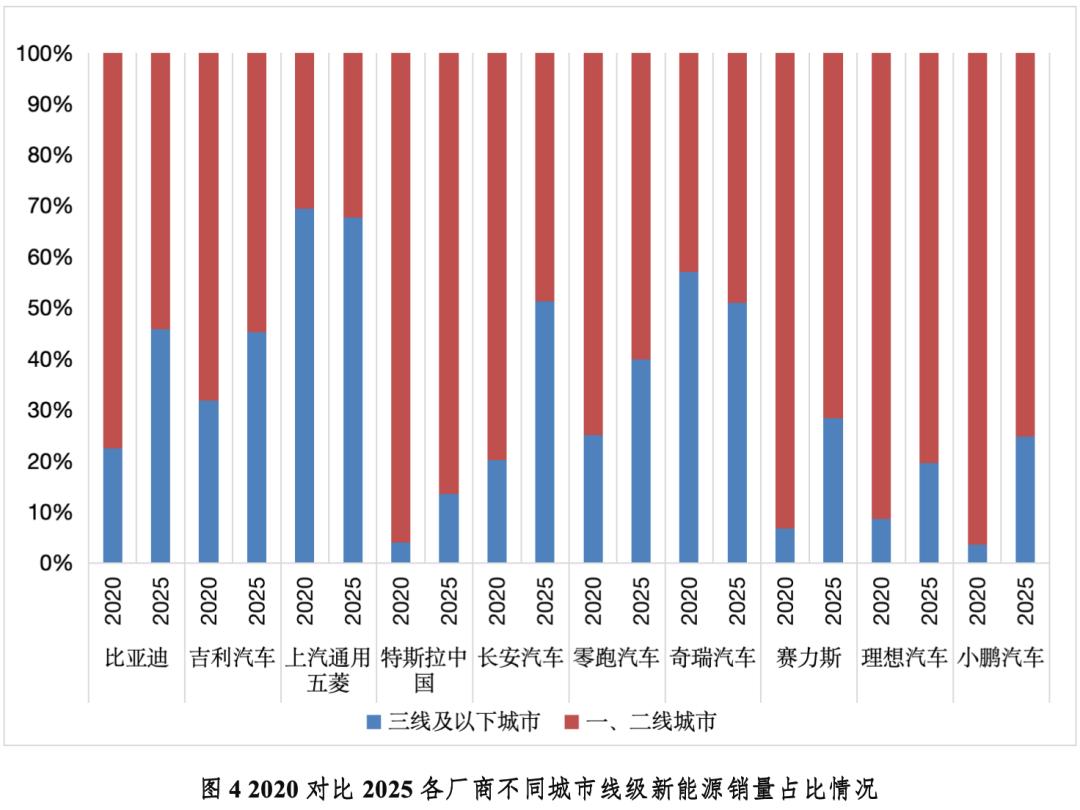
Automobile enterprises are accelerating the layout of the sinking market. Among independent brands, Wuling regards cities at the third - tier and below as its core territory, and nearly 70% of its sales come from these areas. BYD, Geely, and Changan have targeted their efforts and launched models such as Seagull, Xingyuan, and Lumin that meet the needs of the sinking market, achieving rapid sales growth. New - force brands are also keeping up with the market trend. The sales of Leapmotor in cities at the third - tier and below account for 40%, showing strong market penetration. XPeng Motors has also achieved a significant increase in sales in the sinking market with its new MONA series models.
Explore the potential of cities at the third - tier and below and county - level markets from three dimensions: improvement of the consumption environment, precise adaptation of products, and supporting service systems. In terms of charging infrastructure construction, a complementary model of "private photovoltaic home charging + township fast - charging stations" can be implemented to solve the charging problem in rural areas. Automobile enterprises need to target the consumption preferences of the sinking market, launch high - cost - performance new energy models, accelerate the sinking of channels, add sales stores and after - sales service outlets at the county and township levels, and introduce convenient measures such as on - site maintenance.
III
Development Models of Typical Cities
From the perspective of the performance of new energy vehicle sales in cities, the cities with the highest sales from 2024 to 2025 include Guangzhou, Beijing, Chengdu, Shanghai, Shenzhen, etc. The growth logics of different cities are significantly different and can be summarized into four development models.
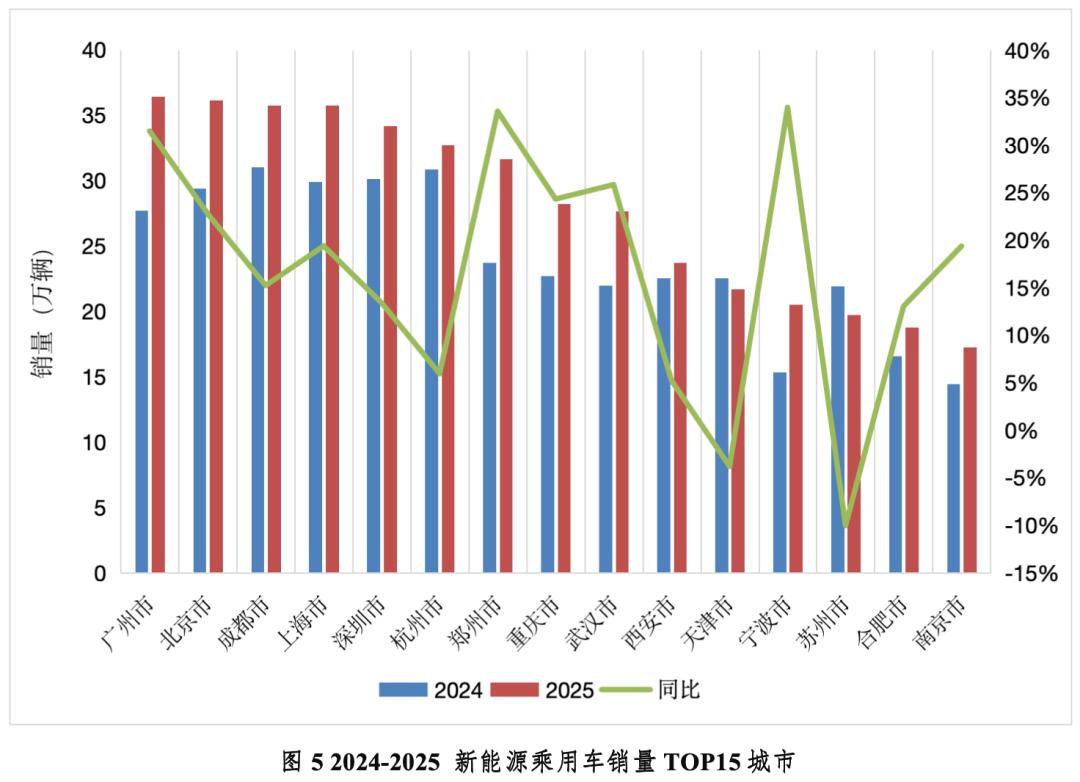
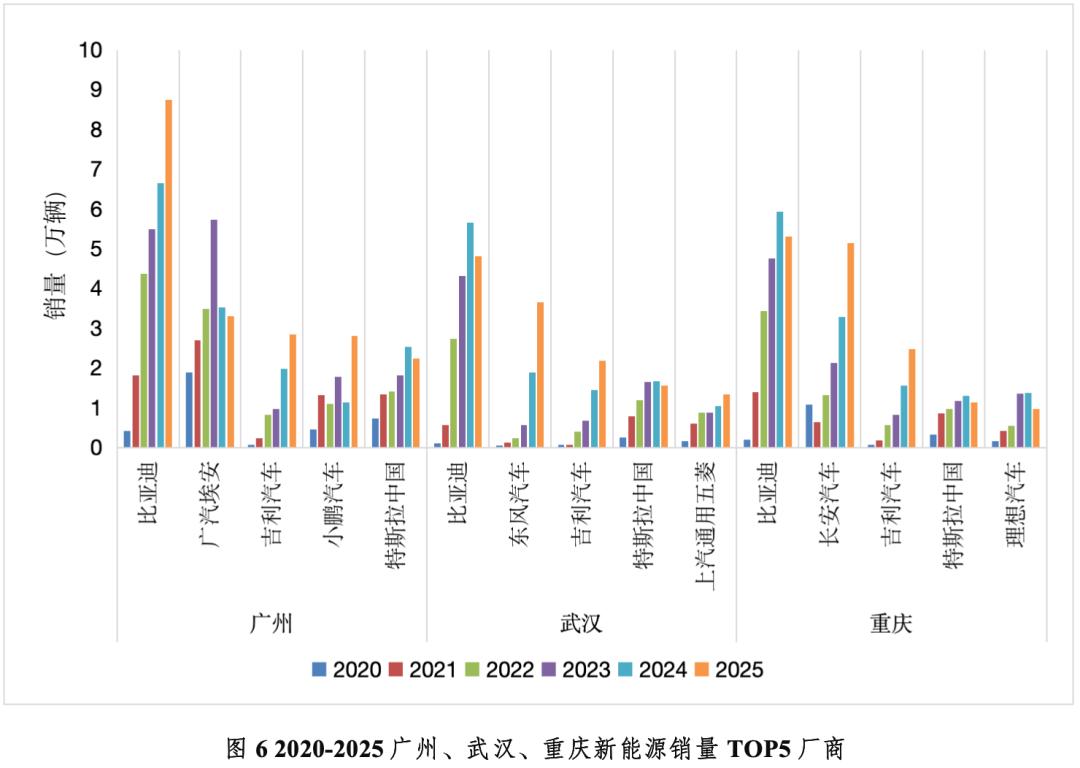
Firstly, the industry - driven model. Cities of this type rely on the industrial radiation effect of local and surrounding leading automobile enterprises, forming market advantages of sufficient supply, solid reputation, and dense channels, represented by Guangzhou, Wuhan, and Chongqing. In 2025, the core driving force for the growth of new energy vehicle sales in Guangzhou comes from the strong support of BYD and XPeng, two local automobile enterprises. The rise of the new energy vehicle market in Wuhan mainly relies on the local layout and production capacity release of Dongfeng Motor. The steady increase in new energy vehicle sales in Chongqing is mainly driven by the product iteration and channel deep - cultivation of Changan Automobile.
Secondly, the environment - driven model. Cities represented by Shenzhen and Hefei have created a good environment for industrial development by improving the supporting facilities for new energy vehicles. Since June 2023, Shenzhen has fully launched the construction of a "Super - charging City", clarifying four key tasks of facility construction, operation services, industrial collaboration, and standard systems, and accelerating the construction of a charging and swapping facility system that is "built as much as possible, evenly distributed, safe and convenient, and intelligent and open". As of the end of June 2025, the city has built and put into use 1,057 super - charging stations and more than 487,000 charging piles, taking the lead in the world in comprehensively surpassing gas stations and fuel dispensers in the number of super - charging stations and charging guns.
Hefei focuses on optimizing the consumption scenarios of new energy vehicles. As of the end of June 2025, the city has built 282,100 charging piles of various types, with a vehicle - to - pile ratio of 1.6:1, significantly higher than the national average. The perfect supporting facility network has become a key factor in promoting the continuous increase in local new energy vehicle sales.
Thirdly, the consumer - vitality - driven model. Taking Chengdu as a typical example, the prosperity of its new energy vehicle market mainly stems from strong consumer vitality, which is specifically reflected in three dimensions. First, the consumption policy stimulates. In the past two years, Chengdu has continuously launched multiple rounds of automobile consumption subsidy policies of "Renew Your Travel, Intelligent Driving in Rongcheng", creating a siphon effect on automobile consumption in surrounding areas. Second, the exhibition economy empowers. The 2025 Chengdu Auto Show was sales - oriented, attracting a total of 910,200 visitors, reaching 33,745 orders, and achieving a transaction amount of 5.753 billion yuan. Third, the population structure supports. The data from the 7th National Population Census shows that there are nearly 10 million young people aged 14 - 45 in Chengdu, accounting for 45.87% of the permanent population, a proportion much higher than the national average, providing a large potential customer group for new energy vehicle consumption.
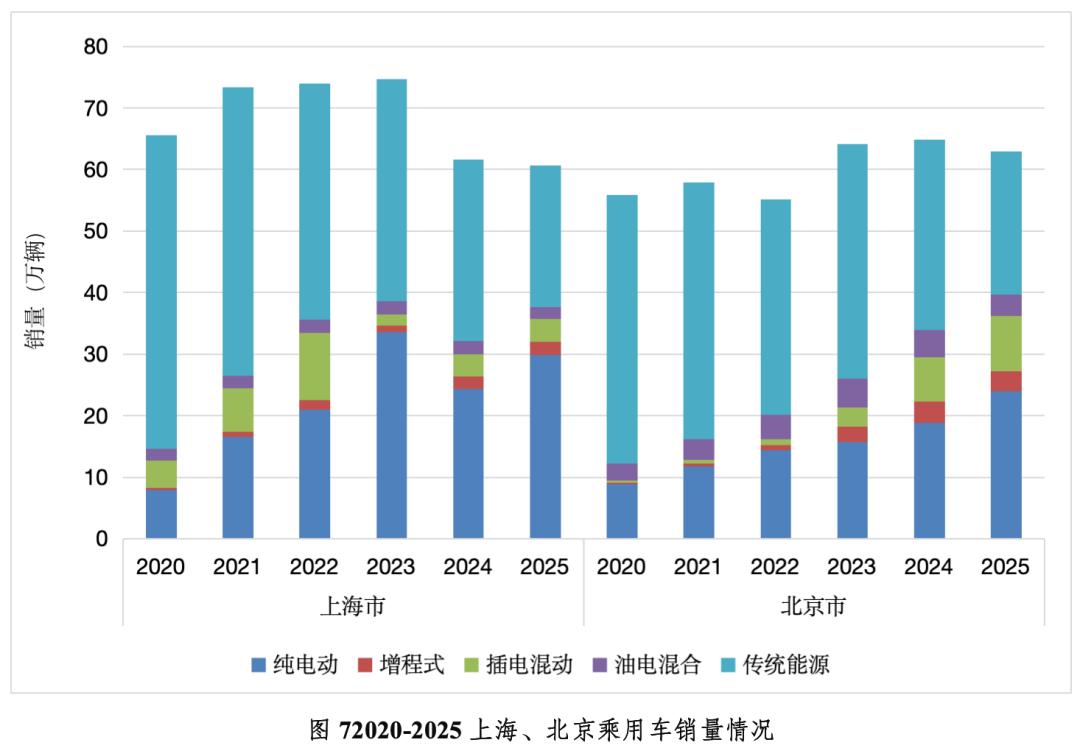
Fourthly, the policy - guided model. Represented by the two super - first - tier cities of Beijing and Shanghai, these cities implement purchase and traffic restrictions on fuel vehicles based on the actual need to manage traffic congestion. At the same time, they provide policy preferences for new energy vehicles in terms of license plate issuance and road access. The sales trend of new energy vehicles is highly related to policy adjustments. In Beijing, 20,000 new energy vehicle indicators were issued to eligible car - less families in 2024, and the number increased to 40,000 in 2025, directly driving the growth of new energy vehicle sales in the city.
In Shanghai, since the free green license plate qualification for plug - in hybrid and range - extended models was cancelled in 2023, the sales of relevant models have been greatly affected. Since January 1, 2024, Shanghai has further raised the threshold for applying for the "green license plate". Individual consumers need to meet four conditions: first, having a Shanghai household registration or holding a valid residence permit in the city and continuously paying social insurance or personal income tax for 36 consecutive months; second, having no new energy vehicles or fuel vehicles (except Shanghai C license plates) under their name; third, having a fixed charging pile; fourth, having a motor vehicle driver's license and having no road traffic safety violations in the year before application. The tightening of the policy has directly led to fluctuations in the sales of pure electric vehicles in Shanghai.
Based on the summary of the development models of typical cities, the following measures and paths can be focused on to further expand automobile consumption:
Remove barriers to automobile consumption. Comprehensively clean up unreasonable restrictive policies on automobile consumption at the local level, eliminate cross - regional circulation barriers, fully release the endogenous potential of automobile consumption, break the pattern of regional market segmentation, and build a unified and competitive national automobile consumption market.
Improve the ecological environment for automobile use. Accelerate the large - scale layout and construction of the charging pile network, promote the upgrading and transformation of existing old charging piles into high - power fast - charging piles, and improve the supporting services around charging facilities.
Stimulate the vitality of the automobile consumption market. By holding automobile cultural activities such as new energy vehicle exhibitions, core technology experience days, and scenario - based test - drive carnivals, comprehensively display the latest technological achievements and innovative models in the industry, lead the consumption trend of new energy vehicles, and drive the transformation of immediate consumption and potential demand through cultural empowerment.
Enhance brand awareness and corporate image. Automobile enterprises can rely on the industrial foundation and market advantages of the cities where their headquarters are located to consolidate the brand awareness and trust of local consumers. On this basis, with the spread of product word - of - mouth, they can achieve the hierarchical diffusion of brand influence and further enhance the brand's recognition and competitiveness in the national market.
This article is from the WeChat official account "Chebai Think Tank". Authors: Wang Hewu, Zhang Jian, Yan Xinming. Republished by 36Kr with permission.