Having raised over 10 billion yuan, it's time for Chinese commercial space unicorns to present their report cards.
In 2025, China's commercial space station reached a new starting point.
In this year, private rocket companies had 67 rounds of financing, hitting a new high in the past five years. Beijing, accounting for 54% of the financing events and over 90% of the total financing amount, became the "Number One Space City". Early - stage investments soared to 26 rounds, exceeding mid - stage investments. After a decade of "weeding out the false and retaining the true", the commercial space industry is moving from "technology verification" to "large - scale delivery".
China Aerospace Science and Technology Corporation pointed out that the next decade during the 15th Five - Year Plan period will be a crucial time, a "key decade" for building a space - power and developing new - quality productive forces, with obvious breakthroughs in policies, industrial collaboration, capital, and application scenarios.
Capital Logic: From "Looking at Technology" to "Looking at Delivery"
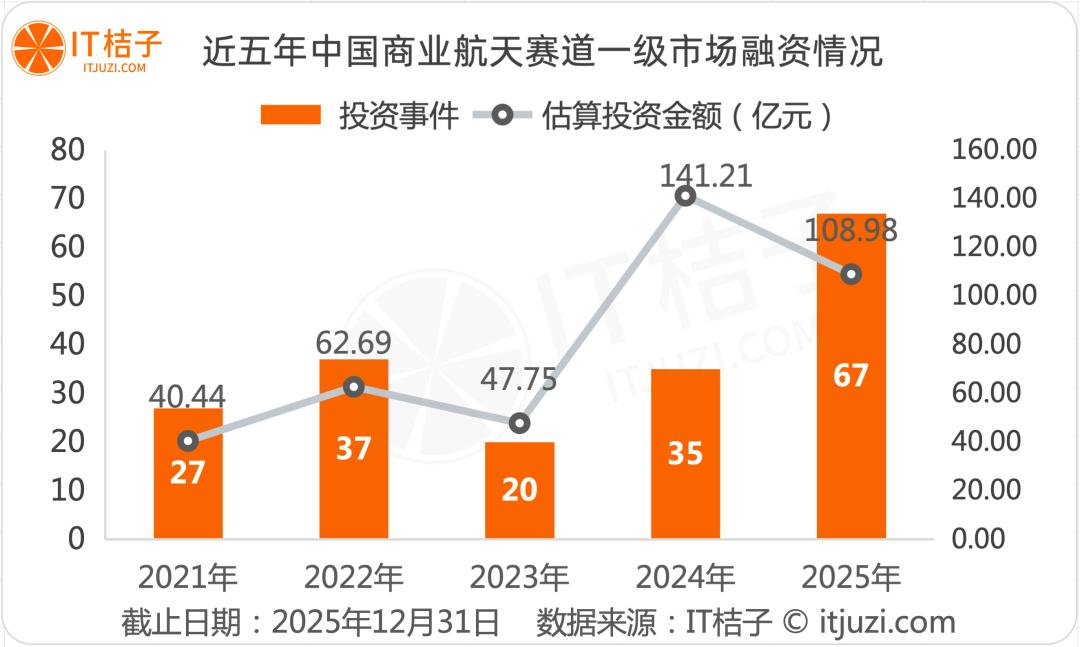
In the past five years, except for a temporary decline in the number and amount of investment events in 2023, the long - term trend of capital's investment enthusiasm and intensity in the commercial space industry has been upward. In 2025, the financing data showed a significant increase, reaching 67 rounds with a total amount of 10.9 billion yuan, marking that the industry has entered a new stage of rapid development.
As leading enterprises completed key technology verification and achieved regular launches, and major national projects such as the "Starnet Project" were implemented, bringing stable order expectations to private enterprises, the commercial value has been greatly enhanced.
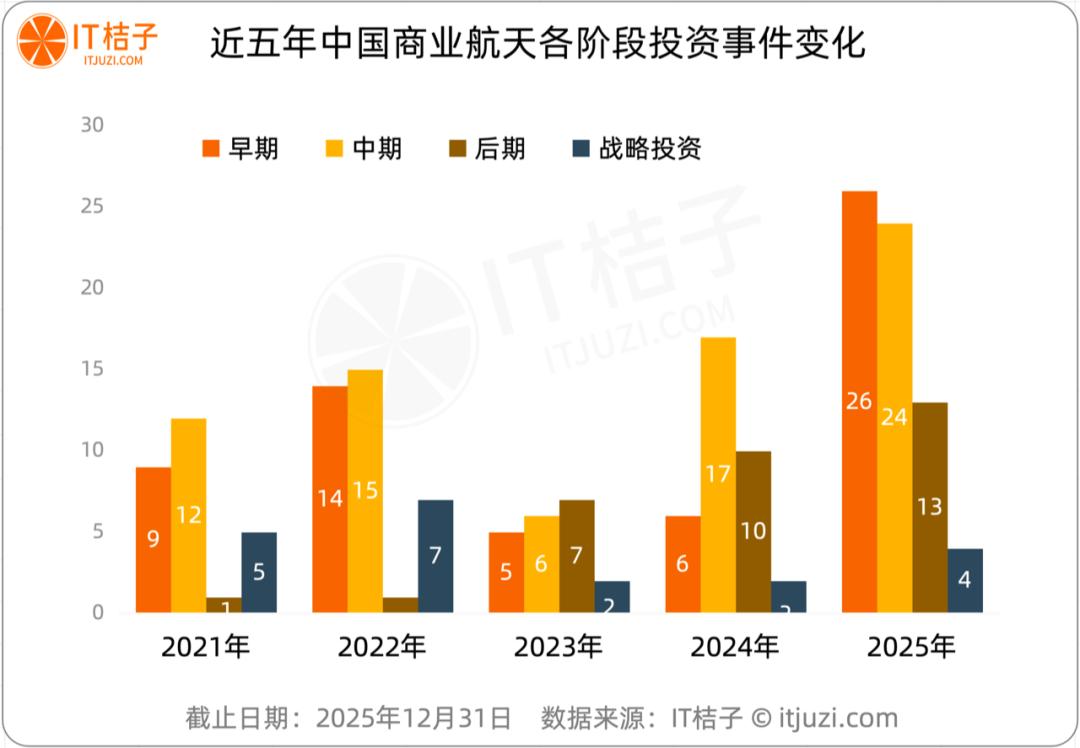
This chart shows the structural evolution of the investment stages in the private commercial space industry.
Mid - stage investments (mainly Series A) have been continuously growing and have dominated in the past five years, indicating that capital has a relatively high risk assessment of this sector and prefers enterprises that have completed technology verification and have commercial delivery capabilities. In 2025, there were 26 early - stage investments, a significant jump and exceeding mid - stage investments, reflecting that after the industry's popularity increased, new - entry capital began to layout potential early - stage projects.
The increase in late - stage investments marks that some leading enterprises have entered the mature expansion stage. However, the number of strategic investments remained low, reflecting the caution of industrial capital in the layout of the space ecosystem. Overall, the change in the investment structure confirms the industrial cycle of the private commercial space industry from early exploration, mid - stage verification to late - stage maturity, and the industry has begun to form an echelon pattern at different stages.
Urban Landscape: Beijing Leads by a Wide Margin
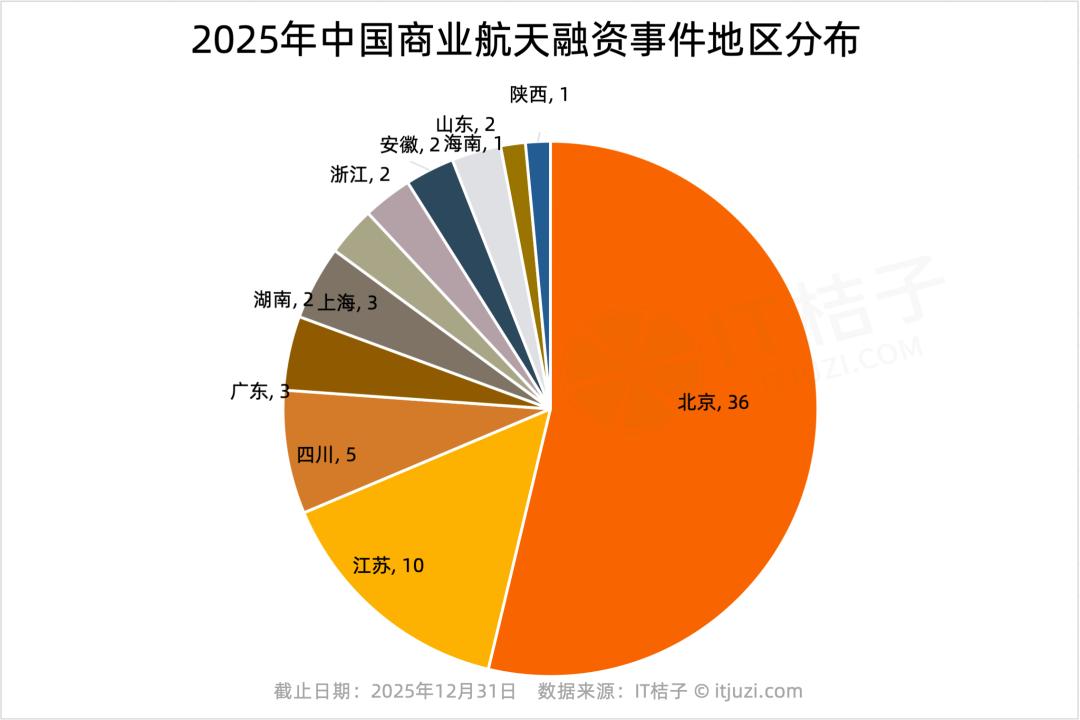
The urban landscape of the commercial space industry shows extreme concentration.
In 2025, financing enterprises were distributed in 11 provinces and municipalities across the country, but 54% were concentrated in Beijing. The total financing amount in Beijing exceeded 9.5 billion yuan, accounting for over 90% of the national total - Beijing's concentration advantage is extremely significant. Other enterprises are scattered in Jiangsu, Sichuan, Guangdong, Shanghai and other places, but there is a large gap compared with Beijing.
This high concentration is closely related to the industrial characteristics of the commercial space industry: the space industry has extremely high requirements for technology, talent, and capital. As the national science and technology innovation center, Beijing has the most concentrated space research institutions, the richest high - end talent reserves, and the most active capital market, forming an ecological advantage that is difficult to replicate.
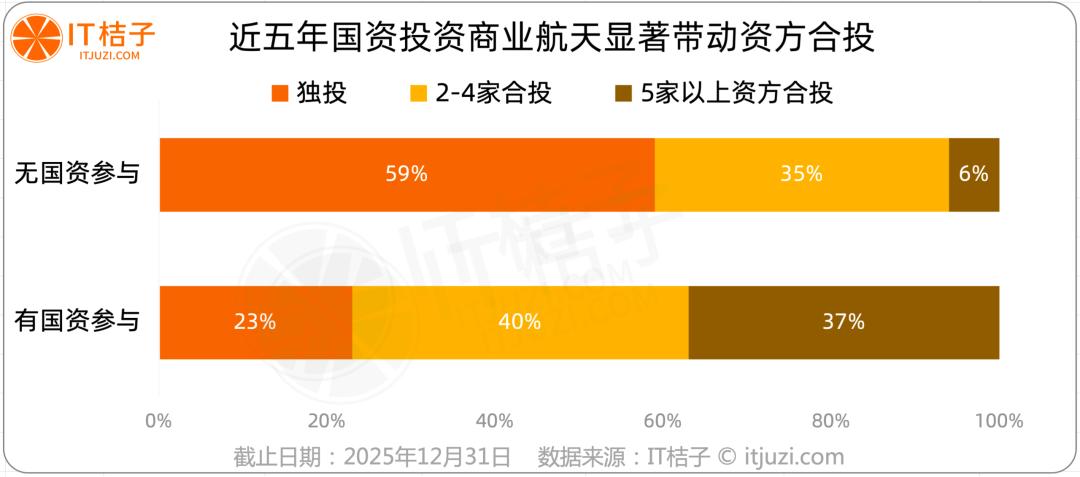
Looking at the situation with or without state - owned capital participation, in the past five years, when only market institutions participated in domestic commercial space projects, 59% were single - investor investments, and the proportion of co - investments was significantly lower. In particular, the proportion of joint investments by more than five investors was only 6%.
When state - owned capital platforms participated, the proportion of single - investor investments was very low, only 23%. The proportion of co - investments by 2 - 4 investors reached 40%, and co - investments by more than five investors also reached 37%, both higher than single - investor investments.
This shows that when state - owned capital participates, it is easier to attract a large number of investors to jointly enter the market, promoting the "multi - party co - investment" financing model, which reflects the obvious "aggregation ability" of state - owned capital in the financing of national strategic industries.
Led by Unicorns: Capital Concentrates on Leading Enterprises
In 2025, there were only 47 domestic commercial space companies that received financing, belonging to a rare and high - end niche sector.
Among them, there were 7 unicorn companies, 4 centaur companies, and 36 other startups. However, the average financing amounts they could obtain were 1.105 billion yuan, 190 million yuan, and 66.75 million yuan respectively, presenting a distinct "pyramid" feature.
This "Matthew effect" is the result of resource concentration at the top. The differentiation in financing amounts is a typical feature of the industry moving from the early exploration stage to the mature stage, reflecting that capital tends to bet on leading enterprises with higher certainty, ultimately promoting the accelerated integration of the industry.
For example, two commercial space unicorns, GalaxySpace and Tianbing Technology, both received 2.5 billion yuan in financing in 2025. Micro and Nano Star and iSpace also completed financings of over 1 billion yuan, with capital highly concentrated on the leading enterprises.
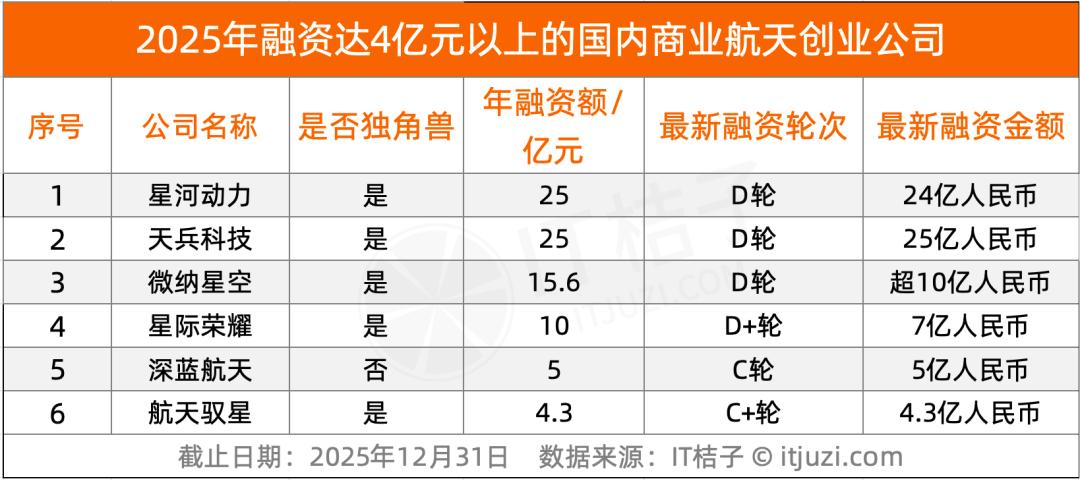
It is worth noting that in addition, three companies in the commercial space industry chain received three rounds of financing in 2025, namely "AstraEra", a company engaged in the R & D of high - speed long - range intelligent aircraft, and commercial satellite companies Juntian Aerospace and Aotian Technology.
Future Outlook: Opportunities in the "Key Decade"
The imagination space of the commercial space industry is opening up. From satellite Internet to space tourism, from rocket recovery to in - orbit services, private space companies are moving from being "supplements to the national team" to becoming the "main force of the industry".
For entrepreneurs, the commercial space industry is a sector with "high thresholds, long cycles, and large potential" - technology verification requires time and capital, but once a breakthrough is made, the ceiling is extremely high.
For investors, this is a sector where "delivery and orders matter" - the technology stories have been told, and next, it depends on who can truly send rockets into space and satellites into orbit.
In 2025, an inflection point in the financing of the commercial space industry has emerged. In the next decade, it will be a crucial window period to determine who can become the "Chinese version of SpaceX".
This article is from the WeChat official account "IT Juzi". Author: IT Juzi. Republished by 36Kr with permission.