Finally, Leapmotor is starting to look like a factory-direct sales model.
"A car company that cannot manufacture components is not a good car company." This has become the general consensus among domestic automotive industry investors in the past two years.
The reason for this judgment is that in the current market competition, every car company needs to find a delicate balance between cost and profit.
From procurement, cooperation to self - manufacturing, car companies manage suppliers in three tiers.
The first tier is the most direct trading model, and also the supply relationship with the deepest game.
A car company usually corresponds to thousands of suppliers, and basically each one has to go through multiple assessments of price, quality, and stability repeatedly.
Those that cooperate continue to stay, and those that don't agree are out.
CATL once accounted for 90% of the battery supply for Xiaomi SU7. Later, due to the failure to reach an agreement on commercial terms, the main battery supplier for the standard and Pro versions of Xiaomi YU7 became Fudi Battery, a subsidiary of BYD.
The second tier is the co - manufacturing cooperation model, where car companies are deeply involved in technology R & D.
Li Auto and Sunwoda jointly established a subsidiary. Li Auto purchases Sunwoda's battery cells and self - develops Li Auto brand batteries.
The third tier is car companies self - developing and self - manufacturing key components.
Following the path of suppliers and squeezing out the profits of the supply chain. In the past, Toyota and BYD were the representatives on this track. They designed, developed, and manufactured key components by themselves. Later, Leapmotor also embarked on the path of vertical integration.
The self - developed and self - produced parts of Leapmotor already cover 70% of the total vehicle cost. For example, with a cost of 100,000 yuan, 70,000 yuan worth of components are self - made by Leapmotor. Calculated based on the 10% gross profit margin difference of external procurement, Leapmotor has a 7,000 - yuan competitive advantage over others.
These data seem to continuously verify the words of the investors at the beginning.
01 Vertical integration is forced
The main hardware cost of an electric vehicle is divided into five parts:
Batteries account for 40%, the electric drive system accounts for 12% - 13%, automotive electronics account for 13% - 14%, the body and chassis account for 14% - 15%, and interior and exterior trims account for 17%.
Currently, only two players can cover all R & D and manufacturing: Leapmotor and BYD.
The core of vertical integration for Leapmotor and BYD is to sell more cars at a more competitive price, but their focuses are different.
Like Toyota, Leapmotor leans towards rationalism. The principle of self - manufacturing components is: joint - venture when possible for manufacturing, rent the factory building when possible, and choose a nearby factory when possible.
In the era of fuel vehicles, Toyota's self - manufacturing rate of components exceeded 80%, but most of them were operated with light assets.
For example, through means such as investment and shareholding, Toyota created a core supplier group - "Kyohokai", including Aisin for transmissions, Denso for electrical accessories, and JTEKT for bearings. These suppliers are either subsidiaries of Toyota or Toyota holds shares in them.
Light assets are also Leapmotor's armor. Leapmotor has 28 core three - electric and high - value - added component factories, but basically all are "only invest in equipment, not in factory buildings."
This approach enables Leapmotor to use 10% of the asset density to challenge the scale effect that its competitors can only achieve with a 30% investment.
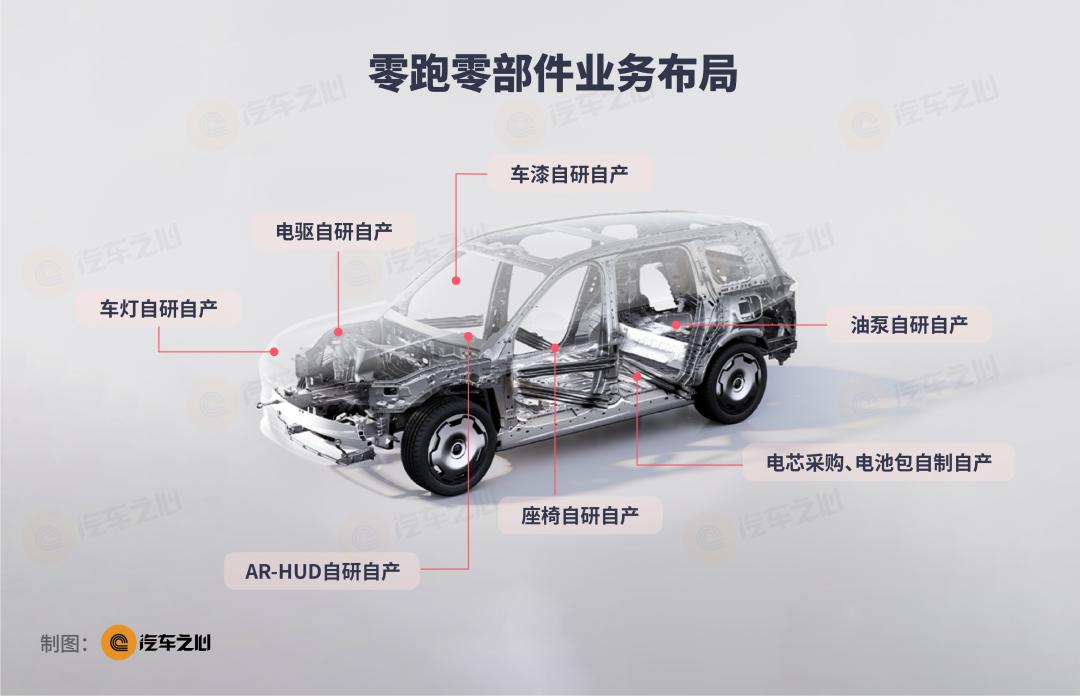
Public information shows that Leapmotor currently has more than 50 investment companies under its umbrella, covering fields such as power, energy, intelligence, intelligent control, technology, and metals.
The advantage of light assets lies in the ability to make flexible adjustments. If suppliers have more competitive products and prices, Leapmotor will resolutely purchase externally.
Zhu Jiangming summarized this model as building cars in a factory - direct - sales way and only making money from components.
BYD leans towards pragmatism.
In 2003, BYD began to layout the production and manufacturing of automotive electronics. Then it successively added production departments for injection - molded interior parts, car lights, and paint. Currently, it has more than 100 component factories under its umbrella.
Someone once described BYD like this: BYD + Fuyao (glass) + Zhongce (rubber tires) + Baosteel (steel) = a complete automotive industry chain.
BYD has built a "vertically integrated" industry chain for itself. From buying mines to extract lithium for batteries, to producing batteries, motors, and electronic controls, and then to selling cars and installing charging piles, BYD handles everything by itself.
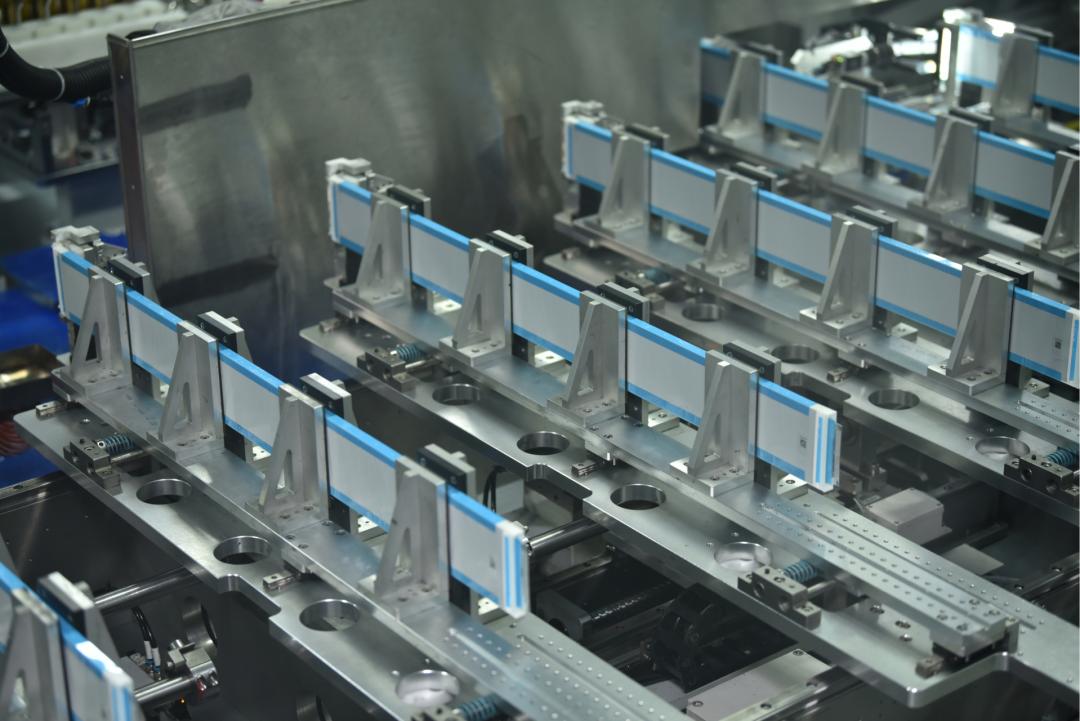
The opposite of the vertical integration model is heavy assets - BYD continuously expands its factories and needs to maintain a huge capital expenditure to build a large number of factories and production lines.
Mass - producing self - made components is essentially a lever: when sales are good, it can earn all the profits from components; on the contrary, it bears the risks of inventory and redundant production capacity.
In 2025, BYD's planned total production capacity is approaching 6 million vehicles, with a large pressure on fixed - asset depreciation, and the production capacity utilization rate is only 78%. BYD not only needs to ensure the full release of the scale effect but also needs high - end models to share the investment cost.
Both BYD and Leapmotor are learners of Toyota's "lean production", but they have different understandings of "lean".
BYD reduces the cost of core components through in - depth vertical integration of the industry chain and a combination of self - production and external supply.
Leapmotor chooses to eliminate more upstream heavy - asset links, concentrate resources on R & D and architecture, and optimize costs at the system level through design cost - reduction and platform generalization.
One emphasizes cost control through scale effect, and the other achieves cost optimization through efficiency improvement. The commonality of both is to reduce the communication cost of intermediate links and supply - chain risks.
As Wang Chuanfu said, vertical integration is not a choice but a survival wisdom forced by circumstances.
02 Car manufacturers selling technology
As industrial giants, how profitable can car companies be by being self - sufficient?
For each part produced, 1 yuan of profit needs to be given to the supplier. For producing 10 million parts, 10 million yuan needs to be paid.
If the middle - man's profit is removed and one produces 10,000 parts for 4.6 million vehicles (BYD's sales volume in 2025), under the ideal scale effect, the maximum premium space of vertical integration can reach 46 billion yuan.
With almost extreme vertical integration of the industry chain, BYD has produced cars with great price advantages.
Data shows that the cost of BYD's in - house produced batteries is 20% cheaper than externally purchased batteries, saving about 0.2 million yuan in cost.
In terms of gross profit, BYD's gross profit margin increased from 17.4% in 2021 to 22.3% in 2024, a cumulative increase of 4.9 percentage points.
All these data ultimately point to one result: The gross profit of Tesla's hardware + software (14.6%) is only two - thirds of BYD's.
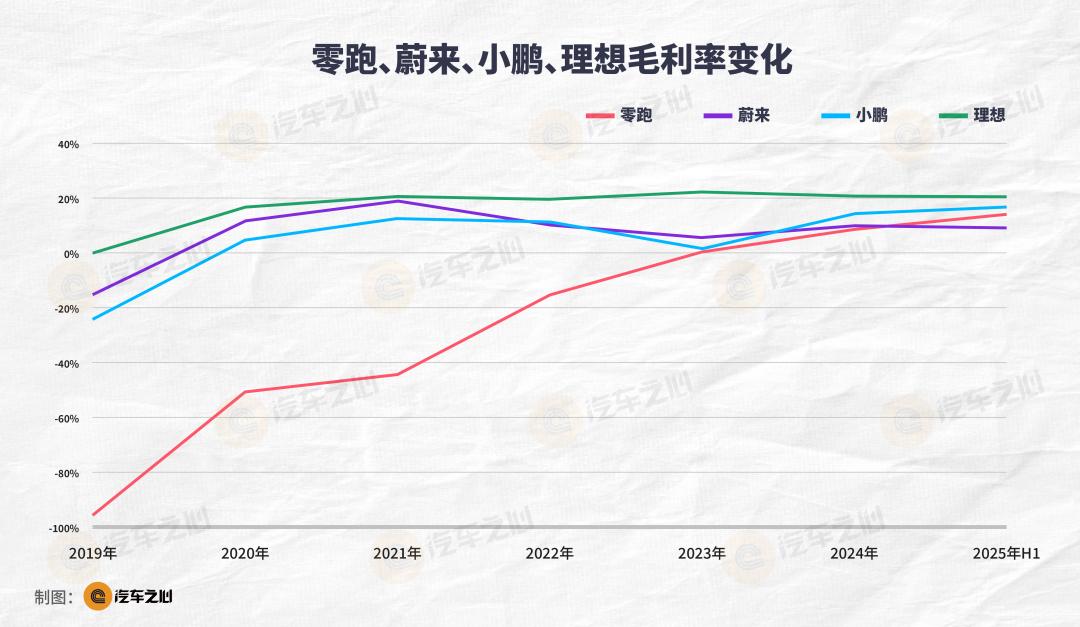
BYD's gross profit margin has advanced from "having" to "being good", while Leapmotor has achieved a breakthrough from "none" to "having".
When Leapmotor's gross profit margin turned positive for the first time, it had been established for 8 years. The lowest was - 95.7% in 2019. In the first half of 2025, Leapmotor's gross profit continued to rise to 14.1%, approaching the normal level of 15% - 20% in the industry.
Cost is the hunter's weapon, and profit is the telescope for the hunter to expand the field of vision.
Looking into the distance, it is about selling more cars to drive more profits; looking nearby, it is about whether self - developed and self - produced components can be continuously superior to suppliers in terms of technology and cost.
The prerequisite for car companies to reduce costs by self - manufacturing components is that the production volume reaches a certain cost - reduction scale, that is, the production capacity utilization rate reaches over 70%.
The price is the most direct manifestation. Geely Xingyuan is equipped with CATL's battery packs because the battery cells provided by CATL for Xingyuan are of mature specifications. With rebates and low - point policies, the price is expected to reach 0.3 yuan per watt - hour, 20% lower than the cost of Geely's own Jinzhuan batteries.
As early as 2022, Li Auto planned to establish a battery - pack production line to build its own battery technology capabilities. However, due to CATL's generous rebate conditions to lock in its main order share, Li Auto's battery layout was forced to be shelved.
Zhu Jiangming frankly said that your competitors are component suppliers. They are all outstanding players in the market and have many car - company customers. If you only use components for your own use, you are naturally inferior to them in terms of scale.
The competitive situation is clear. How can car companies compete with suppliers?
One is to improve the internal component commonality rate.
The logic of component commonality rate is to start from the platformization direction of products, maximize the procurement quantity of each component, use the scale effect to reduce costs, reduce component verification time, and improve development efficiency.
Using scale to even out production costs is an eternal profit model in the automotive business history.
In Leapmotor's LEAP 3.5 architecture, the component commonality rate of C/B series models reaches 80% - 88%, which maximizes the procurement bargaining power and cost amortization.
BYD's modular platform is more mature. Not only are the motors and heat pumps common, but even small parts like windshield - wiper motors are common across all vehicle models. The component commonality rate exceeds 90%, higher than 75% of domestic Tesla.
This is the only way for players with self - developed components to expand their internal scale, while players highly dependent on external procurement can only adjust the supply chain to control costs.
In 2024, Seres reduced the number of first - tier suppliers from 300 to 100, changing from component procurement to purchasing integrated systems. Similarly, XPeng reduced SKUs to enlarge the procurement scale of single parts and enhance bargaining power.
The second is to explore external - supply channels.
Car companies' self - manufacturing of components starts with self - supply, but in the long run, their health depends on external supply.
Car companies acting as suppliers can be divided into three categories:
The first category is the hardware school represented by BYD, mainly providing single components such as batteries and motors.
In 2024, BYD externally supplied 15.6 GWh of power batteries to new car - making forces and earned an additional 1 billion yuan in net profit.
According to data from GGII, in the first three quarters of 2025, the external - supply proportion of BYD's domestic power - battery installed capacity reached 20.85%, and it added international brands such as Hyundai and Porsche to its supply - chain system.
The second category is the software school represented by XPeng, which charges service fees through technology licensing.
Before the mass production of the joint - venture models between XPeng and Volkswagen, XPeng can receive 400 million to 500 million yuan in technology R & D service fees from Volkswagen every quarter.
If the 705 million US dollars invested by Volkswagen in XPeng is also counted, Volkswagen has paid XPeng more than 10 billion yuan in "tuition fees" so far.
The third category is the combination of hardware and software represented by Leapmotor, providing an integrated solution of three - electric systems + software + platforms.
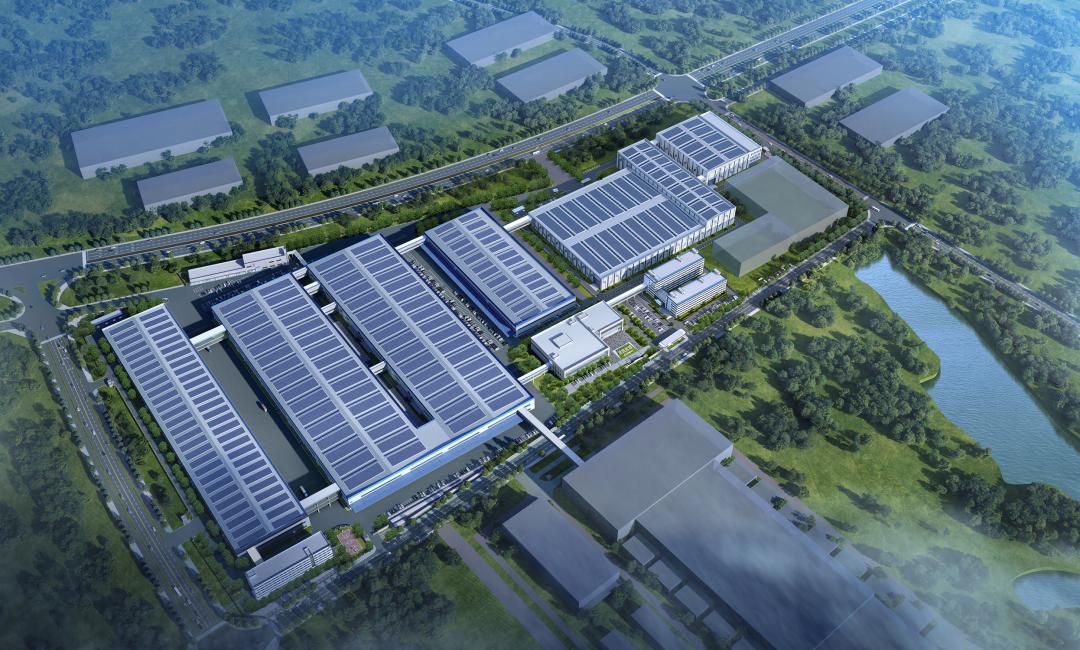
Lingxiao Energy Wuyi Battery Factory under Leapmotor
Leapmotor purchases battery cells from battery manufacturers such as CATL and then externally supplies them after self - packaging. Currently, it has won orders from more than 5 new - energy commercial - vehicle customers.
In addition, Hongqi's G117 project will adopt Leapmotor's LEAP3.5 technical architecture, which can shorten Hongqi's vehicle - R & D cycle by 12 - 18 months. The new model will share the same platform with Leapmotor B10.
It is estimated that in 2025, Leapmotor is expected to earn more than 2 billion yuan in revenue from component external supply alone.
It is certain that car companies acting as suppliers have obtained a new growth curve.
03 Leapmotor retraces the path taken by Toyota and BYD
Car companies are reshuffling, and the supply chain is also being reshaped.
According to data statistics from Gasgoo, in the ranking of supplier installed capacity from January to November 2025, Leapmotor ranked among the top 10 in components such as multi - in - one main drives, motor controllers, BMS, battery PACKs, automatic parking systems, and AR - HUDs.
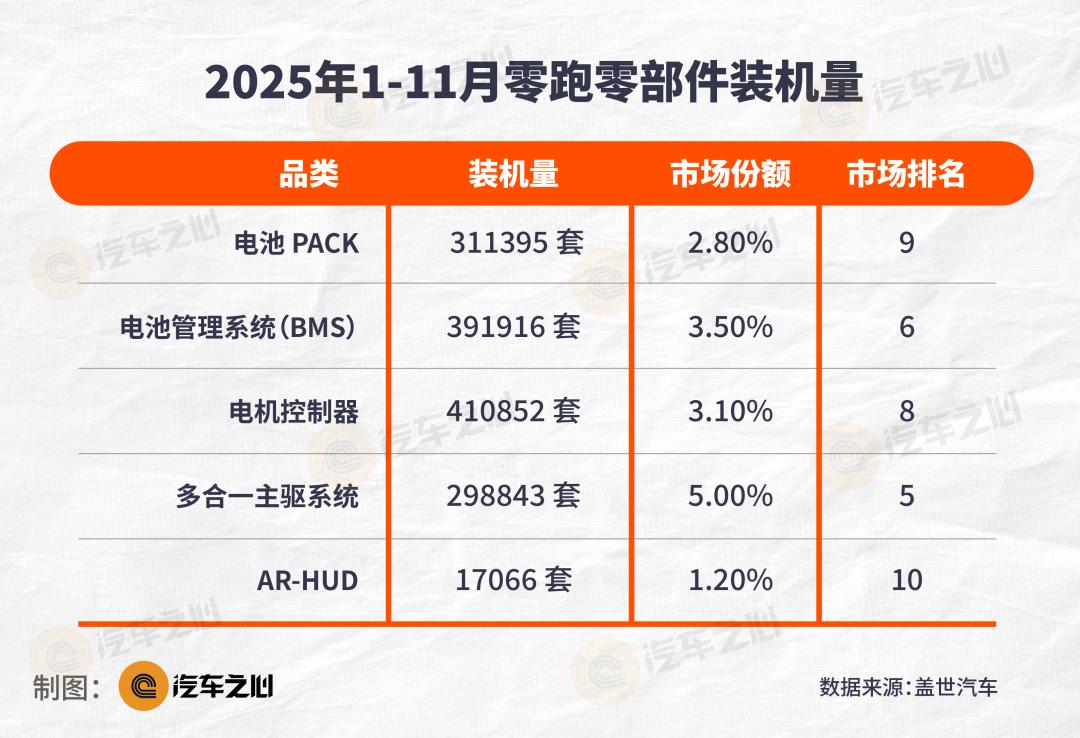
On the surface, it is a car company, but in fact, it has the ability to self - develop, self - produce, and self - sell 65% of the vehicle's components. It not only provides components for its own models but also for other car companies.
This is like Samsung in the mobile - phone field. It is not only the world's largest smartphone shipper but also a supplier of core components such as OLED screens, chips, and camera sensors. Leapmotor has similar capabilities.
Therefore, whether in terms of the self - manufacturing proportion of components or the revenue from external - supply business, Leap