What's the mystery behind Elon Musk's exploration of the photovoltaic industry chain?
Shock the capital market!
According to a report by Cailian Press, Musk's team has recently "surveyed" China's photovoltaic industry chain, and a heterojunction equipment manufacturer has received orders.
According to people familiar with the matter, recently, the SPACE X team and Tesla team under Musk have "surveyed" Chinese photovoltaic enterprises. Currently, the TESLA team is only in the factory inspection stage and has visited multiple enterprises in the industry chain. The SPACE X team mainly visited photovoltaic equipment manufacturers and has an order cooperation with a leading domestic heterojunction equipment manufacturer. However, due to factors such as commercial confidentiality requirements, this cooperation has not been made public.
According to the latest news, the market rumor has been confirmed by leading enterprises. Behind Musk's team's recent secret visits to multiple Chinese photovoltaic enterprises is a bet on a new energy super track.
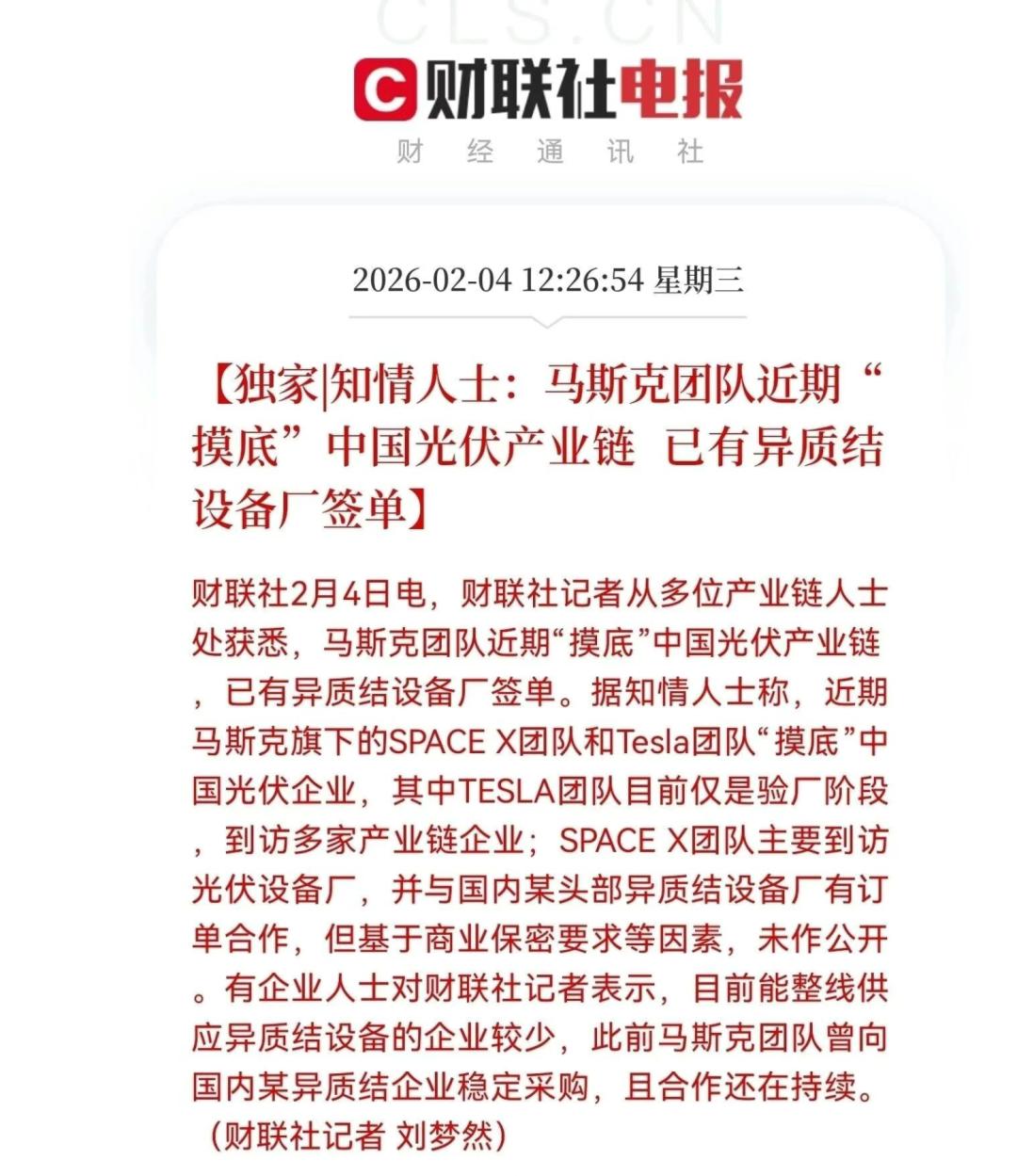
In the early trading session, the space photovoltaic sector in the A-share market witnessed a strong rise, with the space photovoltaic index surging 2.73%. The stock price of JinkoSolar Holding Co., Ltd. directly hit the daily limit. The news of Musk's team's recent secret visits to multiple Chinese photovoltaic enterprises was confirmed by a staff member of JinkoSolar.
At the World Economic Forum in Davos, Musk once highly praised China for its annual solar power installation capacity exceeding 100 gigawatts, and the stable power supply with energy storage can reach 25 gigawatts. Now, this technology tycoon is setting his sights on a farther place - space.
01 The parties involved in the incident have confirmed
After a reporter from Cailian Press called JinkoSolar in the capacity of an investor, it was confirmed that the company had indeed had contact with an inspection team related to Musk's team recently. Musk's team inspected the company's technological reserves and production equipment.
Regarding the cooperation intention and specific inspection details, the staff member answering the phone said it was inconvenient to disclose. He also revealed that "mainstream domestic photovoltaic enterprises have also been inspected." This means that Musk's inspection scope is far beyond just one enterprise.
JinkoSolar is a global leading component enterprise, ranking first in component shipments for many consecutive years. In fact, this company is also the most active industry leader in embracing space photovoltaics.
The capital market responded quickly to this news.
As of the mid - day trading session today, the space photovoltaic index soared 2.73%. The stock prices of companies such as JinkoSolar and Jolywood (Suzhou) Sunwatt Co., Ltd. were particularly eye - catching.
02 In - depth survey
People familiar with the matter revealed that both the SpaceX team and Tesla team under Musk are "surveying" Chinese photovoltaic enterprises.
Currently, the Tesla team is only in the factory inspection stage, while the SpaceX team has taken further actions.
The SpaceX team mainly visited photovoltaic equipment manufacturers and has an order cooperation with a leading domestic heterojunction equipment manufacturer. However, due to commercial confidentiality requirements, this cooperation has not been made public.
Musk's team focused on inspecting photovoltaic enterprises with heterojunction and perovskite technology routes. These technology routes are regarded as representatives of the next - generation photovoltaic technology in the industry.
A corporate insider told a reporter from Cailian Press that currently, there are few enterprises capable of supplying heterojunction equipment for the whole production line. Musk's team has previously made stable purchases from a domestic heterojunction enterprise, and the cooperation is still ongoing.
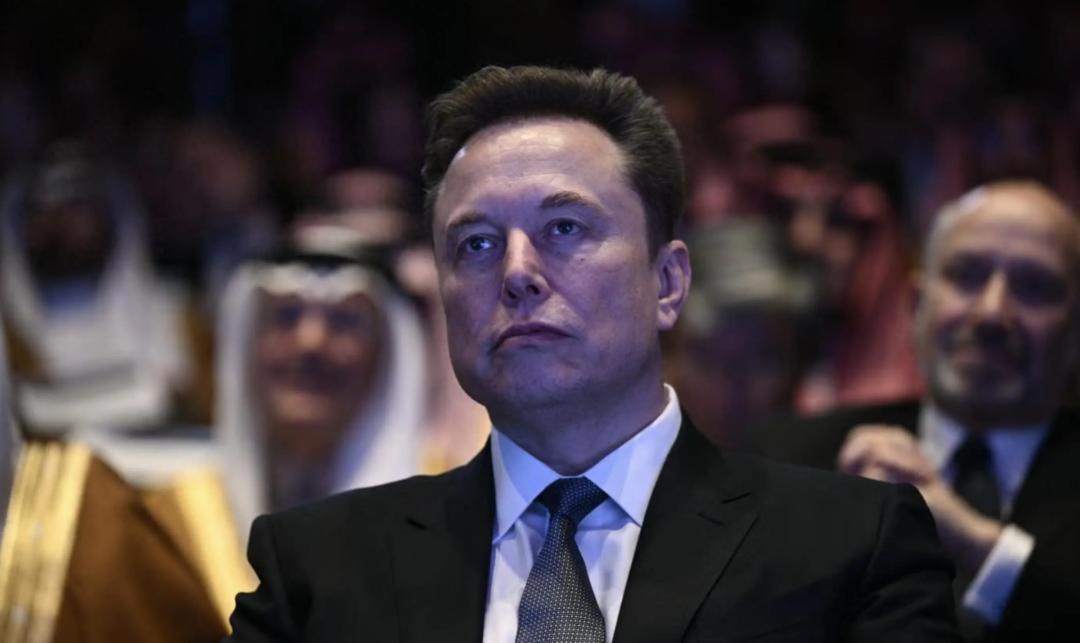
03 Musk's energy map
At the Davos Forum in January this year, Musk clearly stated that SpaceX and Tesla are simultaneously promoting the improvement of solar power production capacity.
His set goal is to achieve an annual solar manufacturing capacity of 100 GW in the next three years. What does this number mean? It is equivalent to nearly half of China's current annual new photovoltaic installation capacity.
Musk proposed using photovoltaics to power AI data centers. This is not only a response to the trend of green energy but also opens up a brand - new imagination space for the photovoltaic industry chain.
More notably, Musk plans to allocate 100 GW of this capacity specifically for space scenarios, aiming to achieve the milestone of the first 100 GW space photovoltaic deployment before 2030.
The concept of space photovoltaics is not actually new, but Musk's entry may truly push it towards industrialization.
So - called space photovoltaics means converting solar energy into electricity by deploying large - scale solar power stations in space. This kind of energy can directly power satellites in orbit, space stations, and even future lunar or Martian bases.
Compared with ground - based photovoltaics, space photovoltaics have natural advantages such as no day - night alternation, no weather interference, and higher light intensity.
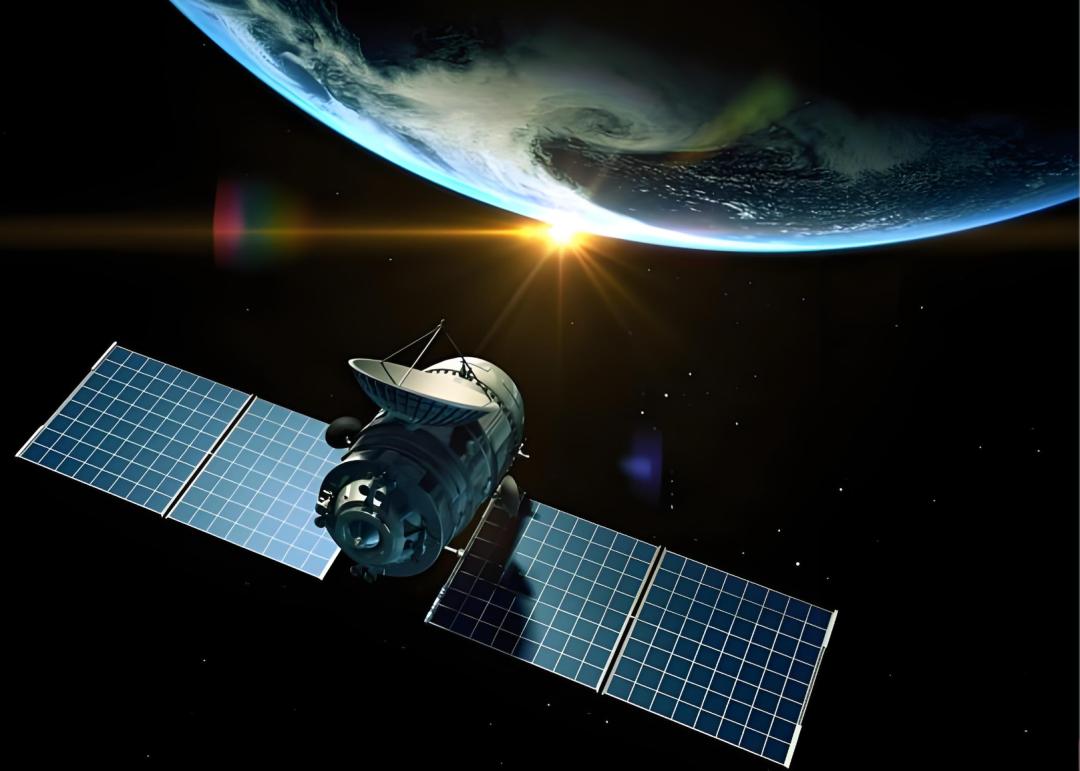
Space photovoltaics have obvious advantages in energy density and power generation hours. The energy density of space photovoltaics is 710 times higher than that of ground - based photovoltaics, and the power generation hours are 47 times higher than those of ground - based photovoltaics, and it does not occupy land resources.
The following table compares the main differences between space photovoltaics and ground - based photovoltaics:

Data sources: Securities Daily, Cailian Press, public information, etc.
04 New opportunities for Chinese photovoltaic enterprises
For Chinese photovoltaic enterprises, Musk's attention may mean new opportunities. JinkoSolar analyzed in the institutional research minutes that perovskite has advantages in efficiency, future efficiency growth, adaptability to the extreme space environment, light weight, flexibility, and cost.
"If the perovskite technology can make a breakthrough in the future, it will greatly improve the application of space photovoltaics." This indicates that Chinese photovoltaic enterprises have been making technological preparations for the era of space photovoltaics.
However, challenges also exist. JinkoSolar recently disclosed its annual performance forecast for 2025, expecting the annual net profit to be between 6.9 billion yuan and 5.9 billion yuan. This loss is mainly due to the intensified price fluctuations in the global photovoltaic industry chain and the disturbances of trade protection policies in overseas markets.
The special requirements of space photovoltaics mean a higher technological threshold. Space photovoltaics have much higher requirements for the conversion efficiency, radiation resistance, and lightweight degree of batteries than ground - based photovoltaics. Enterprises engaged in the R & D of high - efficiency battery technologies such as gallium arsenide, HJT, and perovskite will directly benefit.

05 Industrial impact
According to the analysis of Shenzhen-Hong Kong Securities, Musk bundles energy and computing power in the spatial dimension to form a "space photovoltaic - AI satellite" system. This approach avoids the limitations of the ground power grid and the transmission losses between heaven and earth, and makes full use of the physical advantages of the space environment in continuous power generation and efficient heat dissipation.
The market potential of space photovoltaics is huge. A research report by UBS Group predicts that the global demand for space photovoltaics will be 0.3 GW in 2026 and is expected to soar to 115 GW in 2035. The scale is expected to increase by more than 300 times in ten years.
For the photovoltaic industry as a whole, space photovoltaics may become a breakthrough point for differentiated competition. The recent photovoltaic industry entrepreneur symposium held by the Ministry of Industry and Information Technology in China emphasized the development orientation of "anti - involution". Coupled with the emerging demand for high - power components downstream, which forces efficiency improvement and upgrading, component manufacturers' demand for price increases has become stronger.
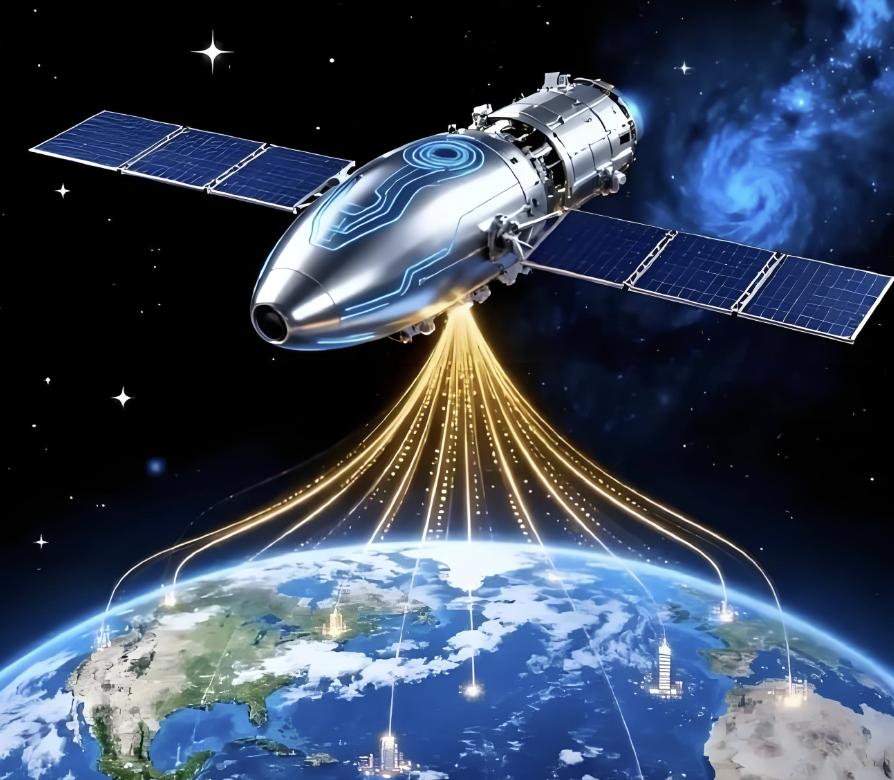
The rise of space photovoltaics may prompt the iteration of photovoltaic technology towards higher reliability and higher power quality. This also means that enterprises in the industry chain need to re - evaluate their technological routes and market positioning.
In the afternoon, the concept of space photovoltaics continued to rise, and JinkoSolar's stock price hit a 20% daily limit. Musk's SpaceX recently announced that it has acquired xAI and is promoting the plan to deploy a data center in space.
The energy density of space photovoltaics is 710 times higher than that of ground - based photovoltaics, and the power generation hours are 47 times higher than those of ground - based photovoltaics. A staff member of JinkoSolar responded cautiously: "It is inconvenient to disclose the cooperation intention and specific inspection details."
However, the capital market has cast its vote of confidence with real money, and Musk's dream of space photovoltaics seems to be quietly coming true.
This article is from the WeChat official account "Investment Banking Circle", author: Senior Sister of Investment Banking. It is published by 36Kr with authorization.