The price of iPhone Air dropped by 3000 yuan in three months, achieving the fastest backstab in history.
At 8 p.m. on January 25th, the iPhone Air started a price - cut promotion on multiple platforms. The Chinese - mainland version of the iPhone Air, with a starting launch price of 7,999 yuan, dropped to as low as 5,499 yuan after a direct reduction of 2,000 yuan and an additional 500 - yuan national subsidy. On JD.com, the iPhone Air can be combined with a 1,400 - yuan national subsidy and a trade - in subsidy, bringing the price down to as low as 4,599 yuan, a significant reduction of 3,400 yuan compared to the launch price.
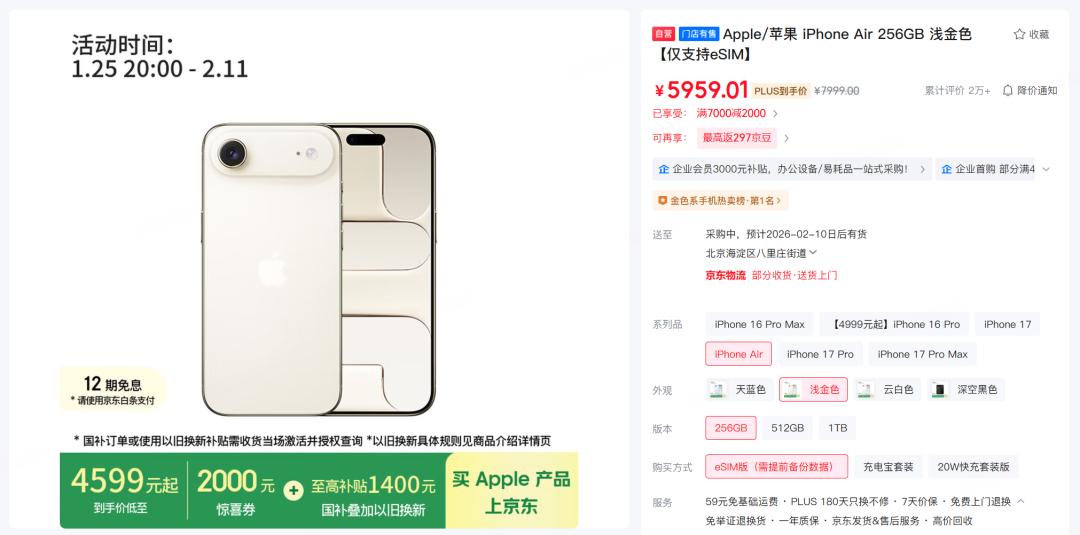
This iPhone Air, touted as the "thinnest in history", started such a substantial price - cut promotion less than three months after its launch. However, the sales of the iPhone Air were so low that there weren't many buyers complaining about being "stabbed in the back" even on Xiaohongshu. Third - party data shows that as of January 24, 2026, the cumulative activation volume of the Chinese - mainland version of the iPhone Air was less than 200,000 units, accounting for less than 3% of the sales of the iPhone 17 series during the same period.
Different from the nearly halved price, a few days later, Apple released its financial report for the first quarter of fiscal year 2026: total revenue was 143.756 billion US dollars, a year - on - year increase of 16%; net profit was 42.097 billion US dollars, a year - on - year increase of 15.9%; diluted earnings per share were 2.84 US dollars, a year - on - year increase of 18.3%. All three indicators far exceeded market expectations.
During a conference call held by Apple's management after the release of the financial report, Apple CEO Tim Cook mentioned that "this fiscal quarter, we set a new record for the highest revenue of iPhone products in Greater China. This is also one of the best quarters for iPhone products in Greater China ever."

Is the price cut of the iPhone Air a series of blunders by Apple or a wise move to quickly clear inventory?
How Completely Did It Fail?
If you only look at the product launch event and posters, the iPhone Air seems almost a perfect example: extremely thin and light, extremely good - looking, with an unparalleled feel. Apple made those few millimeters the sole focus. However, apart from technology media, only some die - hard fans seemed to be in favor: they were finally getting something different.
The iPhone Air is positioned as an extremely thin and light flagship - performance mobile phone. So, even though it only has a single camera, its starting price still reaches 7,999 yuan. Many people only realized after actually using it that it was just a "half - finished product for the sake of thinness". On Xiaohongshu, users' complaints such as "needing to charge three times a day for battery life", "the single - camera is a step back of ten years", and "only being able to apply for two eSIMs and having to go to the business hall" precisely hit all the weaknesses of this product.

Users on the foreign platform Reddit also didn't hold back. Some people directly said they planned to return the phone, citing poor battery life as the reason. Moreover, some digital bloggers sharply pointed out that Apple, with a flagship - level price, launched a product that only has portability. In the domestic market, users' demands for mobile phone battery life, imaging, and dual - SIM functionality have a much higher priority than thinness. Such a product design that is divorced from the actual usage scenario will ultimately be abandoned by the market.
In an environment where domestic mainstream mobile phones are equipped with 5,000mAh batteries and claim "extreme heavy - use for a day", the actual battery life performance of the Air is visibly behind. Many reviews directly gave an evaluation of "needing to charge twice or even three times a day". For commuters and business travelers, this is not thinness but a burden.
Moreover, the imaging experience with a single camera is completely unworthy of the price starting from 7,999 yuan. Competitors' thin and light phones still come with periscope lenses and large - sensor cameras. Apple simply removed the ultra - wide - angle and telephoto lenses, leaving only the main camera. During the day, it can barely rely on algorithms for casual shooting, but at night, for landscapes, and portraits, the freedom of composition and the playability of the pictures are directly halved. In an era when "everyone is a mobile - phone photographer", such a regression is hard to forgive.

Even the speakers on the iPhone Air were reduced to just one. Everything was sacrificed for thinness, and everything was compromised for the sake of thinness.
A shop owner in the Hangzhou Communication Equipment Market revealed that "previously, we stocked some iPhone Air units. We only sold a few units at the original price in nearly a month. Now, after the official price cut, the remaining inventory in our store can only be sold at the current market price, and there's not much profit left."
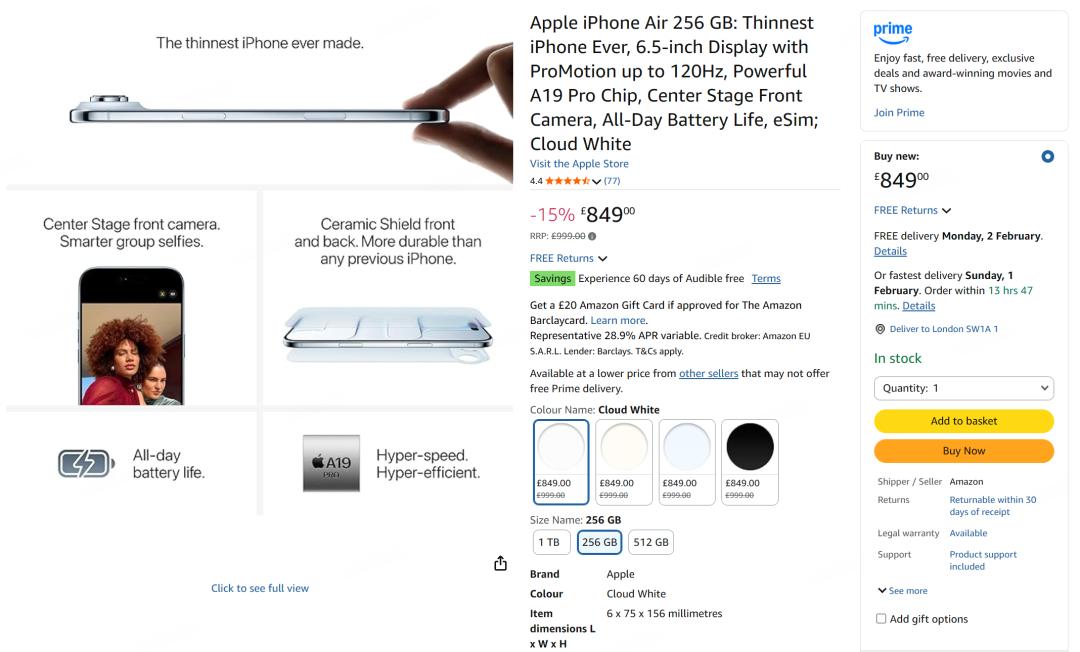
Of course, it's not just the iPhone Air in the Chinese market that has had a price cut; the same is true abroad. In the UK, Amazon reduced the price of the iPhone Air by 150 pounds (about 1,434 yuan) directly, from 999 pounds to 849 pounds. Forbes pointed out that such a large - scale price cut is extremely rare for the iPhone. Usually, the discount of the iPhone on Amazon does not exceed 50 - 100 pounds. The Good Guys in Australia and Amazon Australia also followed suit with a price cut of up to 302 Australian dollars (about 1,468 yuan).
The data from the US market is even more dismal. Only 10 weeks after its launch, the second - hand recycling price of the iPhone Air dropped by more than 40% compared to the price of a brand - new phone. Among them, the 1TB version plummeted by 47.7% - this is the largest depreciation rate of an iPhone recorded by the phone recycling platform SellCell since 2022. In contrast, the decline of the iPhone 17 Pro Max during the same period was less than 27%, and that of the iPhone 17 Pro was less than 32%. In the iPhone family, which is known for its value retention, the Air is like an outlier.
IDC data shows that the sales of the iPhone Air were only about one - third of Apple's highest expectation. Apple cut its production plan in half just a few weeks after its launch. Third - party data is even more shocking: as of January 24, 2026, the cumulative activation volume of the Chinese - mainland version of the iPhone Air was less than 200,000 units, and the activation volume in the first week was only 50,000 - 55,000 units, accounting for less than 3% of the sales of the iPhone 17 series during the same period.
Foxconn and Luxshare Precision, the two largest contract manufacturers for Apple, have "fled". As early as October 2025, Luxshare Precision ended the production of the iPhone Air; Foxconn dismantled almost all of its iPhone Air production lines in mid - November 2025, only keeping 1.5 lines, and completely stopped production by the end of November. Industry insiders revealed that originally the iPhone Air only accounted for 10% of Apple's total production capacity, but even this small amount couldn't be sold.
From Innovation Leadership to a Series of Blunders
If we look back a few years, we'll find a very striking contrast: when the iPhone X removed the Home button and introduced the full - screen and Face ID, the entire industry was forced to rewrite its product roadmaps; when the iPad mini entered the small - tablet market back then, it was almost a category - level hit. In the past two years, the latest offerings from Apple to users have been a head - mounted display device with a high - profile start but a disappointing finish and the iPhone Air, which was significantly discounted by the official within three months.

It's hard to say that these products are "poorly made". The craftsmanship, screen, chips, and system refinement are still at the industry's top level, but they lack that "wow" factor from back then. The head - mounted display failed to become the next ubiquitous screen, and the Air also failed to become a must - have option for a certain type of users like the Plus and mini models did in the past. The failure of the iPhone Air this time may just be a side reflection of Apple's misstep in exploring new hardware forms. The bigger bets have actually been placed on foldable screens and AI.
Previously, Apple announced that it was postponing the release plan of the iPhone Air 2. The second - generation Air, originally planned to be released in the autumn of 2026 along with the iPhone 18, has been postponed indefinitely, and the project with the internal code name "V62" has completely disappeared from the release schedule. Apple itself has admitted that this product line has reached a dead - end.
However, Apple is accelerating the progress of its foldable iPhone plan. Multiple sources have confirmed that Apple's first foldable iPhone will be released as part of the iPhone 18 series in September 2026, with a price tag of 1,999 US dollars (about 14,500 yuan).
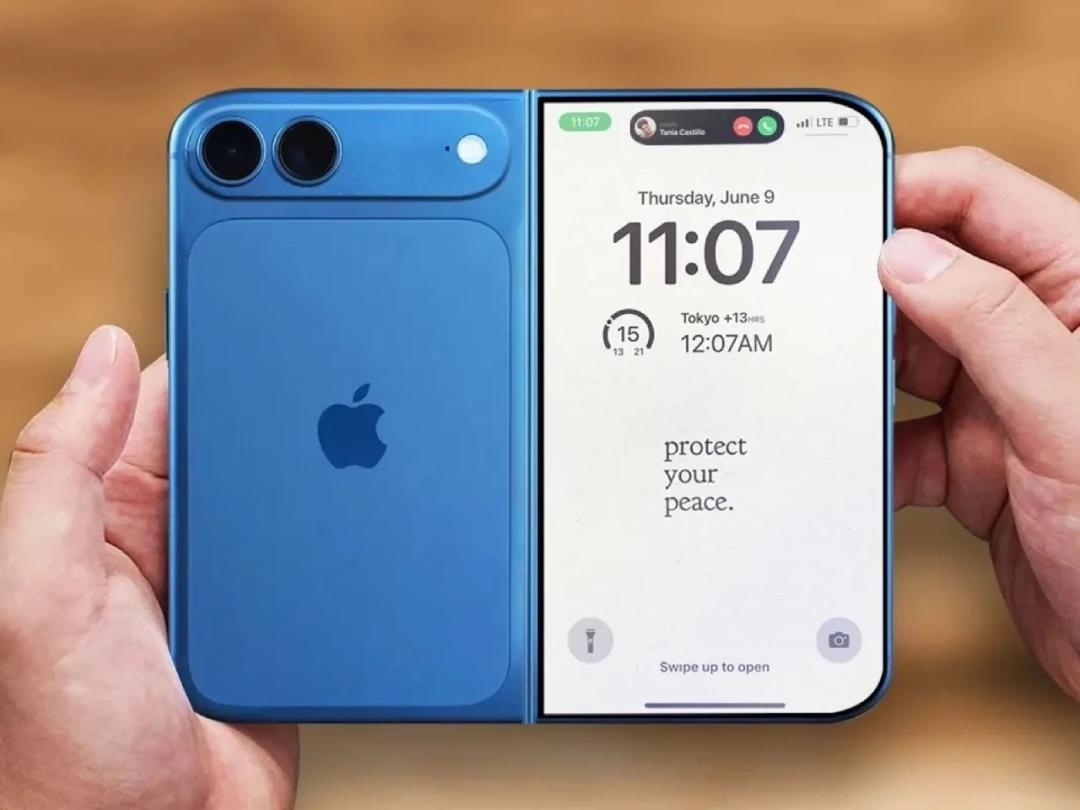
This foldable iPhone adopts a book - style design, equipped with a 7.8 - inch inner screen and a 5.5 - inch outer screen. The biggest highlight is the inner - fold display that is claimed to have "almost no creases". If Apple can really achieve this, it will be a game - changing blow to competitors like Samsung. It sounds great, but the question is: Is Apple really ready?
Compared with the challenges in the hardware device field, Apple's dilemma in the AI field may be even more critical. In the three years since the explosion of generative AI, Apple's presence has almost entirely relied on the contrast of "everyone is talking about it while it has been inactive".
In January this year, Apple officially announced a cooperation with Google, stating that it will use Google's Gemini AI model to power Siri in future AI upgrades. This decision has sparked huge controversy within Apple: a company with a 150 - billion - dollar cash reserve, world - class M - series chips, and the ability to control both software and hardware integration actually has to rely on a competitor's AI model?
For a company that has been proud of its "software - hardware integration and self - built closed - loop" for so many years, this is a rather significant strategic concession. Handing over part of the system - level AI capabilities to Google not only means being controlled by others at the model level but also poses a long - term risk of having its interaction logic shaped by the outside. Even if Apple successfully catches up in the future and creates its own comparable large - scale model, it will be difficult to easily make up for the missed time window and data accumulation.
If we say that Apple didn't realize the importance of AI two years ago, now even my grandma knows that AI development needs to be accelerated. Why is Apple's Siri still the same old alarm timer as before?
Poor conversation memory, weak context awareness, and limited adaptability. These issues can't be solved by simple fixes; they require a complete architecture reset, and Apple has been procrastinating for years.
Looking back at the iPhone Air from this perspective, we can see that it actually represents Apple's mindset in the past few years: going all - out in visible and controllable dimensions (such as thickness, weight, and craftsmanship), while being conservative or even procrastinating in invisible dimensions that will profoundly affect the next - generation experience (such as AI, interaction logic, and system - level intelligence). As a result, the product launches still look good, and the financial reports still look good, but the "surprises" that users can frequently perceive are getting fewer and fewer.
Is Apple Really in Trouble?
A year and a half ago, Apple's market value exceeded 3 trillion US dollars, becoming the world's first listed company to reach this milestone. After 18 months, Apple's market value is still as high as 3.8 trillion US dollars, but it has dropped to the third place. Apple's market value has fallen far behind Nvidia's 4.7 trillion US dollars, and on January 8th, Apple was even surpassed by Alphabet, the parent company of Google.
After the U.S. Eastern Time trading session on January 29th, Apple released its financial report for the first quarter of fiscal year 2026 (as of December 27, 2025): revenue was 143.8 billion US dollars, a year - on - year increase of 16%; net profit was 42.097 billion US dollars; diluted earnings per share were 2.84 US dollars, a year - on - year increase of 18.3%, exceeding the market expectation of 2.67 US dollars. Among them, iPhone revenue reached 85.3 billion US dollars, a year - on - year surge of 23%, setting the largest quarterly scale in the company's history. CEO Cook said in an interview that the demand for the iPhone 17 series was "amazing" and set sales records in all geographical regions around the world.

After the release of the financial report, Apple's stock price rose by more than 3% in after - hours trading but then quickly fell back, finally only rising by 0.72% to 258.08 US dollars. This increase can be described as "lukewarm" for a financial report that "exceeded market expectations."