Over $60 billion in capital influx and over 2,000 investment deals: The 2025 Global Healthcare Investment and Financing Report is released.
2025 is a watershed for investment and financing in the healthcare industry. After the capital winter swept across the global primary market for several years, we witnessed the resilience of the market. Despite the cumulative annual financing of $60.4 billion, only a 4% year-on-year increase, the consecutive two years of positive growth undoubtedly announced the recovery of the primary market.
We witnessed the transformation of healthcare investment from a diversified landscape to a concentration among top players. In 2025, nearly 130 institutions made five or more investments, a nearly 50% year-on-year increase. Capital is concentrating on top institutions with the ability to identify value with unprecedented determination. Qiming Venture Partners led with 37 investments. Longpan Capital and Yuansheng Venture Capital doubled their investment frequencies. State-owned funds, represented by the Beijing Medical and Health Fund, entered the top five active institutions for two consecutive years, indicating the rise of state-owned capital, which is becoming an important force influencing pricing.
2025 is a turning point for healthcare investment from quantitative expansion to qualitative focus. Under the multiple pressures of reconfiguring the valuation system, narrowing exit channels, and strengthening policy mandates, only projects with clear commercialization paths, strong technological barriers, and industrial strategic synergy can attract capital and withstand market cycles.
Key Points:
1. In 2025, the number of financing events and the total financing amount in the global healthcare industry increased slightly by 3% and 4% year-on-year, showing further improvement on the stable situation in 2024.
2. The number of single financing events exceeding $100 million globally has increased for three consecutive years, indicating a good recovery trend.
3. After the in - depth integration of artificial intelligence with various sub - sectors, a new wave of healthcare infrastructure construction emerged, attracting a large amount of capital in the primary market and becoming the most concerned track in 2025.
4. Chinese innovative drug NewCos showed initial potential and topped the financing list. 2026 will be the time to evaluate the innovation capabilities of NewCos.
5. The maturity of technology shows obvious differentiation in financing. The mature - stage tracks have many events with moderate amounts; the growth - stage tracks have relatively balanced events and amounts; the emerging - stage tracks have few events but high amounts.
01
Trends in Global Healthcare Industry Financing from 2012 to 2025
In 2025, the healthcare industry maintained a steady and positive momentum.
Overall, in 2025, the total global healthcare financing increased by 4%, and the number of investment and financing events increased by 3%.
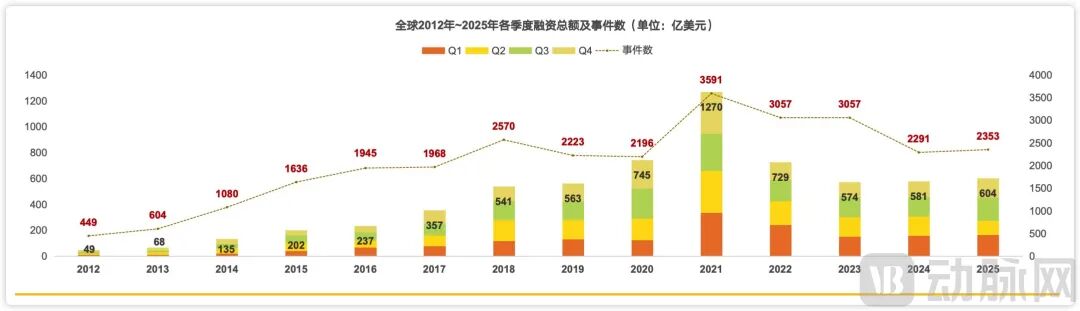
Trends in global healthcare investment and financing from 2012 to 2025, mapped according to data from Arterial Think Tank
In 2025, a total of 2,353 primary - market investments were made in the global healthcare field, with cumulative financing of $60.4 billion. Compared with 2024, the total financing increased by about 4 percentage points, and the number of financing events increased slightly by about 3% from 2,291 in 2024. The capital winter is gradually over.
Looking at each quarter, since 2012, primary - market investment and financing activities in the healthcare field have often been concentrated in specific quarters. Especially in the fields of biomedicine and medical devices, they are mostly concentrated in Q1 and Q3, and 2025 is no exception. It is worth noting that, except for Q2, the global healthcare financing amount in the other three quarters of 2025 increased year - on - year compared with 2024. In particular, the financing amount in H2 2025 increased by about 20% compared with H2 2024, indicating an obvious recovery trend in the primary market.
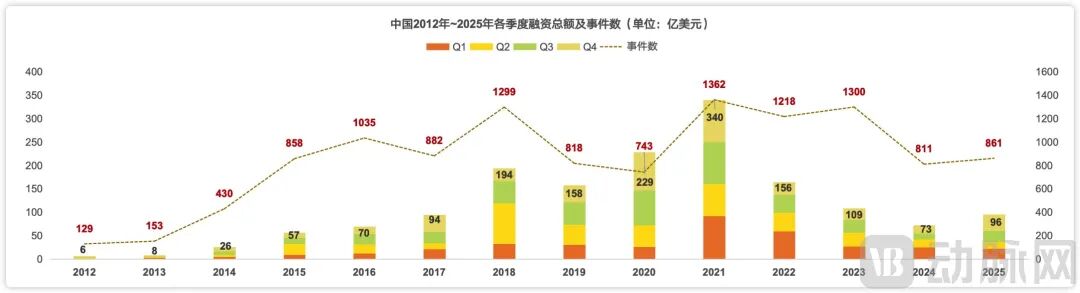
Trends in Chinese healthcare investment and financing from 2012 to 2025, mapped according to data from Arterial Think Tank
Domestically, in 2025, a total of 861 financing transactions were completed in the primary market of the healthcare industry, with cumulative financing of about $9.6 billion. After three consecutive years of decline from 2022 to 2024, it finally showed an increase. Compared with 2024, the domestic total financing increased by 32% year - on - year, and the number of financing events also increased by about 6% year - on - year.
With the improvement of the global primary - market investment and financing environment in the healthcare field, the recovery of the domestic market has also accelerated. Although the increase in the number of transactions is not significant, the transaction amount has rebounded significantly. Similar to the global investment and financing situation, compared with H2 2024, the domestic financing amount in H2 2025 increased by about 97%, which was achieved on the basis of a about 14% decline in H1 2025 compared with H1 2024. Looking at each quarter, the year - on - year growth rates of Q1 - Q4 in 2025 were - 12%, - 17%, 77%, and 112% respectively, also showing a strong recovery trend.
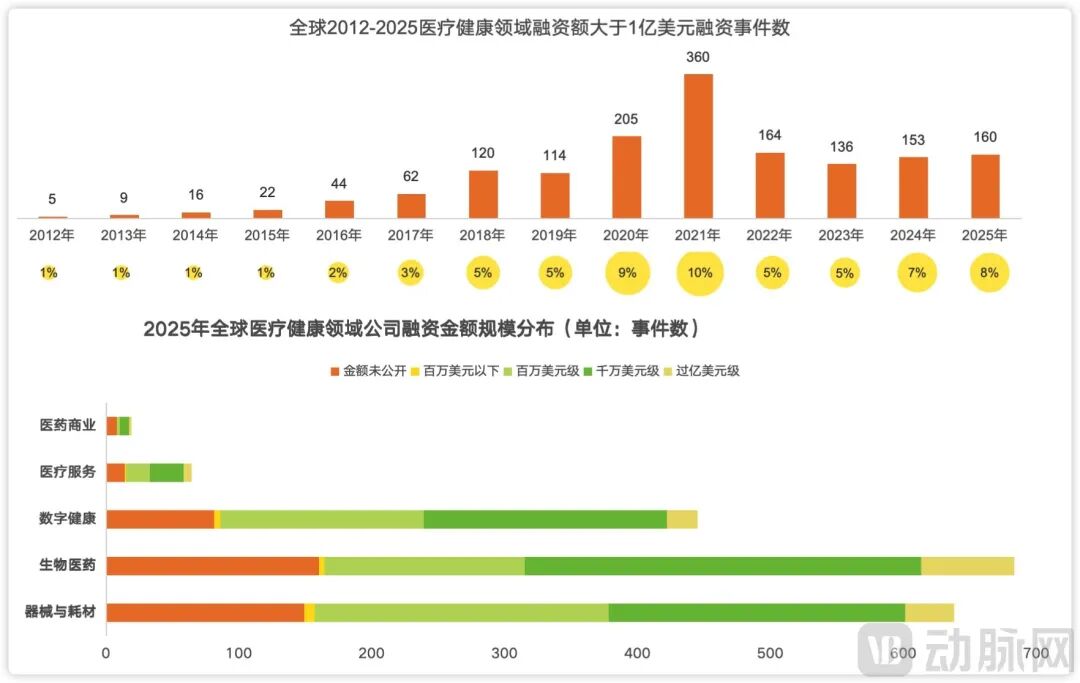
Trends in large - scale financing and financing scale distribution in the global healthcare industry, mapped according to data from Arterial Think Tank
In 2025, the number of large - scale transactions (over $100 million) reached 160, an increase of 7 compared with the same period last year. They accounted for about 8% of the global primary - market healthcare financing, a slight year - on - year increase.
From 2023 to 2025, the number of large - scale financing transactions in the global primary market increased slightly for three consecutive years, and the market began to emerge from the trough of 2022 and 2023. In 2025, the top three financing amounts were $3.5 billion, $1 billion, and $850 million respectively, a significant increase compared with $1 billion, $565 million, and $421 million in 2024.
In terms of sub - sectors, the number of large - scale transactions in medical devices and consumables, biomedicine, and digital health increased by 76%, - 29%, and 109% year - on - year respectively. Due to the large number of large - scale transactions in biomedicine last year, it showed a negative year - on - year growth, but the absolute number still led the sum of the other four sub - categories.
02
Popular Areas of Global Healthcare Investment and Financing in 2025
Both the volume and price of biomedicine declined, while the financing amounts of medical devices and digital health increased significantly.
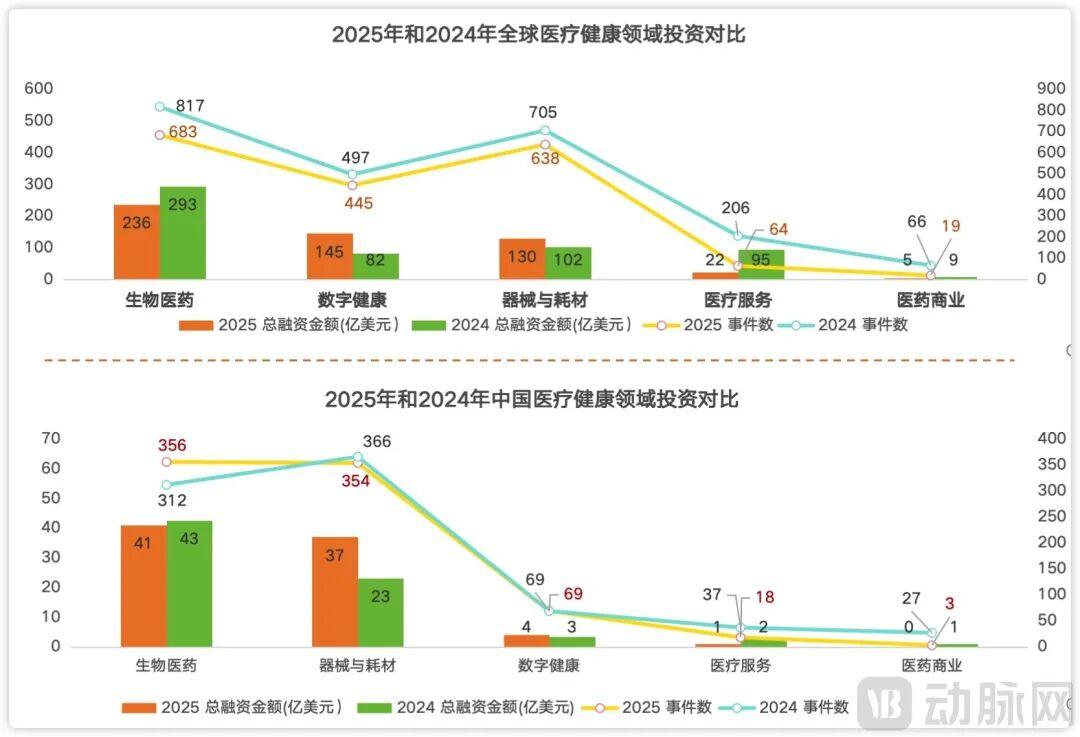
Distribution of sub - sectors in global/domestic healthcare industry investment and financing, mapped according to data from Arterial Think Tank
Globally, in 2025, the healthcare industry financing was divided by sub - sectors. There were 683 biomedicine - related financings, totaling $23.6 billion; 638 medical device and consumable - related financings, totaling $13 billion; 445 digital health - related financings, totaling $14.5 billion; 64 medical service - related financings, totaling $2.2 billion; and 19 pharmaceutical commerce - related financings, totaling about $500 million. Except for the medical device and consumable and digital health sectors, where the transaction amounts increased by 27% and 77% year - on - year respectively, the other sub - sectors showed significant decreases.
Domestically, the situation was different. In 2025, the number of domestic biomedicine financings increased by about 14% year - on - year, but the transaction amount was slightly lower than that in 2024. In the medical device and consumable sector, although the number of financing transactions decreased by 3% year - on - year, the total transaction amount increased by about 61% year - on - year, leading the growth among sub - sectors. In contrast, the digital health track, which was popular abroad, had few transactions in China, indicating different investment preferences between domestic and foreign investment institutions.
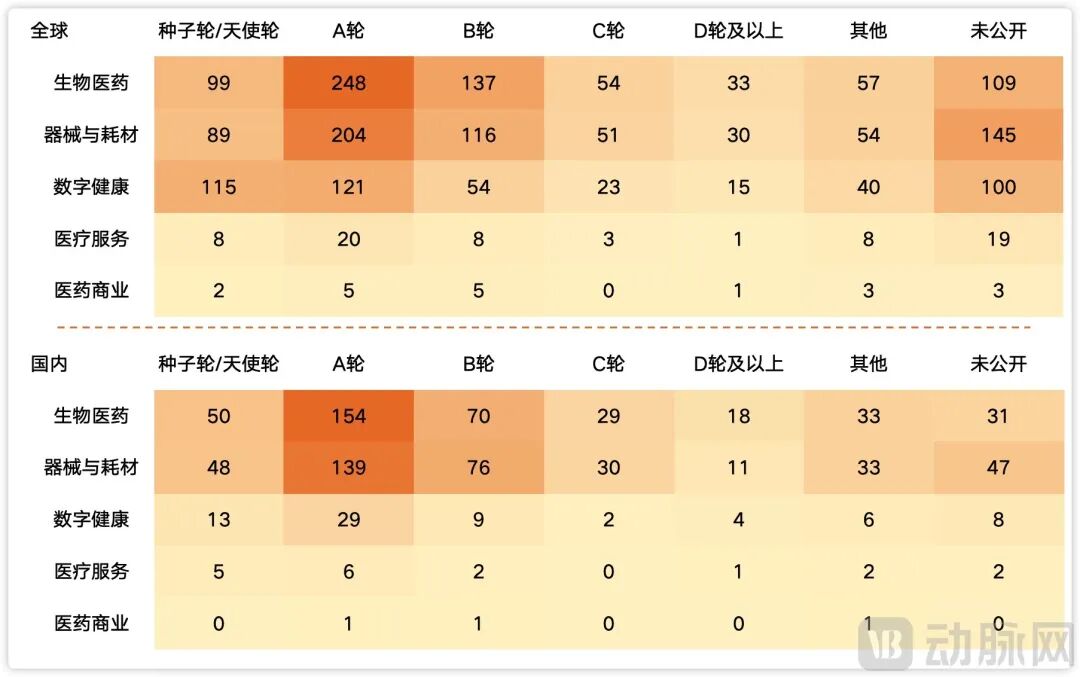
Distribution of investment and financing rounds in the global/domestic healthcare industry, mapped according to data from Arterial Think Tank
Globally, in 2025, excluding unannounced - round events, the number of Series A financing transactions for biomedicine projects was the highest, reaching 248, followed by medical device and consumable projects, with a total of 204 financing transactions. The overall number of financing transactions for medical service and pharmaceutical commerce projects was relatively low. Generally speaking, the financing transactions in the early rounds, represented by the angel round and Series A, accounted for a relatively large proportion. In the three major sub - sectors of biomedicine, medical devices and consumables, and digital health, the proportions of early rounds were 47%, 43%, and 51% respectively.
Domestically, in 2025, the distribution of investment and financing rounds in the primary market of the healthcare industry was similar to that of the global market, with a greater emphasis on early rounds such as the angel round and Series A. The later rounds, such as Series D and above, showed a sharp decline. Among them, the proportions of early rounds in biomedicine and medical device and consumable projects reached 53% and 49% respectively.
It is worth noting that in the medical service and pharmaceutical commerce fields, almost all rounds showed a halving trend compared with 2024.
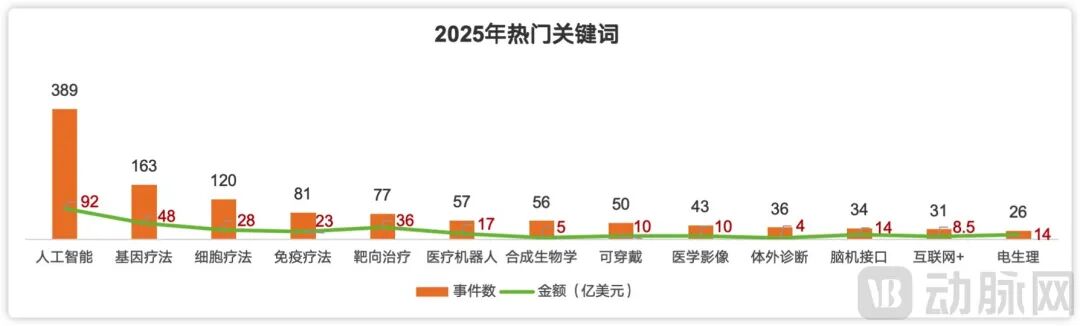
Popular keywords in global healthcare investment and financing, mapped according to data from Arterial Think Tank
Overall, artificial intelligence was the absolute "C - position" in 2025, followed by gene therapy and cell therapy, indicating that capital began to concentrate on technologically mature fields. Looking at the sub - sectors, high - tech barrier fields such as electrophysiology, targeted therapy, and brain - computer interface showed stronger capital bargaining power, with a higher average financing amount ranking. The application - layer tracks such as artificial intelligence and wearables had more frequent financing events but relatively smaller average single - transaction amounts.
The maturity of technology showed obvious differentiation in financing. The mature - stage tracks had many events and moderate amounts. For example, technologies such as AI healthcare, wearables, and medical imaging had clear commercialization paths and had entered the stage of application explosion + merger and acquisition integration. The growth - stage tracks had relatively balanced events and amounts. For example, gene therapy, cell therapy, and immunotherapy were in the stage of accelerated clinical transformation, and capital continued to increase investment. The emerging - stage tracks had few events but high amounts. For example, brain - computer interface and synthetic biology were in the technology breakthrough window period. The scarcity of top projects pushed up the valuation, but the overall commercialization needed to be verified.
03
Top Global Investment and Financing Lists in 2025
Artificial intelligence played an important role, and the power of NewCos began to emerge.
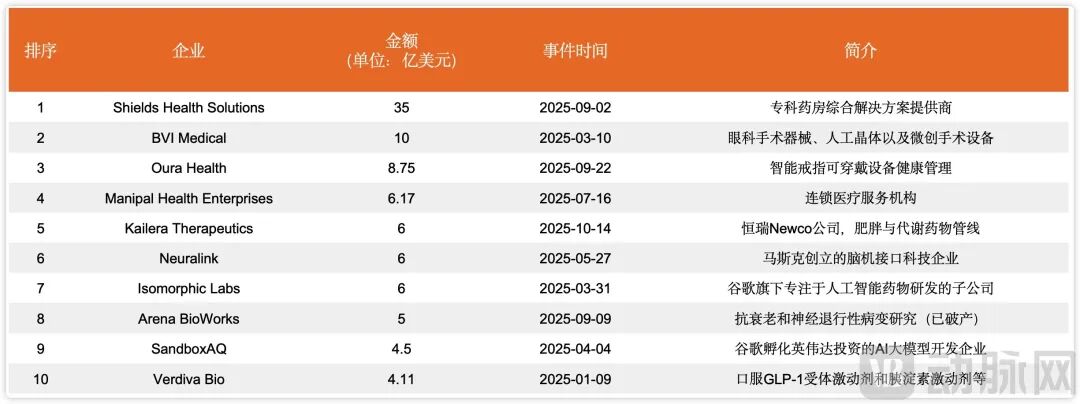
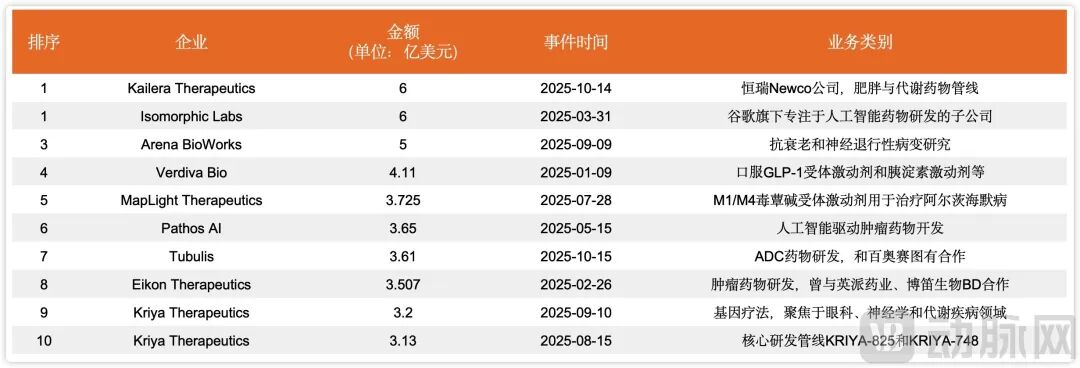
Top 10 global investment and financing in 2025, mapped according to data from Arterial Think Tank
In 2025, the total amount of the top 10 global financing lists increased by 104% year - on - year compared with 2024.
In 2025, the overall healthcare financing presented a "Song of Ice and Fire." On the one hand, cutting - edge technologies such as AI, GLP - 1, and brain - computer interface received unprecedented capital bets. On the other hand, the fall of Arena BioWorks showed that pure - technology stories without clear commercialization paths could collapse even with top - tier capital support.
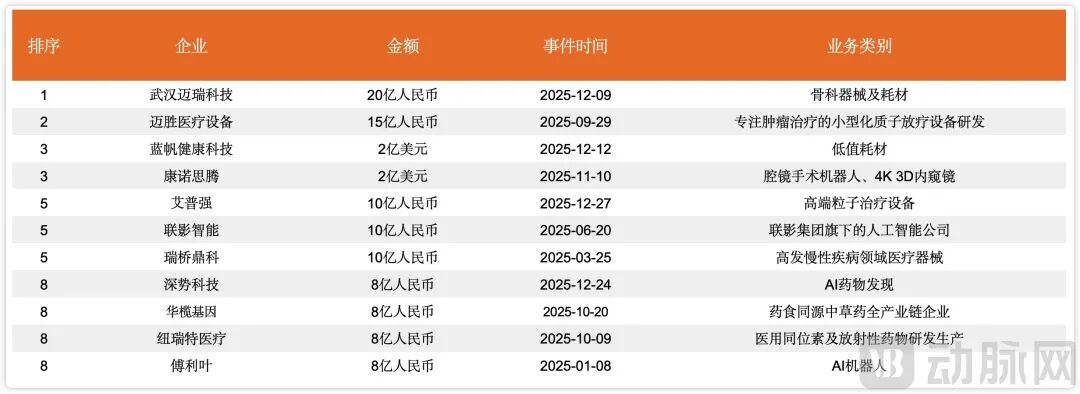
Top 10 domestic investment and financing in 2025, mapped according to data from Arterial Think Tank
Domestically, different from previous years when the top lists were dominated by biomedicine, in 2025, the top 10 domestic financing lists were dominated by medical device and consumable projects.
Three major themes became the focus of capital competition. First, high - end medical devices entered the golden period of domestic substitution + technology popularization. Second, medical robots and AI. Third, innovative medical devices and characteristic therapies. Looking at the investment institutions behind, industrial capital, state - owned capital, and cross - border capital stood side by side, and the proportion of state - owned capital increased significantly.
Top 10 global