Beyond the "Fourth Industrial Revolution": Rethinking Artificial Intelligence and Human Subjectivity
In today's technological discourse, when we talk about artificial intelligence, the most reflexive narrative framework is undoubtedly the "Fourth Industrial Revolution."
It is indeed an alluring linear analogy: the steam engine liberated muscles, electricity liberated energy, and AI liberates intelligence. In this narrative, history is a continuously ascending straight line, and we are standing at the steepest inflection point of the productivity curve.
However, with the emergence of the capabilities of large models and the intensification of social upheaval, we find that while using the logic of the industrial revolution to explain the present is correct in terms of productivity, it is lacking in the epistemological dimension.
The essence of the industrial revolution is instrumental rationality. Whether it is Watt's steam engine or the modern assembly line, they pursue efficiency, scale, standardization, and the conquest of the physical world. They mainly solve the "how" (How) problem.
But generative AI is different. When machines start to converse, reason, and create with an unsettling degree of realism, what it challenges is no longer simply the boundary of productivity, but the essence of cognition, creation, and existence. It touches not the human hands and feet, but the most sensitive areas in the cerebral cortex.
If we are willing to lengthen the historical focus and look back through the mists of five hundred years, you will find that what is happening in Silicon Valley at this moment not only echoes the industrial transformation in the 18th century but also has a striking and profound topological isomorphism with the ideological upheaval that took place in Florence from the 14th to the 16th centuries - the Renaissance.
What we are experiencing is not just an upgrade of the toolbox, but a crisis and reconstruction of subjectivity. This is a Renaissance in the digital context.
From the Closed Order of "Theocentrism" to the Subjective Anxiety of "Humanism"
To understand the complex emotions of excitement and fear we feel when facing AI, we need to go back to the Middle Ages to understand the spiritual structure of that era.
The Middle Ages cannot be simply summarized as "dark" or "irrational." On the contrary, humans in the era of scholastic philosophy had a highly developed logical and speculative system. But the most prominent feature of that era was the "a priori absence of man."
In that tightly-knit system dominated by theology, the universe was a static hierarchical ladder. Although human reason was recognized, its role was auxiliary - it was mainly used to explain revelations, reconcile faith and logic, rather than as the ultimate source of meaning. In that era, the ultimate meaning was considered to have been pre - given in revelations and traditions. The task of human reason was more about discovery, interpretation, and ordering, rather than being the final source of values. Man was always in a pre - set order.
The reason why the Renaissance became the beginning of the modern world is not only because it created glorious art but also because it completed a drastic shift in the value coordinate system.
In 1486, Pico della Mirandola delivered that highly symbolic speech, "Oration on the Dignity of Man." As an epitome of the humanist trend of thought in that era, he pointed out in the name of God that man has no fixed position or fixed image, and the dignity of man lies in having the "free will of self - definition."
This was like a thunderclap. It marked that humans were trying to awaken from a passive "object" accepting fate to an active "subject" constructing meaning.

Italy - January 16: Portrait of Giovanni Pico della Mirandola (1463 in Mirandola - 1494 in Florence), philosopher, theologian, and humanist, engraving. Italy, 15th century.
Five hundred years later, this coordinate system has undergone another drastic tremor.
In the past few centuries, especially since the Enlightenment, we have been accustomed to "anthropocentrism." We take it for granted that on this planet, only humans have the ability of complex logical reasoning and symbolic creation. However, when GPT - 4 showed a high degree of conversation coherence and reasoning ability close to that of humans in a large number of controlled experiments, the "throne of wisdom" exclusively occupied by humans began to shake.
We are facing a profound ontological anxiety: if silicon - based intelligence can calculate faster, have more rigorous logic, and even show certain characteristics of the "Theory of Mind" in some tests, then what is left of the "dignity of man" that Pico praised?
If the Renaissance liberated man from the closed order of theology, then the "Digital Renaissance" wakes man up from the illusion of being the "sole carrier of wisdom." We are forced to re - find our position in front of the mirror of machines.
Transformer as the "Perspective Method" and Generative AI as the "Printing Press"
Historians often pay too much attention to the ideological aspect of the Renaissance and ignore its technological foundation. In fact, the turn towards humanism was not only due to the calls of philosophers but also relied on the implementation of two highly technical "cognitive tools." These two tools have a striking correspondence with today's AI technologies.
Rationalization of Vision: From "Linear Perspective" to "Semantic Manifold"
In the early paintings of the Middle Ages, space was often symbolic, and the size of figures depended on the divine hierarchy rather than physical distance.
In the early 15th century, pioneers such as Brunelleschi introduced mathematical rules through linear perspective. The essence of this transformation was the dimensionality - reduction modeling of space. It announced an astonishing fact: the visual appearance of the world was no longer an elusive divine will but an object that could be measured, regulated, and calculated by human reason. This was a great cognitive confidence.
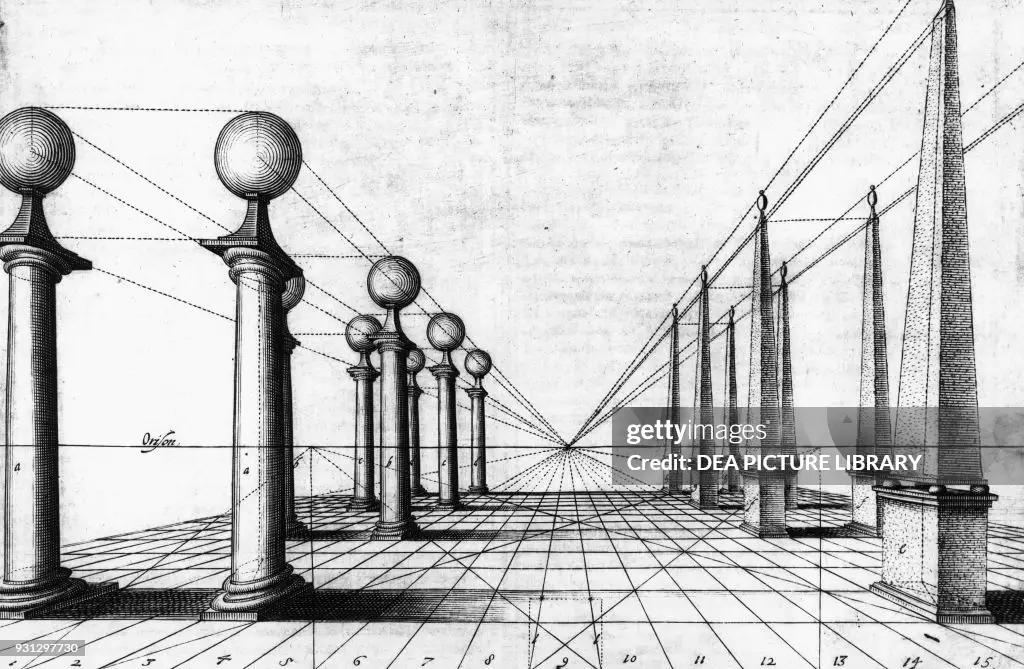
Perspective view, engraving of Artis Perspectivae, Jan Vredeman de Vries (1526 - 1609), Antwerp, 1568.
Today's Transformer architecture is precisely the "perspective method" of the digital age.
If Brunelleschi dealt with three - dimensional Euclidean space, then Transformer deals with high - dimensional semantic space.
From the perspective of deep learning, human language is transformed into vectors of tens of thousands of dimensions. Although AI does not have embodied understanding like humans, through the attention mechanism, it captures the extremely subtle statistical correlations between words in a vast amount of data. In this high - dimensional manifold that we cannot see with the naked eye, AI reproduces in a highly consistent statistical sense the deep - structure patterns of human language.
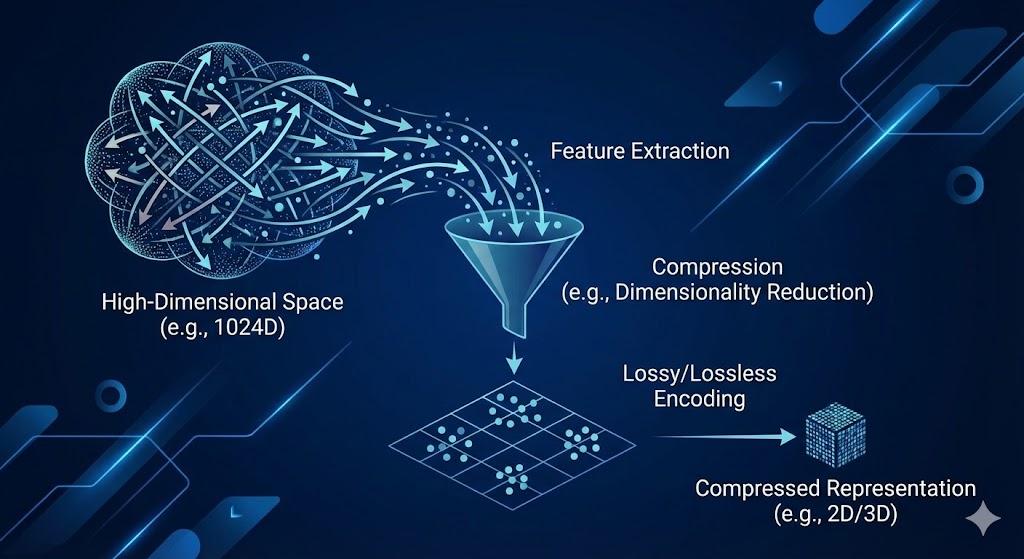
Principle of high - dimensional vector compression (NanoBananaPro)
The perspective method unified the order of the picture with the vanishing point, and Transformer reorganizes the associative structure of information in a statistical sense through probabilistic attention weights. This is a holographic projection and rational reconstruction of the human cognitive map.
Knowledge Distribution: From Gutenberg to the Equalization of Skills
The second key tool is the printing press. After Gutenberg improved the printing press, the most fundamental change was the significant reduction of the marginal cost of information distribution. This directly led to the failure of the church's monopoly on the right to interpret knowledge and gave rise to the religious reform.

Johannes Gutenberg in his studio. Private collection. (Image source: Fine Art Images/Heritage Images/Getty Images)
Today's generative AI is an exponential extension of this logic.
The printing press solved the cost of "replication," while generative AI is solving the cost of "primary creation" and "general skills."
Before the popularization of AI, writing a runnable code or drawing a commercial illustration were all hard skills with high thresholds. But now, the marginal cost of a large number of medium - and low - complexity skills is dropping sharply. An ordinary person without professional training can also call on powerful capabilities through natural language.
This is an extreme form of "equalization of skills." Just as the printing press broke the clergy's monopoly on scriptures, AI is breaking the white - collar class's monopoly on certain professional skills. Of course, the scarcity of high - order judgment, system design ability, and responsibility - taking ability will instead increase as a result, but this is enough to have a more profound impact on the existing social division of labor structure than the industrial revolution.
Be Wary of the Institutional Digital Theocracy
However, although history seems to be repeating itself, it does not guarantee a happy ending again. Standing at the crossroads of this "Digital Renaissance," we need to be wary of an extremely hidden risk: the restoration of the Digital Theocracy.
The risk here does not entirely come from AI technology itself, but more from the institutions, business models, and power structures it is embedded in.
The Surrender of the Right to Judge
In the Middle Ages, people's fates were often attributed to the will of God; today, people's choices are increasingly influenced by algorithms.
When recommendation algorithms determine what information we see, when navigation algorithms plan our routes, and when matching algorithms affect our social interactions, we are gradually getting used to surrendering our right to judge. But we need to clearly recognize that the so - called "optimal solution" given by algorithms is only a mathematical extreme value obtained under the preset objective function (such as click - through rate, retention time, shortest path) and constraints. It is not equivalent to truth, let alone the meaning of life.
If we ignore this and completely rely on the feedback loop of the system, we may degenerate into a passive node in the system, which is a new type of technological fatalism.
The Objectification of Man
The deepest ethical risk lies in the objectification of man. In Kant's ethics, man cannot be instrumentalized because each person should be regarded as an "end in itself," having an irreplaceable value, and their judgment and actions should be respected. Under the business logic of some AI, this bottom line is being eroded: individuals are no longer regarded as acting subjects but are reduced to data sources for training models and feedback signals in system optimization.
If we completely surrender our subjectivity to the technological system, we will not welcome the Renaissance, but may welcome an "algorithmic church" where silicon - based intelligence acts as the priest and opaque algorithms act as dogmas. We are just changing the object of our worship.
Conclusion
So, where is the way out?
The true spirit of the Renaissance has never been to completely deny God (which would lead to nihilism), but to rediscover the value of man outside the theological order. Similarly, the way out today is not to deny technology like the Luddites, but to re - define the irreplaceability of humans in front of the high - dimensional mirror of AI.
Michael Polanyi once proposed the concept of "tacit knowledge" - "We know more than we can tell." AI will eventually do better than us in knowledge that can be fully formalized and coded.
But the approach of AI is precisely forcing us to strip away the mechanical and mediocre intellectual shells and expose the most core part of human intelligence.
In the foreseeable future, what is difficult to be formalized and calculated?
It is the empathy brought by pain and vulnerability. Because we will die and get hurt, we can truly empathize with the pain of others. AI can simulate sad texts, but it has no physical body and cannot bear the weight of life.
It is moral intuition in complex ethical contexts. When facing a dilemma, algorithms can only calculate based on preset weights, while human entanglement, hesitation, and sense of responsibility are precisely the proof of moral subjectivity.
It is the endowment of meaning. Wittgenstein said, "The meaning of the world is outside the world." Machines are good at dealing with the logical closed - loop "inside the world," but endowing all things with value, aesthetics, and meaning is still a unique privilege of humans.
Future experts may no longer be those who simply master knowledge, but those who have profound humanistic qualities, can define problems, distinguish values, and design meaning.
This transformation is not to replace humans, but to force humans to "awaken a second time."
Five hundred years ago, in the face of a closed order, humans chose reason and initiated modern civilization. Today, in the face of the exponential growth of computing power, we must hold on to humanity and initiate the civilization of the post - human era.
Don't belittle ourselves because of the power of tools. The more rapidly technology iterates, the more we must hold on to the territories that technology cannot reach.
Because what defines the future is never the cold parameters, but the human heart that controls the parameters.
This article is from the WeChat official account "Tencent Research Institute" (ID: cyberlawrc), author: Wang Peng. Republished by 36Kr with permission.