Jenseits der "Vierten industriellen Revolution": Neue Überlegungen zu Künstlicher Intelligenz und menschlicher Subjektivität
In today's technological public, the most obvious narrative framework when we talk about artificial intelligence is undoubtedly the "Fourth Industrial Revolution".
It is indeed an alluring linear analogy: The steam engine was the liberation of muscles, electricity was the liberation of energy, and AI is the liberation of intelligence. In this narrative, history is a steadily rising straight line, and we are at the steepest turning point of the productivity curve.
However, we find that explaining the current situation only with the logic of the industrial revolution, although correct in the productivity dimension, is insufficient in the epistemological dimension in the face of the emergence of the capabilities of large models and the intensification of social shockwaves.
The foundation of the industrial revolution is instrumental rationality. Whether it is Watt's steam engine or the modern production line, what they strive for is efficiency, scalability, standardization, and the conquest of the physical world. They mainly solve the question of "How".
But generative AI is different. When machines start to speak, argue, and create with an unsettling naturalness, it not only reaches the limits of productivity but also the essences of cognition, creation, and existence. It touches not the hands and feet of humans but the most sensitive areas of the cerebral cortex.
If we zoom in on the historical lens and look back through the fog of five centuries, you will find: What is currently happening in Silicon Valley not only resonates with the industrial change in the 18th century but also has an astonishing and profound topological isomorphism with the intellectual turn that took place in Florence from the 14th to the 16th century - the Renaissance.
What we are experiencing is not only an upgrade of the toolset but also a crisis and restoration of subjectivity. This is a renaissance in the digital context.
From the closed "God - Centrism" order to the subjective anxiety of "Human - Centrism"
To understand the complex mixture of excitement and anxiety that fills us when dealing with AI, we must first return to the Middle Ages to understand the intellectual structure of that time.
The Middle Ages cannot be simply described as "darkness" or "lack of rationality". On the contrary, people in the Scholastic period had a highly developed logical and speculative system. However, the greatest characteristic of that time was the "a priori absence of humans".
In the strict, theology - dominated system, the universe was a static hierarchical ladder. Human reason was recognized, but its role was only supportive - it was mainly used to explain revelations and mediate between faith and logic, not as the ultimate source of meaning. At that time, it was believed that the ultimate meaning was already given in revelations and traditions, and the task of human reason was more to discover, explain, and order it rather than being the final source of values. Humans were always in a predefined order.
The Renaissance became the beginning of the modern world not only because of its magnificent art but also because of the drastic shift in the value coordinate system.
In 1486, Pico della Mirandola gave his symbolic speech "On the Dignity of Man". As an image of the humanistic trend of that time, he stated in the name of God: Man has no fixed position and no fixed image; his dignity lies in the "freedom of self - definition".
This was like a thunderclap. It marked the attempt of humans to wake up from a passive "object" that accepts fate to an active "subject" that creates meaning.

Italy - January 16: Portrait of Giovanni Pico della Mirandola (1463 in Mirandola - 1494 in Florence), philosopher, theologian, and humanist, engraving. Italy, 15th century.
Today, five hundred years later, this coordinate system has experienced another violent tremor.
In the past few centuries, especially since the Enlightenment, we have become accustomed to "anthropocentrism". We take it for granted that only humans on this planet have complex logical reasoning and symbolic creative capabilities. But when GPT - 4 showed in a large number of controlled experiments a conversation coherence and reasoning ability very close to that of humans, the "throne of wisdom" that humans alone occupied began to shake.
We are facing a deep ontological anxiety: If silicon - based intelligence can calculate faster, argue more logically, and even show features of a "Theory of Mind" in some tests, what remains of the "dignity of man" that Pico praised?
If the Renaissance freed humans from the closed theological order, then the "digital renaissance" wakes humans from the illusion of being the "sole carrier of wisdom". We are forced to search for our own place again in the reflection of machines.
The Transformer as the "Perspective Method" and generative AI as the "Printing Technology"
Historians often pay too much attention to the intellectual level of the Renaissance and ignore its technological foundation. In fact, the turn to humanism was not only based on the calls of philosophers but also on the implementation of two highly technical "cognitive tools". These two tools have an astonishing correspondence with today's AI technologies.
The rationalization of perception: From the "linear perspective" to the "semantic manifold"
In early medieval paintings, space was often symbolic, and the size of figures depended on the holy hierarchy rather than physical distance.
At the beginning of the 15th century, pioneers like Brunelleschi introduced the linear perspective, mathematical rules. The essence of this change was the dimensional reduction and modeling of space. It announced an astonishing fact: The visual appearance of the world was no longer the unfathomable divine will but an object that could be measured, standardized, and calculated by human reason. This was a great cognitive self - confidence.
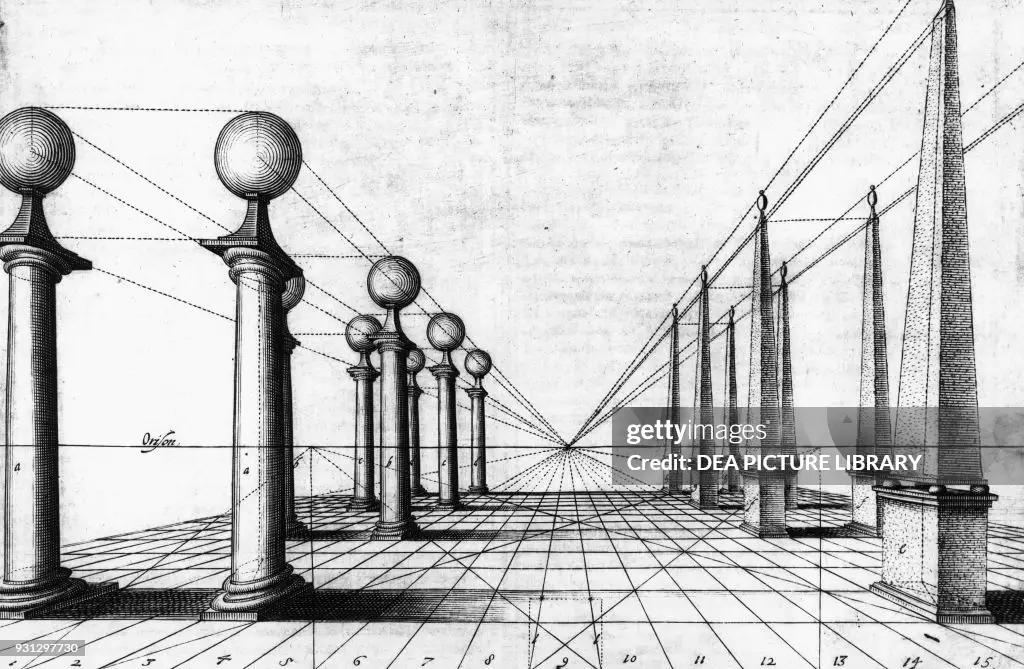
Perspective painting, engraving from Artis Perspectivae, Jan Vredeman de Vries (1526 - 1609), Antwerp, 1568.
Today's Transformer architecture is the "perspective method" of the digital age.
When Brunelleschi dealt with three - dimensional Euclidean space, the Transformer deals with the high - dimensional semantic space.
From the perspective of deep learning, human language is converted into vectors with thousands of dimensions. AI does not have the same embodied understanding as humans, but it captures the tiniest statistical correlations between words in huge amounts of data through the attention mechanism. In this invisible high - dimensional manifold, AI statistically repeats the deep structural pattern of human language.
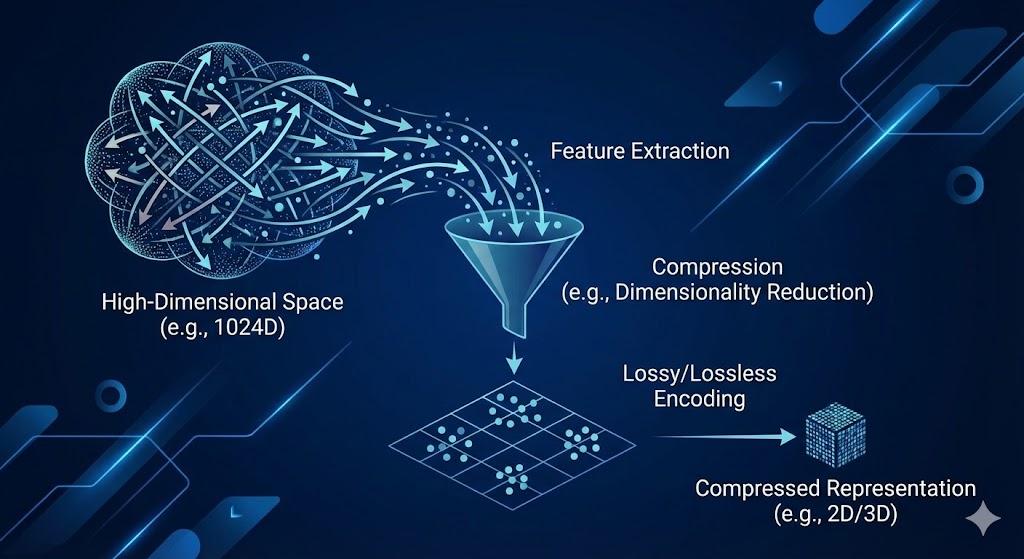
Principle of compressing high - dimensional vectors (NanoBananaPro)
The perspective method arranges the image order with the vanishing point; the Transformer reorganizes the information connection structure statistically through probabilistic attention weights. This is a holographic projection and rational reconstruction of the human cognitive map.
The spread of knowledge: From Gutenberg to the equalization of abilities
The second key tool was the printing technology. After Gutenberg's improvement of the printing press, the essential change was that the marginal cost of information dissemination was drastically reduced. This directly led to the failure of the Church's monopoly on the interpretation of knowledge and contributed to the Reformation.
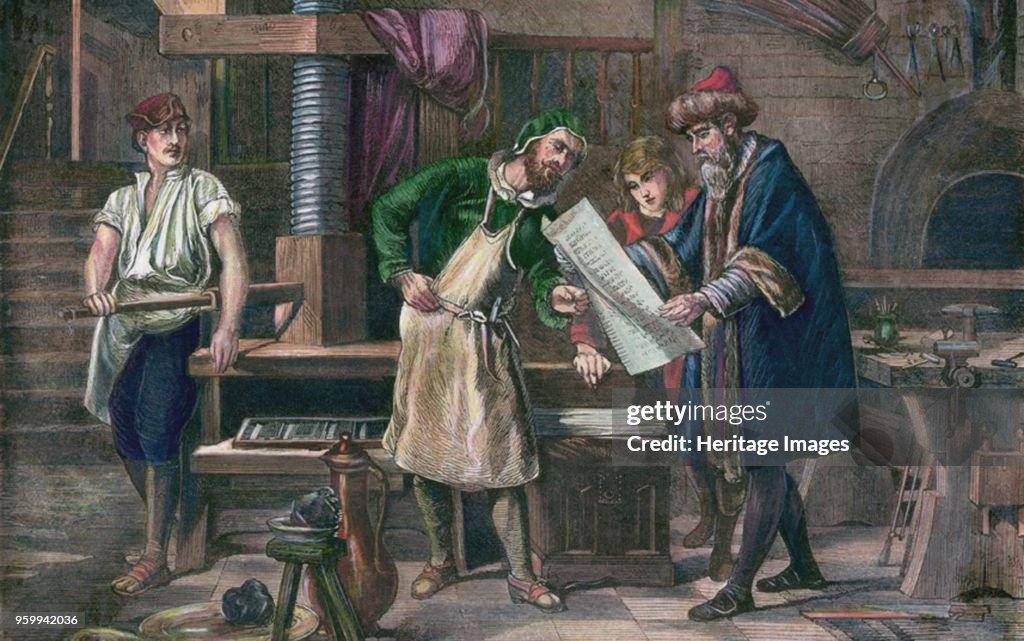
Johannes Gutenberg in his workshop. Private collection. (Image source: Fine Art Images/Heritage Images/Getty Images)
Today's generative AI is the exponential expansion of this logic.
The printing technology solved the problem of "copying costs", and generative AI is currently solving the costs of "simple creativity" and "general abilities".
Before the spread of AI, writing a working code or drawing a commercial illustration were high - threshold abilities. But now the marginal cost of a large number of medium - difficulty abilities has dropped drastically. An ordinary person without professional training can also use strong abilities through natural language.
This is an extreme "equalization of abilities". Just as the printing technology broke the clergy's monopoly on the Holy Scriptures, AI breaks the office workers' monopoly on certain professional abilities. Naturally, the scarcity of high - value judgment ability, system design ability, and responsibility - taking ability has even increased, but this is already enough to shake the existing social division - of - labor structure even more deeply than the industrial revolution.
Warning against institutional digital theocracy
However, the seemingly repeating history does not guarantee that the result will be beautiful again. At the crossroads of the "digital renaissance", we must guard against a very hidden danger: the restoration of digital theocracy.
The danger does not come entirely from AI technology itself but rather from the institution, business model, and power structure in which it is embedded.
The transfer of judgment power
In the Middle Ages, human fate was often attributed to divine providence; today, human decisions are increasingly influenced by algorithms.
When the recommendation algorithm determines which information we see, when the navigation algorithm plans our route, and when the matching algorithm influences our social interaction, we gradually get used to giving up our judgment power. But we must be aware that the so - called "optimal solutions" provided by algorithms are only mathematical extrema calculated under predefined objective functions (e.g., click - through rate, dwell time, shortest route) and boundary conditions. They do not correspond to the truth, let alone the meaning of life.
If we ignore this and completely rely on the feedback loop of the system, we may fall back to a passive node in the system. This is a new form of technological fatalism.
The objectification of humans
The deepest ethical danger lies in the scientization of humans. In Kant's ethics, humans should not be instrumented because each person should be regarded as an "end in itself", has an irreplaceable value, and their judgments and actions should be respected. However, in a certain commercial logic of AI, this baseline is eroded: The individual is no longer regarded as an acting subject but as a data source for the training model and a feedback signal in system optimization.
If we completely give our subjectivity to the technological system, we have not achieved a renaissance but may welcome an "algorithm - church" in which silicon - based intelligence acts as a priest and opaque algorithms act as dogmas. We only have a new object before which we bow.
Conclusion
So where is the way out?
The true spirit of the Renaissance has never been to completely deny God (which would lead to nihilism) but to rediscover the value of humans outside the theological order. Similarly, today's way out is not to deny technology like the Luddites but to redefine the irreplaceability of humans in the high - dimensional reflection of AI.
Michael Polanyi introduced the concept of "tacit knowledge" - "We know more than we can express". AI will finally be better than us at such knowledge that can be completely formalized and coded.
But the approach of AI forces us to peel off the mechanical and daily shells of intelligence and expose the core of human intelligence.
What will be...