Recording the Retreat of Capital: A Comprehensive Analysis of the 27 Declining Tracks in China's Venture Capital Industry over the Past Five Years
Which sectors have clearly "fallen out of favor" in 2025?
In the long history of China's venture capital market, 2021 was undoubtedly a highlight moment.
At that time, under the optimistic expectation of post - pandemic economic recovery, capital showed unprecedented enthusiasm for many sectors.
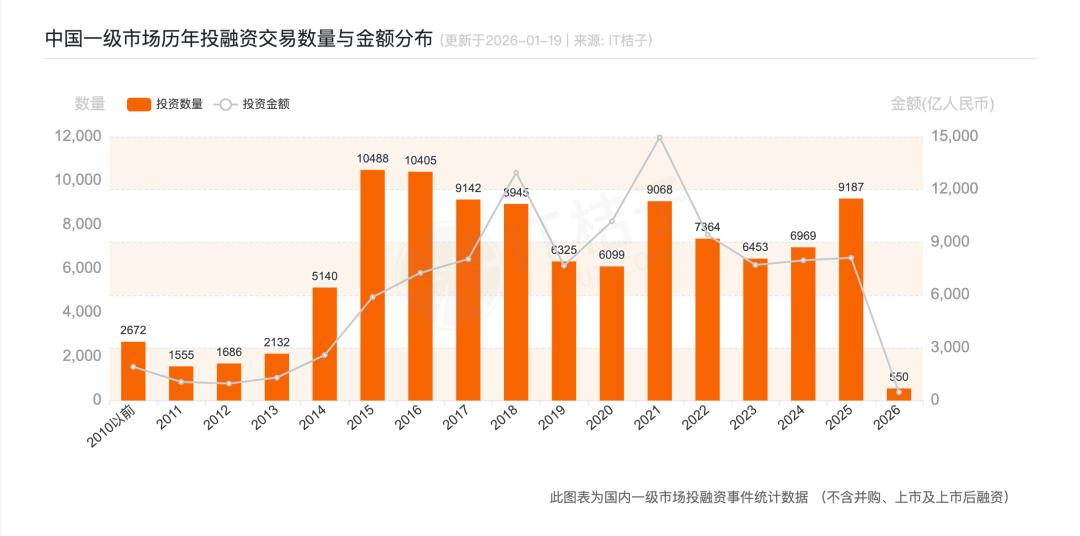
The macro - trend chart of venture capital by IT Juzi shows that the total investment in China's primary market in 2021 reached the highest point in history.
The 27 sectors focused on in this study each received a financing scale of over 5 billion yuan in 2021, with the number of financing events ranging from 5 to 305, indicating the high recognition and strategic layout of the capital market in these fields.
However, just four years later, these once "favorites" experienced a collective capital withdrawal.
As of 2025, the number of financing events and the financing amount in these 27 sectors both decreased by more than 50%. Among them, the financing amount in 10 sectors plummeted by more than 95%, almost equivalent to a complete withdrawal of capital.
This is not a simple cyclical adjustment, but a profound market shift driven by multiple factors such as the macro - economy, policy environment, consumption trends, and technological changes.
Through a comprehensive data review and in - depth analysis of these 27 sectors, IT Juzi attempts to answer several core questions:
● Why did capital withdraw on a large scale from these once - popular fields?
● What are the similarities and differences in the decline degree and reasons of different sectors?
● What does this large - scale capital withdrawal mean for the future of China's venture capital market?
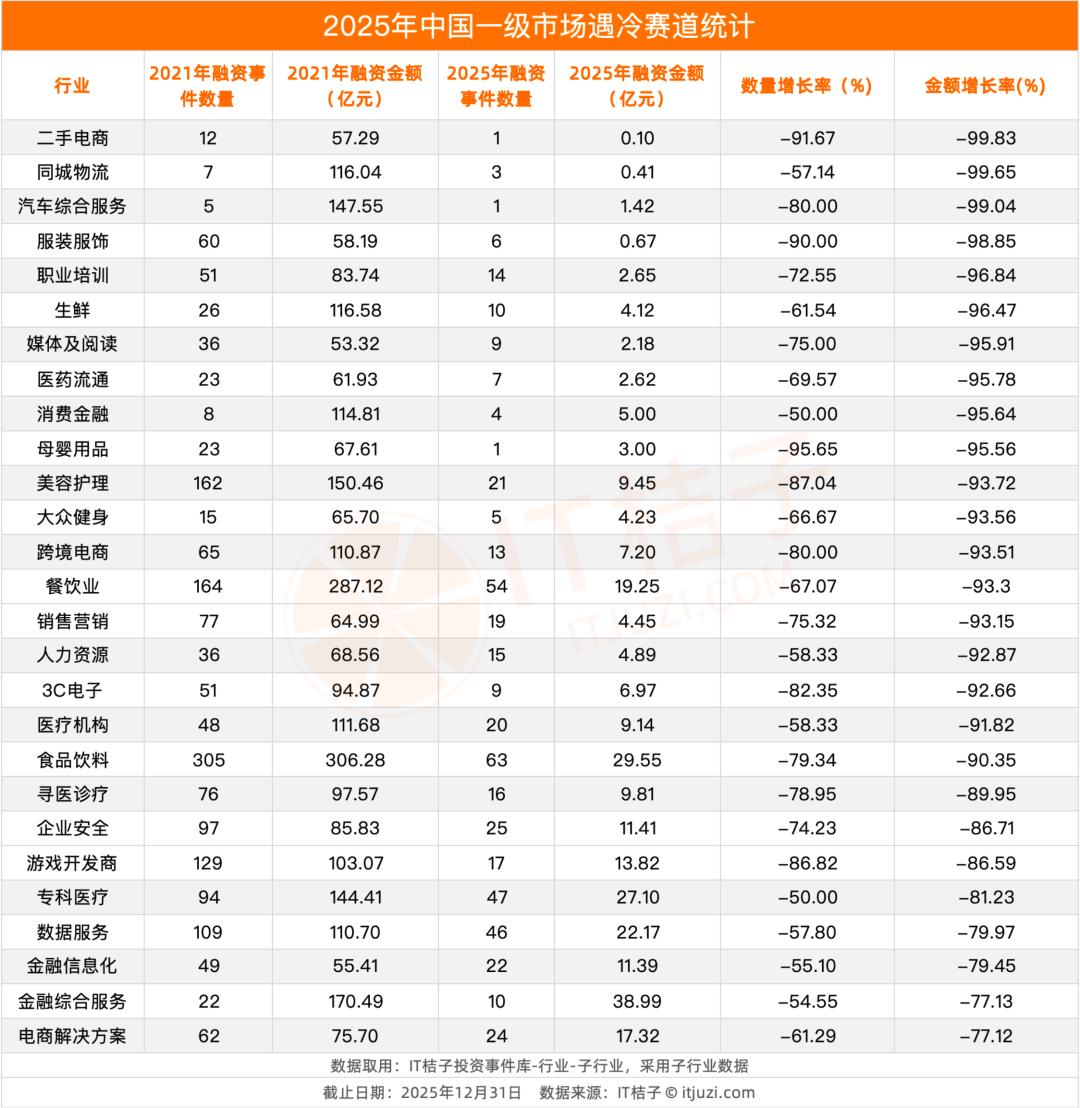
Complete data panorama: The "fall" records of 27 sectors
Hierarchical analysis: In - depth analysis classified by decline degree
Extreme decline category: Ten sectors with complete capital withdrawal
(Amount decrease > 95%)
These 10 sectors represent the areas where capital withdrawal is the most thorough. The decline in their financing amounts is all over 95%, almost equivalent to a complete halt of investment activities.
Second - hand e - commerce (99.83% decline) once carried the beautiful vision of the "circular economy". It received 5.729 billion yuan in financing in 2021 but has never been able to solve the two fundamental problems of the trust mechanism and the profit model. Leading platforms such as Xianyu and Zhuanzhuan are more regarded as traffic - supplementing tools. Independent start - up companies have difficulty breaking through in the shadow of giants, and capital finally chose to completely abandon this sector.
Same - city logistics (99.65% decline) and Automobile comprehensive services (99.04% decline) are typical examples of the dilemma of heavy assets and low gross margins. Same - city logistics received 11.6 billion yuan in financing in 2021, but the industry competition is extremely fierce, and the growth in order volume is difficult to cover the high fulfillment costs. Automobile comprehensive services are restricted by the weak new - car sales and the fragmentation of the after - market. The financing scale of 14.755 billion yuan in 2021 dropped to only 142 million yuan in 2025.
Apparel (98.85% decline), Maternal and baby products (95.56% decline), and Fresh produce (96.47% decline) together form the most tragic battlefield under the wave of consumption downgrade. In 2024, the total online sales during the 618 shopping festival decreased by 7%, and the catering revenue in first - tier cities declined by 4.6 - 4.7%. Consumer confidence has been continuously low. The number of financing events in the apparel sector decreased sharply from 60 in 2021 to 6 in 2025, and that of maternal and baby products decreased from 23 to only 1. The double blow of the fading population dividend and consumption contraction has made these sectors lose their growth fundamentals.
Vocational training (96.84% decline) and Media and reading (95.91% decline) are microcosms of the dilemma of content payment and knowledge monetization. Although there is a rigid demand in the vocational training market, the customer acquisition cost remains high, and it faces fierce competition from free content platforms. In the context of the highly fragmented attention economy, the media and reading sector has difficulty maintaining a sustainable business model.
The decline of Pharmaceutical distribution (95.78% decline) and Consumer finance (95.64% decline) is more driven by policies. Pharmaceutical distribution is affected by the centralized procurement policy and medical insurance cost control, and its profit margin has been greatly compressed. Under the dual pressures of strong supervision and household de - leveraging, consumer finance dropped precipitously from 11.481 billion yuan in financing in 2021 to 500 million yuan in 2025.
Deep decline category: Comprehensive impact of consumption downgrade
(Amount decrease 90 - 95%)
The decline in the financing amount of these 8 sectors ranges from 90% to 95%, which centrally reflects the profound impact of consumption downgrade on the real economy.
Catering industry ranked first in this group with a financing scale of 28.712 billion yuan in 2021, but only 1.925 billion yuan remained in 2025, a decline of 93.30%. Since March 2024, the catering industry in first - tier cities has been in negative growth. The catering revenue in Beijing, Shanghai and other places decreased by more than 4.5% year - on - year, and there has been a triple decline in passenger flow, average customer spending, and consumption frequency. The catering industry has fallen into a self - created trap of low - price competition. Group buying and promotions have become the norm, further cultivating consumers' habit of seeking low - prices and forming a vicious circle.
Beauty and personal care (93.72% decline), as a popular sector with a financing scale of 15.046 billion yuan and 162 financing events in 2021, its decline is particularly noticeable. Its optional consumption nature makes it bear the brunt in the economic downturn. From leading chains to individual studios, the entire industry is experiencing a double decline in passenger flow and customer unit price.
Cross - border e - commerce (93.51% decline) and 3C electronics (92.66% decline) are facing the uncertainty of the global trade environment and the saturation of the consumer electronics market. The number of financing events in cross - border e - commerce decreased from 65 in 2021 to 13, reflecting the dual pressures of weak overseas demand and rising logistics costs.
Sales and marketing (93.15% decline), Human resources (92.87% decline), and Medical institutions (91.82% decline) represent the overall cooling of enterprise services and medical investment. Enterprises cut marketing and human resources budgets under economic uncertainty. Medical institutions are restricted by medical insurance cost control and competition from public hospitals, and the development space of private medical care is squeezed.
The decline of Mass fitness (93.56% decline) reflects the permanent change in fitness consumption habits after the pandemic. Many offline gyms have closed down, and consumers have turned to home fitness and outdoor sports. Capital has lost confidence in the heavy - asset fitness model.
Severe decline category: Industry reshuffle under structural adjustment
(Amount decrease 80 - 90%)
Food and beverage, as the single sector with the largest financing scale in 2021 (30.628 billion yuan, 305 events), saw its financing amount drop to 2.955 billion yuan in 2025, a decline of 90.35%. This is not only the result of consumption downgrade but also an inevitable outcome of the industry's return to rationality from the "internet celebrity approach". Many new consumer brands rose rapidly under the impetus of capital but also fell quickly, leaving behind a calm review of profitability and brand power.
The decline of Medical consultation and treatment (89.95% decline), Game developers (86.59% decline), and Enterprise security (86.71% decline) reflects the specific challenges in their respective fields. The medical consultation and treatment sector is seeking a new balance in policy adjustment and medical insurance payment reform. The game industry is facing intensified competition due to tightened game license issuance and market saturation. Enterprise security is facing a growth bottleneck after the increase in market penetration.
Notable decline category: Adaptive adjustment under transformation pressure
(Amount decrease 70 - 80%)
The decline of these 5 sectors is relatively moderate, but they still face significant transformation pressure.
Specialty medical care (81.23% decline). Although the financing amount decreased from 14.441 billion yuan to 2.71 billion yuan, the number of financing events decreased from 94 to 47, a decline of only 50%, indicating that there is still some investment activity in this field, but the scale of single - financing has shrunk significantly.
Data services (79.97% decline), Financial informatization (79.45% decline), and E - commerce solutions (77.12% decline) represent the overall cooling of the enterprise services field. After the high - speed growth from 2019 - 2021, the SaaS industry is facing pain points such as low customer retention rate, high customer acquisition cost, and difficulty in product standardization. In 2025, 99% of Chinese SaaS companies are still in the red, and the industry has entered a difficult integration period.
Comprehensive financial services (77.13% decline). Although the financing scale reached 17.049 billion yuan in 2021, the investment enthusiasm has significantly declined under the background of strong financial supervision and market saturation.
Industry horizontal comparison: A panoramic view of sector - wide decline
Consumer retail sector: The hardest - hit area of consumption downgrade
The consumer retail sector includes 7 sectors: apparel, food and beverage, catering industry, fresh produce, 3C electronics, maternal and baby products, and beauty and personal care. The total financing scale in 2021 was as high as 108.099 billion yuan, accounting for 37.8% of the total of the 27 sectors. By 2025, the total financing of these 7 sectors was only 7.821 billion yuan, with an overall decline of 92.77%.
The collective decline of this sector clearly reflects the comprehensive impact of consumption downgrade since 2024. Although the total national social consumer goods retail sales maintained a 3.7% growth, the growth mainly came from the sinking market (7.1% growth rate), and the consumption in first - tier cities was actually in a contraction state. Consumers pay more attention to cost - effectiveness. Pinduoduo's revenue soared by 60% and its profit increased by 212% in the first quarter, which is in sharp contrast to the single - digit or even negative growth of Alibaba and JD.com.
Enterprise services sector: Market saturation and profit dilemma
The enterprise services sector includes 5 sectors: sales and marketing, human resources, enterprise security, data services, and e - commerce solutions. The total financing scale in 2021 was 40.007 billion yuan, and it dropped to 7.11 billion yuan in 2025, an overall decline of 82.23%.
The decline of this sector has its particularity. After a decade of high - speed growth, the Chinese enterprise services market is facing the challenges of increased market penetration and narrowed incremental space. What's more serious is the profit dilemma: UFIDA Network is expected to lose 1.72 - 1.92 billion yuan in 2024, Kingdee International has been in the red for many years, and 99% of Chinese SaaS companies are still losing money. Excessive competition, low customer retention rate (the renewal rate is far lower than the 80% level in foreign countries), high customer acquisition cost (gross margin of 55 - 60%, but the proportion of sales and R & D expenses exceeds 50%), and difficulty in product standardization have become the four chronic diseases of the industry.
Medical and health sector: A painful period under policy adjustment
The medical and health sector includes 4 sectors: pharmaceutical distribution, medical institutions, medical consultation and treatment, and specialty medical care. The total financing scale in 2021 was 41.558 billion yuan, and it dropped to 4.866 billion yuan in 2025, an overall decline of 88.29%.
The decline of this sector is closely related to the policy environment. Policies such as medical insurance cost control, the expansion of centralized procurement, and the rectification of the medical insurance fund are continuously advancing. The profit space of pharmaceutical distribution is compressed, and medical institutions are facing pressure on revenue growth. However, in the long run, the fundamentals of population aging and the increasing demand for health remain unchanged. In 2025, the medical and health sector is expected to see a re - evaluation of its value with policy optimization and demand recovery.
Fourth, the education and training and logistics sectors: Double strangulation by policies and competition
Although vocational training and mass fitness do not belong to the traditional education sector, they also face the dilemmas of high customer acquisition cost and unclear profit models. The 4 e - commerce and logistics sectors of second - hand e - commerce, same - city logistics, cross - border e - commerce, and fresh produce had a total financing scale of 40.076 billion yuan in 2021, and only 1.183 billion yuan remained in 2025, an overall decline of 97.05%, making it the sector with the most severe decline.
Financial services sector: Contraction under strong supervision
The 3 sectors of consumer finance, financial informatization, and comprehensive financial services had a total financing scale of 34.071 billion yuan in 2021, and it dropped to 5.538 billion yuan in 2025, an overall decline of 83.74%. Strong financial supervision, household de - leveraging, and risk prevention and control have become the main themes, and financial innovation has given way to compliance and stability.
Data insights: Four key findings
Finding 1: The top 5 sectors with the most severe decline
Sorting by the decline in financing amount, the five sectors with the most severe decline are:
1. Second - hand e - commerce (99.83%): From 572.9 million to 10 million
2. Same - city logistics (99.65%): From 1.1604 billion to 41 million
3. Automobile comprehensive services (99.04%): From 1.4755 billion to 142 million
4. Apparel (98.85%): From 581.9 million to 67 million
5. <