Chery stages a comeback, Li Auto drops out of the top ten, and the new energy landscape undergoes a major change in 2025.
In the Chinese automotive market in November, unexpectedly, there was no year - end buying spree.
After the "provincial subsidies" and "national subsidies" were "suddenly" suspended or ended in the previous two months, the most substantial subsidy in the market now is only the policy of exempting new energy vehicles from purchase tax.
So, when the overall automobile sales in November declined at an unprecedented rate, on the other hand, the penetration rate of new energy vehicles reached an unprecedented high - 59.3%, just one step away from the next milestone of 60%.
Along with the dramatic change in penetration rate, there is also a change in the ranking of new energy vehicle sales among automakers.
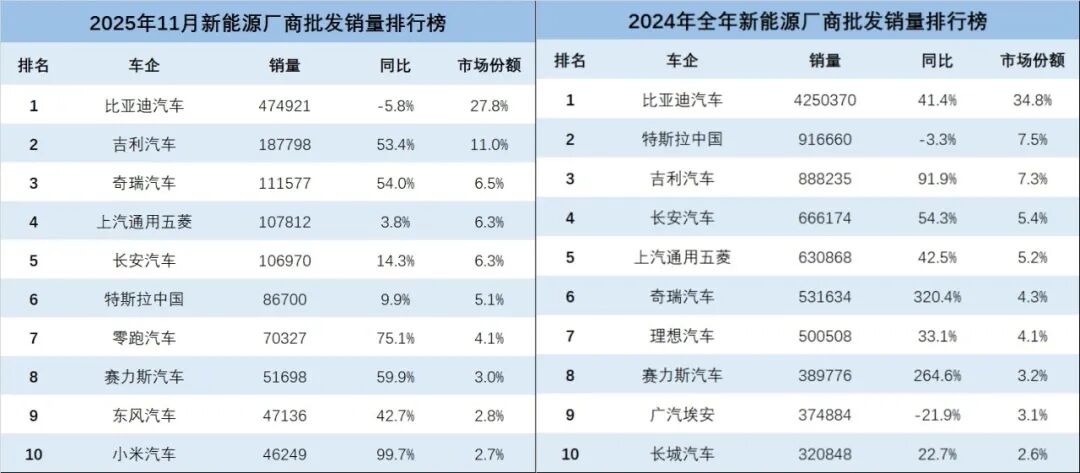
Data source: Passenger Car Association
BYD still holds the top position, but the year - on - year decline in sales and market share has given latercomers more opportunities.
The most powerful challengers are Geely and Chery. The former has become the second - largest after BYD, relying on the hot sales of the Galaxy series. The latter has successively overtaken Tesla, Changan, and SAIC - GM - Wuling, driven by several new models of the Fengyun brand.
However, not all companies are in such a good situation. For example, Li Auto, which has been the leader among new - energy vehicle startups for many years.
After six consecutive months of decline, it has disappeared from the TOP 10. Instead, it is Leapmotor, which has been strong this year.
According to the current development trend, in the last month of 2025, the penetration rate of new energy vehicles in the Chinese passenger car market will most likely exceed 60%.
Although in the mouths of many experts, this figure means that the overall development of China's new - energy vehicle industry will enter a more mature stage. However, the competition pattern among new - energy vehicle manufacturers is far from stable.
NO.1 [ Some hit the brakes, while others start to speed up ]
When looking at the new - energy vehicle sales figures of traditional automakers in November, it is not difficult to find that BYD is a special case.
If the sales of new - energy commercial vehicles are included, BYD just set a new monthly sales record this year with 480,200 vehicles in November. The specialness lies in the year - on - year change - while most automakers are still growing, BYD's sales have declined year - on - year. Moreover, this is the third consecutive month of year - on - year decline for it this year.
After several years of rapid development, BYD suddenly hit the brakes. This brake is both out of necessity and a proactive move.
In the second quarter of this year, BYD's net profit declined by 29.9% year - on - year - this is the first quarterly decline in more than three years. In the first few months of this year, BYD's inventory depth once reached 3.21 months, far exceeding the industry average of 1.38 months.
From the start of high - speed development in 2021 to now, BYD has indeed reached the stage of "stabilizing prices and ensuring sales volume". In September, BYD actively lowered its annual sales target, and since then, its monthly sales have started to decline year - on - year.
Among BYD's many challengers, Geely poses the greatest pressure. In the first 11 months of this year, Geely's total new - energy vehicle sales exceeded 1.5 million, and its new - energy vehicle penetration rate has reached 60.5% - also surpassing other automakers.
However, this achievement should be viewed in two parts. On the one hand, there is the rapidly growing Geely Galaxy and Lynk & Co. Especially Galaxy, in the first 11 months of this year, its sales soared by 167% year - on - year; in October, it became the new - energy vehicle brand that reached annual sales of one million the fastest. Driven by this, Geely's overall vehicle sales and financial data have also reached the best state in recent years.
On the other hand, the performance of Zeekr, which was also highly anticipated, is only mediocre - although its sales are also increasing, the growth rate and total volume are somewhat below expectations.
According to Geely's recently announced goal, they are now preparing to achieve sales of five million vehicles in 2027. The largest increment will come from the Galaxy brand. Recently, there have been reports that Geely has taken over the former SAIC - GM Beisheng Plant (Phase III) in Shenyang, and the Lotus sports car factory in Wuhan is also being renovated. In the future, these will be used to produce Galaxy models.
If BYD and Geely, ranked in the top two on the list, are showing signs of leaving the competition far behind, then Chery, Changan, and SAIC - GM - Wuling, ranked slightly lower, are still in a fierce battle.
At the beginning of November, Chery's Fengyun was officially upgraded from a model series to a brand. According to Yin Tongyue (Chairman of Chery Automobile), it was thanks to the new models of this brand - Fengyun A9L and Fengyun T11 - that Chery entered the top three in the new - energy vehicle sales list for the first time.
In November, Chery's new - energy vehicle sales growth rate reached 54%, a figure similar to that of Geely. With Fengyun and Jetour, which also has good momentum and reputation recently, perhaps Chery can replicate the success of Geely Galaxy in the past two years.
Of course, this is still in the future. Judging from the cumulative sales this year, Changan and SAIC - GM - Wuling have higher sales. Not only are their overall sales similar, but they also have a common feature in their sales structure - A00 - class models account for a relatively large proportion.
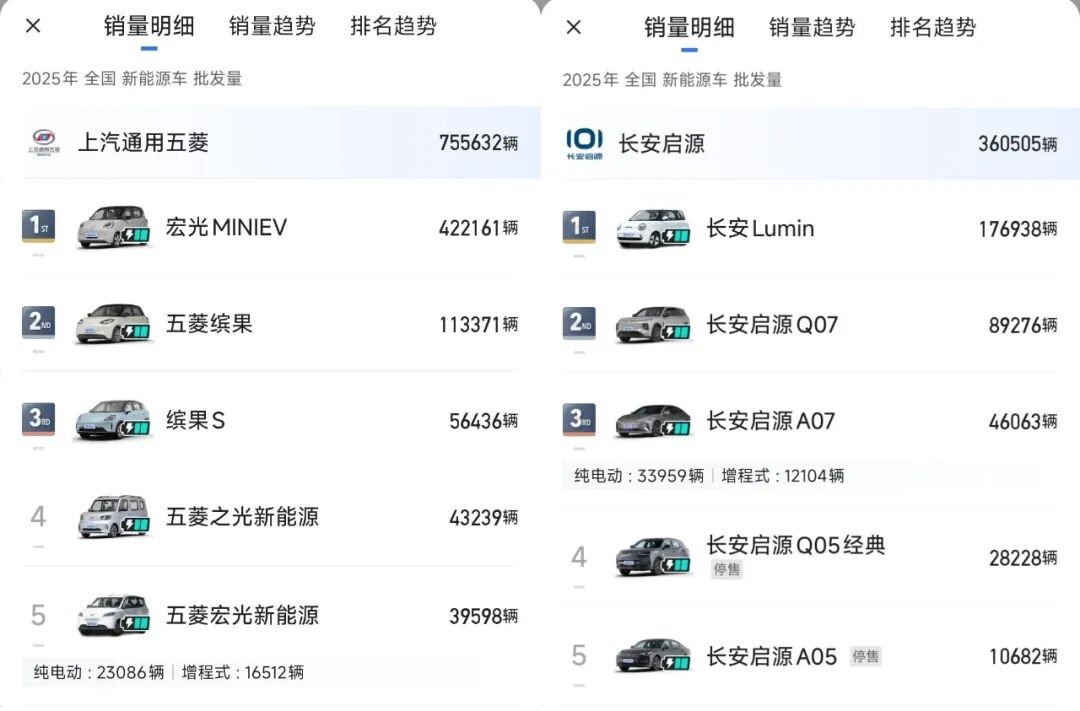
Data source: Yiche Ranking
There is no need to say much about the Wuling brand. Among its total sales of 756,000 vehicles this year, the Hongguang MINI EV alone accounted for 420,000. For Changan, since the beginning of this year, the year - on - year growth rates of Deepal and Avatr have both exceeded double - digits, but they are still some distance from the sales targets set at the beginning of the year. The most questioned issue lies with Qiyuan.
As Changan's main force in the new - energy vehicle field, nearly half (177,000) of Qiyuan's total sales of 360,000 vehicles come from the Lumin. Instead, the core products such as the Q07 and A07 have monthly sales of less than 10,000 vehicles, far from the main products of other automakers.
According to this trend, it is only a matter of time before Chery New Energy surpasses others in annual sales.
NO.2 [ 2025, the "best" year for new - energy vehicle startups ]
While traditional automakers are competing and accelerating their transformation, this year's new - energy vehicle startups have also reached a new level.
Looking at each brand, among the top 10 brands in terms of sales from January to November this year, new - energy vehicle startups account for half. According to the annual target completion rate statistics by some media, the few brands that have achieved their targets in advance are all new - energy vehicle startups.
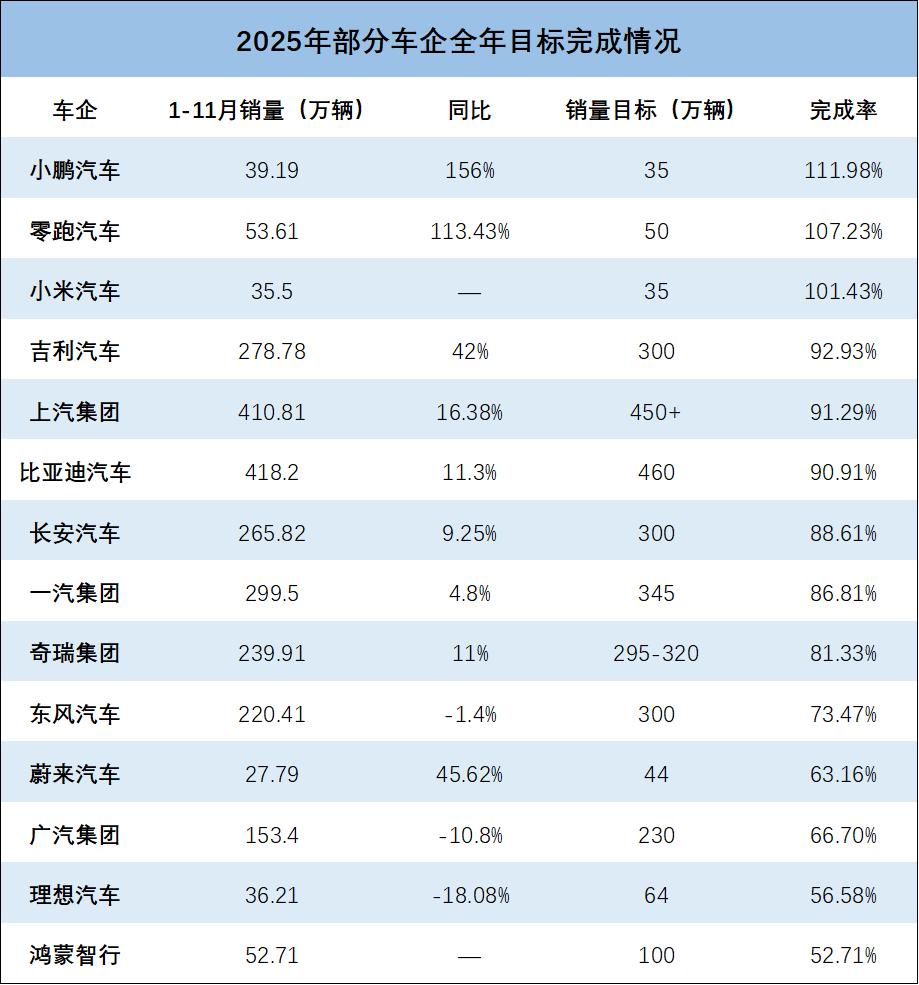
From this perspective, this year can be regarded as the best year for new - energy vehicle startups since their establishment. However, the competition among different brands is becoming more and more intense.
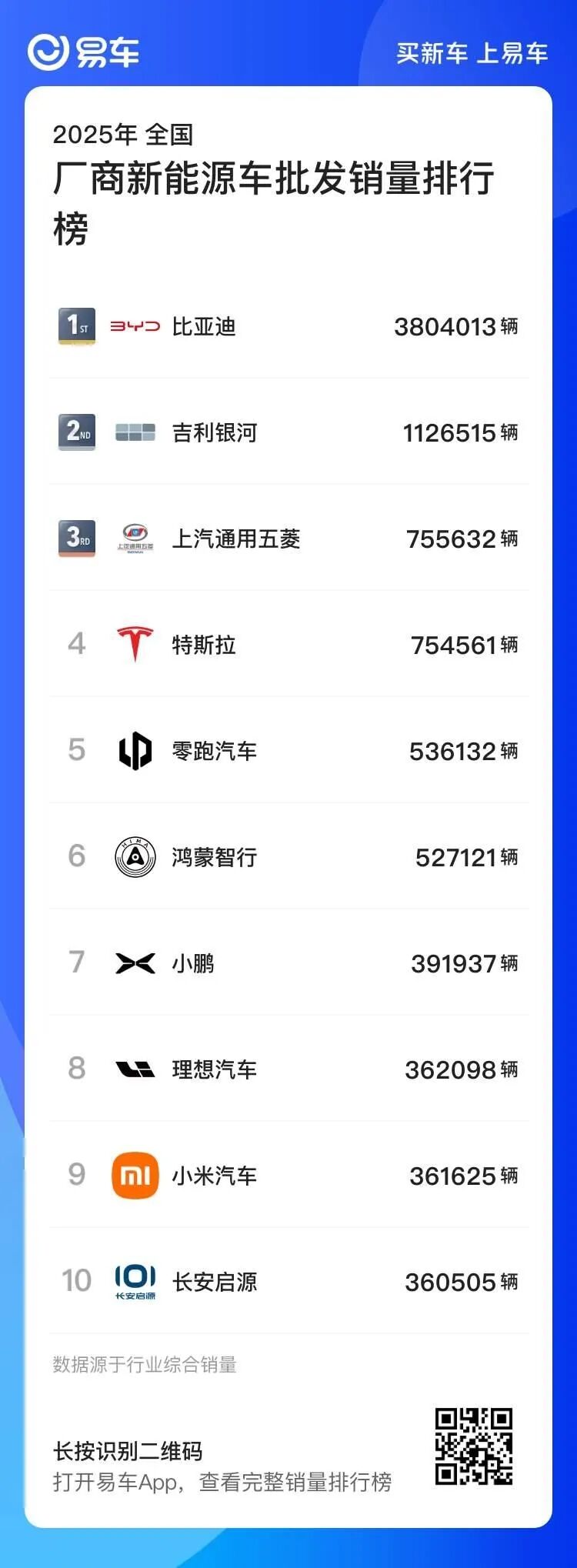
Among these brands, the most "unique" in development this year is Li Auto - while others are on the rise, Li Auto's sales have declined for six consecutive months, with a cumulative decline of more than 18%. Last year, it had the best annual sales among new - energy vehicle startups, but now it has been successively overtaken by Hongmeng Zhixing and Leapmotor; its monthly sales have also fallen behind Hongmeng Zhixing, Leapmotor, Xiaomi, XPeng, and NIO.
In November, with a delivery volume of 81,900 vehicles, Hongmeng Zhixing not only set a new record for its monthly delivery volume but also broke the ceiling of the monthly delivery volume of new - energy vehicle startups. Behind the growth, it mainly relies on the support of new models. Since the end of September, the delivery of the Xiangjie S9T and Shangjie H5 has begun, and Hongmeng Zhixing's monthly sales and cumulative sales this year have also ranked first among new - energy vehicle startups. As more new models of the "Five Realms" are launched, the sales of the entire Hongmeng Zhixing will surely continue to rise.
Different from the fluctuating sales of Hongmeng Zhixing in the previous months, Leapmotor, which ranked second in terms of delivery volume among new - energy vehicle startups in November, has seen its monthly sales steadily increasing this year. Judging from the wholesale volume, its overall scale has exceeded 500,000 vehicles this year, and it will challenge one million vehicles next year. If successful, it will also make history among new - energy vehicle startups.
The brand with the fastest growth rate among all new - energy vehicle brands this year is XPeng. From the former "Wei Xia Li" to the later "Li Xia Wei", after eleven years of establishment, XPeng has finally become the "leader" among the three brands thanks to the MONA M03 and P7 +. Currently, the sales of these two models alone account for 60% of XPeng's total sales. With more models equipped with super - extended - range technology coming next year, it is unknown whether this pattern will change.
Among new - energy vehicle startups, there is also a brand that has to be mentioned, which is Xiaomi. Thanks to the increase in production capacity in the second half of the year, Xiaomi's delivery volume has been rising steadily since July, and it is expected to exceed 400,000 vehicles this year. There are reports that by the end of next year, Xiaomi's annual production capacity of cars will aim for 1.2 million vehicles.
Whether it is the order volume or the production capacity growth rate, it has to be said that Xiaomi has indeed made history in the automotive industry. However, with the recent reversal of its reputation, it is unknown whether Xiaomi's sales can maintain the current high - speed growth.
NO.3 [ Joint - ventures are not as optimistic as expected ]
While traditional domestic brands and new - energy vehicle startups are speeding ahead in the new - energy vehicle field, in 2025, the joint - venture sector, which has been questioned for its slow transformation, has also achieved some commendable results.
The most well - known to the outside world are Dongfeng Nissan and GAC Toyota, which are regarded as exemplary cases of transformation. From January to November this year, the cumulative sales of the former in the new - energy vehicle field increased from less than a thousand vehicles last year to more than 50,000; the latter also achieved more than a ten - fold increase. Coupled with the recent launch and debut of new models such as the Nissan N6 and the BZ7X, their new - energy vehicle transformation in the future is also continuously favored.

In fact, judging from the new - energy vehicle sales ranking, among all the joint - venture brands, the total sales of Dongfeng Nissan and GAC Toyota are not the highest. Somewhat unexpectedly, the top two are SAIC - GM and Volvo. The former mainly benefits from the plug - in hybrid version of the GL8, while the latter mainly relies on export sales.
Another notable phenomenon is that while the transformation of joint - venture brands seems to be going well on the surface, their share in the new - energy vehicle market is actually decreasing compared with last year.
An intuitive reflection is that in the top 20 new - energy vehicle brand sales list last year, we could still see the names of SAIC Volkswagen and BMW Brilliance; this year, except for Tesla, it is all the world of domestic brands. Numerically, SAIC Volkswagen, which ranked first in joint - venture new - energy vehicle sales last year, had an annual sales volume of nearly 140,000 vehicles; while SAIC - GM, which ranks first in the first 11 months of this year, has a total new - energy vehicle sales volume of only more than 70,000.
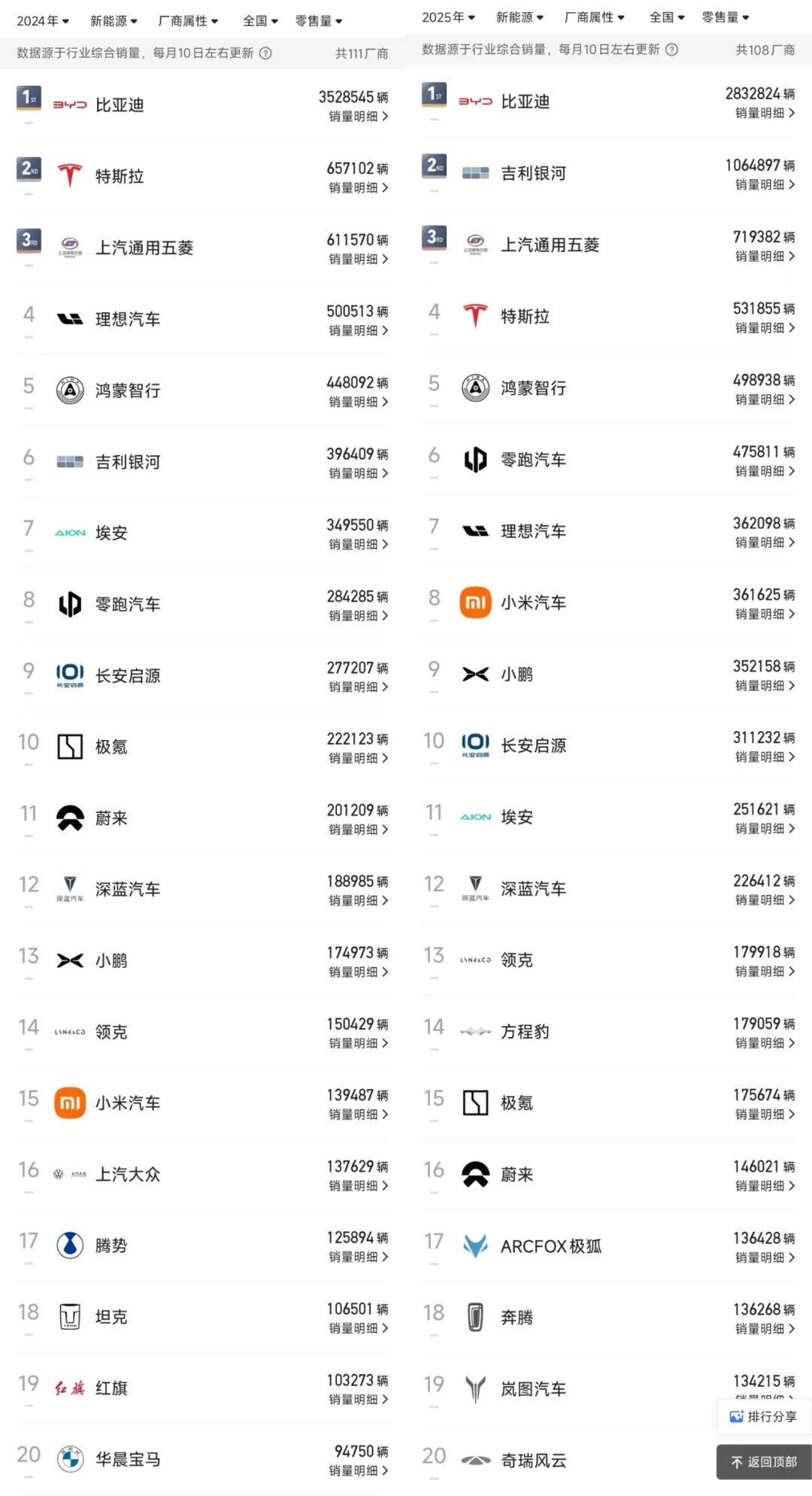
This means that in 2025, most joint - venture brands still failed to come up with appropriate transformation strategies. In the highly competitive Chinese automotive market, their competitiveness in the new - energy vehicle market continues to decline.
Recently, the Ministry of Industry and Information Technology released the latest list of new vehicle applications for approval. Many joint - venture brands that did not achieve much in 2025 have finally launched more competitive products.
For example, SAIC Audi's second model for the Chinese market, the E7X, following the E5 sportback; Cadillac's VISTIQ; SAIC Volkswagen's Passat ePro; smart's first new - energy sedan, the #6 EHD; including the first model, the Yuzhong 07, jointly developed by Volkswagen and XPeng, will also start production on the last day of this year...
In 2026, we look forward to joint - venture automakers coming up with more countermeasures after recognizing the situation.
NO.4 [ In conclusion ]
Looking at the entire new - energy vehicle sales ranking, the biggest change from last year to this year is actually the increase in sales volume.
In 2024, if a brand's monthly sales could reach 20,000 vehicles, it could surely rank in the TOP 10. But this year, the threshold has become 30,000 vehicles. What was once regarded as a milestone of monthly sales exceeding 10,000 vehicles can now be achieved by brands ranked outside the