DJI's panoramic cameras are alleged to hold nearly half of the market share, and two reports are mired in data doubts.

Recently, a "data mystery" has emerged in the panoramic camera market, adding more fog to the already fiercely competitive consumer imaging track.
Not long ago, the third - party institution Jiqian Consulting released a research report on the global action and panoramic camera market in 2025. The report shows that DJI's global revenue share in the action camera field has steadily climbed to 66%, ranking first in the global industry. In the brand - new panoramic camera track, DJI's first product, Osmo 360, has captured 43% of the global market share in less than three months since its launch, causing a sudden change in the pattern of players in the track.
A few days later, a report released by Frost & Sullivan presented a different picture - DJI's share in the panoramic camera field was 17.1%, and the data for action cameras was also "halved". What's even more puzzling is that, according to media reports, after the release of the report, due to reasons such as "internal data verification" as claimed during interviews, it was "taken offline" twice, and so far, there is no download entry on Frost & Sullivan's official channels.
Facing the controversy triggered by the market share data, a relevant person inside DJI revealed: "After seeing the two reports with huge differences, we traced and deduced the data statistical logics of both sides immediately. Our shipment volume of panoramic cameras in Q3 did exceed 300,000 units. It is understood that Jiqian's report is based on the disclosed data of listed companies, the actual sales data of mainstream e - commerce platforms, and a large amount of social media monitoring as the information input basis."
In the second half of 2024, Insta360's revenue was 1.65 billion yuan (annual sales in 2024 - sales in the first half of the year: 2916.3689 million yuan - 1270.264 million yuan).
In addition, Insta360 also responded externally during a recent earnings conference.
Behind the data differences between the two reports is a facet of the battle for industry discourse power. When the market enters the "Chinese time", the competition is no longer limited to products and sales volume but extends to the formulation of standards and cognition.
In the action camera field, DJI's long - term competition with overseas giant GoPro is a typical "hard - core breakthrough". After about six years of technological iteration and market expansion, DJI gradually completed the role transformation from a "challenger" to a "leader".
However, when a company's long - term perseverance breaks through the critical point of quantitative change, the technological and brand potential it releases will far exceed the competition of a single product line, and it will enter the stage of diversified product ecosystem layout. This qualitative change effect is particularly clear in DJI's performance in 2025.
Reviewing DJI's journey in the action camera field, from patiently entering the market to efficiently breaking the situation, we will find that the growth potential of a technology company may not lie in its initial speed but in the acceleration of each "key entry".
Perhaps the answer to this battle for market share has already been written in consumers' cognition and choices.

Behind the "Blitzkrieg"
Judging from the rapid breakthrough of Osmo 360 and Osmo Nano, it seems like a successful "blitzkrieg" on the surface. However, if we examine the technological breakthrough process behind it closely, we will find that it is more of a long - term accumulation leading to a qualitative change. The rapid commercial rise of these two products is not an accidental explosion but is rooted in DJI's six - year continuous exploration and technological accumulation in the action camera field.
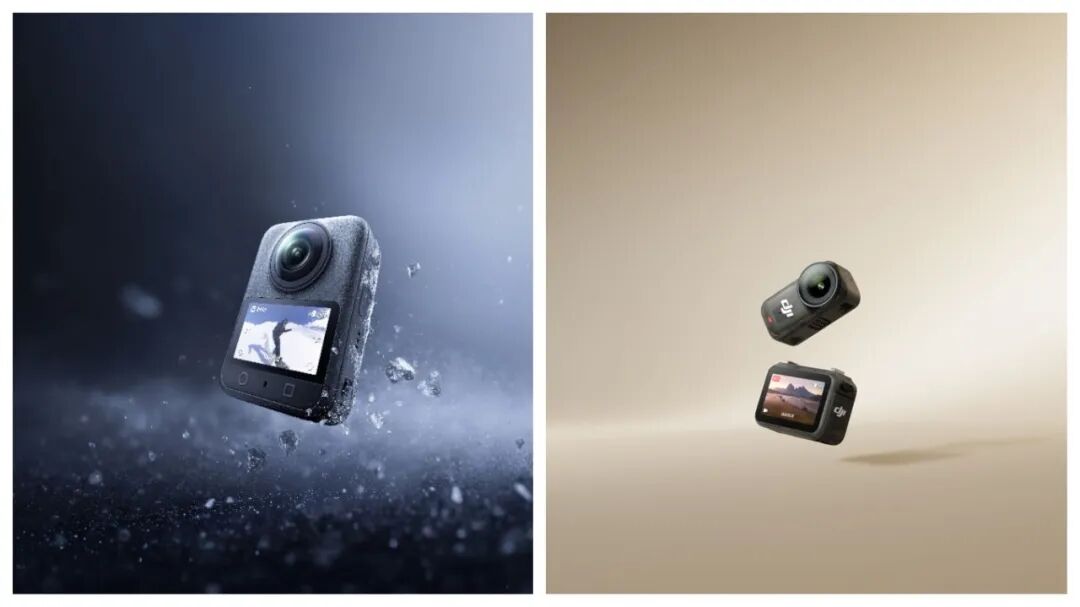
Osmo 360 Panoramic Camera, Osmo Nano Wearable Camera
The "speed" seen in the market comes from DJI's "slowness" in product iteration. The lightweight form and stable performance presented by Osmo 360 and Nano did not happen overnight but gradually matured along a technological path of continuous trial - and - error and evolution. This also witnesses DJI's transformation from a "challenger" in the action camera market to a "definer".
Looking back at its development trajectory, a clear path from entering to defining the market can be seen.
In 2019, the first - generation Osmo Action product solved the core pain points of users in shooting scenarios with its front - color screen and stabilization algorithm, successfully opening a gap in the market. At that time, DJI was already thinking about a more future - oriented question: What should a truly simple and easy - to - use action camera be like?
The questions included how to break through the bottlenecks of existing action cameras, how to achieve dual - screens, better waterproof performance, and a more lightweight volume technically, and how to attract more high - quality users and lower the threshold for the general public in terms of product ecosystem and market pricing.
In the following generations of products, this question was continuously addressed. In 2021, Osmo Action 2 no longer followed the industry's traditional "integrated" design logic but adopted a magnetic snap - on architecture, enabling the quick disassembly and replacement of the main unit and accessories. This modular design greatly expanded the application scenarios and playability of action cameras.
However, although the overly innovative and breakthrough configuration design was well - received by users, limited by the hardware specifications of Action 2 at that time, the overheating problem of the high - specification 4K120 could not be solved, resulting in continuous negative feedback. This also made DJI decide to take a more steady approach.
This setback became a key turning point. In the subsequent Osmo Action 3 and 4, DJI showed a more pragmatic strategy, solving the pain point of long - time recording stability. DJI did not give up innovation because of its double - edged nature but chose to find the best balance between "disruptive form" and "core user experience". In 2023, after releasing Osmo Action 4, DJI finally reached the same market share as GoPro. Two years later, the emergence of Osmo Action 5 Pro transformed the accumulated internal product iteration mechanism, that is, the ability to quickly and accurately identify user needs into product features, and interconnected the accessories, quick - disassembly, and audio ecosystems. Since then, DJI has achieved a magnificent counter - attack in the action camera field.
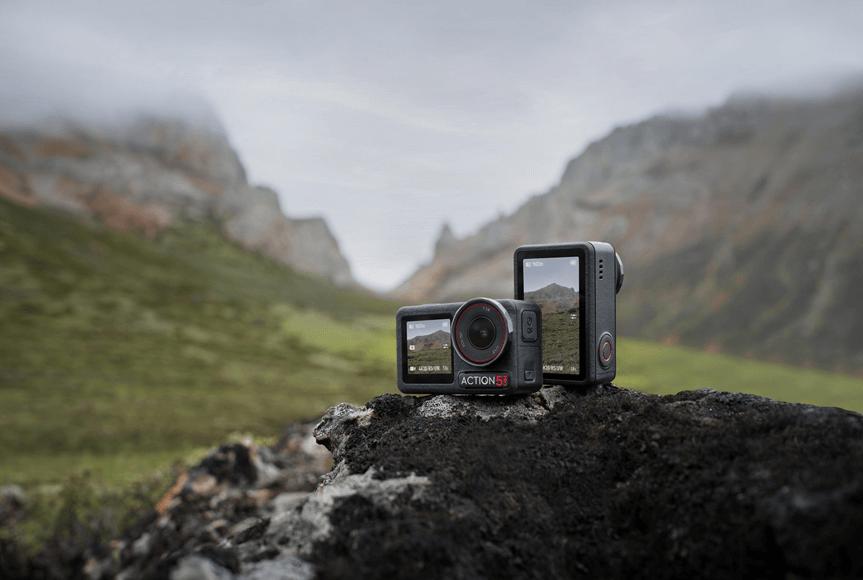
Osmo Action 5 Pro
Looking back at DJI's six - year breakthrough history, we will find a principle: true innovation often does not lie in showing off single - point technology but in the systematic ability formed through continuous iteration. Not chasing short - term returns and daring to deeply cultivate for long - term vision is a sign of the maturity of a technology company's ecosystem. Therefore, what DJI has built in this process is not just a product line of a single device but a complete, efficient, and low - threshold creation system, which is an ecological barrier that is more difficult to replicate than simply stacking parameters.

The "Compound Interest" of the Ecosystem and Integrated Experience
The systematic maturity has prompted DJI to extend its product layout to more diverse scenarios. Today, whether it is the Osmo Nano thumb - sized camera, which pursues extreme lightweight, or the Osmo 360 panoramic camera, which breaks the traditional perspective, their success in the market no longer depends on the advantages of a single product but is rooted in the support of a whole set of ecological systems behind them.
Osmo Nano can be regarded as a mature transformation of DJI's thinking on the magnetic snap - on architecture. It inherits the convenient concept of Action 2 but is transformed into a "pocket professional machine" without any weak points through its extreme lightweight design, an imaging core comparable to that of flagship action cameras, and thoroughly optimized battery life and heat dissipation. In addition, four years after the "idealistic" innovation of Action 2, DJI users have finally welcomed a higher - level experience of the magnetic snap - on architecture. While the snap - on is firm, problems such as overheating have also been greatly improved.
Meanwhile, Osmo 360 can share the batteries and accessories of the Osmo Action series, and Osmo Nano re - uses the core sensor of the flagship product. From the UI interaction between devices to the operation logic of the editing software DJI Mimo and DJI Studio, DJI has built a highly unified usage and creation experience. Users can operate different devices under the same ecosystem to complete the entire process from shooting to final output.
It can be seen that DJI's product definition ability has evolved from solving the pain points of a single scenario to a kind of universality beyond scenarios. Achieving a professional - level experience and cross - product - line collaboration in a refined space tests its ecological integration ability.
This kind of ecological collaboration not only improves the user experience but also reduces R & D and supply - chain costs through economies of scale. Relying on the manufacturing capabilities and supply - chain advantages established in fields such as drones, DJI has gradually distanced itself from its peers in terms of customizing key components and production efficiency.
Furthermore, the cost advantage has been transformed into "user dividends", enabling more people to access innovative technologies at a lower threshold. And extensive user recognition continuously feeds back into product iteration and category expansion, forming a positive cycle.
In essence, ecological collaboration has become a technological lever for DJI to expand its ability in in - depth scenarios, allowing DJI's product layout to resonate in their respective "battlefields". It magnifies the advantages of a single product into a moat for the entire brand.

Breaking the Deadlock in "Redefinition"
After officially entering the panoramic camera field, DJI also launched the Osmo 360 with a one - inch sensor, directly facing the difficult problem of balancing volume, power consumption, and image quality in traditional panoramic cameras.
From a technological logic perspective, the root cause is that the industry generally uses rectangular CMOS designed for mobile phones to capture circular image fields, resulting in about a quarter of the sensor area being wasted. Before DJI entered the market, this was not an unnoticed problem. However, when panoramic cameras were still a niche category, the upstream supply chain lacked the motivation to customize core components for niche categories.
For supply - chain manufacturers, if they need to open a new production line for this, they first need to ensure stable customers and large - scale mass - production demand. In this game at the back end of the market, DJI did not compromise but chose to push the supply chain one step further and proposed a solution of customizing square CMOS. This decision fundamentally changed the technological path: the square CMOS allows the circular image field to fit perfectly inside, increasing the sensor utilization rate by 25% and enabling it to directly output native 8K panoramic videos without upsampling. It can fundamentally solve the pain points of users in the traditional panoramic camera industry.
In addition, Osmo 360 introduces the 10 - bit D - LogM color mode and seamlessly migrates the mature image stitching algorithm and intelligent tracking technology from the drone field to the handheld device, effectively solving the pain points of panoramic video in terms of natural stitching and editing efficiency. While achieving high performance, the product reduces the threshold for professional - level panoramic creation with a price of 2,999 yuan.
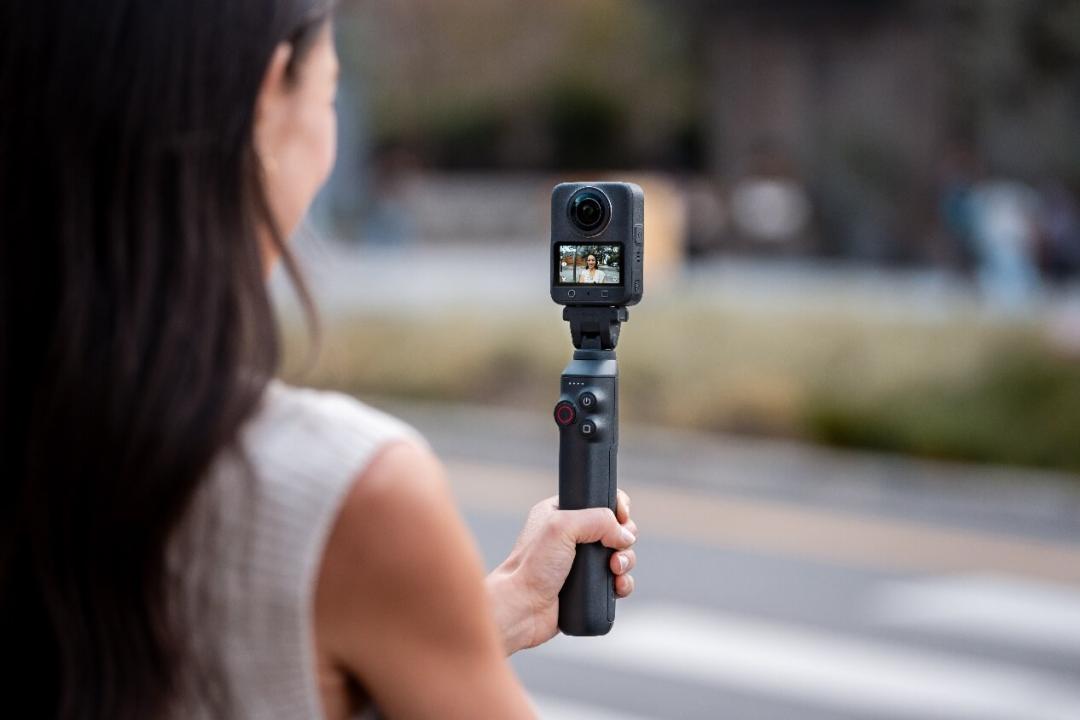
Osmo360
The market performance of Osmo 360 quickly confirmed the success of this technological route. Looking back at GoPro, which has a too - single product line, it suffered a loss of $432 million in 2024, and the decline continued in 2025.
However, DJI's ecological expansion, which combines technological and aesthetic upgrades with the transfer of capabilities, has not stopped. The deeper logic lies in accurately capturing and defining new market demands through the integrated innovation of "sky" and "ground" technologies.
After the high - speed growth of the consumer drone market, it is facing the dual challenges of homogeneous experience and stricter regulatory policies. Users are eager for more convenient, safer, and more socially - shareable creation tools. Against this background, combining the immersive recording ability of panoramic cameras with the unique perspective of drones has become an inevitable technological direction.
With the success of Osmo 360, it is reported that DJI's first panoramic drone, Avata 360, which was initiated in 2022, has been exposed in spy photos by multiple foreign media: This product has a similar fully - enclosed propeller arm design to the Avata series accumulated in drone products and the DJI O4 image transmission system. At the same time, it will most likely re - use the fisheye lens design of the osmo360 panoramic camera and the accumulated square CMOS solution. This cross - dimensional technological re - use may ultimately give birth to a new species that breaks the boundaries of traditional categories.

Conclusion
Whether it is action cameras, panoramic cameras, or the frequently - spied - on panoramic drones, in an era when image recording is inseparable from human creation and entertainment, the "rules of the game" in the industry are being continuously reshaped.
For "technology - ecosystem players" represented by DJI, the evolution path of their products has shown systematic and ecological development characteristics. The "one - shot success" of new products and new