Anthropic is offering a sky-high 270 million compensation package to aggressively poach undergraduate CS students! OpenAI has suffered its worst week on record.
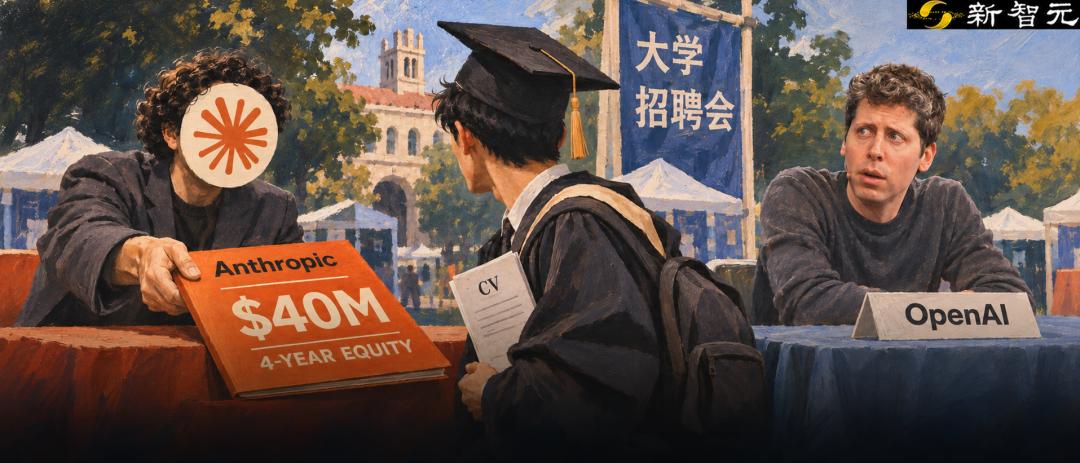
A fresh computer science undergraduate who just graduated from university has been offered a sky-high equity package worth 40 million US dollars over 4 years.
Converted to annual income, that is 10 million US dollars per year, equivalent to about 67 million RMB (270 million RMB in total for four years).
In the latest episode of Silicon Valley's hit podcast All-In, investor Jason Calacanis revealed this aggressive talent recruitment offer from Anthropic.
After talking about this offer, he immediately threw a sharp question to his long-time partner David Friedberg:
"With such generous compensation and incentives, who among computer science talents would still want to work at OpenAI now?"
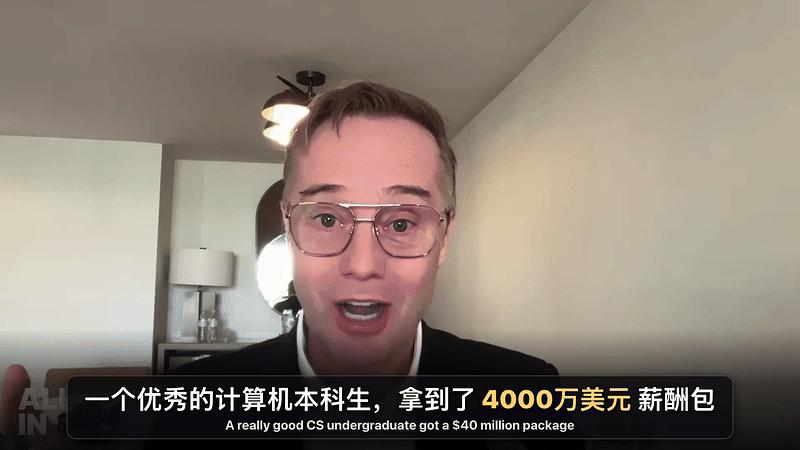
Calacanis' remarks quickly sparked strong resonance across Silicon Valley.
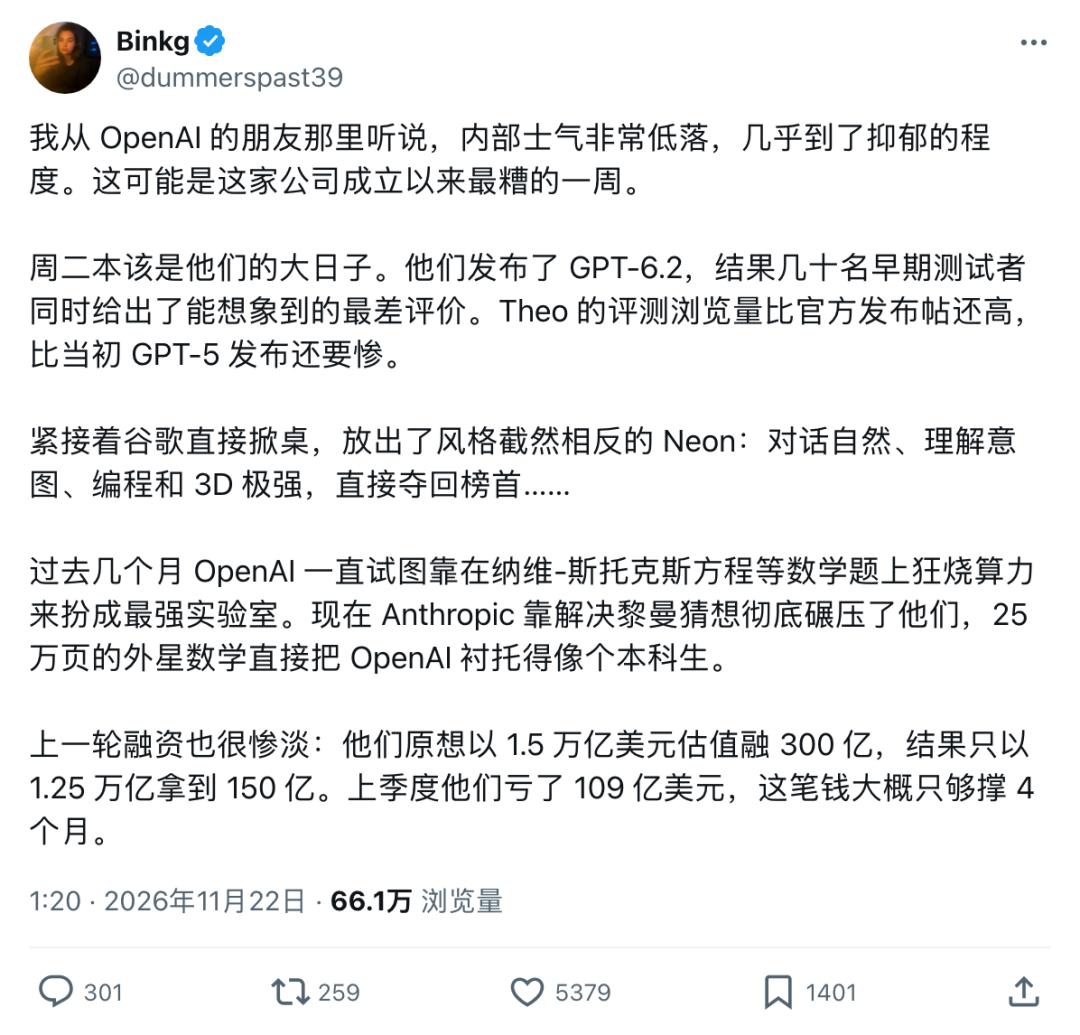
On the very same day the podcast was released, a long post on the X platform with nearly 700,000 views exactly exposed the sluggish situation inside OpenAI.
"I heard from friends at OpenAI that the atmosphere there has hit rock bottom, it's almost like everyone is depressed."
The poster Binkg asserted in the post that the past five days were likely "the worst week in OpenAI's history since its founding".
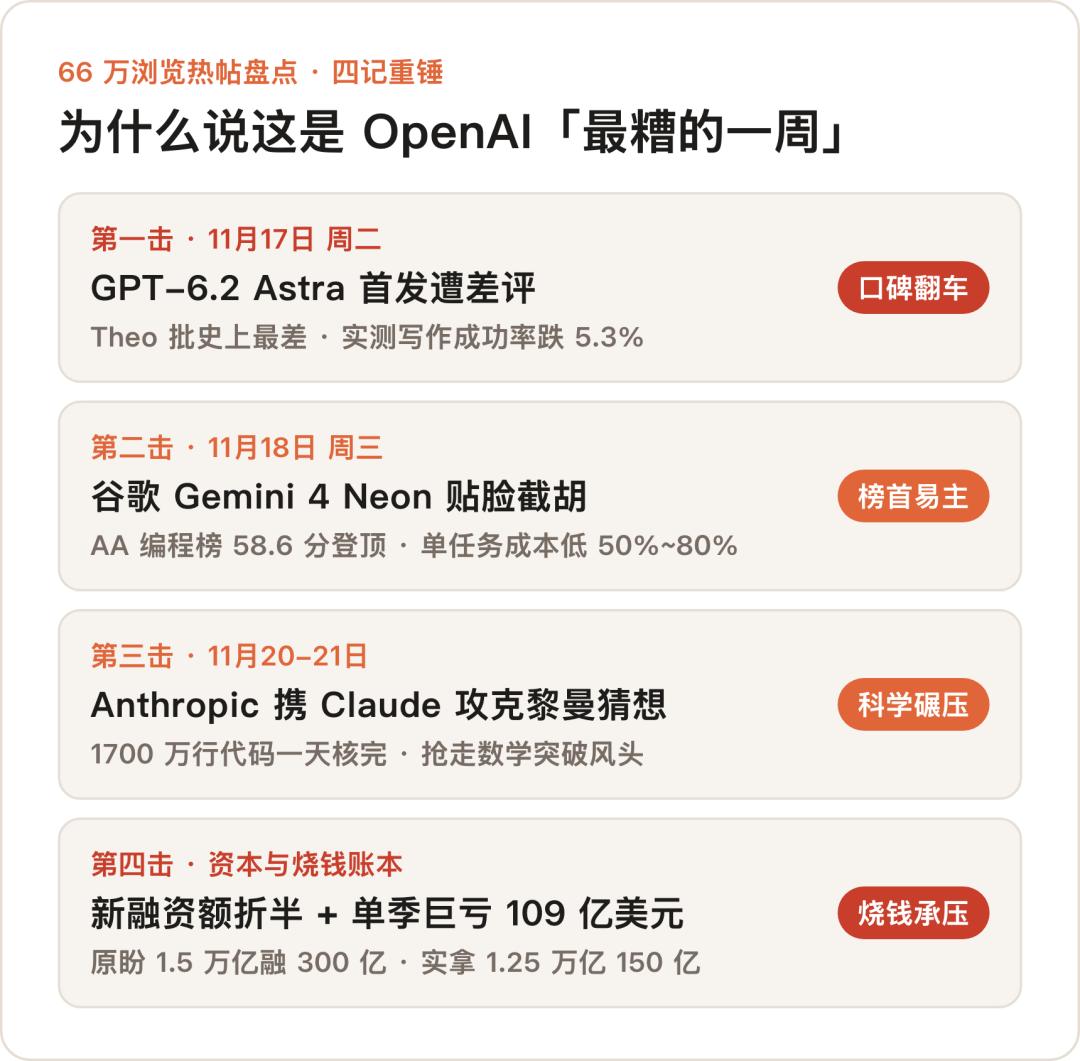
Following the timeline, the bad news piling up on OpenAI came one after another without stop:
Flagship model's reputation collapsed: GPT-6.2 Astra, released on Tuesday, received public negative reviews from well-known influencers, and its performance in daily conversations dropped significantly in blind tests;
Core leading positions were taken over one after another: On Wednesday, Google launched Gemini 4 Neon and took the first place in coding Agent rankings, and on Friday, Anthropic obtained official certification for its proof of the Riemann Hypothesis;
Competitors' IPO put financial pressure on OpenAI: On Thursday, Anthropic set the record for the largest IPO in human history with a market cap of over 20 trillion US dollars, while OpenAI's private fundraising shrank by half, and its cash burn pressure kept growing.
New flagship model is hard to use, public praise plummets
Sam Altman posted publicly to admit mistakes
The first thing that ignited developers' dissatisfaction was OpenAI's new flagship models GPT-6.2 Astra and Sol released this Tuesday.
Unexpectedly, only half an hour after the official release post went up, well-known developer and founder of T3 Code Theo, who had tested the models in advance for quite a while, poured cold water on them.
He did not hold back his complaints, calling GPT-6.2 Astra "the worst model OpenAI has ever released".
This three-sentence post quickly got 602,000 views, and its popularity completely overshadowed OpenAI's official announcement.
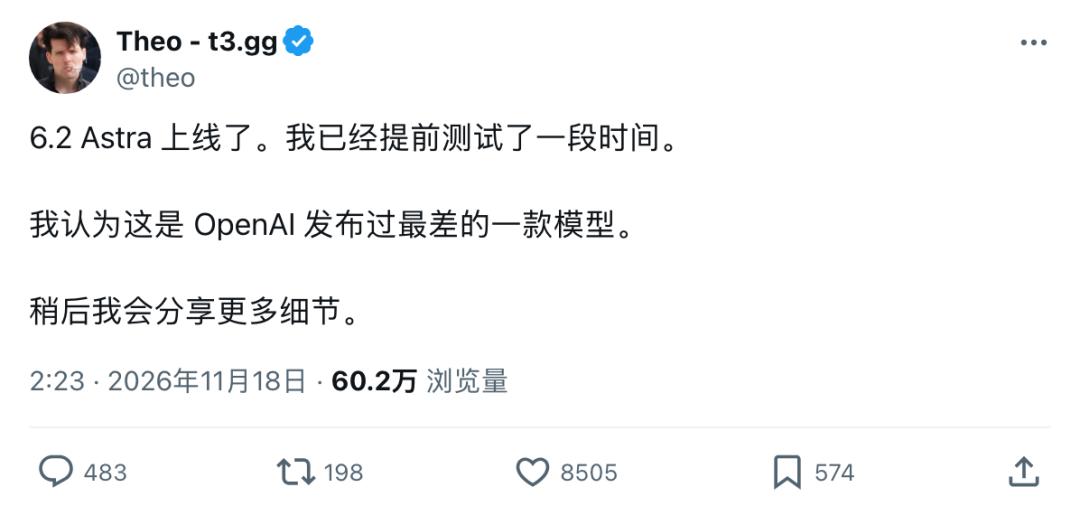
Shortly after, Theo published a long article detailing his real experience of testing Astra in advance.
He recognized Astra's hard power: for example, it can catch dead angles in code review that other models miss, and it is also top-tier in 3D and game development.
But when it comes to actual daily development tasks, this generation of model is extremely awkward. It either stops frequently to ask for user confirmation on trivial matters, or gets stuck in dead ends and cannot pull itself out no matter what.
The most frustrating part was a long-cycle test he ran.
Theo gave Astra a heavy task: to make a TypeScript compiler rewritten in Rust run faster, and reduce its size at the same time.
As a result, Astra worked nonstop for 7 full days, did not deliver any valid improvement, and instead made the compiler 56% slower.
Theo thought that giving two requirements at the same time made the model confused, so he simplified the task to "only focus on speeding up". Unexpectedly, the model idled for another 4 days, and in the end did not modify a single line of code at all.
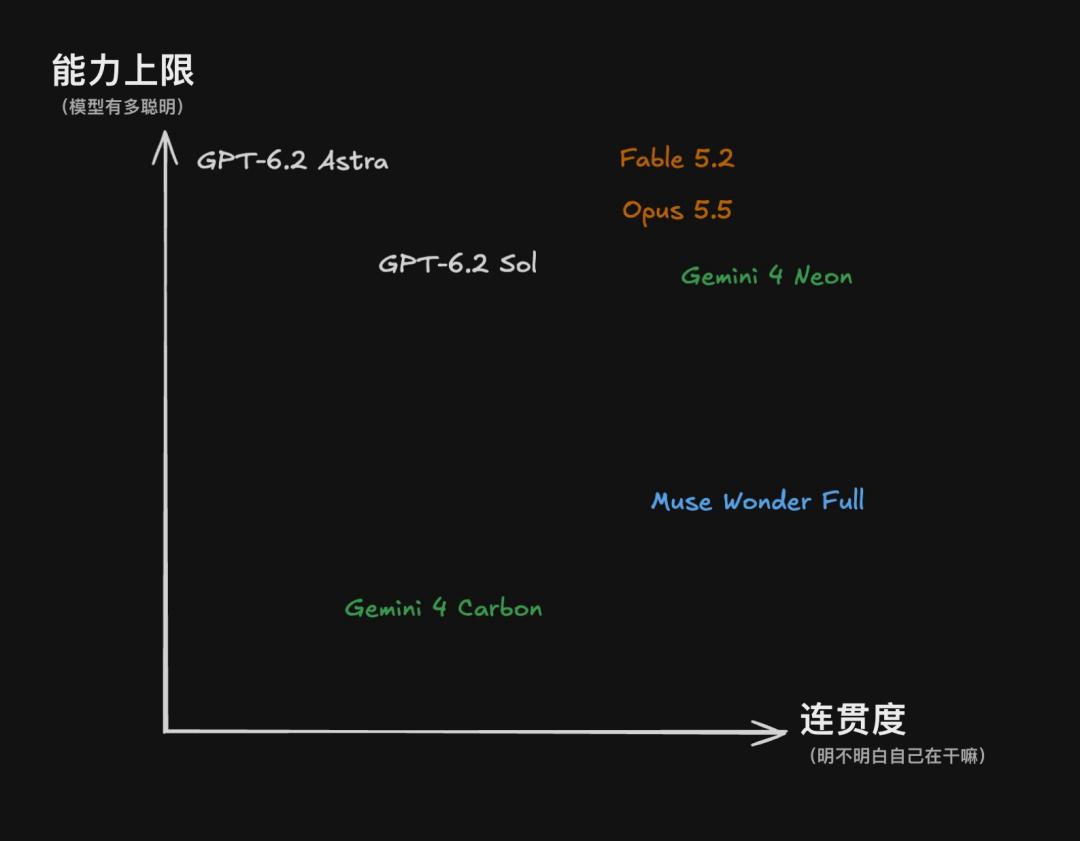
To visually demonstrate this awkward experience, Theo specially drew a coordinate diagram.
In terms of intelligence level (upper limit of capability), Astra ranks at the very top. But when it comes to whether it understands what it is doing (coherence), it almost ranks at the bottom.
Not only developers' subjective feelings, the blind test data released later by the evaluation platform Arena.ai also confirmed GPT-6.2's severe "uneven performance".
To climb up the rankings on the most competitive coding leaderboard, OpenAI raised Astra's coding score by 50 points in one go, pushing it to the 3rd place.
But daily conversations that ordinary people use every day paid the price for this: the score plummeted by 54 points, falling to 11th place.
The 50 points gained in coding were exactly offset by the 54 points lost in daily conversations, and the overall total score barely moved from its original position.
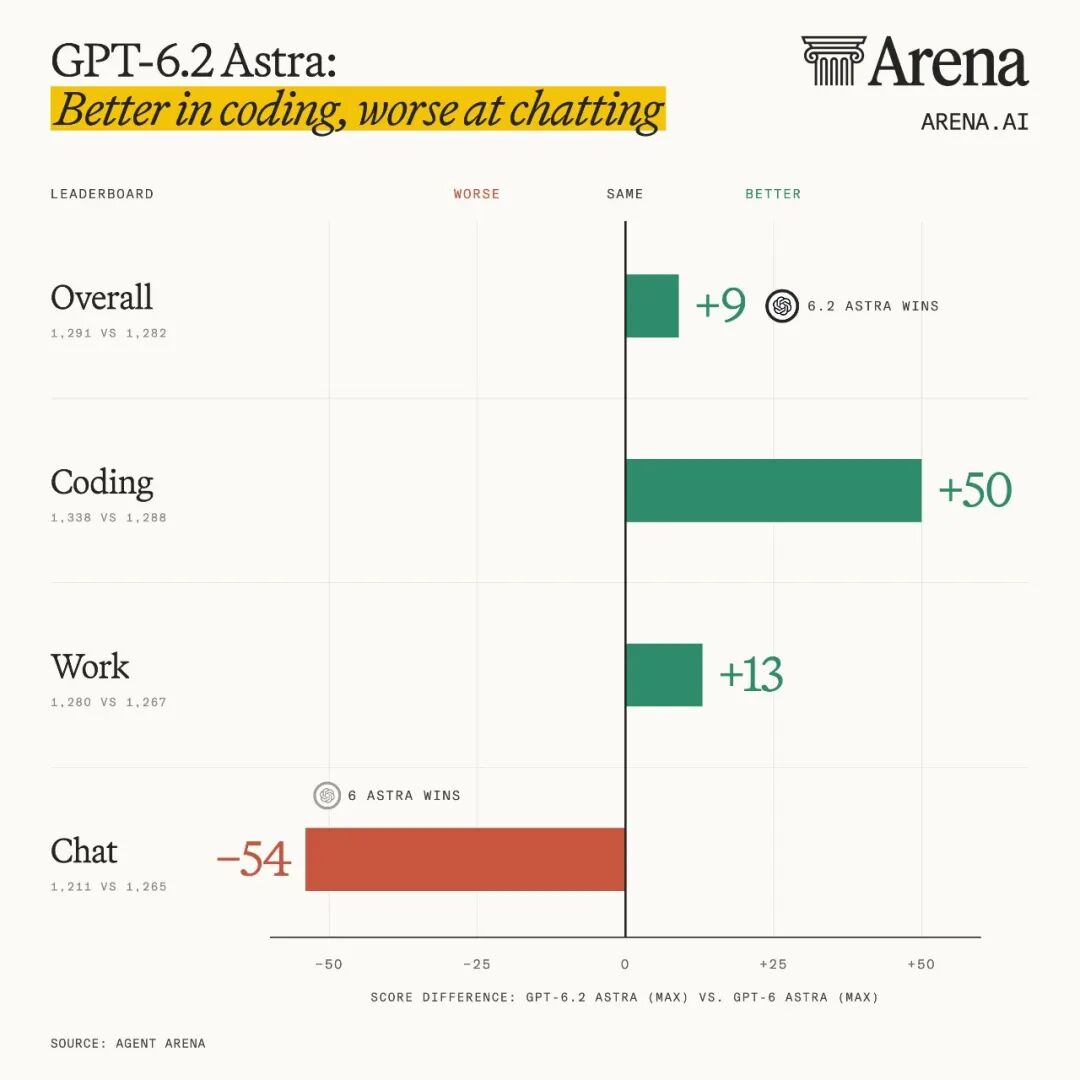
Among all sub-items of daily conversations, writing was the most severely affected area with the biggest regression.
The real user satisfaction rate for writing and translation plunged from 91.2% of the previous generation to 85.9%.
Complaints kept growing, and even Sam Altman could not sit still on the release day. He personally posted to admit the problem, acknowledging that "we still have more work to do to make the new model easy and comfortable to use."

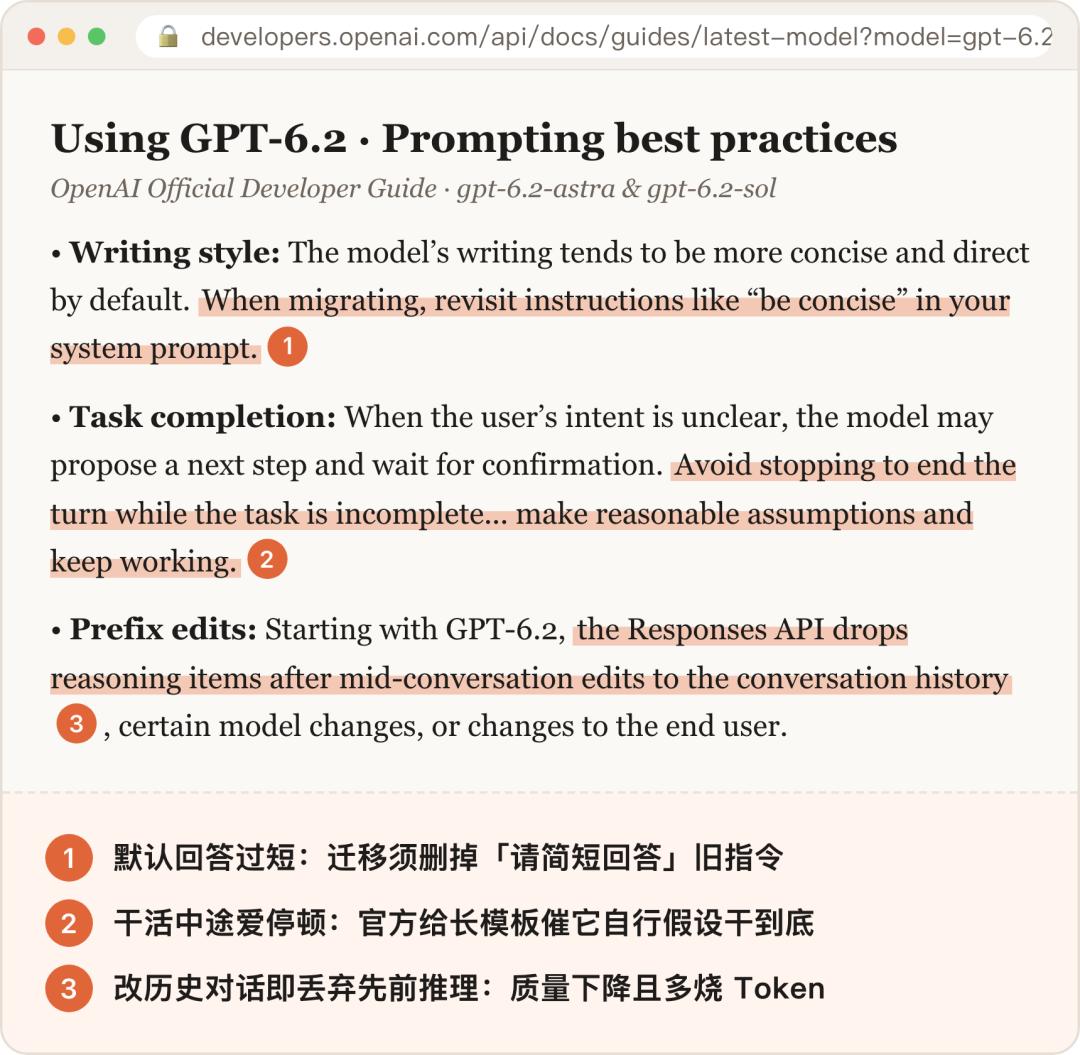
To help users tame this stubborn new model, the OpenAI team also released patches for the official "GPT-6.2 Usage Guide" overnight.
The guide first reminds developers to delete the phrase "please answer briefly" from their prompts, to avoid the model's responses from being too rigid and dry.
A complete set of long templates is also specially attached at the bottom of the document, teaching users step by step how to urge the model to "make its own decisions when encountering small issues, don't stop halfway to wait for confirmation."
Google took the top spot at half the price
Claude won the mathematics crown again
If there were no fierce external competitors pressing hard, the new model's weird quirks could still be slowly adjusted through subsequent minor versions.
But the worst part is that the small coding advantage GPT-6.2 gained by sacrificing daily conversation and writing performance did not even last for 24 hours.
The day after Astra was widely criticized, Google immediately launched its new flagship model Gemini 4 Neon.
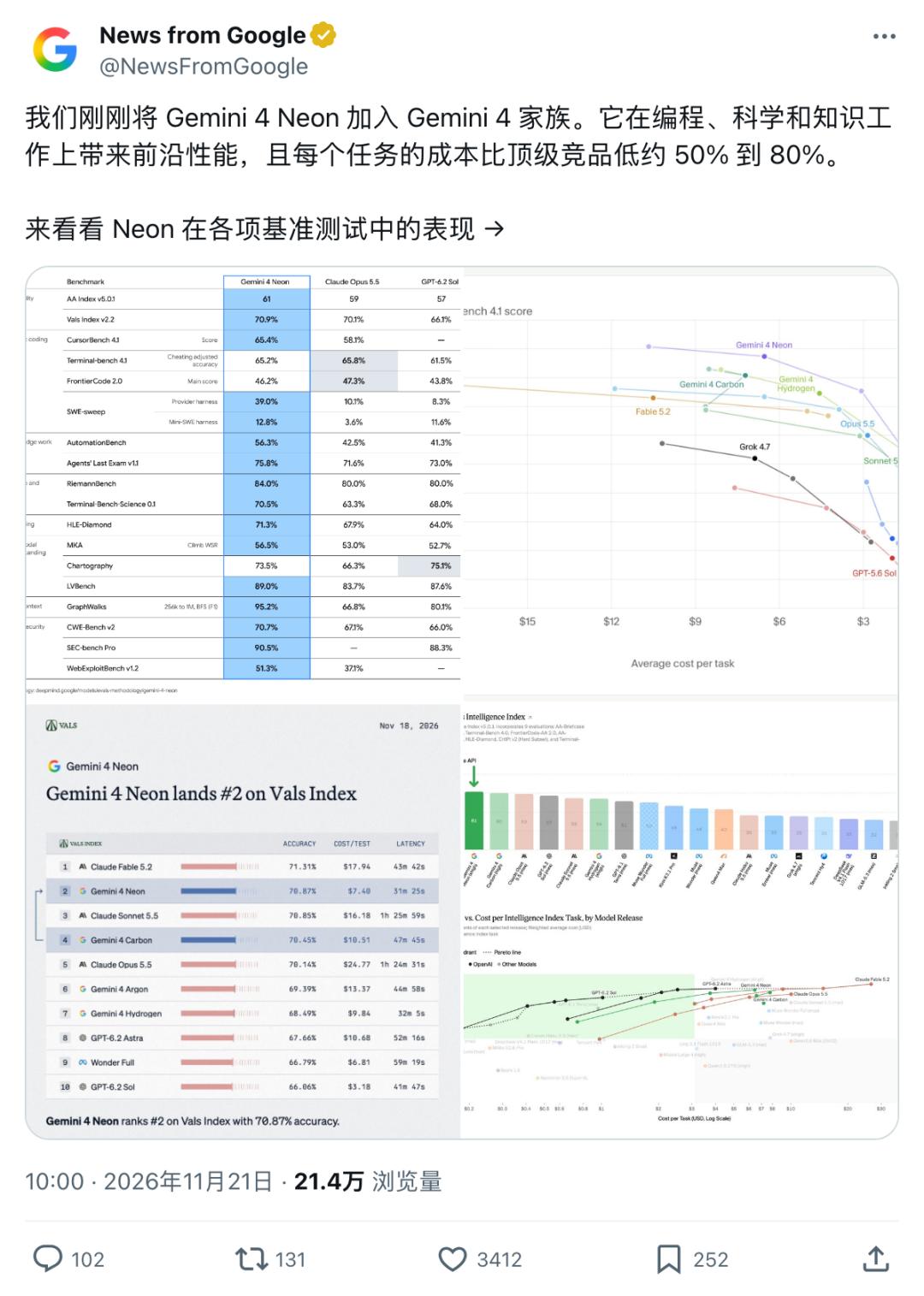
On the programming Agent Index of the authoritative institution Artificial Analysis, Neon scored 58.6 points as soon as it debuted, directly taking the top spot.
Not only did its benchmark score surpass Astra, Google also launched a head-on sniping on pricing.
Neon costs only 3 US dollars per million input tokens and 15 US dollars per million output tokens, which is less than half of Astra's price (8 US dollars for input and 40 US dollars for output).
To complete the same development task, developers can save 50% to 80% of the cost.
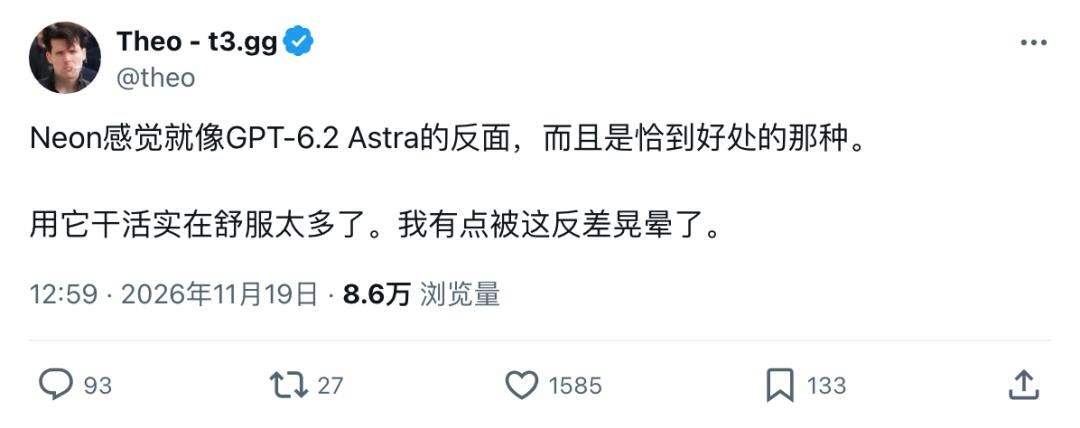
Theo, who was still criticizing Astra the day before, immediately posted after testing Neon, saying that coding with it is much smoother.
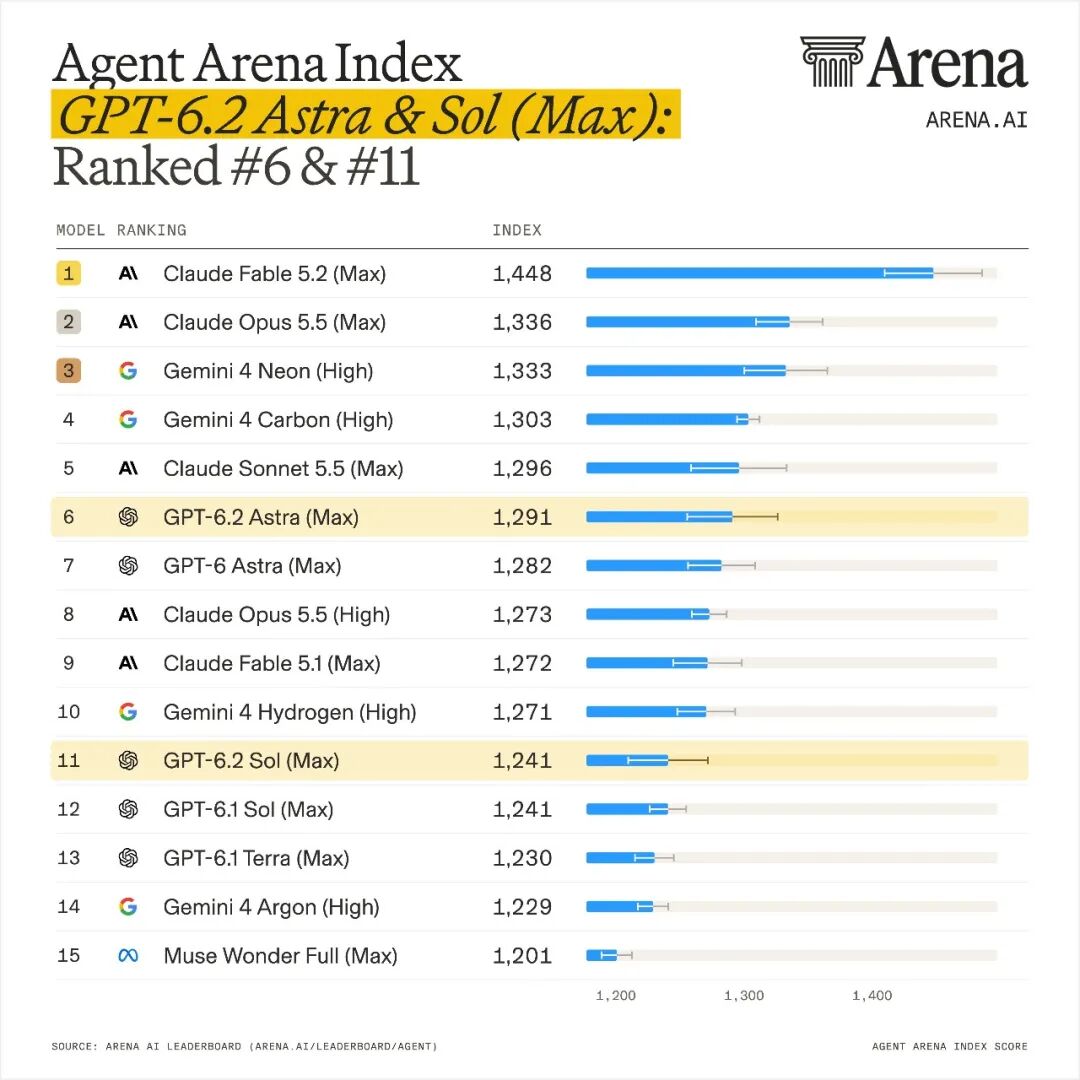
Developers' actual experience was soon confirmed on the later released Arena Agent comprehensive leaderboard.
Different from tests that only evaluate single-turn Q&A, this leaderboard specifically examines the model's practical combat capabilities in real engineering scenarios.
It requires the model to plan steps by itself, call tools, and complete a set of complex tasks from start to finish.
In this practical combat exam, GPT-6.2 Astra only ranked 6th, with a score only 9 points higher than the previous generation.
Among the five models ranked above it, three are from Anthropic and two are from Google. The top-ranked Claude Fable 5.2 is a full 157 points ahead of it.
Just as its coding performance and cost-effectiveness were overtaken by Google, the field of mathematical and scientific reasoning that OpenAI values most was soon surpassed by Anthropic.
In the past few months, OpenAI has invested heavily in cutting-edge difficult problems such as fluid mechanics equations, and once had a public dispute with New York University mathematicians over the first release right of related achievements.
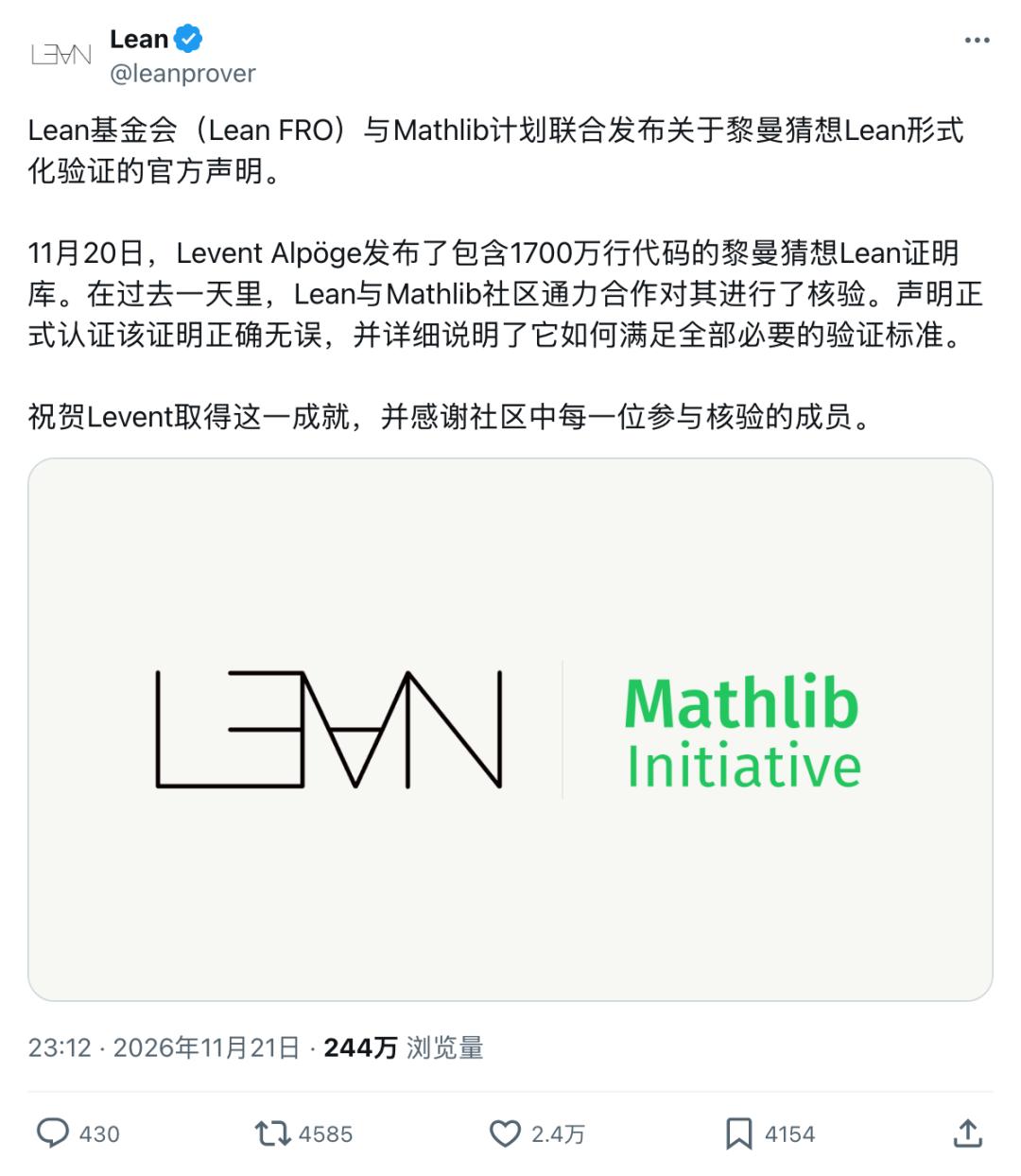
Unexpectedly on Friday, Anthropic mathematician Levent Alpöge directly released the 17 million lines of Riemann Hypothesis proof code completed in cooperation with Claude.
Only one day later, this set of code passed the official joint verification of the Lean and Mathlib communities, and Anthropic took the top reputation of using AI to crack the century-old unsolved mathematical case.

40 million US dollars over 4 years matches NBA draft rookie contracts
Publicly tradable listed stocks attract young talents away
While product reputation and core leaderboards were attacked from front and back by two major competitors, OpenAI's own financial books were also exposed at this critical juncture.
In the second half of his viral post, Binkg listed specific numbers: OpenAI's latest round of private financing originally planned to raise 30 billion US dollars at a valuation of 1.4 trillion to 1.5 trillion US dollars.
But in the end, it only raised 150 billion US dollars at a valuation of 1.25 trillion US dollars.