The interactive film and game sector has entered a supply expansion period: platforms are ramping up their related layouts, yet the commercialization outcomes are yet to be verified.
Recently, a number of content platforms and game enterprises have successively launched support policies, independent entrances and new products in the field of interactive film and game (also known as interactive film and television), and third-party research institutions have simultaneously raised their estimates of the size of this market segment. Against the background that generative AI reduces the production cost of video content, the composite content form that combines film and television narrative and game interaction is transitioning from occasional blockbusters to a relatively systematic content supply.
At the same time, public data and institutional analysis also show that the head effect of the track is obvious, most projects are under profit pressure, AI is still in the early stage in terms of narrative coherence and quality control, and the relevant scale figures are mostly calculated by institutions, which need to be verified by longer-cycle operating data and unified statistical calibers.
Popularity spreads from the product end to the platform end
The starting point of this round of attention is the market performance on the product side. On June 9, *The Prosperous Dynasty: Chapter of the Female Emperor* was launched simultaneously globally. According to the data released by the distributor on June 14, the sales volume across all platforms exceeded 1 million units 5 days after launch, and the cumulative sales of the entire series exceeded 3 million units; this work once topped the iOS paid charts in multiple markets and ranked high on the Steam China region bestseller list. For reference, the previous work of the series *Chapter of Wu Mei* took 12 days to reach 1 million sales. According to the pricing structure calculated by the DataEye Research Institute, the revenue of the Chapter of the Female Emperor in the 5 days after launch is about 70 million yuan, which is an estimate rather than official financial data.
The supply side is heating up accordingly. According to public information, Bige Group completed its strategic equity investment in Interactive Star in June, and the two parties plan to cooperate in the fields of AI drama series and interactive film and games, and the related product *Shao Song: Restore Our Lost Land* was launched in August; the *No Mortal World* developed by ByteDance's team was released on the Steam platform in Early Access (EA) form in September, which is regarded by the industry as one of the representative products with deep AI participation in the production process.
Platform-side actions are more intensive. Kuaishou launched the independent entrance of "Interactive Content World", which centrally presents the light interactive content that was previously attached to short videos; platforms such as Douyin and NetEase have launched guaranteed incentives for interactive dramas and interactive film and games. According to public reports, the Douyin Group Short Drama Copyright Center opened cooperation on November 12, with a maximum guarantee of 200,000 yuan per drama and additional revenue sharing. NetEase Tianma upgraded the relevant incentives on November 9, and Kuaishou also set up tiered guarantees. It needs to be distinguished that the guarantee is a support condition for platforms to compete for high-quality supply, not the realized sales revenue of the content, nor is it directly equivalent to the scale of end-user demand.
Scale estimates are on the rise, and calibers need to be clarified before reading the figures
According to the estimate of DataEye Research Institute, the global interactive film and game market size may exceed 2.3 billion US dollars in 2026, and the domestic interactive film and television/film and game track is expected to reach 1.8-2 billion yuan. Among them, global data is denominated in US dollars and domestic data is denominated in RMB. The statistical scope and category boundaries are different, and the two are not suitable for parallel comparison or simple summation.
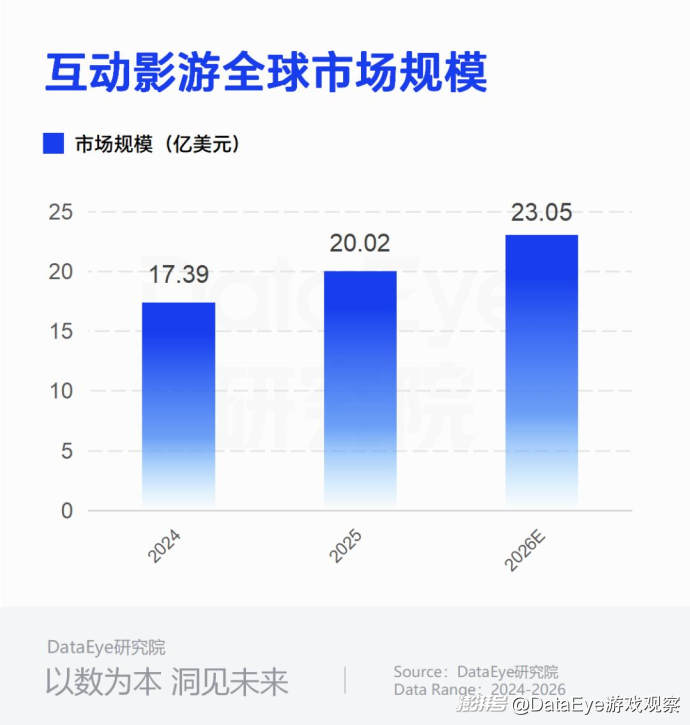
More attention should be paid to the data attributes. The above values are all institutions' forecasts for 2026, not realized revenues; at present, the national statistical department, the competent department of press and publication and industry associations have not yet released separate special statistics for the "interactive film and television" segment. There are also differences in the calculations of different institutions. For example, the survey caliber of Global Info Research is: the global interactive film and game revenue in 2025 is about 2.06 billion US dollars, which is expected to reach 5.34 billion US dollars in 2032, with a compound annual growth rate of about 14.8% from 2026 to 2032. How to define the category boundary and whether to include interactive dramas and casual games are the prerequisites that cannot be ignored when reading the data.
AI lowers production thresholds, and three paths have taken initial shape
In this round of changes, the most direct contribution of AI is on the cost side. Some brokerage analysts estimate that the production cost of 2-hour interactive film and game content under the traditional live-action shooting mode is about 5 million to 10 million yuan, which is expected to drop to the order of 100,000 yuan after the introduction of AI production process. The cost structure has shifted from one-time fixed investment to variable investment billed by call volume, which gives small and medium-sized teams the room to try large-scale projects. This estimate is an industry estimate, and the actual cost reduction still depends on the material efficiency and quality control investment.
From the landed cases, the commercialization paths can be roughly summarized into three categories.
The first one is the carrier transformation of cultural export: using multilingual versions and participatory narrative to lower the threshold of understanding, *The Prosperous Dynasty* has achieved good chart performance in markets such as South Korea and Singapore.

The second is the lightweight route, which combines short/manhua dramas, branch choices and casual games, controls the duration of a single round to several minutes, focuses on monetization through advertising, and adapts to fragmented usage scenarios.
The third is the initial commercial verification of AI-native products: three weeks after the launch of the EA version of *No Mortal World*, third-party data platforms estimated that the sales volume was about 292,000 copies, and institutions estimated the revenue at 7 million to 8 million yuan accordingly. The product once ranked high on the Steam bestseller list; the producer announced in October that the number of players exceeded 260,000, which is not the same caliber as the estimated number of copies, and the official has not announced the sales volume and revenue. According to public reports, this project was completed by a team of less than 20 people in a cycle of about one year with full-link AI production, which is regarded as a test of the engineering capability of small teams.

In addition, the hybrid pipeline combining live-action shooting and AI is being adopted by more projects. *Shao Song: Restore Our Lost Land* uses actor performances to convey the emotional expression of literary scenes, and introduces AI in some production links. The producer said that it will increase the application proportion of AI virtual human and AI 3D animation in the future to lower the shooting threshold of grand historical scenes.
Head IPs have also begun to embrace AI-native pipelines. As cited in the article, the authorized *The Three-Body Problem: Eve of Judgment* has been launched on Steam, and is scheduled to be released in the first quarter of 2027, with all video content generated by AI. Cases have also emerged where AI short films are derived into interactive works: an independent creator completed a 3-minute 34-second short film with a 10-day cycle and a cost of 3,000 yuan, which has received more than 60 million views across the network, and further derived an interactive narrative game.
Apart from the popularity, four constraints still need to be faced squarely
The first is the highly concentrated revenue distribution. Research institutions describe the current pattern as "significant head effect": a small number of blockbusters occupy the main market share, a large number of small and medium-sized projects are difficult to make profits, and there are many projects with mismatched input and return in public reports. The sales volume of blockbusters cannot be directly extrapolated to the general profit level of the track.
The second is that AI's narrative capability is still in the early stage. Industry feedback focuses on broken NPC memory, unstable personality, low material efficiency, and difficulty in converting topic traffic into long-term retention, etc. There are still obvious bottlenecks in quality control and emotional coherence. The technology has solved the problem of "being able to produce and afford production", but has not yet solved the problem of "telling coherently and retaining users".
The third is that the demand side has not been fully verified. The concentrated launch of guaranteed incentives by platforms objectively reflects that high-quality supply is still insufficient; some analysis points out that the current paying group is mainly game players, who are more sensitive to traces of AI generation, and branch narrative has much higher requirements for script structure than linear content.
The fourth is that the compliance and statistical foundation need to be improved. Interactive film and games have both film and television and game attributes, involving requirements such as content review, filing management, copyright authorization and AI-generated content identification; brokerage research reports also list policy supervision and content compliance, lower-than-expected cost reduction effect, lower-than-expected product commercialization, and intensified industry competition as the main risks. In the absence of unified statistical standards, various scale estimates should be used as trend references rather than as the basis for deterministic judgments.
Conclusion
The transition from "occasional breakout of a single blockbuster" to "systematic organization of supply by platforms" is the more noteworthy part in this round of changes. AI mainly changes the cost curve and entry threshold on the production side, and whether the track can form a stable and sustainable content business still depends on script quality, quality control capability, user retention and compliance foundation. For a sub-sector that is still in the early stage, what is more worth tracking than the scale figure is whether more mid-tier products that achieve stable profits can appear in the follow-up, and whether the industry can gradually establish referable statistical and evaluation calibers.