YC 2026 Retrospective: 4 Core Tracks and 842 Startups
On November 19, Anthropic landed on the NASDAQ, with an IPO issuance size reaching 813.4 billion US dollars, setting a global IPO financing record.
In its prospectus, there is a set of numbers worthy of entrepreneurs' attention: more than half of the Fortune 500 companies spent at least 100,000 US dollars on Anthropic in the past year, but this figure is less than 0.1% of their total expenses.
Enterprises have already started to pay. Next, for AI to enter more real work scenarios and undertake more complex tasks, a series of specific problems still need to be solved, and these problems are becoming the starting point for new companies.
The listing of Anthropic shows people how far an AI giant can go. Looking down along these startups, we can find which links in the entire industry are still waiting to be completed.
We studied 842 companies incubated by YC in 2026, and found that AI entrepreneurship trends are changing. In this review, we sort out four main entrepreneurial lines to see how technological breakthroughs, customer demands and capital investment turn into businesses of new companies one after another.
Which direction is the wind of AI entrepreneurship blowing?
Applications are no longer the main line.
The proportion of vertical industry Vertical AI and cross-industry Horizontal AI has shown a general downward trend since 2025, dropping from more than 70% in 2025 to only 30% this year.
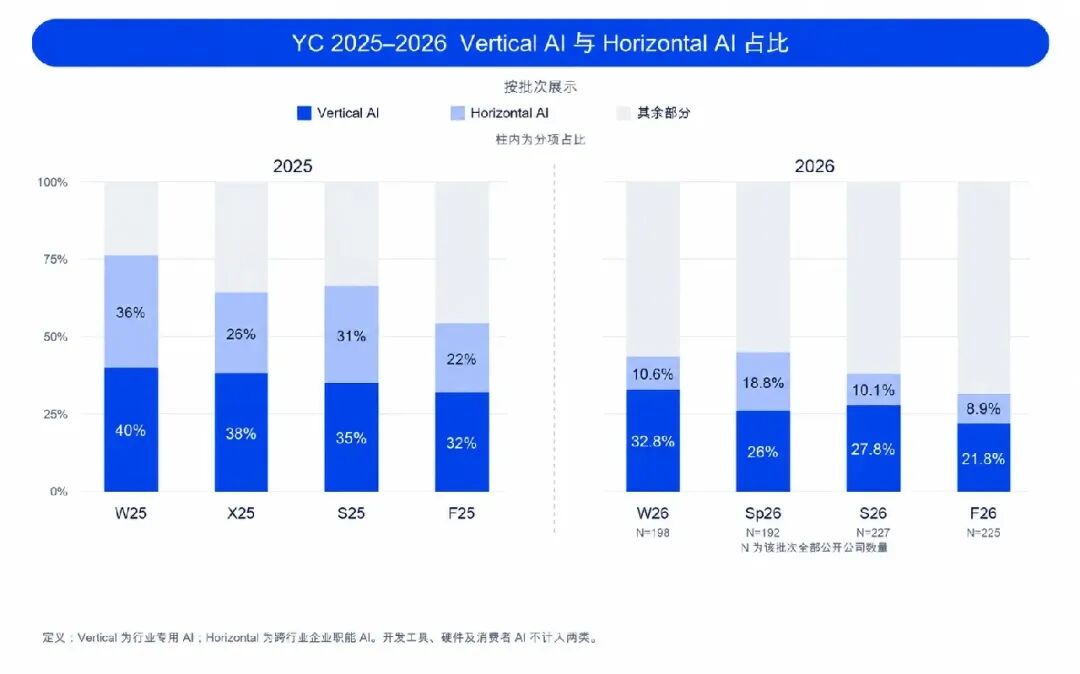
Data source: YC; YC runs 4 incubation sessions a year, divided into Winter (W), Spring (X/Sp), Summer (S), and Autumn (F)
Which tracks are growing?
The most obvious track is hard technology, including robotics, aerospace and new energy, and the number of related companies has increased by 10%. It is mainly stimulated by the following aspects: AI reduces the software development cost of hardware companies, and at the same time accelerates scientific research and engineering verification; the positive impact of SpaceX's listing; AI computing power investment drives physical construction.
The second is consumer AI. Obviously, the $1.35 billion financing of Personal Agent company Instinct has created a new FOMO sentiment.
Developer tools and AI infrastructure, as well as model inference services, have risen slightly.
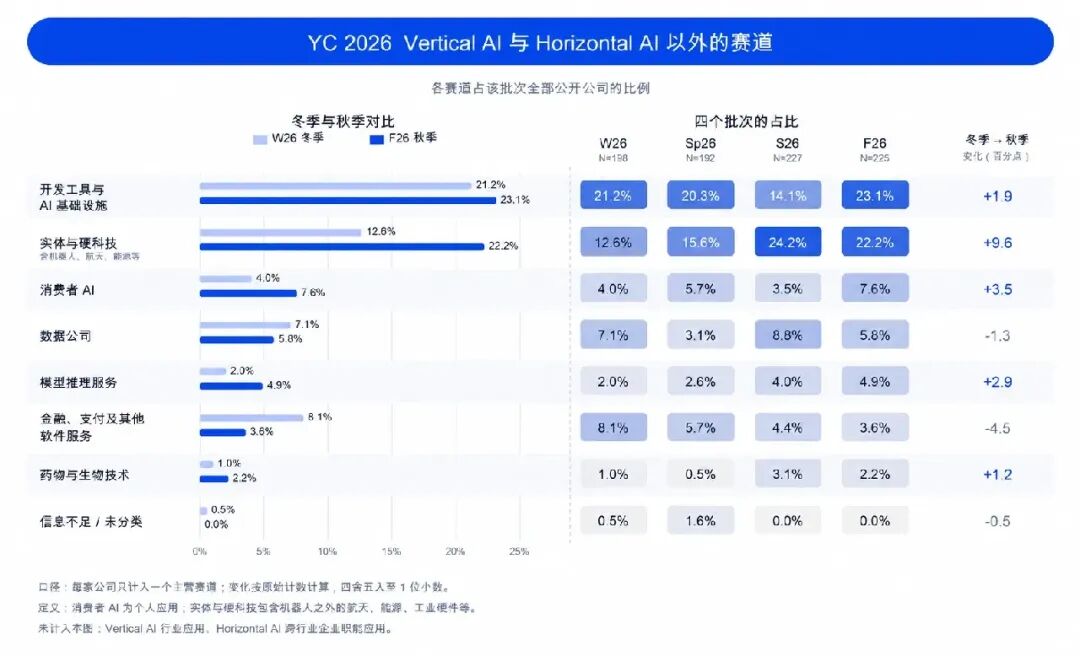
Data source: YC
What is the logic behind the track changes? According to our observation, the essence is that there are still many intermediate links and landing problems to be solved from model intelligence to real business revenue.
Anthropic's prospectus also reveals this problem — the bottleneck of enterprise deployment is not only model capability, but also the lack of perfect system connection, insufficient governance rules, and work processes that need to be redesigned.
If we look at Anthropic's customer data, we will find that AI penetration in actual work is very shallow. Although more than half of the Fortune 500 companies are Anthropic's customers and their annual consumption exceeds $100k, on average, this figure is even less than 0.1% of their total expenses, even the top 10 users by volume spend less than 1% of their expenses on Anthropic.
Therefore, tools, services and platforms that integrate model intelligence for real business scenarios have achieved good financing results. Here are two examples:
AI security is a typical track. Tolmo received $22M led by Accel. Its main function is to check and help fix vulnerabilities in customers' production environments. For example, when a customer launches a new interface, the security team needs to know whether the interface is open to the public, what data it can access, whether it will malfunction if attacked, and which services will be affected after modification. This series of problems are what Tolmo uses Agent to help customers solve.
Another interesting case is Paradev, a workbench for managing Coding Agents. Users can arrange multiple AIs to write code at the same time without interfering with each other, and finally check the results uniformly. The product demand can be seen from 16.3k Github Stars, and USV led their $11.5M financing. They are betting on the bottleneck generated after AI writes a large amount of code, and users need new tools to organize and check the work of these AIs.
What kind of applications can get a multi-million dollar seed round?
YC applications compete on team strength and performance.
According to public information, the standard for "large results" of YC seed round financing in 2026 has been raised to 10 million US dollars. AI application companies that meet this standard include: General Legal (legal), Clara (medical), Complir (e-commerce), Tasklet (Work Agent), Ploy (GTM Agent), Vorflux (Coding Agent).
We briefly analyze why they got these "large results".
The first obvious factor is the star founding team.
The CEO of General Legal was previously the CTO of Casetext, an AI legal company that was acquired by Thomson Reuters for $650M in all cash in 2023. This means that the founder already has successful experience in the field of legal AI applications, and the success rate of starting a second business in the legal industry is improved.
Clara's team has also achieved certain results in the medical field. They all previously worked at Circle Medical, and the CEO once led this Internet medical platform to create $100M ARR and achieve profitability. The new company Clara tells an AI narrative, but the underlying logic is still to lower the threshold of access to medical services.
The CEO of Tasklet also has a successful exit track record. He previously founded Firebase, which was acquired by Google to provide APP development tools. In addition, the two founders of Tasklet have worked together for many years, from Firebase to Google, and then started a business together again.
The CEO of Poly is also a top talent, but he chose to start a business across industries. The CEO was previously the co-founder and CTO of Webflow, a web development tool. Now he turns to build GTM Agent. Poly helps companies make web pages, write copywriting, and promote to attract visitors to become customers.
The co-founder and CTO of Rippling also chose to start a business across industries, and chose the fiercely competitive AI Coding track. Vorflux automatically writes code, conducts tests, and directly delivers task results.
The second easily identifiable factor is early impressive ARR data and other growth verification.
$1M ARR is an important milestone. It took General Legal 84 days to go from 0 to $1M ARR, and only 41 days to go from $1M to $2M ARR; Poly's ARR was close to $1M during YC.
Growth rate is also an observable indicator. AI product compliance "specialist" Complir saw its revenue grow 4 times during YC, with a month-on-month growth rate of 40%. Complir helps merchants check whether products comply with regulations of various countries, and prepare required labels and materials. It currently manages more than 100k product information.
At present, Tasklet has the highest ARR data and growth rate. According to its team, ARR exceeded $5M in only half a year, with a growth rate of 1200%.
The above are individual cases, and this set of data can better illustrate the overall situation — YC official data shows that the median ARR achieved by admitted enterprises during the incubation period increased from $80k to $200k, a 2.5-fold increase. Obviously, if YC companies want to get good financing results, they must focus on growing ARR.
Next, four types of businesses are worth paying attention to
1. Data business has strong "capital absorption" capability
In our statistics, AI data company Luel stands out with a $31.2M seed round financing. Data companies have a strong ability to attract venture capital. AfterQuery is known as the fastest-growing company in YC history. According to its $3.2B valuation, it may have raised more than $300M in two years.
YC data companies also have strong profitability. YC data shows that among the companies it invested in in the past two years, more than a dozen of them have annual revenue of over 10 million US dollars each by selling data or reinforcement learning environments to model laboratories. Ooak Data, which we contacted before, focuses on real workflow data, and has received contracts worth tens of millions of dollars from top AI laboratories in only half a year.
Back to Luel, why is its seed round financing so large?
Luel adopts a heavy operation model, organizing manpower from all over the world to collect real long-tail data according to customer needs, mainly collecting audio, video and action records for embodiment training, then completing quality inspection and authorization delivery. In addition, Luel also allows third parties to list datasets, and the platform participates in revenue sharing.
Putting Mercor, AfterQuery and Luel together, we can see that AI data demands are becoming more and more detailed and specific. From the judgment process of professional work such as finance and law, to long-tail real scenarios such as housework operation and minority language dialogue, model companies are looking for data that can make up for their capability gaps, and are willing to pay to organize people to produce it.
However, the data business is also becoming more and more difficult to do. Luel has very heavy operations, needing to manage more than 500,000 data contributors distributed in 96 countries, find people who meet the requirements for each order, and be responsible for the final delivery results. The more specific the customer's requirements for language, equipment, scenarios and actions, the more difficult it is to standardize delivery. Whether the data can be resold depends on the scope of authorization and the needs of other buyers. While orders are growing, personnel, collection costs and capital investment may also increase together. Revenue grows fast, but profits may not keep up. These are all practical problems that data companies like Luel need to face.
We identified 37 data-related companies in YC 2026, which can be divided into the following categories.
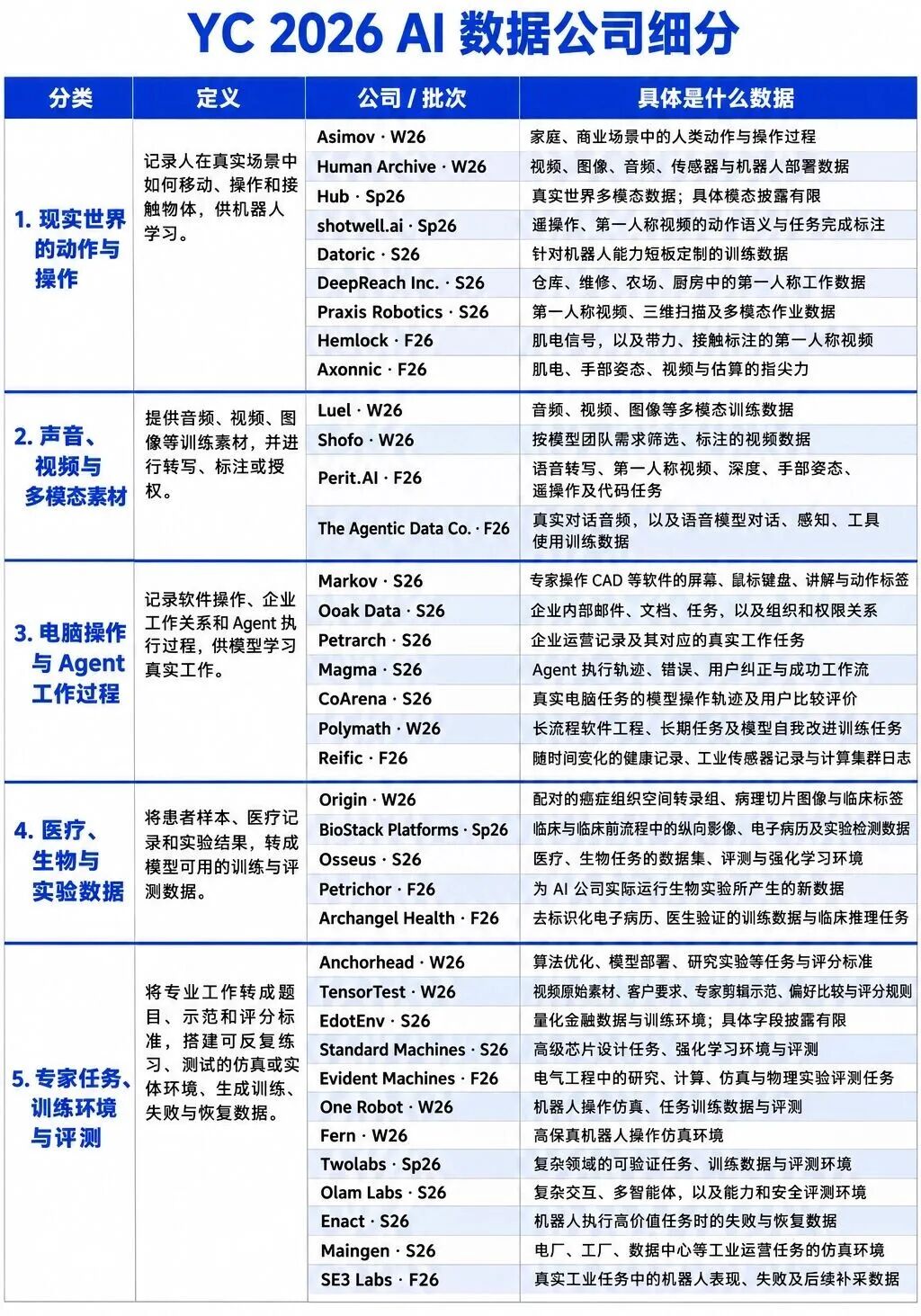
Data source: YC
2. Enterprise proprietary intelligence, post-training is the new infrastructure
In the spring of 2025, Deepseek R1 came into the public view, and how to make good use of open source models has become the focus of entrepreneurs and investors.
Enterprises gradually have many open source model choices, but they need to run models stably and reliably, which has spawned the rapid growth of AI Inference infrastructure such as Together AI, Baseten, and Fireworks AI.
Wafer is a company that grew up in this stage. It started with GPU Kernel optimization, uses AI Agent to automatically rewrite and optimize underlying computing code, and later further provides complete model inference services. In 2026, their ARR exceeded $40M.
By 2026, enterprises have moved from using open source models to demanding exclusive models that are more suitable for their own businesses, and model post-training has naturally become a new entrepreneurial opportunity. The problem is that most enterprises do not have training teams like Frontier Labs. Therefore, infrastructure companies that lower the threshold of model training have opportunities.
Many companies doing model training infra have appeared in YC, and the proportion of related companies has increased from 2% to 4.9%, but there are no star cases that have stood out so far.
Outside YC, we also see startups entering from different perspectives, for example:
NeuroSpark, which focuses on AI inference infrastructure, improves GPU utilization and reduces unit Token inference cost through heterogeneous computing power integration, full-stack inference optimization and intelligent resource scheduling, providing enterprises with high-performance and low-cost model inference services.
Fluxion, an agent inference system focusing on edge computing and Physical AI scenarios, enables multi-models to run efficiently under limited hardware resources through elastic memory management, heterogeneous chip optimization and edge-cloud collaborative scheduling, reducing inference costs and protecting data privacy.
MarsCompute, which also focuses on AI inference infrastructure, improves GPU/TPU inference efficiency and reduces Token cost through AI-driven automatic operator optimization, video memory management and heterogeneous chip adaptation.
Looking forward to 2027, the new keyword may be "Own your intelligence".
Under the cloud of large models "swallowing" everything, if you only call the same model API, it is difficult to establish long-term differentiation.
The truly unique capability of an enterprise is still its understanding of specific tasks, judgment of high-quality results, and continuously accumulated customer feedback. If these can be converted into high-quality training data, Eval and Reward, and then solidified into the model through Post-training, there is an opportunity to form deeper differentiation.
Therefore, people are beginning to look for companies that can turn enterprise workflows into evaluations, turn expert experience into training data, and turn failures into model improvements.
Agnost AI starts from production log analysis, helping enterprises identify failures, errors and repeated tasks that occur when Agents are actually used. It found that enterprises are still using expensive general frontier models for a large number of simple and repetitive tasks. So the company began to use these production logs to build evaluation sets and training data, and train small models for specific workflows for customers.
Since we want to build our own intelligence, vertical models naturally come back to the table.
After all, not all industries need to be based on LLM. For example, some prediction tasks need to process structured data, event sequences, temporal relationships and probabilities, and do not necessarily need a general LLM that is good at conversation.
Take the financial vertical model as an example. Lyon uses transaction records, loan history and customer behavior of financial institutions to build a basic model specifically for finance. The same set of models can be applied to multiple tasks such as fraud identification, credit default prediction, customer churn and product recommendation.
Under this main line, we have sorted out the following companies.
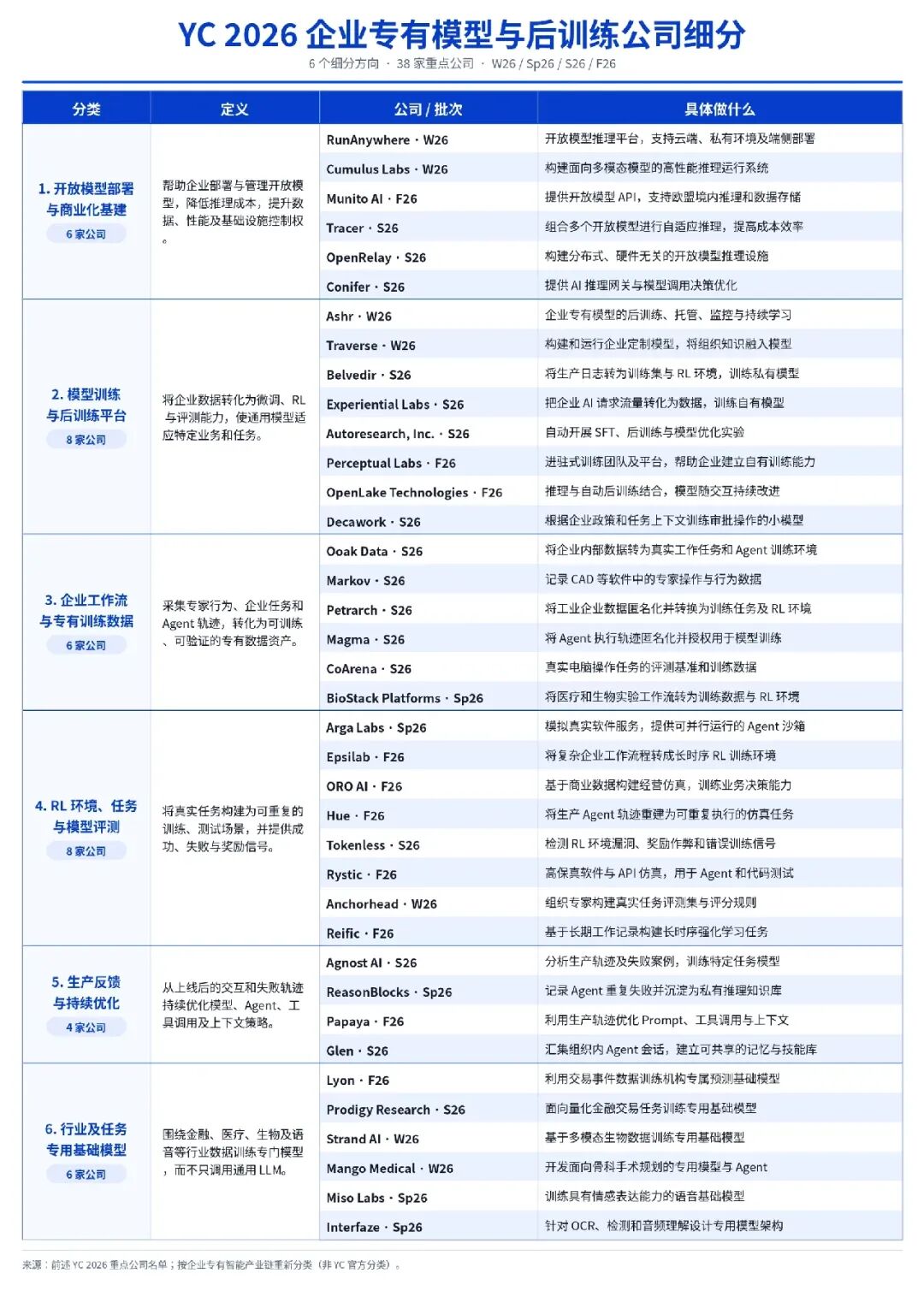
Data source: YC
3. Solving embodiment bottlenecks, rational voices responding to the boom
We found that early attention to embodiment has long expanded from the model itself to three more basic questions: where does real-world data come from, how can robots keep learning during deployment, and how can hardware and capital support large-scale implementation.
Robot data collection has gone through several rounds of iteration. First, teleoperation is carried out on real robots, where operators remotely control robotic arms to repeatedly complete grasping, placing and assembly tasks.
This method can directly generate action data adapted to the robot body, but the cost is very high, and the collection scale is limited by the number of robots, sites, operators and equipment maintenance capabilities.
The first round of iteration — first-person video + wearable devices, collect the real process of humans completing tasks, and then convert these experiences into data that robots can learn.
Human Archive uses wearable collection devices to record human operations in scenarios such as home, catering, hotel and industry. The data includes not only first-person videos, but also information such as hand posture, depth and tactile sensation. The company disclosed that its collection system has a maximum daily data production capacity of 8,000 hours, has delivered data to cutting-edge model research teams, and has signed cooperation arrangements to expand