Why haven't Chinese automakers ushered in large-scale mergers yet?
In 1978, US President Jimmy Carter signed the Airline Deregulation Act, expecting to create an industry boom, but the outcome was a complete mess.
Before that, the US government exercised strict control over the routes and fares of airlines. Carriers could not open new routes at will, nor raise prices whenever they wanted. While no one in the industry was living an extremely prosperous life, at least they did not need to guard against disruptive attacks from competitors every day.
After deregulation, the rules of the game changed.
A large number of low-cost airlines flooded into the market, forcing traditional airlines to follow suit. Fares that used to be determined by the government began to be set by the market. There were more and more planes, and air tickets became cheaper and cheaper, but airlines suffered increasingly heavy losses.
According to a report released by the US Government Accountability Office (GAO), since deregulation in 1978, the US aviation industry has filed 162 bankruptcy applications in total. Even long-established giants such as Pan Am and Trans World Airlines failed to survive the industry reshuffle.
It was not until around 2008 that the US aviation industry ushered in a new round of large-scale mergers and reorganizations: Delta merged with Northwest Airlines, United Airlines merged with Continental Airlines, and American Airlines merged with US Airways, eventually forming the current market pattern.
From deregulation in 1978 to the last round of large-scale mergers in 2013, the US aviation industry spent 35 years completing this process.
If we look at this period of history in the context of China's current automotive industry, many details feel strangely familiar.
01
A Familiar Price War
The very first thing that came after US aviation deregulation was a full-blown price war.
In the past, airlines operated under government protection, with fares and routes strictly regulated. Now, a large number of new companies flooded into the market, competing for passengers with low fares, and old players no longer cared about decency and joined the price war one after another.
For consumers, this is certainly a good thing. From 1980 to 2005, calculated by actual purchasing power, the median US air fare dropped by nearly 40% cumulatively, but for airlines, the situation was completely different.
The aviation industry has a characteristic: the fixed cost is extremely high, while the marginal cost is relatively low.
Whether an airplane is fully occupied or only half full, a large number of expenses such as rent, depreciation, maintenance, crew salaries and airport parking fees still have to be paid in full. As long as there are empty seats in the cabin, airlines have the incentive to sell tickets at a discount: as long as the fare can cover the cost brought by the additional passenger, it can share a little more of the fixed cost.
To maintain market share, airlines also need to buy new aircraft and open new routes to further expand their operating scale. After all, economies of scale also exist in the aviation industry: the larger the fleet and the more complete the route network, the more opportunities there are to dilute fixed costs.
People Express, founded in 1981, is a typical example of this scale competition.
The company had only 3 aircraft and 250 employees when it was first established. By 1985, its fleet had expanded to 68 aircraft, the number of destinations increased to 32, it operated nearly 400 flights every day, and the number of employees exceeded 4,000.
Later, the company spent about 300 million US dollars to acquire Frontier Airlines in an attempt to further expand its market share. However, due to excessively rapid expansion, rising costs and fierce market competition, it quickly fell into financial crisis and was acquired out of the market in 1986.
The story of People Express almost condenses the craziest years after the deregulation of the US aviation industry: starting with low prices, expanding wildly, continuing to cut prices, and finally being squeezed out of the game by itself.
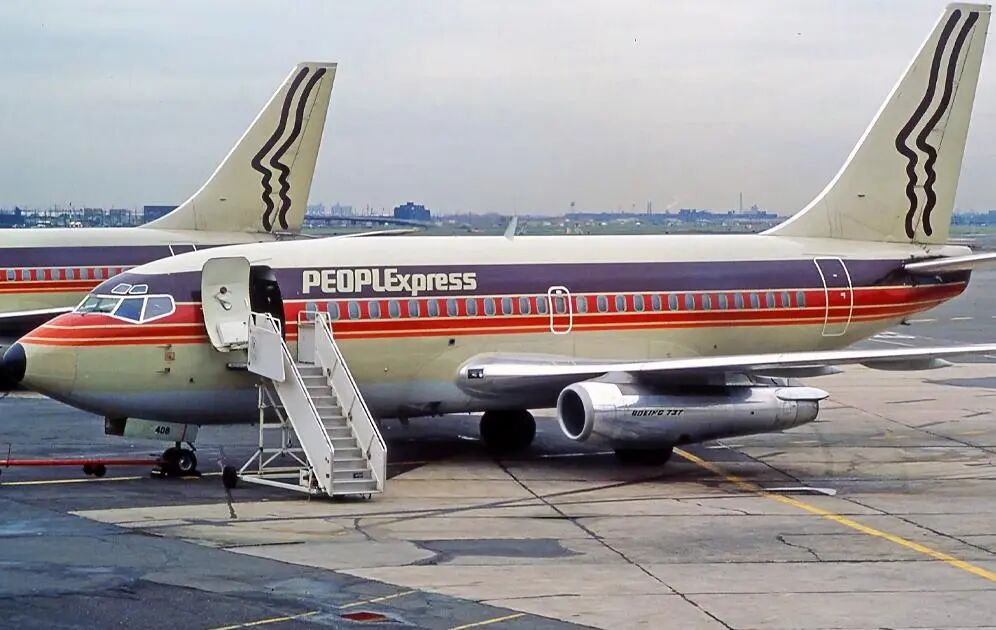
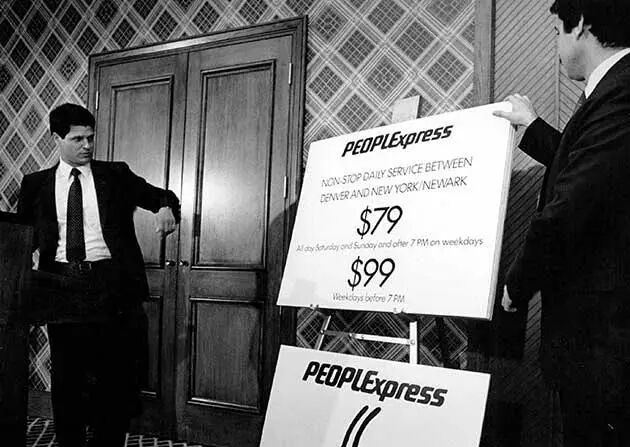
The former People Express Airlines and its cheap tickets, Photo by Pete Macklin
For a single airline, price cuts and expansion may be the most rational choice; but for the entire industry, if all enterprises cut prices and expand at the same time, the price war will drag down the whole industry.
From 1990 to 1993, the US aviation industry suffered a cumulative loss of nearly 130 billion US dollars. In 1991, Pan Am, once the industry benchmark, declared bankruptcy, and Eastern Airlines also ceased operation in the same year. In 1993, the US government even specially set up a national committee to study how to rescue the aviation industry.
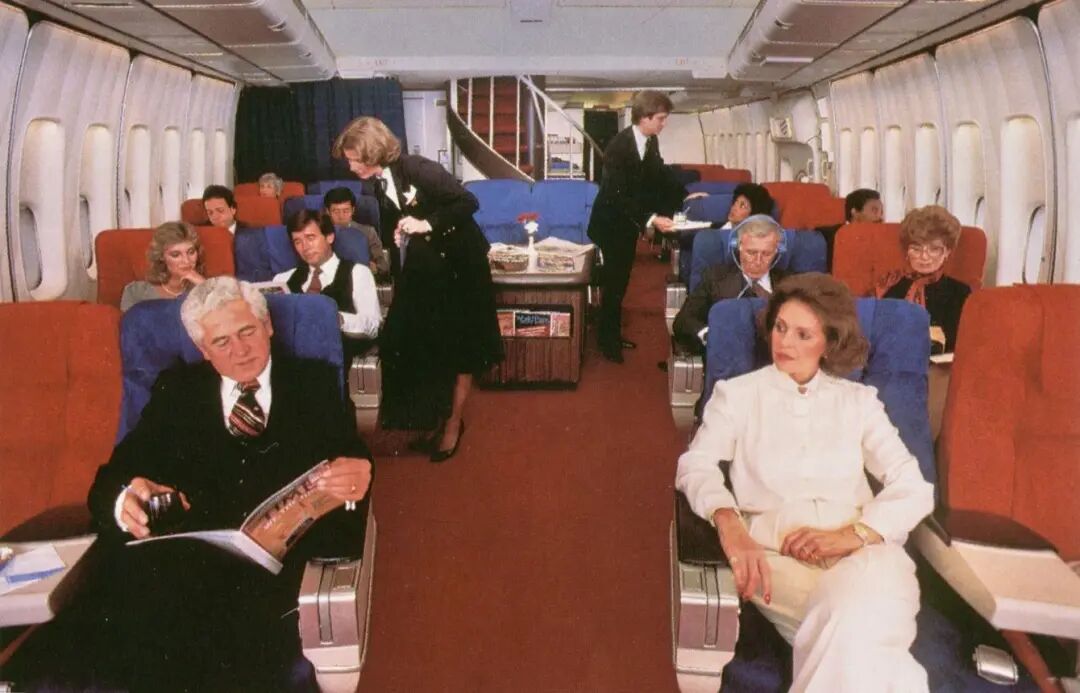
The first-class cabin of Pan Am, Source: Pinterest
China's automotive industry is going through a similar dilemma.
In the past few years, in order to compete for market share and stay in the game, various automakers have kept cutting prices, launching new models and expanding production capacity. New EV startups hope to cross the break-even point through sales growth, traditional automakers hope to dilute R&D investment for transformation through scale, and supply chain enterprises keep lowering component quotations to win orders.
However, the growth rate of the market can no longer keep up with the expansion plans of all enterprises.
Data from the National Bureau of Statistics of China shows that in the third quarter of 2026, the capacity utilization rate of China's automobile manufacturing industry dropped to 66.2%, down 4.6 percentage points from 70.8% in the second quarter.
According to data from the China Passenger Car Association, in the first three quarters of this year, the operating revenue of China's automotive industry was about 8.04 trillion yuan, a year-on-year increase of 2.6%, but the total profit was only 267.5 billion yuan, a year-on-year decrease of 23%, and the sales profit margin dropped to 3.3%. Looking at September alone, the sales profit margin of the automotive industry was only 1.4%.
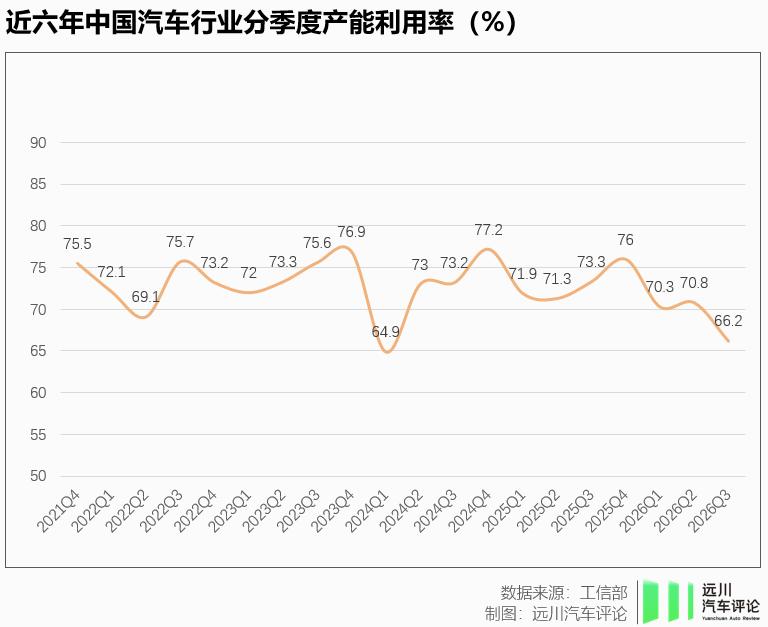
Not all automakers are losing money, but the speed at which the entire industry generates profits has long failed to keep up with the speed at which it generates revenue.
If a plane is not full, airlines tend to lower fares to increase the passenger load factor. Similarly, if an automobile factory is under-operated, automakers tend to cut prices for promotion to increase capacity utilization.
As a result, trading price cuts for sales volume and diluting costs through higher sales has become the easiest solution for many automakers at the moment, and the cutthroat competition has intensified in this way.
02
Bankruptcy Cannot End the Price War
If there is any lesson from the US aviation industry that Chinese automakers can learn in advance, it is that the price war will not stop automatically just because the participants can no longer bear the losses.
Since the 1980s, enterprises in the US aviation industry have kept going bankrupt and being merged, but the reduction in the number of airlines has not allowed the industry to return to profitability immediately.
One important reason is that bankruptcy does not mean the withdrawal of capacity. Chapter 11 of the US Bankruptcy Law allows enterprises to restructure their debts, adjust costs and continue operating under court protection. For airlines, this means that even if they are insolvent, their planes can still keep flying and their routes can still continue to operate.
Some airlines, after debt restructuring, labor cost reduction and lease agreement adjustment, can even re-enter the competition at lower costs. In December 2002, United Airlines, mired in debt crisis, filed for bankruptcy protection and then started a restructuring process that lasted for more than three years.
It was not until around 2008 that the US aviation industry ushered in a new round of deeper integration. After several large-scale mergers and acquisitions, the traditional US aviation industry finally formed its current market structure.
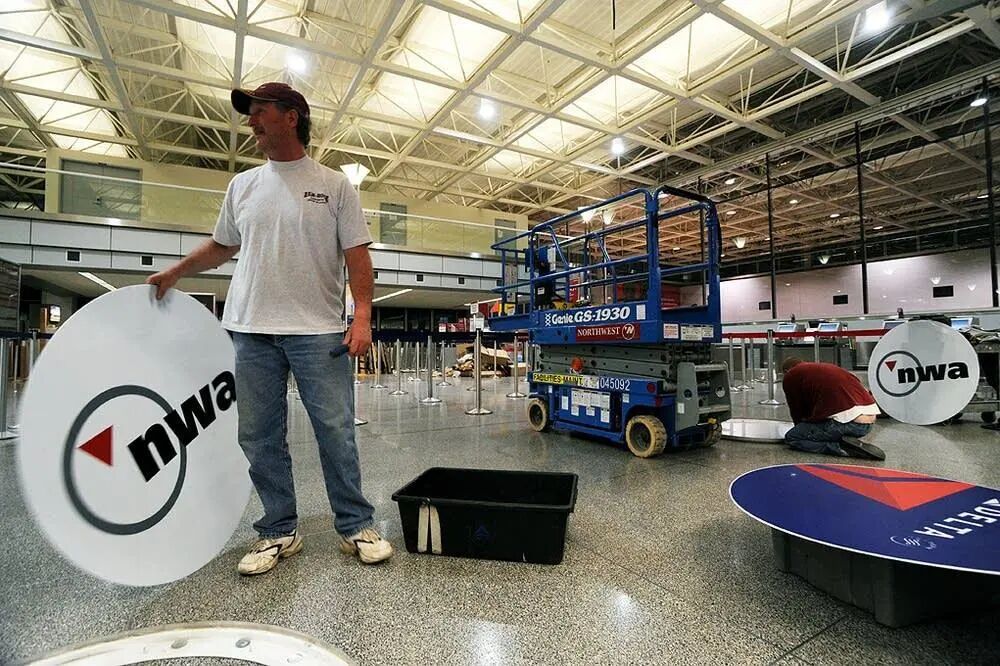
The merger of Delta Air Lines and Northwest Airlines
The importance of this round of mergers lies not only in the reduction of the number of airlines, but also in the fact that they can integrate route networks, airport hubs, fleets and membership systems, reduce redundant investment, and arrange future capacity growth more prudently.
The US aviation industry calls this business strategy "Capacity Discipline". To put it in layman's terms, it means no longer believing that as long as you buy enough planes and open enough routes, you can outlast your competitors.
As airlines began to restrain capacity expansion, coupled with factors such as falling fuel prices, improved aircraft energy efficiency and debt restructuring, the US aviation industry saw a significant profit improvement in the mid-2010s.
According to data from the US Bureau of Transportation Statistics, in 2015, the combined net profit of the top ten US airlines reached 24.2 billion US dollars, compared with only 7.3 billion US dollars in 2014.
From the outbreak of the price war, to successive corporate bankruptcies, to the mergers and reorganizations of large aviation groups, it took the US aviation industry more than 30 years to gradually find a new balance.
03
Why Is It So Hard for Chinese Automakers to Go Under?
China's automotive industry seems to be developing along a similar path.
Over the past decade, dozens of new EV startups have appeared on the stage, and brands such as WM Motor, Byton, Aiways, HiPhi, Hozon Auto and Ji Yue have successively encountered operational crises, some of which have entered bankruptcy or liquidation procedures.
According to general business logic, as small and medium-sized enterprises are gradually eliminated, the industry should enter a stage where large enterprises acquire small ones, and large groups acquire other large groups. However, at least up to now, China's automotive industry has not seen cross-group large-scale mergers similar to those in the US aviation industry from 2008 to 2013.
What is even more strange is that many automotive brands with operational difficulties and sluggish sales have not been quickly abandoned even if they lack clear profit prospects. There is a force that cannot be ignored behind this: local governments.
In 2020, Lifan Motors fell into a severe debt crisis.
As an automotive enterprise cultivated locally in Chongqing, Lifan once had a huge motorcycle and automotive business, but due to poor operation, it gradually came to the verge of bankruptcy. As of November 2020, the creditors of Lifan Group and its related enterprises had declared claims amounting to 11.67 billion yuan. If it went directly to bankruptcy liquidation, the expected repayment rate for ordinary claims would only be 12.65%.
However, Lifan did not exit the market at that point.
In the judicial restructuring led by the Chongqing court, the state-owned investment platform of Liangjiang New Area, Chongqing and the investment company under Geely formed a consortium to become the strategic investor.
Through debt restructuring, capital introduction and industrial resource integration, Lifan got a new chance for development. Its factory production capacity was taken over by Ruilan, Geely's battery swap brand, but the capacity utilization rate has long been less than 50%; the listed company later evolved into the current Qianli Technology, shifting its business to intelligent driving related sectors.

Qianli Technology is expected to continue its "automotive manufacturing" business
From the perspective of law and the interests of creditors, restructuring is of course reasonable. Compared with direct liquidation, retaining the operating value of the enterprise may increase the debt repayment rate and reduce the impact on employment and the industrial chain.
But for local governments, the problems of an automotive enterprise are far more than just a financial statement.
An automotive enterprise not only belongs to its shareholders, but is also closely linked to local employment, tax revenue, industrial chain, land investment and financial institutions. If an automobile factory closes down, it may affect not only thousands of employees, but also a large number of surrounding component suppliers, logistics enterprises, dealers, as well as banks and investment platforms that provide financing for the project.
Lifan is not an isolated case. In 2021, Zotye Auto entered judicial restructuring after a severe debt crisis, and introduced Jiangsu Shenshang as the restructuring investor. Although the subsequent business recovery did not go smoothly, the listed company and part of its business assets were preserved.
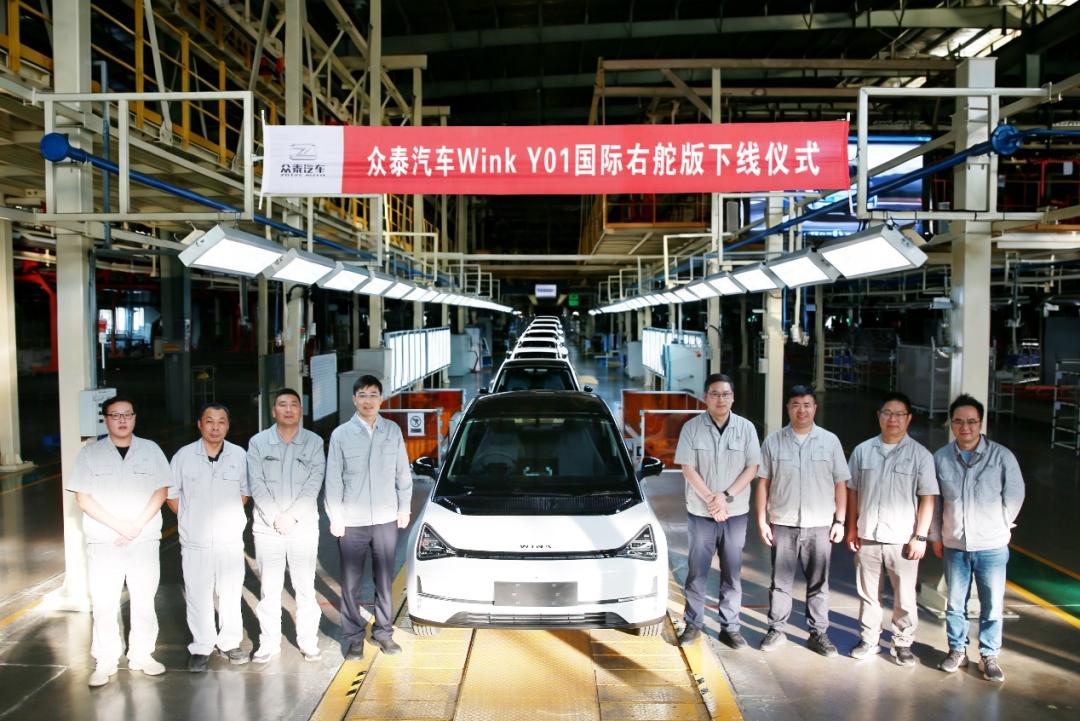
Many people don't know that Zotye is still making cars, and it even plans to go global
The story of Hozon Auto is more representative.
Hozon was once the sales champion among new EV startups in 2022, but soon fell into operational difficulties. In 2025, its parent company Hozon New Energy entered the bankruptcy restructuring procedure, but even in 2026, the enterprise is still looking for a new way out. The draft restructuring plan disclosed in September this year shows that the intended investor plans to contribute about 3 billion yuan to obtain 70.62% equity of Hozon New Energy, and plans to resume production of some models.
Hozon has previously laid out three major production bases in Tongxiang, Yichun and Nanning, with state-owned assets from multiple regions participating in the background.
In April this year, Focus on CCTV even specially reported on Hozon's Yichun project, pointing out that the local state-owned assets related platform had invested nearly 2 billion yuan to acquire equity, in addition to